
Discover and Classify Your Data
Provide your data with the protection it deserves.
Many organizations struggle to keep ahead of today’s overwhelming flood of data, resulting in limited value at best, and unmitigated risks at worst. Our research offers strategic and structured guidance on discovering your data and building a classification system that unlocks its value as a powerful decision-making tool while protecting sensitive information and meeting regulatory requirements.
Data backlogs, inadequate data handling procedures, ad hoc classification programs, end-user issues and other technical challenges stand in the way of organizations understanding what data they have. By starting with small, incremental steps and prioritizing the most critical data in collaboration with data owners, data leaders can get a handle on their data inventory, improve accessibility and storage, and maximize data’s value to the organization.
1. You don’t have to do it all at once.
Depending on the size of your data backlog, classifying all your data may not be feasible at the outset. Don’t be afraid to start small, prioritizing and classifying a manageable portion of data, quantifying the results, and reporting them back to management. Then, take the next step of tackling a bigger portion.
2. Keep it simple.
For a data classification system to be robust and useful, it must be as simple as possible, allowing for very little ambiguity. That simplicity must extend to everyone who handles the data, from custodians to end users, all of whose roles and responsibilities must be clearly defined.
3. Classification is an ongoing process.
Data does not stay static – effective classification must be seen as a process, not a one-time project. This will be especially useful in the realm of risk mitigation, as knowing what data you have and where it lives will help assess its criticality, leading to more accurate threat modelling and security controls investments.
Use this blueprint to start discovering and classifying your data
Our research offers multiphase guidance and a comprehensive array of templates, workbooks, and other tools to formalize and structure your data classification efforts. Use this step-by-step approach to discover the data that matters and build a measurable, auditable, and manageable classification program that protects what you have and allows you to leverage it for maximum organizational benefit.
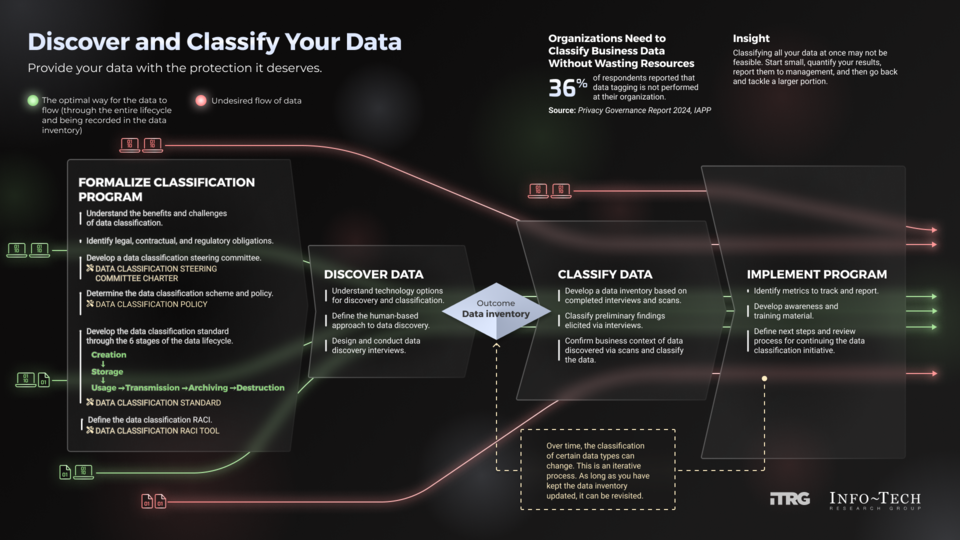
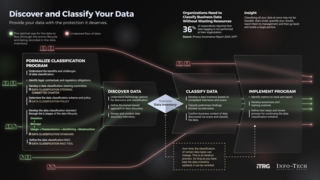
- Formalize your classification program by developing classification and policies and standards, establishing a steering committee charter, and assigning roles and responsibilities.
- Implement your data discovery plan to understand what you have, including interviewing data owners and assessing vendor solutions for technology-assisted discovery.
- Classify your data by analyzing what you’ve found, identifying technical solutions to classification, and laying the groundwork for maintaining and optimizing your classification program going forward, including establishing key metrics and improving end-user awareness and training.
Member Testimonials
After each Info-Tech experience, we ask our members to quantify the real-time savings, monetary impact, and project improvements our research helped them achieve. See our top member experiences for this blueprint and what our clients have to say.
9.5/10
Overall Impact
$131,945
Average $ Saved
46
Average Days Saved
Client
Experience
Impact
$ Saved
Days Saved
Utah Transit Authority
Workshop
9/10
$89,699
44
so much content was delivered. Worst is realizing the magnitude of work that remains or needs to be done to be successful.....
Port of Long Beach
Guided Implementation
10/10
$34,499
10
Safayat was great. His understanding on the Data & Analytics and the security related to the Data that are in house and traveling was great. My t... Read More
Boces Schuylar Steuben Chemung Tioga Allegany
Guided Implementation
9/10
N/A
N/A
We engaged Info-Tech Research Group to assist with advancing our data classification efforts. Throughout the engagement, Mike Brown was consistentl... Read More
FirstLight Power Services LLC
Guided Implementation
10/10
$34,499
44
Bristol Bay Native Corporation
Guided Implementation
9/10
$11,039
5
Platinum Equity Advisors LLC
Guided Implementation
10/10
N/A
N/A
Best part was I was able to focus on the documentation I created and receive feedback and advise.
Plastipak Holdings
Guided Implementation
9/10
$68,000
90
worst: had formula issues with one of the tools best: our analyst, Petar - he was responsive, active in finding resolutions, and all-around very ... Read More
Ministry of Industry, Innovation, Science and Technology
Guided Implementation
9/10
$13,600
32
Louisville Water Company
Workshop
9/10
N/A
120
The highlight of the experience was the extensive amount of data collected, along with Safayat's valuable context explaining the purpose of the wor... Read More
Black & McDonald Limited
Guided Implementation
8/10
$10,000
6
Good high level overview of approach/offering. Difficult to estimate any savings at this point.
County of Stafford
Workshop
9/10
$100K
110
The RACI tool efforts were very time-consuming but necessary. Otherwise, it was a great experience.
City of Winter Park
Guided Implementation
9/10
N/A
5
Safayat is very knowledgeable. He seems to have a complete grasp of the subject matter. It was very easy to interact with him.
Flight Centre Australia
Guided Implementation
9/10
$13,700
10
Excellent engagement, validation our approach and gave us strong steer with regard to next steps, no bad aspects of the engagement
Goodwill Industries of Middle Tennessee, Inc.
Guided Implementation
10/10
$13,700
10
Mainstreet
Guided Implementation
10/10
$10,000
50
Safayat and Greg are patient and take the time to understand our requirements.
Kentucky Cabinet for Health and Family Services
Workshop
10/10
N/A
50
The ITRG team worked diligently with us before the workshop to better understand our priorities, and Erik did a great job tailoring the workshop co... Read More
PA Public Utility Commission
Workshop
10/10
$1.37M
120
As a regulatory agency, there are significant fines and consequences such as prison that result from improperly dealing with CSI (Confidential Secu... Read More
Community Living Toronto
Guided Implementation
10/10
$10,000
32
safayet was amazing and very thorough. please keep up the great work.
City of Santa Fe
Workshop
10/10
$68,500
50
The facilitation was great, and the material aligned to what we needed to meet the City's objectives.
United Nations International Computing Centre
Guided Implementation
10/10
N/A
N/A
Professionalism, flexibility and availability of the expert.
Commonwealth of Virginia - Office of the Attorney General
Guided Implementation
10/10
$2,603
20
Alan was very helpful and accommodating to our needs.
Ministry of Industry, Innovation, Science and Technology
Guided Implementation
8/10
$61,706
50
Central Bank of Barbados
Guided Implementation
10/10
N/A
N/A
Anu has a cheerful disposition paired with knowledge and experience. Thanks to her, we were able to advance our data discovery efforts for nine (9... Read More
Noble Research Institute, LLC
Guided Implementation
8/10
$2,519
5
Goodwill Industries of South Florida
Guided Implementation
10/10
N/A
10
Central Bank of Barbados
Workshop
9/10
$47,500
50
The best part was that Reddy’s expertise in this area was excellence guidance for us. He was able to not only describe the best practice approach t... Read More
Lawyers’ Professional Indemnity Company
Workshop
9/10
$16,000
90
Best part is in just 4 days we were able to achieve months worth of work.
Sterilite Corporation
Workshop
9/10
$34,000
50
Interdigital Communications
Guided Implementation
9/10
$27,719
10
City Of Issaquah
Guided Implementation
10/10
$29,609
120
Logan has been a great mentor! always on time and ready to help!
Workshop: Discover and Classify Your Data
Workshops offer an easy way to accelerate your project. If you are unable to do the project yourself, and a Guided Implementation isn't enough, we offer low-cost delivery of our project workshops. We take you through every phase of your project and ensure that you have a roadmap in place to complete your project successfully.
Module 1: Formalize the classification program
The Purpose
Key Benefits Achieved
Activities
Outputs
Develop a steering committee charter to provide oversight and leadership.
- A structured governance body to guide decision-making and ensure accountability.
Identify relevant regulations to align classification policies with legal and industry standards.
- A compliance-driven classification framework that reduces regulatory risks and enhances audit readiness.
Create a data classification policy to define how data is categorized and managed.
- Formalized definitions and requirements for operationalizing a data classification program.
Assign roles and responsibilities to stakeholders involved in classification efforts.
- Clearly defined RACI chart, ensuring effective enforcement and ongoing management of classification initiatives.
Develop a classification standard with handling requirements across classification levels.
- Consistent guidelines for data access, storage, retention, and protection, minimizing risks of misclassification or unauthorized access.
Module 2: Discover the data
The Purpose
Key Benefits Achieved
Activities
Outputs
Consider data governance and DLP solutions for automated and technology-assisted data discovery.
- Clear understanding of key attributes to evaluate when selecting a tool, ensuring the right fit for the organization’s needs.
Conduct interviews with data owners to gather business context and validate technical findings.
- A systematic approach for conducting data discovery interviews, ensuring alignment between business and IT perspectives.
Module 3: Classify the data
The Purpose
Key Benefits Achieved
Activities
Outputs
Assign classification labels according to predefined policies and sensitivity levels.
- A centralized and organized data inventory, ensuring that data is categorized consistently across the organization.
Use classification insights to streamline storage, retention, and archiving strategies.
- Improve efficiency by potentially eliminating redundant or obsolete data, while prioritizing protection for high-value assets.
Module 4: Plan to implement the program
The Purpose
Key Benefits Achieved
Activities
Outputs
Prioritize and track meaningful metrics using the Data Classification Metrics Tracking Tool.
- A list of key performance indicators (KPIs) to measure classification success, compliance adherence, and security improvements
Develop a plan for end-user awareness and training to ensure employees understand classification policies and responsibilities
- Improved user engagement and accountability, reducing misclassification risks and strengthening compliance.
Communicate program status and updates to leadership and key stakeholders through structured reporting.
- A customized program communication deck, fostering executive buy-in, cross-functional collaboration, and accountability.
Discover and Classify Your Data
Provide your data with the protection it deserves.
Analyst Perspective
Keep data classification simple.

Logan Rohde
Cybersecurity Advisor
Security and Privacy
Info-Tech Research Group

Safayat Moahamad
Research Director
Security and Privacy
Info-Tech Research Group
Data classification is crucial for organizations to protect sensitive information, comply with regulatory requirements, and enhance operational efficiency. It supports better data governance, enabling organizations to optimize storage, improve data accessibility, and enhance decision-making processes.
However, organizations are overwhelmed with data, and securing it is a growing challenge. Business and IT leaders can ensure that critical data is protected without wasting resources by keeping data classification simple. Focus on:
- Taking incremental steps; don’t try to classify everything immediately.
- Identifying and securing the most critical, high-sensitivity data first.
- Collaborating with data owners to help prioritize key assets.
To streamline the process, integrate data classification into daily workflows, allowing users to label information as they create it. This approach reduces the burden on employees while improving compliance and governance over time. Understanding where critical data resides and how it is protected enables organizations to justify security investments through data analysis and enhance overall data protection and governance strategies.
Executive Summary
Your Challenge
- You have compliance requirements to identify, classify, and protect high-risk data.
- Your AI initiatives require an understanding of which data is sensitive and how it should be handled.
- Existing data handling procedures don’t properly address the sensitivity of your data.
- Your data classification program is ad hoc or dated, and the scheme isn’t applied consistently
Common Obstacles
- You have a large data backlog and don’t know where to start the classification project.
- You have a limited budget. You need to understand where the most protection against data breaches is required so you can save on storage costs.
- End users are the weakest link in the data security chain. They need significant awareness and training to accurately classify sensitive information.
Info-Tech’s Approach
- Formalize the data classification initiative with policies, standards, and a structured steering committee to ensure accountability and consistency.
- Identify where your data lives and implement controls to protect it. Ensure the protection is proportional to its sensitivity and criticality.
- Understand what tools are available to implement an efficient data classification program.
Info-Tech Insight
Avoid analysis paralysis. Classifying all your data at once may not be feasible. Start small, quantify your results, report them to management, and then go back and tackle a larger portion.
Your Challenge
This research is designed to help organizations design a process to discover and classify their data.
- Data classification is the process of organizing data into relevant categories. Classification helps improve information security and privacy by enabling the assignment of access permissions and the implementation of protection measures for different kinds of data.
- Without a consistent process to discover and classify sensitive or critical data, you won’t be able to identify what data is at high risk of being leaked or stolen. Prioritize risk mitigation initiatives to prevent a data breach or determine how to scale investment in data loss prevention tools.
Data discovery and classification is the first step in protecting high-risk data from malicious actors.
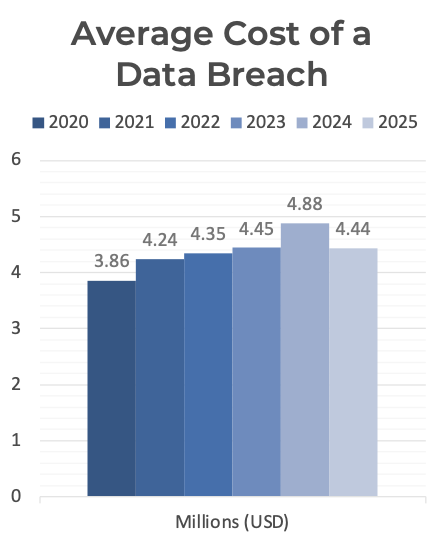
Average data breach costs rose to a historic high of $4.88M in 2024, before declining in 2025, driven in part by AI and automation. Nevertheless, costs for organizations with lower security maturity still averaged $5.52M, which is well above 2024’s record high.
Source: IBM, 2025
Common obstacles
Data discovery can be daunting. Avoid analysis paralysis.
- Large data backlogs can make it difficult to figure out where to start. Classifying all your data at once may not be feasible.
- You have a limited budget. You need to understand where you need the most protection against data breaches so you can save on storage costs.
- The dynamic nature of data complicates matters. The criticality of a piece of data shifts over time. Your data classification program will need to incorporate reassessments to prevent over protecting the data.
Focus the program to classify what matters. The classification program should be measurable, auditable, and manageable.
Data Visibility Remains Elusive
34%Only a third of organizations have full knowledge of where their data is stored.
39%
Fewer than four in 10 organizations report being able to classify all of their data.
Source: Thales, 2026.
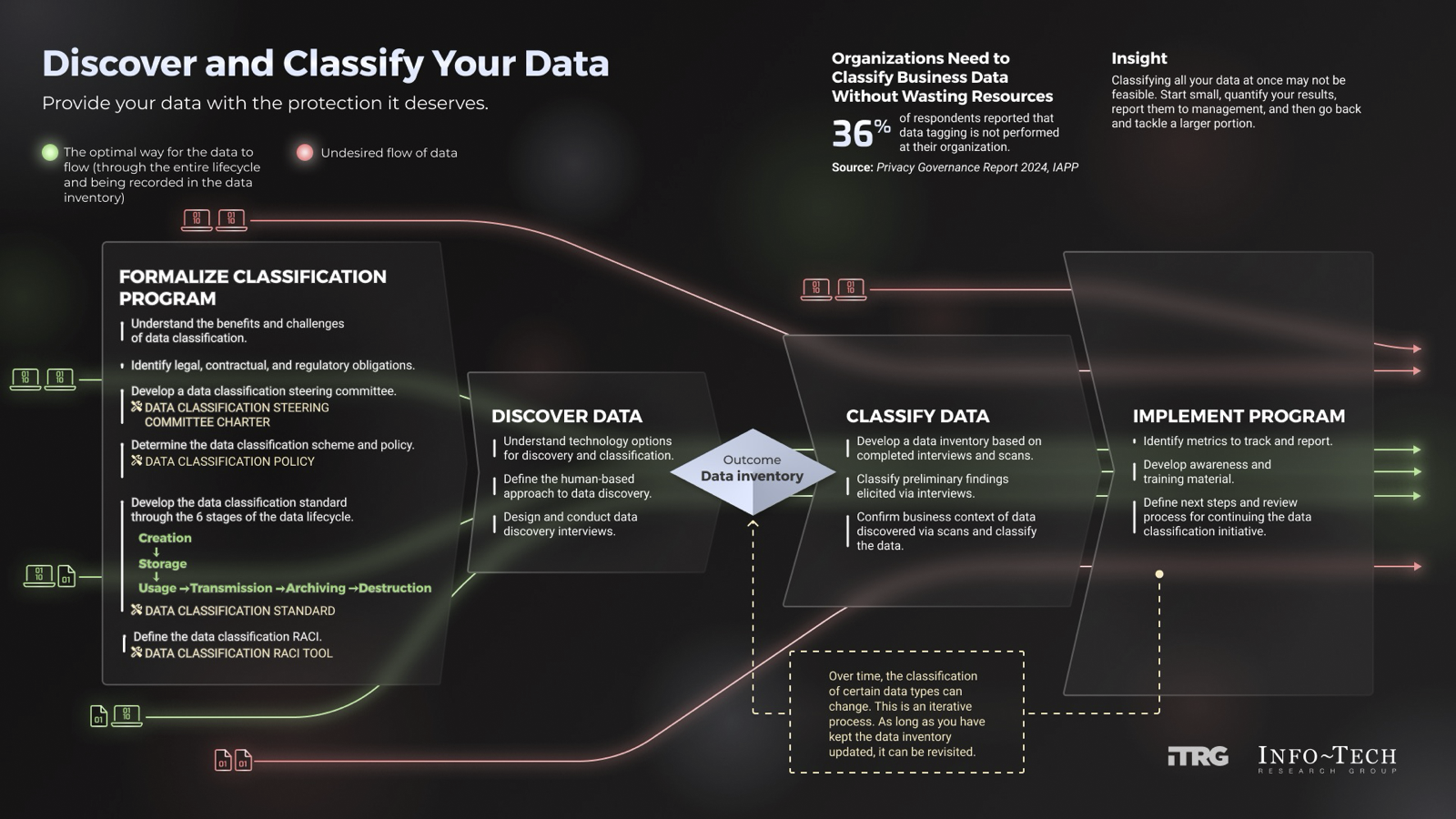
Understand how data discovery & classification supports your data practice
Explore Info-Tech’s Data Research Center to see how our research can support your data practice.
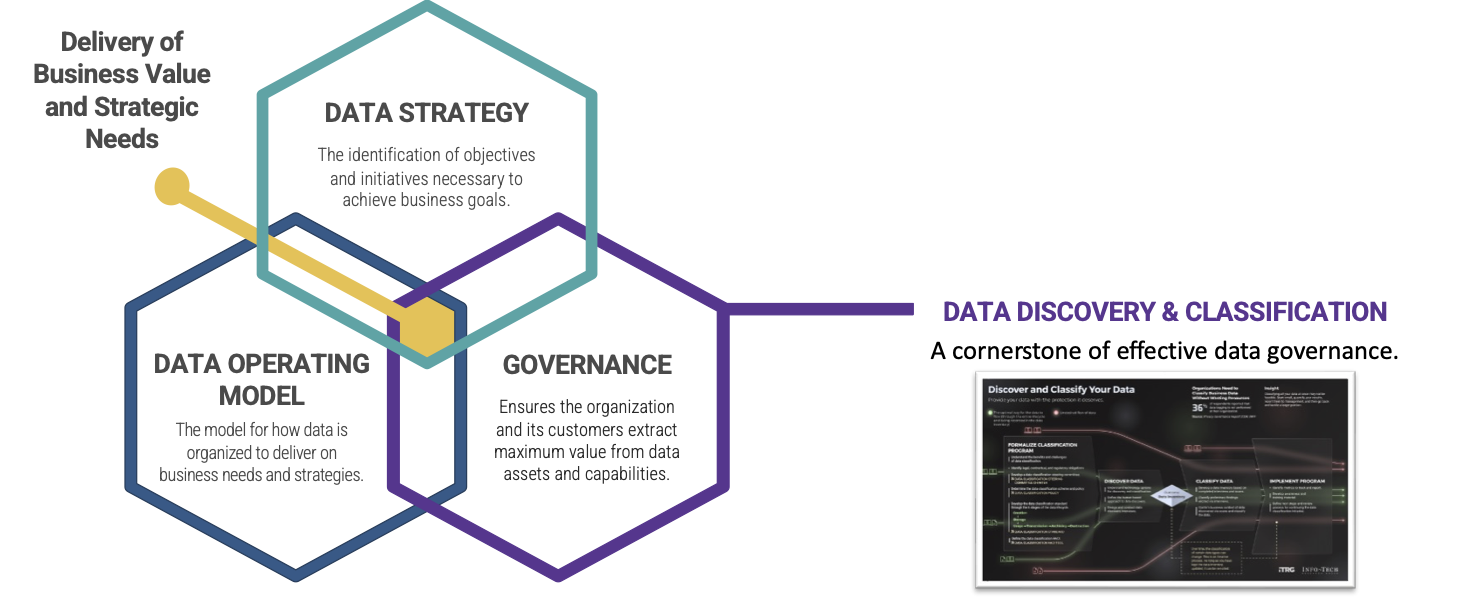
The Data Value Trinity
- Data strategy tells you what you need to achieve to be successful.
- The data operating model aligns resources, processes, measures, stakeholders, value streams, and decision rights to enable the delivery of your strategy and priorities.
- Data governance ensures the alignment of data initiatives and organizational outcomes.
A change in one necessitates a change in the others
Enable AI projects through data discovery and classification
Successful and responsible AI requires effective data governance. Effective data governance requires a foundation of known and well-classified data.
AI systems require reliable data with high data quality to deliver value without exposing the organization to unnecessary risk. You cannot enforce controls or meet compliance requirements if your data has no labels to act on.
Data discovery gives organizations visibility into what data they have, and data classification helps them decide which data is fit to train on or expose to AI tools.
In other words, data discovery and classification is a cornerstone upon which effective data governance and subsequent AI initiatives are built.
What if you deploy AI without classifying your data?
- Sensitive data may be unintentionally exposed through AI tools.
- Uncertain data quality will make it difficult to confidently use data for AI.
- Governance cannot be effectively enforced since controls require proper data labels to act on.
90%
Most organizations have sensitive files exposed to all employees via Microsoft Copilot.
Source: Varonis, 2025.
Insight summary
Provide your data with the protection it deserves.
Avoid analysis paralysis.
- Classifying all your data at once may not be feasible. Start small, quantify your results, report them to management, and then go back and tackle a larger portion.
Keep it simple.
- Leave as little ambiguity as possible for an easy-to-follow classification program. Clearly define the roles and responsibilities of everyone involved, from data custodians to data users.
Data, by its nature, does not stay static.
- A piece of data’s criticality will peak, but strategic reassessment will eliminate under/overprotection of data. Data classification must be a program, not a one-time project.
- Successful risk mitigation is dependent on knowing your data’s criticality and where it lives. While data discovery can be overwhelming, strategic interviews with data owners, in addition to the use of technology, are starting steps to mapping data.
- This information leads to more accurate threat modeling and security controls investments.
Focus the program on measurable, auditable, and manageable classification.
- Perform data location analysis and security analysis to inform your overall security initiatives. Understand which departments own the most sensitive data and provide training to improve awareness.
- Use the classification distribution visuals to make strategic decisions such as which security controls and processes your organization should expand, and which repositories it should consolidate.
Blueprint deliverables
Each step of this blueprint is accompanied by supporting deliverables to help you accomplish your goals:
- Steering Committee Charter
- Classification Scheme Selection Tool
- Classification Policy
- Classification Standard
- Data Classification RACI
Develop a classification program.
Incorporate human and technology-based tools to simplify discovery.
- Inventory Tool
- Verification Tool
- Metrics Tracking Tool
- Awareness Pamphlet
- Awareness Poster
- Awareness Deck
Implement the classification program to ensure appropriate levels of protection.
Key deliverable:
Data Classification Inventory Tool
Use this tool to define your classification scheme, track and consolidate the classification of corporate assets, and gain visibility into the location and security of your organization’s most sensitive data.
Measure the value of this blueprint
After each Info-Tech experience, we ask our members to quantify the real-time savings, monetary impact, and project improvements our research helped them achieve.
Overall Impact9.4 / 10
Overall Average Savings
$119,318
Overall Average Days Saved
45
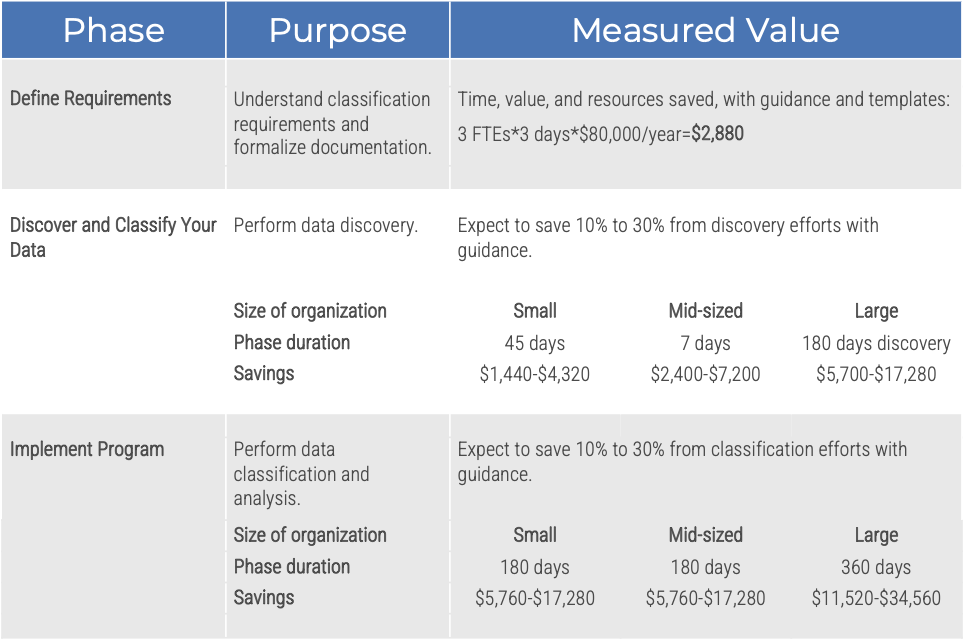
Phase 1
Formalize the Classification Program
Phase 1
1.1 Establish a steering committee
1.2 Formalize data classification policy
Discover and Classify Your Data
This phase will walk you through the following activities:
- Develop a steering committee charter
- Create a data classification policy
- Develop a data classification standard
- Assign roles and responsibilities in the data classification program
This phase involves the following participants:
- Security leader
- Data steward
- Data custodian
- Data owners
- Legal representative
- Data user representative
Outcomes of this step
- Identify compliance regulations
- Build steering committee
- Define roles and responsibilities
- Formalize requirements and definitions
- Document data handling requirements and procedures
Data classification defined
Data classification is the process of identifying and classifying data based on sensitivity and the impact the information could have on the company if the data is breached. The classification initiative outlines proper handling procedures for the creation, usage, storage, disclosure, and removal of data.
Data classification is the first step in security initiatives that mitigate the risk of loss of data integrity, availability, and confidentiality.
47%
Less than half of sensitive cloud data is properly protected with encryption.
Source: Thales, 2026
Why do we need data classification?
With the increase in data and digital advancements in communication and storage (e.g. cloud), it becomes a challenge for organizations to know what data exists and where it lives. A classification scheme must be properly implemented and socialized to help ensure appropriate security measures are applied to protect that data appropriately.
Without data classification, an organization treats all information the same.
- Sensitive data may have too little protection.
- Less sensitive data may have too much protection.
Strategically classifying data will allow an organization to implement proper controls where necessary.
Data classification will benefit your organization
Effective data classification will help you:
Classify and secure the business’ data assetsIn identifying and assessing the risk of organizational data, appropriate resources must be allocated so that proper security mechanisms can protect the business’ most sensitive data.
Maintain compliance
In most cases, data classification is the foundation to complying with regulatory requirements such as GDPR, HIPAA, NIST, and PCI DSS.
Companies that do not comply with such mandates can be subjected to fines and/or penalties.
Improve operational efficiency.
Data classification enables the identification of data that is not needed, cutting storage costs and increasing overall data management and search efficiency.
As a result, companies can focus on proportionally deploying data security measures on the data assets that are most sensitive.
Empower end users.
Preestablished categorizations enable users to select appropriate classifications.
Overall, this promotes organizational involvement and accountability in the protection of data.
Challenges of data classification
Amount of data
Huge volumes of different data types stored in many places. Consider data across all business platforms.
An ongoing, iterative process
Classification schemes will evolve with organizational goals, communication and storage technologies, and new data collected. Analyze data flows regularly to ensure appropriate use and storage of data.
There is no one-size-fits-all
The specific categorizations you use will be dependent on several factors, such as the organizational goals, data interactions, and governance priorities.
End-user awareness
All employees must know how to classify, maintain, and handle the data they interact with in order for the program to be successful.
Data management and responsibility
Documenting information flow and process accountabilities is difficult. Establish clear roles and responsibilities in the data classification steering committee (DCSC) to ensure good governance.
Understand data types
What is a data type?
A data type is any data, or logical collection of data, which is used for a specific business purpose.
Examples include:
- Client data
- Employee files
- Source code
- Press releases
Some data types may be the subjects of other data types. For example, performance assessment data is a subset of employee data.
When determining how granular to get in defining data types, consider whether the data type is used and stored independently of the higher-level data type.
What is data?
Data is raw information, in any format, representing qualitative or quantitative values.
Review types of data
Structured
Structured data adheres to a fixed, predefined format, typically quantitative and highly organized, requiring minimal or no reformatting.
An example is a database containing customer details such as names, addresses, phone numbers, email IDs, and billing information.
Semi-Structured
Semi-structured data is a type of structured data that does not strictly follow traditional database schemas. It uses metadata tags or markers to provide some organization.
For example, a tab-delimited file with marketing leads, or a social media post with user comments is semi-structured.
Unstructured
Unstructured data is qualitative and requires preprocessing prior to conducting analytics.
Examples include raw IoT data, network logs, multimedia files, and social media posts.
It is typically stored in data lakes. Specialized tools are needed to structure and analyze this data.
Snapshot: Data handling at organizations
31%
Data Strategy
Only 31% of organizations have a data strategy aligned to business objectives.
41%
Data Management
41% of organizations have established a formal data management program.
40%
Data Governance
Four in 10 organizations have a fully operational data governance function.
22%
Data Knowledge
Just one in five organizations report having a mature, consistent understanding of their data.
26%
Data Quality
One in four organizations have operationalized a continuous data quality program.
26%
Data Controls
Only a quarter of organizations have mature data risk management operations and controls.
Source: EDM Association, 2026.
Types of sensitive data
Sensitive data generally falls into one of the following four categories:
-
Personally identifiable information (PII)
E.g. social security number, driver’s license number, financial account number with security code/password -
Protected health information (PHI)
E.g. medical history, health insurance numbers, biometric identifiers -
Payment card industry (PCI) data
E.g. cardholder name, expiration date, PIN, magnetic strip contents -
Intellectual property (IP)
E.g. trade secrets, merger and acquisition plans, product plans
Regulatory obligations
Data classification is often driven by legal, regulatory, and contractual obligations.
- Your data classification program may be directly or indirectly mandated depending on your organization’s industry and/or location.
- Your organization may deal with more types of data than you think. Work with the legal department to learn which regulations apply to your data. They can help reinforce the importance of the data classification initiative with upper management.
About Info-Tech
Info-Tech Research Group is the world’s fastest-growing information technology research and advisory company, proudly serving over 30,000 IT professionals.
We produce unbiased and highly relevant research to help CIOs and IT leaders make strategic, timely, and well-informed decisions. We partner closely with IT teams to provide everything they need, from actionable tools to analyst guidance, ensuring they deliver measurable results for their organizations.
What Is a Blueprint?
A blueprint is designed to be a roadmap, containing a methodology and the tools and templates you need to solve your IT problems.
Each blueprint can be accompanied by a Guided Implementation that provides you access to our world-class analysts to help you get through the project.
You get:
- Discover and Classify Your Data – Phases 1-3
- Data Classification Steering Committee Charter
- Data Classification Policy
- Data Classification Scheme Selection Tool
- Data Classification Standard
- Data Classification RACI Tool
- Data Discovery Interview Tracking Tool
- Data Classification Verification Tool
- Data Classification Inventory Tool
- Data Classification Metrics Tracking Tool
- Data Classification Program Communication Deck
- Data Classification Awareness Pamphlet
- Data Classification Awareness Poster
- Data Classification Awareness Deck
Need Extra Help?
Speak With An Analyst
Get the help you need in this 3-phase advisory process. You'll receive multiple touchpoints with our researchers, all included in your membership.
Guided Implementation 1: Formalize the Classification Program
- Call 1: Establish a data classification steering committee.
- Call 2: Formalize data classification documentation.
Guided Implementation 2: Discover the Data
- Call 1: Plan data discovery.
- Call 2: Implement data discovery.
Guided Implementation 3: Classify the Data
- Call 1: Classify the data.
- Call 2: Maintain and optimize the program.
Contributors
- Charles Tatosi Chavapi, Information Security Manager, Tadebswana Mining Industry
- Jim Finlayson, IT Director, City of Grand Junction
- Diane Kelly, Information Security Manager, Colorado Judicial ITS
- Ken Dewitt, IT Director, Navajo County
- Liam Guan, Enterprise Information Management Advisor, Ontario Lottery and Gaming Corporation
- Leon Letto, Senior Technical Sales Engineer, AirWatch
- Jim McGann, Vice-President, Marketing and Business Development, Index Engines, Inc.
- Ian Parker, Head of Information Security, Risk and Compliance, Fujitsu
- Doug Waram, Director of IT, County of Wellington
- William Mendez, Information System Security Officer, City of Miami
- Claudiu Popa, President & CEO, Informatica Corporation
- Chris Whiting, Solutions Architect, APA Group
 Assess and Manage Security Risks
 Assess Your Cybersecurity Insurance Policy
 Achieve Digital Resilience by Managing Digital Risk
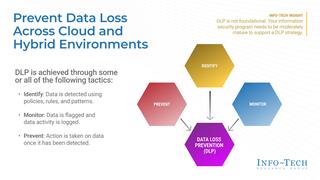 Prevent Data Loss Across Cloud and Hybrid Environments
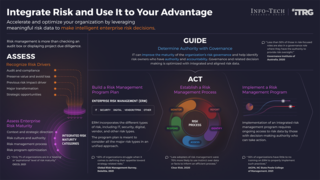 Build an IT Risk Management Program
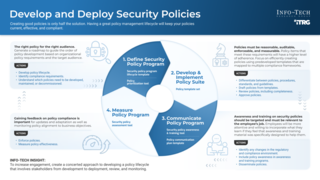 Develop and Deploy Security Policies
 Fast Track Your GDPR Compliance Efforts
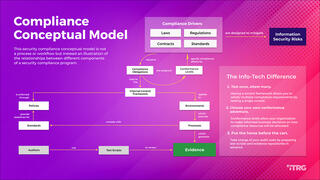 Build a Security Compliance Program
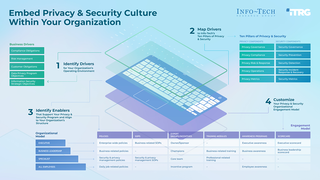 Embed Privacy and Security Culture Within Your Organization
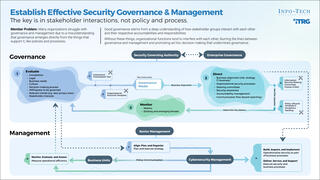 Establish Effective Security Governance & Management
 Improve Security Governance With a Security Steering Committee
 Develop Necessary Documentation for GDPR Compliance
 Reduce and Manage Your Organization’s Insider Threat Risk
 Satisfy Customer Requirements for Information Security
 Master M&A Cybersecurity Due Diligence
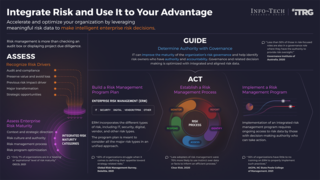 Integrate IT Risk Into Enterprise Risk
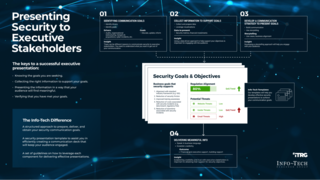 Present Security to Executive Stakeholders
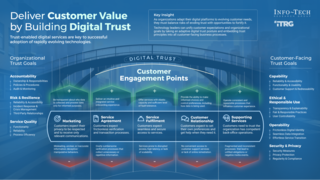 Deliver Customer Value by Building Digital Trust
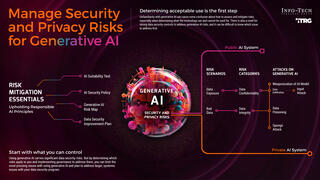 Address Security and Privacy Risks for Generative AI
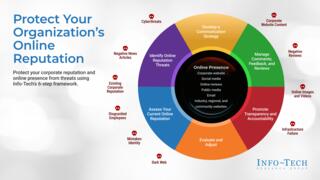 Protect Your Organization's Online Reputation
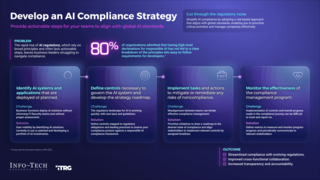 Develop an AI Compliance Strategy
 Get Started With AI Red-Teaming
 Achieve CMMC Compliance Effectively
 Building Info-Tech’s Chatbot
 Building the Road to Governing Digital Intelligence
 An Operational Framework for Rolling Out AI
 Discover and Classify Your Data
 Defend Against Deepfake Cyberattacks
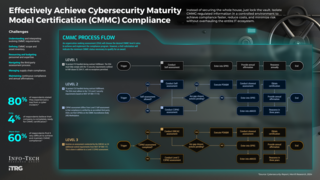 Assess Your CMMC Readiness
