Our systems detected an issue with your IP. If you think this is an error please submit your concerns via our contact form.
Develop Your Agile Approach for a Successful Transformation
Understand Agile fundamentals, principles, and practices so you can apply them effectively in your organization.
In today’s age of ceaseless technological evolution, Agile offers the flexible and iterative approach organizations need to keep pace with rapid changes in technology, security, and other key IT functions. But Agile transformations are hard to implement effectively – rather than a series of boxes to be ticked, Agile is a sweeping, fundamental change to the way your organization thinks and operates. Our comprehensive framework will help you push past misconceptions and confusion to instill Agile principles successfully across your organization.
Though Agile enables shorter delivery times and improved quality, IT teams often have different, conflicting, or inadequate knowledge of its principles and practices, leading to ineffective implementation that doesn’t deliver on Agile’s promise. IT leaders must work through these friction points, with the right people, to deliver a successful Agile realignment.
1. Evolve beyond Waterfall.
Waterfall methodology isn’t up to the challenges of today’s IT landscape. Though some organizations may not be able to completely leave it behind, Agile’s iterative practices can help deliver faster, better outcomes than Waterfall’s rigid, linear approach.
2. Get everybody on the same page.
Agile transformations are more likely to be successful when the entire organization understands Agile fundamentals, principles, and practices, as well as the role each person plays in its success. Focus on developing a solid understanding of Agile practices so that everyone involved understands that Agile is a mindset, not a process.
3. Treat the causes, not the symptoms.
Though Agile itself enables nimble, rapid pivots in the face of change, adopting an Agile mindset for the first time can be a complex undertaking for your teams, many of whom may encounter a variety of obstacles for which there is no single remedy. Take the time to understand these common challenges, then develop a plan to address the root causes of each.
Use this step-by-step blueprint to plan and implement a successful Agile transformation
Our research offers templates, surveys, tools, and other resources to identify your Agile challenges and build a tailored plan to overcome them. Use this step-by-step framework to help your IT teams understand and embrace the Agile approach across the organization, whether they’re just starting their Agile journey or refreshing their existing Agile practice.
- Identify common Agile challenges to pinpoint the obstacles to your organization’s Agile transformation.
- Establish a solid foundation for Agile delivery to align your teams with Agile fundamentals, identify insights and team feedback, and build your roadmap to Agile implementation.
- Work through specialized modules to foster deeper understanding of Agile principles and practices to resolve pain points.

Research & Tools
1. Develop Your Agile Approach for a Successful Transformation – A comprehensive framework that gathers everything you need for a top-to-bottom Agile implementation.
Use this presentation deck to identify your organization’s biggest Agile pain points, allowing you to focus your efforts on what’s holding your Agile transformation back.
2. Roadmap for Transition to Agile – A template for building a customized Agile transformation plan unique to your organization.
Use this template to ensure your organization has a solid understanding of Agile principles and practices to help ensure your Agile transformation is successful.
3. Backlog Management Module – A step-by-step plan for identifying and working through your backlog.
Use this module to develop a better understanding of backlog management and user story decomposition and implement a three-tiered backlog with quality filters.
4. Scrum Simulation Module – A detailed simulation exercise designed to demonstrate effective Scrum practices.
Use this interactive exercise to encourage a deeper understanding of good Scrum practices and Agile principles, as well as the behavioral blockers affecting Agile teams and organizational culture.
5. Understanding MVP Module – A step-by-step activity to give you clarity on the minimum viable product.
Use this module to gain a better understanding of MVP principles, and how to apply them in practice.
6. Estimation Module – A series of exercises to give your team knowledge of Agile estimates and their pitfalls.
Use this module to gain a better understanding of Agile estimation practices and how to apply them, including how Agile estimation and reconciliation provide reliable planning estimates.
7. Product Owner Module – A guide to help establish an effective product owner role.
Use this module to gain a deeper understanding of product management fundamentals and define your product management roles and terms.
8. Product Roadmapping Module – A detailed guide to product roadmapping fundamentals.
Use this module to learn how to create effective product roadmaps, including an introduction to six critical product roadmapping tools.
9. Agile for COTS – A guide to apply Agile practices to a COTS implementation.
Use this tool to trace the operational processes, steps, or features native to your commercial-off-the-shelf (COTS), software as a service (SAAS), platform as a service (PAAS), or third-party software solutions.
10. Working With Non-Agile Teams Module – A guide to overcoming the challenges of working with non-Agile teams.
Use this module to understand and adopt Info-Tech's emissary approach to help bridge the gap between the Agile and non-Agile parts of the team.
11. Working with an Agile Vendor Module – A guide to help form meaningful procurement partnerships with Agile vendors.
Use this module to understand how to work with an Agile vendor and how to create Agile-friendly RFPs and contracts.
12. Kanban Module – A guide to understanding Kanban and how to leverage it for your Agile transformation.
Use this module to understand Kanban methodologies, run a Kanban simulation, and create your own Kanban board.
13. Agile Maturity Assessment Module – A companion spreadsheet designed to deliver a complete snapshot of the state of your Agile operations.
Use either of the two available tools to assess the effectiveness, efficiency, and quality of your Agile practices.
Member Testimonials
After each Info-Tech experience, we ask our members to quantify the real-time savings, monetary impact, and project improvements our research helped them achieve. See our top member experiences for this blueprint and what our clients have to say.
9.7/10
Overall Impact
$111,534
Average $ Saved
29
Average Days Saved
Develop Your Agile Approach for a Successful Transformation
Understand Agile fundamentals, principles, and practices so you can apply them effectively in your organization.
Analyst Perspective
Understand Agile fundamentals, principles, and practices so you can apply them effectively in your organization.
Agile transformations can be difficult and complex to implement. That's because they require fundamental changes in the way an organization thinks and behaves (and many organizations don't fully understand the changes required).
Agile is an extremely broad and deep topic, and it works best when everyone in the organization has a common understanding of its practices and how it impacts their role in the organization.
This blueprint explains Agile fundamentals, principles, and practices in an easy-to-understand way, regardless of whether you are a "leader" or a "doer," working in IT or not.

Alex Ciraco, Hans Eckman, and Caleb Pittman
Application Practice
Info-Tech Research Group
Executive Summary
| Your Challenge | Common Obstacles | Info-Tech's Approach |
|
|
|
Info-Tech Insight
Agile transformations are more likely to be successful when the entire organization genuinely understands Agile fundamentals, principles and practices, as well as the role each person plays in its success. Focus on developing a solid understanding of Agile practices so your organization can "Be Agile", not just "Do Agile".
Info-Tech's methodology
| Phase Steps | 1. Identify Common Agile Challenges | 2. Establish a Solid Foundation for Agile Delivery | Agile Modules |
| 1.1 Identify common agile challenges |
2.1 Align teams with Agile fundamentals 2.2 Interpret your common Agile challenges survey results 2.3 (Optional) Move stepwise to iterative Agile delivery 2.4 Identify insights and team feedback |
|
|
| Phase Outcomes | Understand common challenges associated with Agile transformations and identify your organization's struggles. | Establish and apply a uniform understanding of Agile fundamentals and principles. Create a roadmap for your transition to Agile delivery. | Foster deeper understanding of Agile principles and practices to resolve pain points. |
Use our agile approach for a successful transformation
Everyone's Agile journey is not the same.
Conduct Survey
Use our Common Agile Challenges Survey to identify your organization's Agile pain points.
Establish Your Common Agile Foundation
Level-set everyone on what Agile is (and isn't).
Prioritize Pain Points
Understand your specific pains and identify the most urgent ones.
Use the Agile modules to address pain points
Work through your most urgent pain-points using the corresponding modules. Every organization will have different pain points.
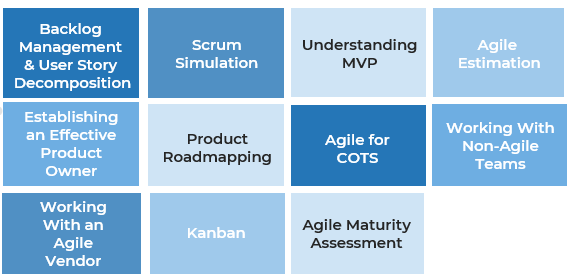
More modules coming soon!
Application delivery continues to fall short
78% of IT professionals believe the business is "usually" or "always" out of sync with project requirements.
Source: Blueprint, 2012.
Only 34% of software is rated as both important and effective by users.
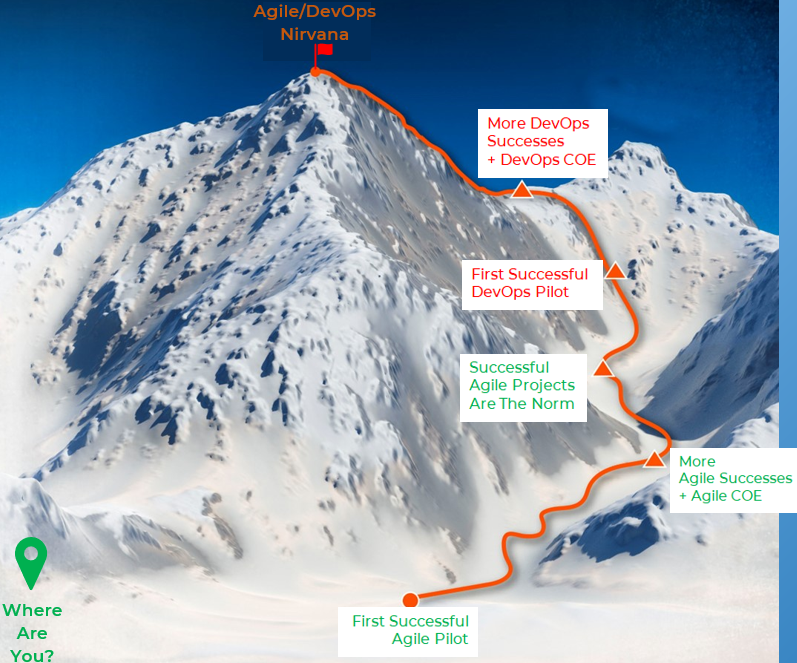
Agile DevOps is a progression of cultural, behavioral, and process changes. It takes time.
Enhancements and maintenance are misunderstood
Development Team
100%
Develop and Implement
The development team's work distribution is independent of the work distribution model for the maintenance team.
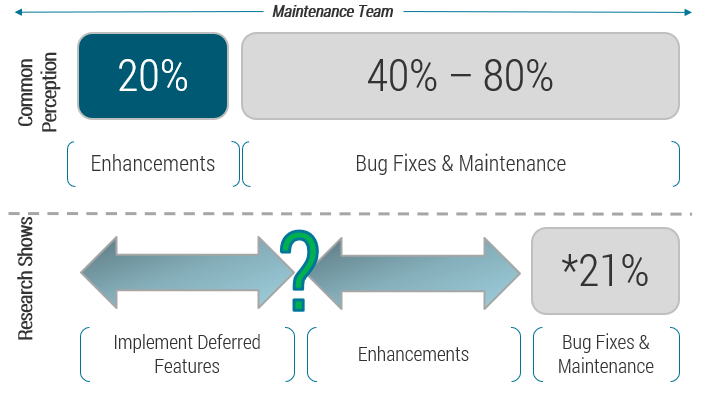
Source: "IEEE Transactions on Software Engineering"
Info-Tech Insight
Every maintenance team develops new code, enhances existing applications, and maintains and fixes production systems. Governance, management, and the ability to measure delivery is required to make the informed decisions about what activities to invest in to drive value.
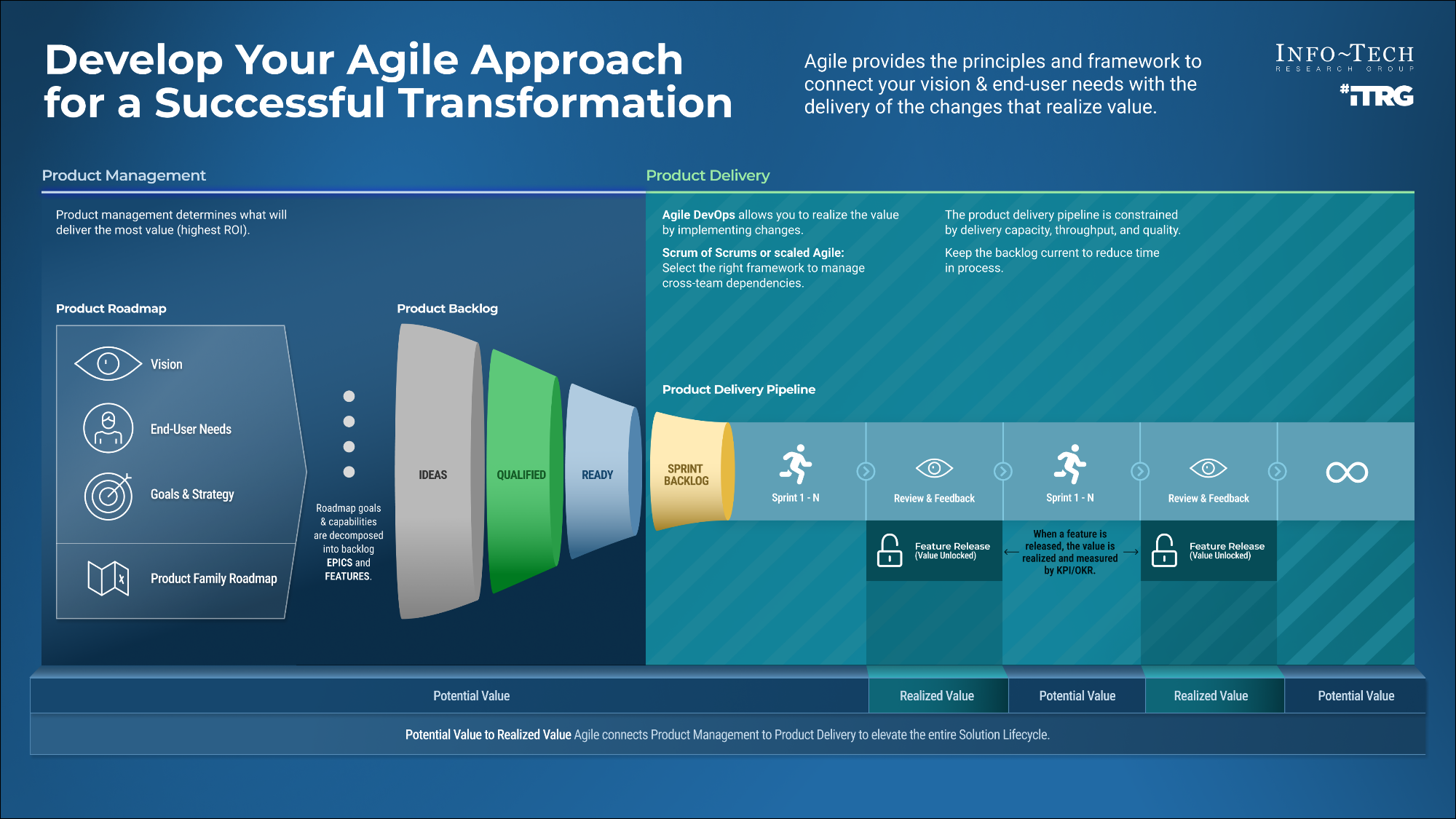
Why Agile/DevOps? It's about time to value
Leaders and stakeholders are frustrated with long lead times to implement changes. Agile/DevOps promotes smaller, more frequent releases to start earning value sooner.
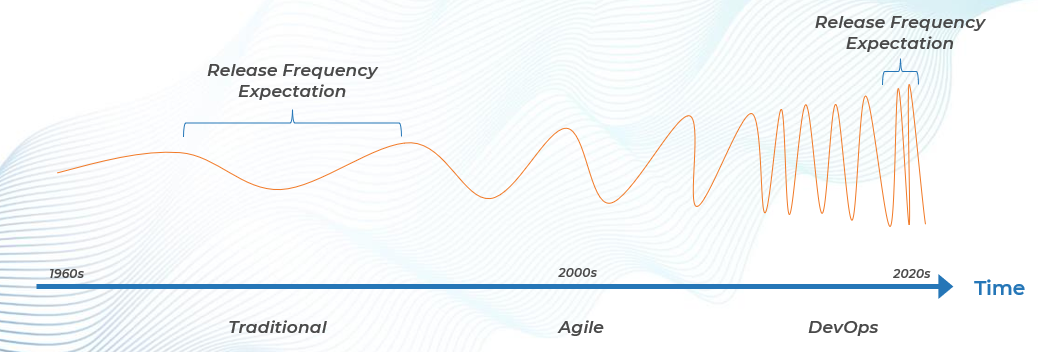
Time to delivering value depends on Frequency of Releases
Source: 5Q Partners
This content is exclusive to members.
Sign up to continue reading the full blueprint, or sign in if you already have an account.
Our systems detected an issue with your IP. If you think this is an error please submit your concerns via our contact form.