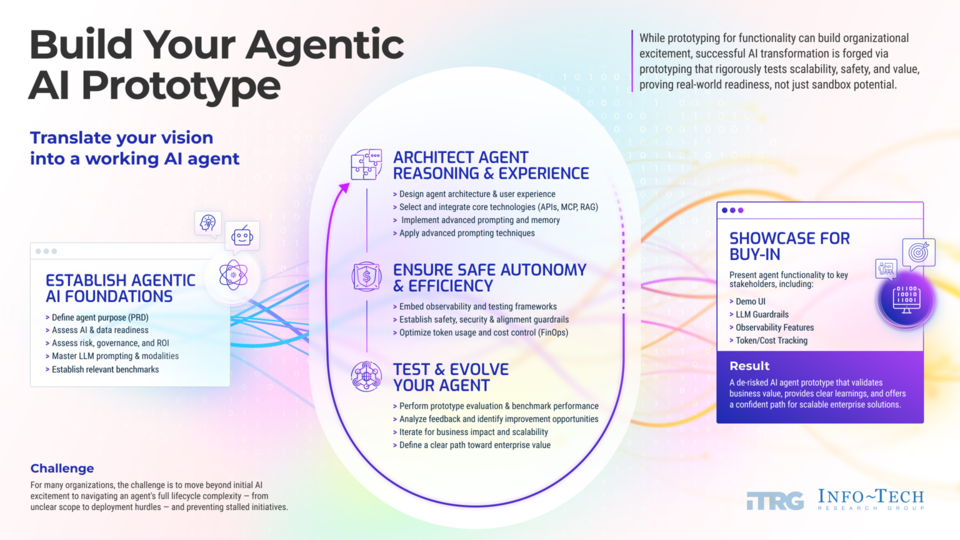
Organizations recognize AI agents as essential for driving innovation and competitive advantage, but initiatives often stall due to misalignment, complexity, and uncertainty.
- Agentic use cases are selected without a clear understanding of desired outcomes, and don’t deliver value. As a result, the agent may technically work, but it doesn't drive real ROI or reduce workload in areas that matter.
- Poor workflow and capability design results in increased agent complexity and failure to scale and requires constant supervision.
- No orchestration or governance design means that risk, inconsistency and trust issues emerge as agents go into production.
- Lack of evaluation frameworks means that organizations can’t prove impact, learn fast, or justify further investment.
Leverage this approach for a faster, more focused path from AI ideas to real agentic AI prototypes. Design the foundations upfront so teams can move quickly without misalignment, rework, or risk.
- Accelerate time-to-value by ensuring the best use case is selected so teams invest in the opportunities that matter.
- Design your agentic AI systems for real impact with explicit alignment to business outcomes, personas, KPIs, and constraints that guide all design decisions.
- Reduce delivery of risk and rework by designing agent workflows, orchestration, guardrails, and human oversight intentionally before development begins.
- Provide your developers with meaningful training on how to build agents in OpenAI SDK.
Book Your Workshop
Onsite Workshops offer an easy way to accelerate your project. If you are unable to do the project yourself, and a Guided Implementation isn’t enough, we offer low-cost onsite delivery of our Project Workshops. We take you through every phase of your project and ensure that you have a road map in place to complete your project successfully.
Book NowModule 1: Define Business Requirements & Align on Value Proposition
The Purpose
Convert business needs into a clear problem statement, success criteria, and scope to ensure a shared definition of “value,” which must inform every design decision.
Key Benefits Achieved
- Clear line of sight between agent opportunities and measurable business impact.
- Defined personas, KPIs and identified constraints that will ensure your agentic AI system will deliver value.
- Finalize your agentic AI prototype scope across business stakeholders and technical teams.
| Activities: | Outputs: | |
|---|---|---|
| 1.1 | Introduction to agentic AI concepts |
|
| 1.2 | Define the core problem statement |
|
| 1.3 | Discover key user personas |
|
| 1.4 | Document business KPIs with baselines and targets |
|
| 1.5 | Map the current-state workflow for the selected use case, identifying reasoning steps and edge cases |
|
| 1.6 | Finalize the prototype scope and boundaries |
|
Module 2: Map Your Agent Capabilities & Workflow
The Purpose
Design how your agents will work, including mapping workflows, decisions, tools, and handoffs between humans and agents.
Key Benefits Achieved
- Visualize your agentic workflow to demonstrate how your agents will function.
- Identify the right models, tools, and instructions for each agent.
- Prepare your developers to build APIs, agents, tools, and outputs in OpenAI.
| Activities: | Outputs: | |
|---|---|---|
| 2.1 | Introduction to agent workflow design, models, tools, and instructions |
|
| 2.2 | OpenAI Developer Crash Course 1: APIs, agents, tools & structured output. |
|
| 2.3 | Identify the optimal model for each agent |
|
| 2.4 | Define the necessary tools and agent instructions for each agent |
|
| 2.5 | Optimize and rationalize agent distribution |
|
Module 3: Define Your Prototype Orchestration & Governance
The Purpose
Define how agents are orchestrated, governed, and observed by embedding accountability and human oversight by design.
Key Benefits Achieved
- Design agent orchestration with clear controls, guardrails and oversight.
- Clearly identify areas for guardrails and human-in-the-loop requirements.
- Prepare your developers to build guardrails and orchestration patterns in OpenAI.
| Activities: | Outputs: | |
|---|---|---|
| 3.1 | Introduction to agent orchestration, guardrails, and human-in-the-loop (HITL) |
|
| 3.2 | OpenAI Developer Crash Course 3: Orchestration, guardrails, observability, FinOps |
|
| 3.3 | Determine the optimized orchestration pattern for the use case |
|
| 3.4 | Identify input, agent, and output risks |
|
| 3.5 | Document all necessary guardrails and HITL steps |
|
Module 4: Define Your Agent Evaluation Criteria
The Purpose
Establish clear evaluation criteria including metrics, test cases, traceability, and security.
Key Benefits Achieved
- Define what good looks like through clear agent success metrics.
- Establish your evaluation datasets and test criteria, and ensure design traceability.
- Set realistic expectations around next steps for the design finalization and prototype build.
- Prepare your developers to perform evaluations in OpenAI.
| Activities: | Outputs: | |
|---|---|---|
| 4.1 | Introduction to agent evaluation |
|
| 4.2 | OpenAI Developer Crash Course 4: Evaluations |
|
| 4.3 | Document agent competencies, success criteria, and metrics |
|
| 4.4 | Document agent tracing requirements |
|
| 4.5 | Build evaluation datasets to test agents and the system |
|
| 4.6 | Determine your experimentation plan & define next steps |
|