From CPQ to Control Plane: How Conga Is Reassembling Enterprise Commerce
What Was Announced?
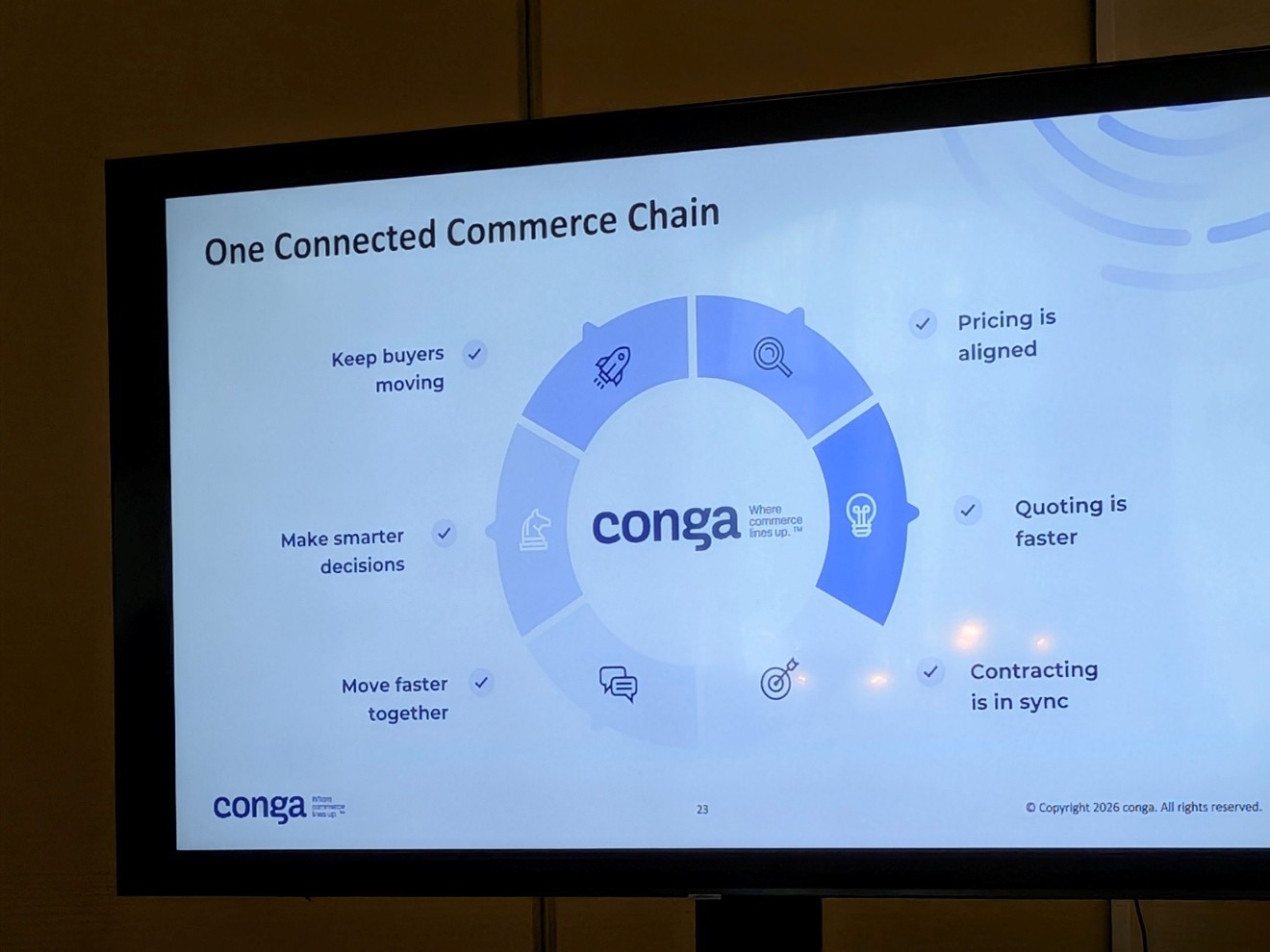
Conga Connect 2026. Source: Shashi Bellamkonda
At Conga Connect 2026 in Orlando, Conga formalized its transition to a platform strategy centered on a connected commerce chain spanning CPQ, price optimization and management (POM), contract lifecycle management (CLM), and document automation, all integrated across CRM and ERP ecosystems. The PROS acquisition is now positioned as the native pricing intelligence engine inside this chain, not a separate optimization tool.
Conga has also introduced AiMe as an integrated AI layer within its workflows, assigning specific personas to sales, legal, admin, revenue operations, and a general-purpose category. Conga did not specify how AiMe interacts with existing AI agents within a customer's ecosystem. While Conga, in collaboration with PROS, has extensive expertise in data science and machine learning, its development of AI agents remains ongoing. It stated that AiMe will assist based on internal customer data and not use it for training, which should comfort customers.
The company confirmed expanded availability on Microsoft Dynamics 365 and the Azure Marketplace and executed a live brand refresh during the conference, rolling out the new visual identity progressively as the event unfolded.
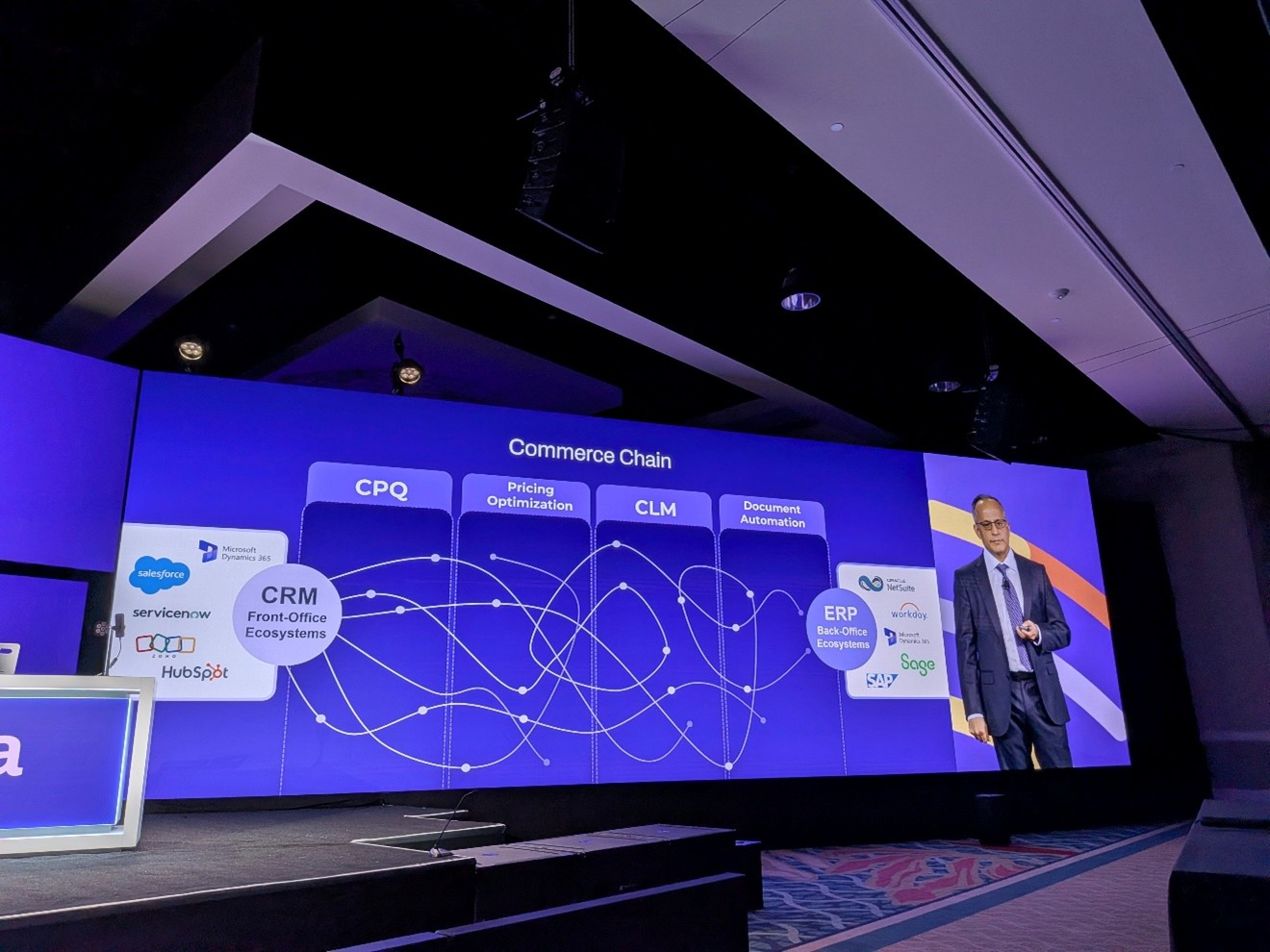
Conga Connect 2026. Source: Shashi Bellamkonda
What is the business value?
For customers, the value is reduced commercial drag. Pricing, quoting, contracting, and approvals are treated as a single operational flow rather than departmental handoffs. Conga's own research, conducted across more than 1,200 commerce and contracting decision-makers globally, puts numbers to that drag: 45% lost a deal in the past six months due to slow quote approvals, 72% say slow contract processes increase compliance exposure, and 93% report that deals struggle to move smoothly across sales, legal, finance, pricing, and IT functions.
For Conga, the value is expansion-driven growth. With more than 10,000 customers and deep penetration in the Fortune 500, the strategy is to increase revenue through upsell and retention rather than relying primarily on new logo acquisition. CPQ becomes the entry point; pricing, contracting, and AI become the expansion engine.
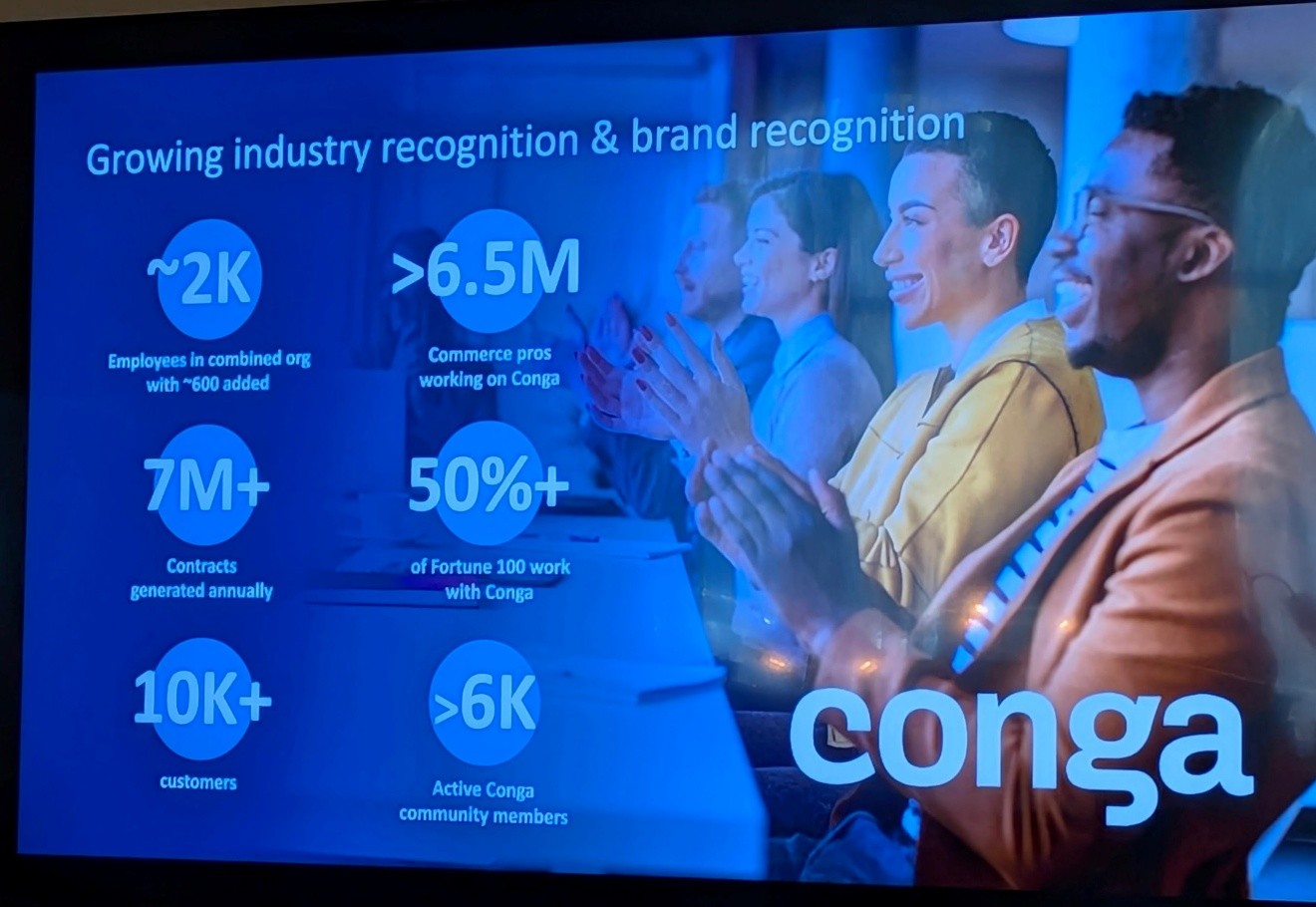
Conga Connect 2026. Source: Shashi Bellamkonda
Why should tech leaders pay attention?
Architecture, data, and go-to-market strategies are more tightly aligned here than is typical for a vendor at this stage. Conga is betting that enterprises want fewer systems with deeper intelligence, not more best-of-breed tools connected by custom integrations. Pricing decisions informed by machine learning now flow directly into live quotes and contracts, shortening decision cycles across sales, finance, and legal.
Conga is optimized for large, complex organizations. In our opinion, long-term growth depends on whether it can extend the platform to midmarket accounts without simplifying away the depth that enterprise customers rely on or complicating deployment economics for buyers without dedicated revenue operations teams.
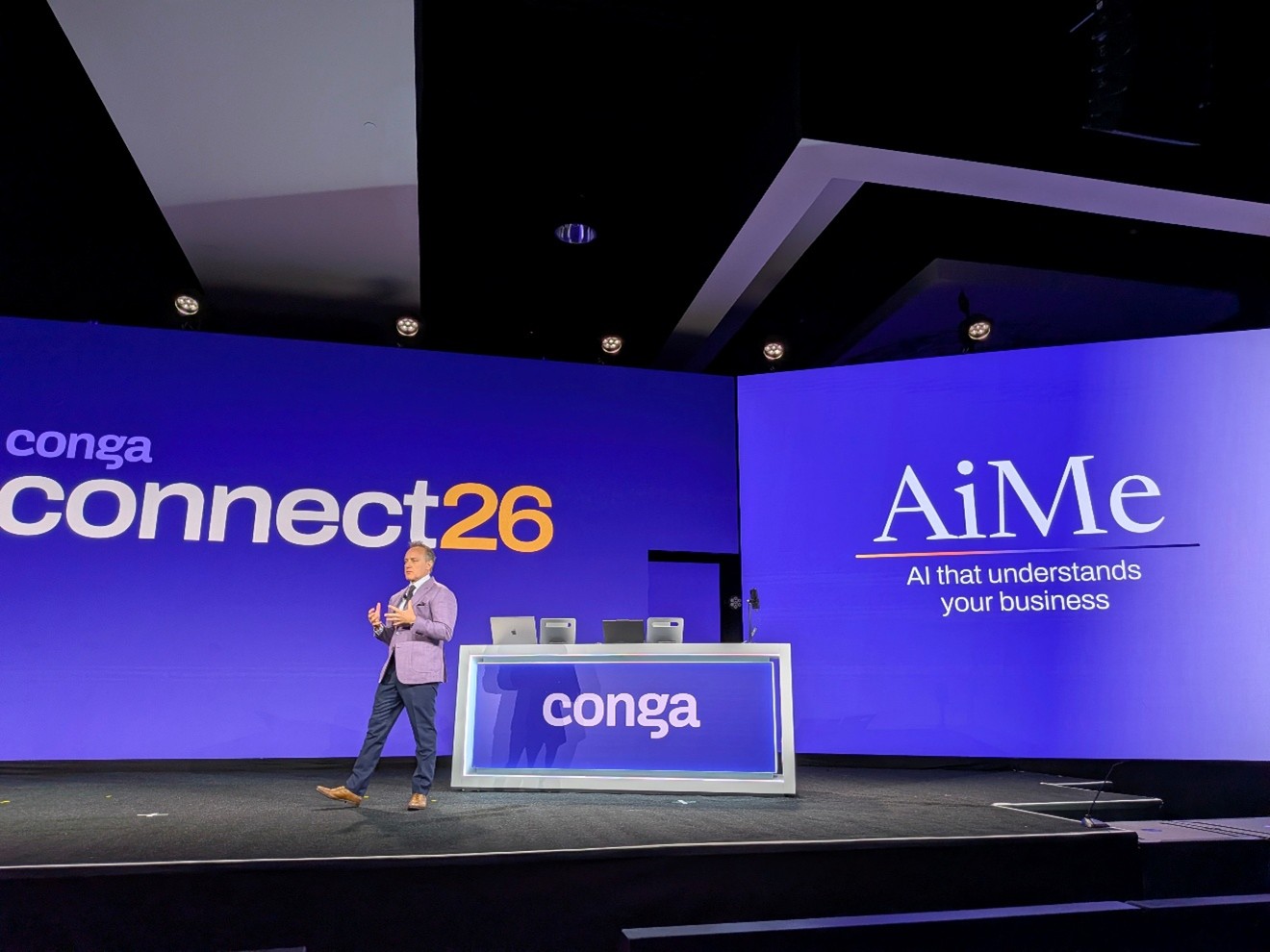
Conga Connect 2026. Source: Shashi Bellamkonda
During the keynote, David Osborne introduced a rebrand during the presentation, and the whole conference venue displayed the new brand identity. The live rebrand executed by CMO Celia Fleischaker and her team as the event unfolded was a calculated risk that paid off visually and operationally. A platform strategy requires a platform brand, and Conga now has one to build from. For technology leaders making long-term architectural decisions, brand consistency matters: It affects partner alignment, ecosystem messaging, and the confidence customers carry into multiyear commitments.
Competitive Context
Vendavo remains a credible pricing optimization option but does not carry native CPQ depth. Salesforce Revenue Cloud is hindered by Salesforce CPQ's decline and associated reimplementation costs. Clients have also found it inadequate for complex scenarios, particularly in manufacturing environments. Salesforce has recently decided to discontinue the standalone CPQ, integrating its features into Revenue Cloud, which is connected with other modules.
DealHub prioritizes deployment speed and usability over pricing rigor, and Microsoft Dynamics 365 customers have historically lacked an enterprise-grade CPQ and pricing standard. Conga's confirmed Dynamics availability directly addresses that gap. PROS, prior to the acquisition, retained strong pricing credibility in its own right. On the contracting side, Ironclad has built strong momentum in legal-led CLM buying motions, particularly in technology companies, while Malbek competes on ease of deployment and Salesforce-native integration. Both represent a real threat to Conga's CLM retention if the platform narrative does not land convincingly with legal and procurement buyers, who evaluate contracting tools largely independently of CPQ decisions.
Conga's most consequential competition is not a single vendor but the fragmented revenue architecture that already exists inside enterprise accounts – spreadsheets, point-to-point integrations, and manual approval chains that are deeply embedded and politically difficult to displace.
What is the real differentiation?
The differentiation is pricing intelligence embedded at the point of sale, supported by a unified data model across configuration, optimization, quoting, and contracting. This is not API integration alone. Pricing recommendations actively shape quotes in real time, closing the loop between what a customer is offered and what the contract ultimately reflects.The PROS acquisition materially strengthens this position. PROS brings a mature machine learning and data science foundation that Conga would have taken years to build independently. AiMe, as a concept, matters less than the underlying models, data, and closed-loop learning now embedded in the platform. The acquisition accelerates what Conga can credibly claim at the AI layer – and what it can actually deliver.
What the PROS Acquisition Means for Customers: Continuity, Not Forced Convergence
The PROS acquisition stands out because Conga is keeping PROS as a distinct product rather than forcing customers into a single, merged product. PROS’ pricing and CPQ products remain available for specialized use cases, minimizing disruption and maintaining continuity for existing PROS customers, especially in industries like manufacturing, travel, and energy. Instead of replacing PROS, Conga integrates its pricing expertise into the broader platform, letting customers opt in to revenue lifecycle expansion when it fits their needs. This approach preserves customer trust and revenue while making pricing optimization an optional add-on, not a forced migration, supporting retention without unnecessary pressure.
Our Take
Conga's main strength is its established presence in Fortune 500 revenue operations. The company focuses on upselling and retention, leveraging its deep integration rather than pursuing new clients at the cost of platform depth, and expands both from CPQ and CLM. The PROS acquisition strengthens Conga's AI trajectory precisely where CPQ platforms have historically been weakest: pricing science and dynamic optimization.
The strategy is sound but not finished. The challenge is that in many organizations there will be multiple buyers for different parts of the Conga platform. The team managing contracts is not the same team managing pricing, and the people configuring quotes are not the people reviewing renewal clauses. Each of Conga's four pillars has a different buyer, a different budget owner, and a different definition of success inside the same enterprise account. Expanding across all four requires Conga to build vertical-specific use cases, align partners to individual buyer personas, and give each pillar its own landing narrative, not a single platform story delivered by a single account team.
Chief Revenue Officer Lisa Martin, who joined in November 2025, appears to understand this acutely. Her framing net retention revenue as the golden metric and retention requiring a fundamentally different motion than acquisition is reflected in a new client director role focused exclusively on expansion within the installed base. Early cross-sell results from the first combined quarter with PROS customers indicate strong initial interest, serving as a credible starting point for this strategy.
For technology leaders and current Conga customers assessing their quote-to-cash architecture should anticipate discussions regarding expansion. We recommend evaluating POM, CLM, and AiMe individually based on objective metrics such as cycle time, margin variance, and approval latency rather than relying solely on broader platform narratives.
Organizations standardizing revenue architecture should test the commerce chain against a real deal involving pricing exceptions and complex approvals. Dynamics 365 shops should now treat Conga as a native option rather than a workaround, and organizations below Fortune 500 scale should watch for Conga to introduce midmarket packaging with simplified deployment economics before committing to the full platform.
If Conga stabilizes execution, clarifies packaging, and selectively extends down market, it has a credible path to becoming the system of record for enterprise commerce. The bones of the strategy are sound. The test is execution.
