
Activate Data Governance
Create the rules of engagement for trusted data with a decision-focused framework.
Data governance, like governance in general, is about making decisions that steer resources toward value while appropriately managing risk. But efforts often go off track because data leaders start with management mechanisms such as catalogs, glossaries, and quality, which don’t address the underlying problem: unanswered governance decisions. This comprehensive blueprint offers a step-by-step methodology that helps you define and activate a framework for establishing data governance as a decision-making system.
Data governance has become a critical lever as expanding AI initiatives increase the need for trustworthy data. Governance ensures the organization extracts maximum value from the use of data assets and capabilities, but many struggle to make this work in practice. Governance must first codify business judgment – clarifying who makes decisions, what trade‑offs define “good enough for the purpose,” and how shared ownership works across domains – so that management only executes where those decisions create measurable impact.
1. You already have governance – it’s just fragmented.
Most organizations don’t lack governance; it’s scattered across risk, privacy, finance, product, and legacy data management practices. The goal should be to align these efforts into a single, predictable framework for handling data decisions so that multiple teams are not solving the same problems differently.
2. Institutionalize governance, don’t isolate it.
Sustained data governance comes from embedding data governance into existing power structures – executive councils, risk, privacy, architecture – where legitimacy, cadence, and organizational memory already exist. Making governance part of how the organization already runs is how governance becomes institutional rather than episodic.
3. Give leaders meaningful decisions to make.
Data governance activates when decision-makers are asked to make real decisions about how data should be used and what “trusted” means. Those decisions are surfaced, recorded, and reinforced until they become organizational norms.
Use this step-by-step research to activate data governance with a decision-first approach
This research helps you define and activate a data governance framework that will steer, influence, and determine how your organization manages its data. The framework follows four phases and includes multiple templates and tools, such as a decision log, governance handbook, data domains primer, catalog entries, and policy package.
- Define the decisions you need your organization to make by identifying your governance drivers, understanding your organizational context, and developing the “why” behind your data governance program.
- Define your decision-making framework by tailoring the governance structure to fit your context, articulating roles and responsibilities, defining membership, and establish decision-making processes.
- Establish critical guardrails in the form of policies and processes, plan how you’ll measure success, and finalize the governance structure.
- Activate data governance within your organization by preparing day-1 agendas, securing strategic approval, and initiating governance processes.
Member Testimonials
After each Info-Tech experience, we ask our members to quantify the real-time savings, monetary impact, and project improvements our research helped them achieve. See our top member experiences for this blueprint and what our clients have to say.
9.3/10
Overall Impact
$116,611
Average $ Saved
31
Average Days Saved
Client
Experience
Impact
$ Saved
Days Saved
Alachua County Florida
Workshop
10/10
$68,999
60
The host/session leader was very efficient and accomplished what we needed to do quickly. Yet, he also allowed and encouraged the participants to ... Read More
Toronto District School Board
Workshop
8/10
N/A
N/A
Great session! Areez was very knowledgeable, engaging, and made the data governance concepts easy to understand with practical examples. Enjoyed ... Read More
Catrion Catering Holding Company
Guided Implementation
10/10
$32,429
47
Abbas, Thank you for the excellent work and the well-structured approach you have brought to this engagement. The framework provides us with a clea... Read More
City Of Lewisville
Workshop
10/10
N/A
44
Los Angeles Regional Food Bank
Guided Implementation
10/10
N/A
10
Queensway-Carleton Hospital
Guided Implementation
7/10
$10,000
10
good understanding of the material,
Lake Simcoe Region Conservation Authority
Guided Implementation
9/10
$2,000
2
Actionable steps outlined to go forward.
Athens State University
Guided Implementation
8/10
$65,549
50
University of Wyoming
Workshop
10/10
$103K
50
Arkansas Department of the Military
Guided Implementation
10/10
$28,289
41
Sonepar Canada Inc
Guided Implementation
5/10
$2,000
5
Good documentation available and proposed roadmap. Well provided insights before we move forward No continuity from session to session. Model is s... Read More
Targa Resources LLC
Guided Implementation
10/10
N/A
10
Wiss, Janney, Elstner Associates, Inc.
Workshop
10/10
$137K
29
Areez was excellent - he was able to "read the room" and tailor the workshop to our company and attendees. We were able to get our initial data go... Read More
Saskatchewan Indian Gaming Authority
Workshop
10/10
$9,000
20
Florida Department of Revenue
Guided Implementation
10/10
N/A
110
Abbas has been great to work with throughout the guided implementation. He's extremely knowledgeable, patient, and does a great job meeting us wher... Read More
SaskTel
Workshop
8/10
N/A
20
The best parts of our experience was that Paul understood our needs and adjusted the deliverable to meet our needs, while at the same time influenc... Read More
Rensselaer Polytechnic Institute
Workshop
10/10
$8,279
95
Best: The quality of information provided / the Instructor's experience and ability to relate to us. Worst: no complaints
Fair Haven Community Health Care
Guided Implementation
8/10
$13,799
32
Kuvare US Holdings
Guided Implementation
9/10
N/A
N/A
Abbas was great to work with. He took the time to listen to my thoughts and understand my situation. He provided thoughtful feedback and clearly ex... Read More
Wellabe, Inc.
Guided Implementation
10/10
$13,799
20
Santa Cruz County
Workshop
8/10
N/A
41
The workshop brought clarity to what data governance means and why it matters. It was good that we included some staff outside of our department - ... Read More
The Rehmann Group LLC
Guided Implementation
10/10
$6,899
3
New Mexico Department of Children Youth and Families
Workshop
10/10
$131K
50
Columbia Mutual Insurance Company
Guided Implementation
10/10
$2,621
2
RPC Inc.
Guided Implementation
10/10
$13,799
16
American Automobile Association, Inc.
Guided Implementation
10/10
$34,499
20
Infotech did a great job informing the staff, and arming them with practical knowledge.
Camico Mutual Insurance Company, Inc
Guided Implementation
10/10
$6,899
5
Expertise and ability to present us with tailored feedback and comprehensive material were great value adds
City of Atlanta / Atlanta Information Management (AIM)
Guided Implementation
10/10
$68,999
20
Arkansas Department of the Military
Guided Implementation
10/10
$551K
44
OU Health
Guided Implementation
10/10
$22,079
29
The most valuable part was being able to talk through real examples from our own organization and shaping the tools around what our audience actual... Read More
Frequently Asked Questions
What is data governance?
Data governance is the reallocation of decision rights over enterprise data and deciding what is trustworthy and how it may be used. According to Info-Tech Research Group, data governance is about making decisions that steer resources toward value while appropriately managing risk. When done well, Info-Tech's approach prevents organizational risk and drives speed, value, and relevance through clear decision-making frameworks and guardrails.
How does Info-Tech's data governance framework differ from traditional approaches?
Info-Tech Research Group's data governance framework starts with decisions, not tooling. While traditional approaches often begin with catalogs, glossaries, quality tooling, and lineage without first defining who decides what and why, Info-Tech's decision-focused framework reframes governance as decision-making. Info-Tech's approach identifies the decisions that change outcomes (definitions, acceptable use, quality standards, trust expectations) and clarifies who should decide them before implementing any management mechanisms.
What is the difference between data governance and data management?
Data governance addresses the creation of guardrails and a decision-making framework, while data management is the execution of those guidelines. According to Info-Tech Research Group, governance defines who makes decisions, what trade-offs define good enough for purpose, and how shared ownership works across domains. Management then executes where those decisions create measurable impact through activities like cataloging, quality controls, and lineage tracking.
Why does data governance often fail in organizations?
Data governance efforts often go off track because data leaders start with management mechanisms such as catalogs, glossaries, and quality tooling, which do not address the underlying problem: unanswered governance decisions. Info-Tech Research Group identifies three common obstacles: mistaking governance for management, oversimplifying ownership by assigning single owners when critical data spans multiple domains, and misinterpreting activation as asking business teams to take on tasks they don't see as relevant instead of securing agreement on decisions tied to value, risk, and use.
What is Info-Tech's decision-focused framework for data governance?
Info-Tech Research Group's decision-focused framework consists of three core elements: naming the deciders (identifying cross-domain decisions that change outcomes and clarifying who decides them), creating a Day 1 Agenda (putting those decisions on real agendas and resolving them with documented guardrails like trade-offs, thresholds, and escalation paths), and routing management where it matters (using decision guardrails to target management work like quality, standards, and controls where it moves the needle and tracking impact). Info-Tech's framework ensures governance translates into measurable business impact.
What are the four phases of Info-Tech's Activate Data Governance blueprint?
Info-Tech Research Group's Activate Data Governance blueprint follows four phases: Phase 1 defines the decisions your organization needs to make by identifying governance drivers and developing the why behind your program. Phase 2 defines your decision-making framework by tailoring the governance structure to fit your context, articulating roles and responsibilities, and defining membership. Phase 3 establishes critical guardrails in the form of policies and processes, plans how to measure success, and finalizes the governance structure. Phase 4 activates data governance within your organization by preparing Day 1 agendas, securing strategic approval, and initiating governance processes.
How do I identify governance drivers for my data governance program?
According to Info-Tech Research Group's Activate Data Governance blueprint, identifying governance drivers means documenting key data problems impacting organizational objectives and differentiating governance decisions from management decisions based on the drivers your organization is experiencing. Info-Tech's Activate Data Governance Workbook helps organizations identify their drivers, translate them into key decisions to guide the program, and document existing governance structures that may be leveraged. This ensures the data governance program is rooted in real business drivers rather than abstract best practices or technology-first thinking.
What is a Data Governance Decision Log and why is it critical?
Info-Tech Research Group's Data Governance Decision Log is one of the most critical tools for a data governance leader. The Decision Log helps organizations catalog key governance decisions that must be made, provides a clear structure to escalate decisions to the appropriate decision-making tiers, and documents the actions that must be taken to implement the decisions. Info-Tech's template enables teams to prioritize decisions, place them on the right committee agendas, record outcomes immediately, and create an actionable roadmap for future governance initiatives and meetings.
How should I structure data governance roles and responsibilities?
Info-Tech Research Group recommends establishing a right-sized governance structure aligned to existing organizational bodies to prevent duplication and increase long-term stability. Info-Tech's approach defines clear roles, responsibilities, and ownership, ensuring that the people with the authority and expertise are the ones making the decisions. The governance structure should be tailored to your organization's context and embedded into existing power structures like executive councils, risk committees, privacy offices, and architecture groups where legitimacy, cadence, and organizational memory already exist.
What are guardrails in data governance?
According to Info-Tech Research Group, critical guardrails are clear boundaries that ensure decisions align with organizational objectives and risk management requirements. Info-Tech's framework translates governance decisions into essential guardrails including principles, policies, standards, and supporting processes that guide how data is defined, managed, and used across the enterprise. These guardrails create practical rules that govern clarity, trust, and responsible use of data while directing management activities toward areas of measurable impact.
How do I activate data governance in my organization?
Info-Tech Research Group's blueprint activates data governance by moving from planning to execution through three key activities: preparing Day 1 agendas that put real decisions on real meeting agendas, securing executive approval using Info-Tech's Executive Communication Deck to enable resources and sustained support, and hosting formal governance meetings with structured agendas that demonstrate tangible value from day one. Info-Tech's approach ensures governance becomes a living, decision-driven practice with recurring meetings, documented decisions, and a transparent decision log rather than remaining theoretical.
What is the Data Governance Charter and why is it important?
Info-Tech Research Group's Data Governance Charter Template is a comprehensive document that consolidates all governance elements into one authoritative artifact. The charter clarifies the program's vision, mission, purpose, goals, and objectives for managing data as a strategic asset, establishes the governance structure with leadership, councils, stewards, work groups, decision rights, and escalation paths, and documents policies, governance metrics, IT management metrics, and review cycles for continuous alignment. Info-Tech's charter template enables organizations to communicate their data governance program effectively to all users.
How long does it take to implement Info-Tech's data governance framework?
Info-Tech Research Group's typical Guided Implementation for Activate Data Governance consists of 8 to 12 calls over the course of 4 to 6 months. The workshop format condenses the blueprint into four intensive sessions covering all four phases, plus post-workshop time to complete deliverables. Info-Tech's Data Governance Handbook and templates are designed to reduce the tactical workload of setting up governance, enabling teams to hit the ground running and achieve faster time to impact compared to building a framework from scratch.
What tools and templates does Info-Tech provide for data governance?
Info-Tech Research Group provides ten comprehensive tools and templates for data governance: the Activate Data Governance Storyboard with phases 1-4, the Activate Data Governance Handbook with templates and guides, the Data Governance Charter Template, the Data Governance Day 1 Agenda, the Activate Data Governance Workbook, the Activate Data Governance Decision Log, the Executive Communication Deck, the Data Domains, Metadata, Catalogs, and Lineage Primer, the Business Data Catalog, and the Data Governance Policies Package. These ready-to-use assets enable organizations to rapidly stand up and operationalize their data governance programs.
How does data governance support AI initiatives?
Data governance has become a critical lever as expanding AI initiatives increase the need for trustworthy data, according to Info-Tech Research Group. AI needs good data, and good data needs governance. Info-Tech's data governance framework future-proofs organizations by wrapping robust governance around data so they are ready to leverage AI when it matters most. According to Info-Tech's Future of IT 2026 Survey data, improving data governance is the top priority for 40% of respondents when considering how to best support AI goals.

Data Governance
At the end of this course, you will be able to build and sustain an effective data governance program.
- Course Modules: 4
- Estimated Completion Time: 2 hours
Workshop: Activate Data Governance
Workshops offer an easy way to accelerate your project. If you are unable to do the project yourself, and a Guided Implementation isn't enough, we offer low-cost delivery of our project workshops. We take you through every phase of your project and ensure that you have a roadmap in place to complete your project successfully.
Module 1: Define the Decisions You Need Your Organization to Make
The Purpose
- Create a unified view of the data governance program.
- Ensure the data governance program is rooted in real business drivers rather than abstract best practices or technology-first thinking.
Key Benefits Achieved
- Gain clarity on why data governance is needed in your organization, including specific risks, issues, and objectives
- Create a unified "why," establishing alignment and urgency that is meaningful to both IT and business stakeholders.
Activities
Outputs
Identify your governance drivers.
- Documented data governance drivers (goals and objectives)
Develop your why.
- Data governance vision, mission, and purpose statements
Module 2: Define Your Decision-Making Framework
The Purpose
- Establish a formal structure to make data-related decisions across the organization
- Clarify existing governance roles and responsibilities to align with organizational realities.
Key Benefits Achieved
- Establish a right-sized governance structure aligned to existing bodies, preventing duplication and increasing long-term stability.
- Define clear roles, responsibilities, and ownership, ensuring that the people with the authority and expertise are the ones making the decisions.
- Create defined, repeatable processes for identifying and raising issues to enable consistent decision-making and faster resolution of cross-domain challenges.
Activities
Outputs
Tailor your data governance structure to your organization.
- Defined data governance structure
Articulate roles and responsibilities.
- Defined data governance roles and responsibilities
Define membership.
- Defined data governance membership
Module 3: Identify Your Critical Guardrails
The Purpose
Key Benefits Achieved
- The organization establishes foundational principles and policies that clarify what “good” looks like and set consistent expectations for how data is handled.
- Create initial processes and standards to support policy execution, ensuring governance becomes operational rather than theoretical.
- Create a measurable framework through governance and data quality metrics, allowing the organization to track its progress, identify gaps, and continuously improve.
Activities
Outputs
Define your initial guardrails.
- Foundational data governance policies and supporting processes
Plan to measure success.
- Data governance metrics
Finalize your governance structure.
- Completed Activate Data Governance Decision Log
Module 4: Activate Data Governance Within Your Organization
The Purpose
Key Benefits Achieved
- The Data Governance Charter is completed, consolidating all elements into one authoritative document that communicates purpose, structure, guardrails, and commitments.
- Data governance leaders have clear pathways to resolve issues using structured agendas, demonstrating tangible value from day one.
- Data governance leaders have a compelling presentation to secure executive approval and engagement, enabling resources, authority, and sustained support.
- The foundations are set for governance to become an active operating rhythm with recurring meetings, documented decisions, and a transparent decision log
Activities
Outputs
Prepare your Day 1 Agenda.
- Day 1 Agenda
Secure strategic approval for data governance.
- Completed Executive Communication Deck
Activate data governance within your organization.
- Completed Data Governance Charter
Activate Data Governance
Create the rules of engagement for trusted data with a decision-focused framework.
Activate Data Governance
Create the rules of engagement for trusted data with a decision-focused framework.
EXECUTIVE BRIEF
Analyst perspective
Focus on decisions.

Nysa Zaran
Research Director, Data and Analytics
Info-Tech Research Group

Mia Scherba
Research Analyst, Data and Analytics
Info-Tech Research Group
Data governance, like governance in general, is about steering resources toward value while appropriately managing risk.
Governance in practice is about decision-makers, who have mandate and authority, making judgment calls about what is valuable and what is risky and assessing whether management layers are driving desired outcomes.
Data governance is no different.
Data leaders, though, start with management mechanisms – catalogs, glossaries, quality, lineage – because they appear to provide immediate control and visibility. However, they do not solve your underlying problems: unanswered data governance questions such as, “what data must we clearly define?”, “who should define it?”, “are we okay with using our data in this new way?”, and “what really helps us trust our data?” These are judgment calls made by people influenced by culture, purpose, and regulations.
This blueprint will help you define and activate a data governance framework that makes sense to your organization. This governance framework will steer, influence, and determine how your organization must manage its data. You will leverage this framework repeatedly – to make decisions, validate strategies, remove obstacles, and, ultimately, drive outcomes
Executive summary
Your Challenge
- Data is an organizational asset, much like intellectual property, products, tangible assets, processes, employees, and reputation. It can either drive or erode organizational value, controlling risk or exposing the organization to it.
- Many organizations understand the criticality of data and want to make data-driven decisions. Still, many struggle to do so as their data landscapes are unorganized, undefined, and operate without accountability, leading to misinformed decisions and misallocated resources.
- As the importance of data continues to grow due to initiatives such as AI adoption, the pressure on IT and data leaders to fix these problems increases. However, they lack the expertise and influence to make organizationally relevant, implementable decisions alone.
Common Obstacles
- Mistaking Governance for Management Leaders start with catalogs, lineage, and quality tooling without first defining who decides what and why, producing busywork instead of outcomes.
- Oversimplifying Ownership Assigning a single owner seems like a quick fix, but critical data rarely lives in one domain. Its value and risk span multiple functions. Governance needs to establish how decisions on shared domains will be made.
- Misinterpreting Activation Activation isn’t about asking business teams to take on tasks they don’t see as relevant. It’s about securing agreement on decisions tied to value, risk, and use. When the “why” is clear, leaders will resource and champion execution.
Info-Tech’s Approach
Data governance is activated when decisions translate into measurable impact.
- Name the Deciders Identify cross‑domain decisions that change outcomes (e.g. truth definitions, acceptable use, “good enough” quality) and clarify who decides them.
- Make Your Day 1 Agenda Put those decisions in a Day 1 Agenda and resolve them with documented guardrails (trade‑offs, thresholds, escalation) to impact your organization immediately.
- Route Management Where It Matters Use the decisions’ guardrails to target management work (quality, standards, controls) where it moves the needle and track impact.
Info-Tech Insight
Well‑governed data enables the business to meet its objectives. Therefore, governance must first codify business judgment – clarifying who makes decisions, what trade‑offs define “good enough for purpose,” and how shared ownership works across domains – so management only executes where those decisions create measurable impact.
Your challenge
This research is designed to help organizations build and sustain an effective data governance program.
- Your organization has recognized the need to treat data as a corporate asset for generating business value and/or managing and mitigating risk.
- This has brought data governance to the forefront and highlighted the need to build a value-driven program that provides trusted data to users.
- Accountability for data is often placed with IT or data teams, but they do not have the authority to make decisions that impact the business use for data.
- An effective data governance program is one that defines decision-making, accountability, and responsibility related to data use and handling and escalates it to the right decision-makers. This decision-making structure materializes as principles, policies, and procedures, all of which help enable effective data management, innovation and risk mitigation.
As you embark on establishing data governance in your organization, it’s vital that you define the drivers and business context for the program from the get-go. Data governance should never be attempted without direction on how the program will yield measurable business value.
76%
of leading data and analytics professionals say data-driven decision-making is their #1 goal for data programs
(Precisely, 2025)
33%
Only 33% report that they fully trust the data their organization is using.
(Precisely, 2025)
Common obstacles
- Misinterpretation or a lack of understanding about data governance, including the contrast between data governance and management
- A perception that data governance is inhibiting or an added layer of bureaucracy or complication rather than an enabling and empowering framework to guide stakeholders in their use of data
- Failure to align data governance with enterprise governance, including oversimplifying ownership and overcomplicating governance structures
- A misunderstanding of what it means to activate data governance within the organization
- Difficulty communicating the purpose and importance of data governance to realize value from data in an organization
72.5%
of CIO’s say they are currently invested in “data management solutions” and plan to increase that investment.
(Info-Tech’s Future of IT 2026 Survey data)
40%
Applying management solutions implies that data governance has been established, yet “improving data governance” is a top priority for 40% of respondents.
(Info-Tech’s Future of IT 2026 Survey data)
Info-Tech’s methodology to Activate Data Governance
Phase Steps |
1. Define the Decisions You Need Your Organization to Make
|
2. Define Your Decision-Making Framework
|
3. Identify Your Critical Guardrails
|
4. Activate Data Governance Within Your Organization
|
Phase Outcomes |
|
|
|
|
Insight summary
Decisions drive governance
Data governance is the reallocation of decision rights over enterprise data and deciding what is trustworthy and how it may be used. When done well, it prevents organizational risk and drives speed, value, and relevance. Technology can scale and enable governance decisions, but governance is not technology alone.
You already govern your data
What you call “no governance” is often fragmented governance, distributed across risk, privacy, finance, product, and legacy data management practices. Align them into one predictable, known framework for handling data decisions so teams stop solving the same problems differently.
Institutionalize governance, do not isolate it
Sustain data governance by integrating it into existing power structures (executive councils, risk, privacy, architecture) where legitimacy, cadence, and organizational memory already reside. This is how governance becomes institutional rather than episodic.
Give leaders meaningful decisions to make
Activate data governance by giving decision-makers real decisions to make – clarifying definition, trust, and use – and surfacing, recording, and reinforcing those decisions until they become organizational norms.
Ownership over critical domains is shared
Because valuable data spans functions and risk centers, it rarely belongs to a single team or owner. Sustainable governance gives the people who co-own value and risk a coherent way to resolve tensions quickly and keep the enterprise aligned.
Blueprint deliverables
Each step of this blueprint is accompanied by supporting deliverables to help you accomplish your goals.
Data Governance Day 1 Agenda
Establish effective, relevant, and productive meeting agendas for your governance structures to activate data governance in your organization.
Data Governance Charter Template
Communicate your data governance program to the organization’s users by compiling a comprehensive and actionable charter.
Key deliverable:
Activate Data Governance Executive Communication Deck
A customizable presentation that enables executive-level communication.
Blueprint deliverables
Each step of this blueprint is accompanied by supporting deliverables to help you accomplish your goals.
Activate Data Governance Workbook
Leverage Info-Tech’s guides to understand your governance drivers and translate them to key decisions to guide your program.
Activate Data Governance Decision Log
Document and prioritize the governance decisions that need to be made by your organization.
Activate Data Governance Handbook
Leverage a library of templates, examples, and guides to rapidly stand up your data governance program.
Data Domains, Metadata, Catalogs, and Lineage Primer
Use templates and examples to understand what domains exist in your organization and where shared accountabilities exist.
Business Data Catalog
Identify your organization’s data assets and document key information to guide governance.
Data Governance Policies Package
Leverage Info-Tech’s policy templates, decision guides and executive one pagers to establish effective, actionable data governance policies.
Measure the value of this blueprint
Leverage this blueprint’s methodology and tools to rapidly activate data governance and create a robust program that remains effective over time.
Outcome |
Value |
Faster time to impact |
The Data Governance Handbook reduces the tactical workload of setting up governance, enabling teams to hit the ground running. |
Reduced waste and frustration |
Target the decisions and data domains that truly matter. Avoid spending on unnecessary technology, policies, or cataloging efforts that don’t move the needle. |
Unblocked value-realization |
Avoid disengagement and buy-in fatigue by formalizing accountability structures that make sense to your organization. |
IT-enabled, business-driven data governance |
Invest in technology with confidence knowing each solution is targeted at business priorities and backed by stakeholder buy-in, reducing waste and reinforcing your program’s reputation. |
Governed data for AI |
AI needs good data, and good data needs governance. Future-proof your organization by wrapping robust governance around your data so you’re ready to leverage AI when it matters most. |
Info-Tech offers various levels of support to best suit your needs
DIY Toolkit
“Our team has already made this critical project a priority, and we have the time and capability, but some guidance along the way would be helpful.”
Guided Implementation
“Our team knows that we need to fix a process, but we need assistance to determine where to focus. Some check-ins along the way would help keep us on track.”
Workshop
“We need to hit the ground running and get this project kicked off immediately. Our team has the ability to take this over once we get a framework and strategy in place.”
Executive & Technical Counseling
“Our team and processes are maturing; however, to expedite the journey we’ll need a seasoned practitioner to coach and validate approaches, deliverables, and opportunities.”
Consulting
“Our team does not have the time or the knowledge to take this project on. We need assistance through the entirety of this project.”
Diagnostics and consistent frameworks are used throughout all five options.
Guided Implementation
What does a typical GI on this topic look like?
Phase 1
|
Phase 2
|
Phase 3
|
Phase 4
|
A Guided Implementation (GI) is a series of calls with an Info-Tech analyst to help implement our best practices in your organization.
A typical GI is 8 to 12 calls over the course of 4 to 6 months.
Workshop overview
Contact your account representative for more information.
workshops@infotech.com 1-888-670-8889
Activities |
Session 1Define the Decisions You Need Your Organization to Make1.1 Identify your governance drivers. 1.2 Develop your “why.” |
Session 2Define Your Decision-Making Framework2.1 Tailor your data governance structure to your organization. 2.2 Articulate roles and responsibilities. 2.3 Define membership. |
Session 3Establish Critical Guardrails3.1 Define your initial guardrails. 3.2 Plan to measure success. 3.3 Finalize your governance structure. |
Session 4Activate Data Governance within your Organization4.1 Prepare your Day 1 Agenda. 4.2 Secure strategic approval for data governance. 4.3 Activate data governance within your organization. |
Post-WorkshopNext Steps and Wrap-Up (offsite)5.1 Complete in-progress deliverables from previous four days. 5.2 Set up review time for workshop deliverables and to discuss next steps. |
Deliverables |
|
|
|
|
|
The data value trinity
Delivery of Business Value and Strategic Needs
DATA STRATEGY
The identification of objectives and initiatives necessary to achieve business goals.
DATA OPERATING MODEL
The model for how data is organized to deliver on business needs and strategies.
GOVERNANCE
Ensures the organization and its customers extract maximum value from data assets and capabilities.
- Data strategy tells you what you need to achieve to be successful.
- The data operating model aligns resources, processes, measures, stakeholders, value streams, and decision rights to enable the delivery of your strategy and priorities.
- Governance ensures the alignment of data initiatives and organizational outcomes.
A change in one necessitates a change in the others.
Info-Tech’s Data Governance Framework
Decision-Makers make decisions that materialize as guardrails.
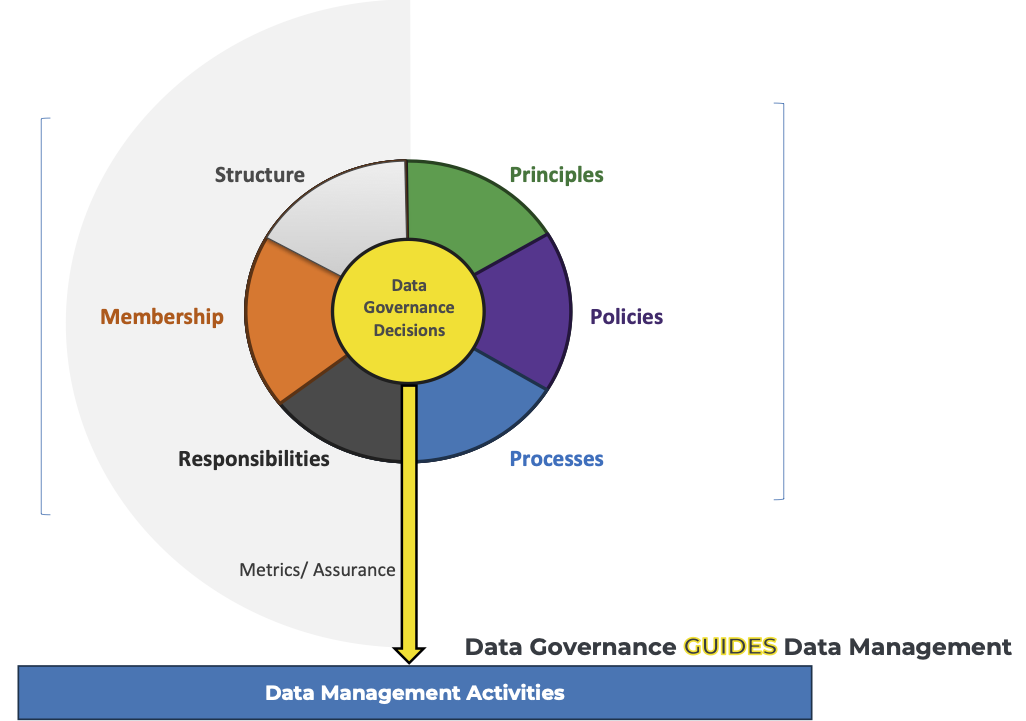
The Decision-Making Framework
The decision-making framework is a structured approach that defines how governance decisions are made and by whom. Decisions should be made by those who have the authority and expertise to make them.
Guardrails
Critical guardrails are clear boundaries that ensure decisions align with organizational objectives and risk management requirements. These guide data management activities.
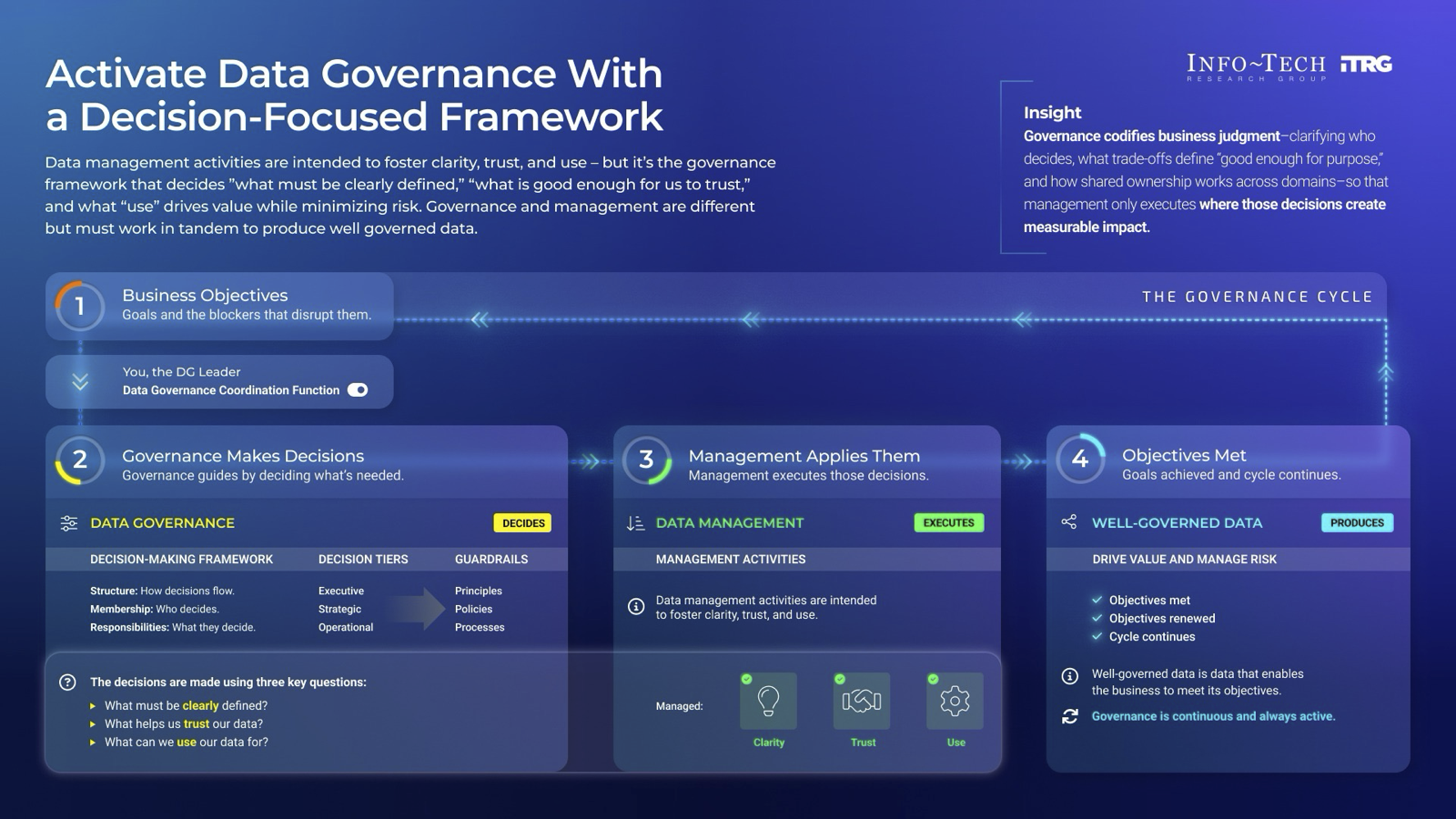
Is your data managed without governance?
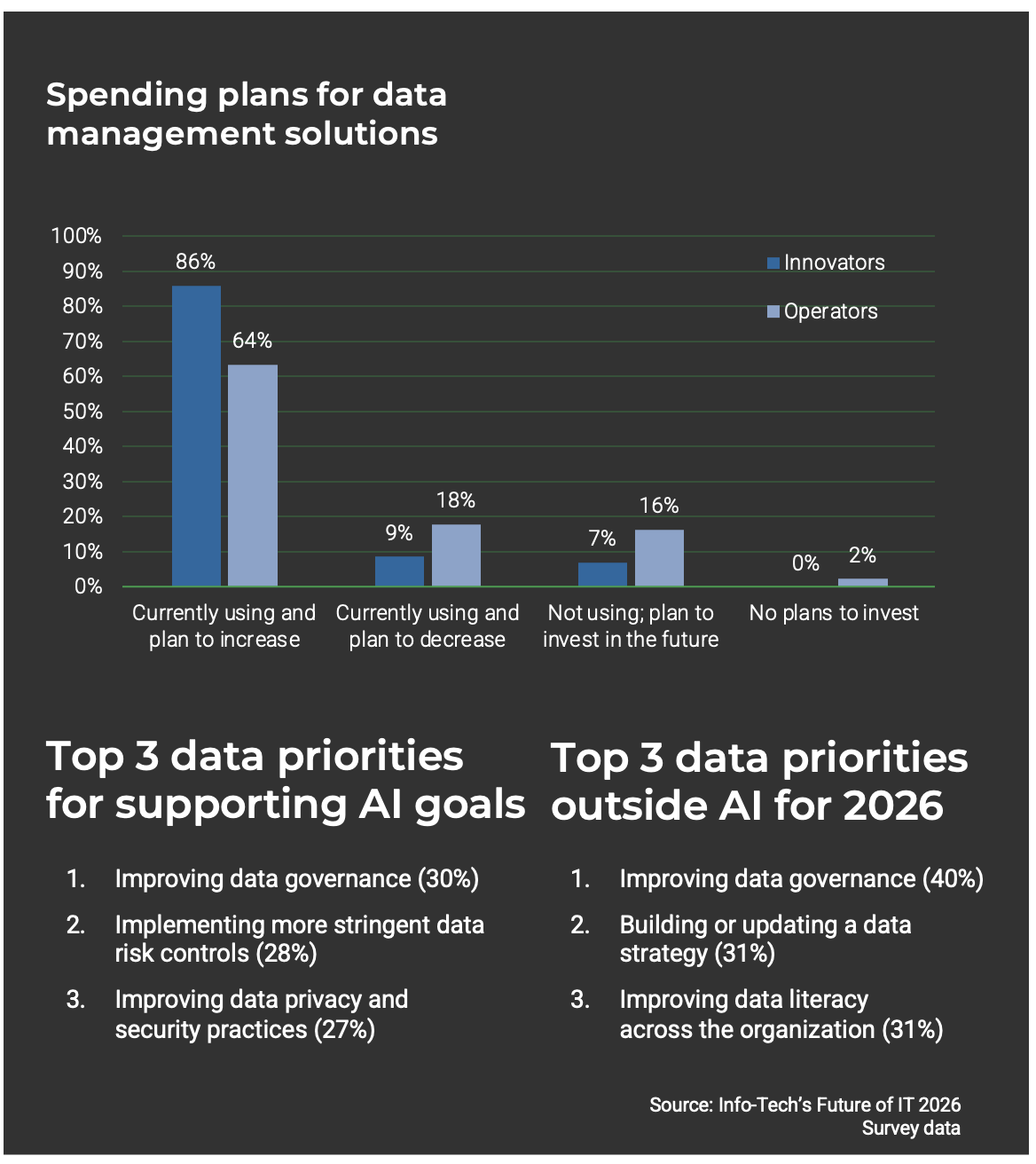
- Overall, 72.5% of organizations report that they are currently invested in data management solutions and plan to increase that investment.
- Applying a data management solution implies that an organization has sorted out its data governance program. Where data governance addresses the creation of guardrails and a decision-making framework, data management is the execution of those guidelines.
- Yet improving data governance is the top priority for organizations in 2026 – both when considering how to best support AI goals and considering data priorities outside of AI.
- Do not waste resources on misguided management solutions. Clarify your governance decisions first.
About Info-Tech
Info-Tech Research Group is the world’s fastest-growing information technology research and advisory company, proudly serving over 30,000 IT professionals.
We produce unbiased and highly relevant research to help CIOs and IT leaders make strategic, timely, and well-informed decisions. We partner closely with IT teams to provide everything they need, from actionable tools to analyst guidance, ensuring they deliver measurable results for their organizations.
What Is a Blueprint?
A blueprint is designed to be a roadmap, containing a methodology and the tools and templates you need to solve your IT problems.
Each blueprint can be accompanied by a Guided Implementation that provides you access to our world-class analysts to help you get through the project.
Need Extra Help?
Speak With An Analyst
Get the help you need in this 4-phase advisory process. You'll receive multiple touchpoints with our researchers, all included in your membership.
Guided Implementation 1: Define the Decisions You Need Your Organization to Make
- Call 1: Understand data governance drivers, goals, and objectives.
- Call 2: Establish principles, vision, mission, and purpose.
Guided Implementation 2: Define Your Decision-Making Framework
- Call 1: Document current structure and identify gaps.
- Call 2: Assign roles, responsibilities, and membership.
Guided Implementation 3: Establish Critical Guardrails
- Call 1: Create foundational policies and processes.
- Call 2: Identify metrics and document decisions yet to be made.
- Call 3: Finalize and confirm governance framework.
Guided Implementation 4: Activate Data Governance Within Your Organization
- Call 1: Prepare your initial governance meetings and communication deck.
- Call 2: Summarize results and plan next steps.
Contributors
- John Ladley, Principal, Sonrai Solutions LLC
- Jennifer Quick, Chief Legal Officer & Corporate Secretary, CannaPiece Corp
- Ishma Zahur, Executive Leader & Transformation Advisor
- Andrea McKinney, Chief Corporate Services & Technology Officer
- Liz Henderson, Board Advisor, Non-Executive Director, Speaker, Data Queen
- Frank Schellenbach, Director, Enterprise Data Governance
- Ayo Olayinka, President, Komayo Holdings LLC
- Rosy Lopez Gross, Senior Global Subsidiary Management, CSC
- Edison Pascascio, Director of Data Strategy, Utah Transit Authority
- Danny Buie, Vice President – IT Strategy & Data, Tyler Technologies, Inc.
 Establish an Analytics Operating Model
 Create and Manage Enterprise Data Models
 Build a Robust and Comprehensive Data Strategy
 Mandate Data Valuation Before It’s Mandated
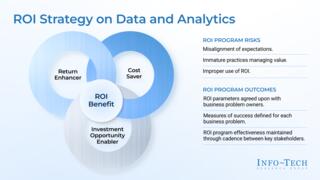 Position and Agree on ROI to Maximize the Impact of Data and Analytics
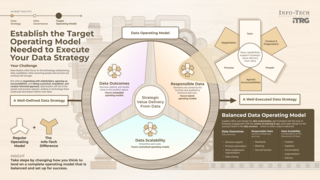 Establish the Target Operating Model Needed to Execute Your Data Strategy
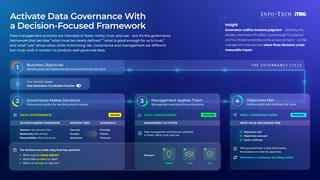 Activate Data Governance
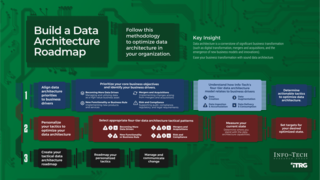 Build a Data Architecture Roadmap
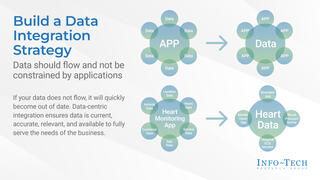 Build a Data Integration Strategy
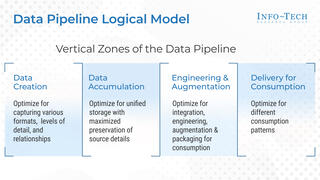 Build a Data Pipeline for Reporting and Analytics
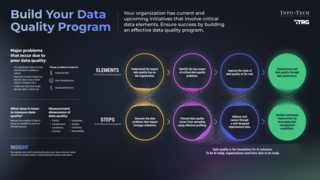 Build Your Data Quality Program
 Mitigate Machine Bias
 Design Data-as-a-Service
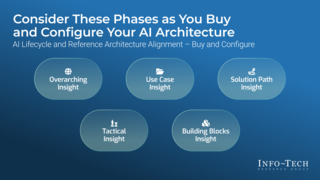 Define the Components of Your AI Architecture
 Get Started With Artificial Intelligence
 Go the Extra Mile With Blockchain
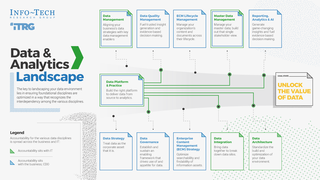 Understand the Data and Analytics Landscape
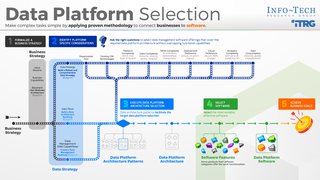 Select Your Data Platform
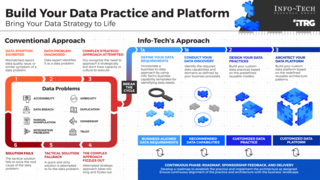 Build Your Data Practice and Platform
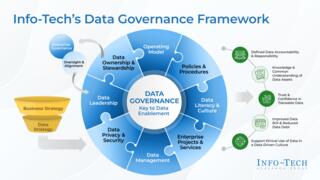 Establish Data Governance – APAC Edition
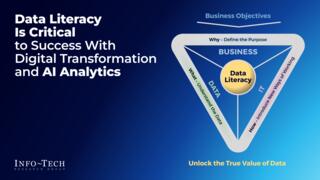 Foster Data-Driven Culture With Data Literacy
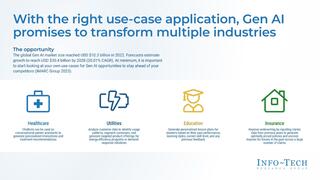 Generative AI: Market Primer
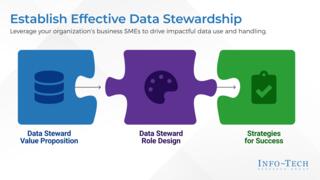 Establish Effective Data Stewardship
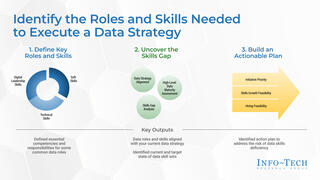 Identify and Build the Data & Analytics Skills Your Organization Needs
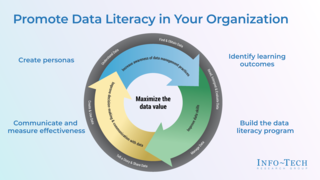 Promote Data Literacy in Your Organization
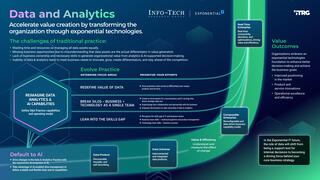 Define a Data Practice Strategy to Power an Autonomous Enterprise
 Fueling AI Greatness: The Critical Role of Data & AI Literacy
 Building the Road to Governing Digital Intelligence
 Map Your Data Journey
 Launch a Customer-Centric Data-as-a-Product Journey
 Data Priorities 2026
