VOL 3 JUNE 2026
INFO-TECH AI INSIGHTS
AI Transformation Brief
Featuring AI best practices and insights to enable our members to strategize, plan, develop, deploy, manage, and govern AI-based technologies and solutions.
In This Issue AI in the News | AI Research Highlights | Vendor Spotlight | Upcoming Events & Resources
AI IN THE NEWSThe geopolitical risks involving Anthropic’s Fable 5 and Mythos 5 rumors calling for a global pause on AI development not trueAnthropic Fable 5 bannedAnthropic announces Fable 5 and Mythos 5
Read the Anthropic paper – When AI builds itself
On June 16, 2026, during the G7 Summit, the US and Europe discussed access to AI models after the Anthropic dispute.
On June 12, 2026, The US government, citing national security concerns, issued an export control directive to suspend all access to Fable 5 and Mythos 5 by any foreign national.
On June 4, 2026, Anthropic released a paper that highlighted Claude now generates over 80% of the company's production code and has achieved a 52x speedup in optimizing its own training experiments, signaling the imminent arrival of autonomous recursive self-improvement (RSI).
ANALYST ANALYSIS
Following the US administration's export ban on Anthropic’s Mythos and Fable AI models, the US and Europe are discussing a "trusted partner" scheme to grant close allies privileged access to advanced AI tools.
The US issued an export ban based on a standard software flaw (a non-universal jailbreak). The abrupt nature of this order forced a global shutdown of the software to comply with the ban for all foreign national access. To restore order, it is recommended that blunt shutdowns should be replaced with sophisticated, precise, and identity-verified API routing, while relying on technical bodies like NIST to arbitrate true national security risks.
A few media outlets are largely responsible for suggesting that Anthropic's recent paper (When AI builds itself) on recursive self-improvement was promoting a global pause on AI development. This is simply not the case, and the Anthropic authors are well aware that the likelihood of any proposed global pause on AI development is slim to none.
OpenAI files paperwork for its IPO, AI model “thinking” repositioned, and Altman and other AI leaders reframe their predictions of AI
OpenAI IPOAI leaders dial back their dire predictions
OpenAI reframes AI model’s capabilities
On June 10, 2026, OpenAI reframed their user experience terminology to change its focus from “thinking” to “capabilities.”
On June 8, OpenAI officially submitted a confidential draft S-1 to the SEC, initiating the start for its public market debut.
On May 26, 2026, OpenAI CEO Sam Altman, alongside leaders from Nvidia and Anthropic, publicly walked back previous warnings of an imminent "jobs apocalypse," admitting that earlier human replacement intuitions were fundamentally off-base.
ANALYST ANALYSIS
By removing the thinking-based terms from OpenAI’s user experience, this demonstrates a maturing from experimental engineering jargon to intent-based software design. Reframing the user interface around explicit "capabilities" simplifies task delegation for nontechnical users.
Public markets will now rigorously assess whether a multi-billion-dollar annual compute run rate can successfully convert into sustainable quarterly enterprise profitability to justify its targeted multi-hundred-billion-dollar valuation.
Public market listings, rising backlash, and high hardware costs have forced a shift away from sci-fi doom narratives. Altman (and others) are now focused on more pragmatic workplace productivity issues.
#2
INFO-TECH AI INSIGHTS
AI Transformation Brief
AI IN THE NEWS
AWS Graviton5 now GA, Pinterest signs largest AWS deal in history, AWS and Snowflake partner to accelerate Agentic AI adoptionAWS Graviton5 CPU generally availableAmazon Snowflake Collaboration
On June 10, 2026, AWS announced the general availability (GA) of AWS Graviton5, a custom 3nm silicon architecture boasting a 25% compute performance uplift over Graviton4.
On June 10, 2026, AWS inked its largest infrastructure commitment in Pinterest’s history, a $4 billion multi-year cloud contract through 2031 to accelerate the social platform's visual search and ad-targeting AI roadmaps.
On May 27, 2026, AWS and Snowflake signed a $6B multi-year strategic collaboration agreement to accelerate enterprise agentic AI adoption.
ANALYST ANALYSIS
The general availability of AWS Graviton5 moves custom hyper-scaler silicon out of general-purpose compute and into highly intensive, low-latency AI inference workloads.
The landmark $4 billion deal with Pinterest signals an industry shift that major consumer tech platforms are moving away from costly x86-based infrastructure in favour of custom silicon options such as Tranium to reduce the cost-per-query of modern visual generative AI models.
The $6B collaboration between AWS and Snowflake benefits both parties. For Snowflake, it signals how they are repositioning themselves from a data platform to an agentic AI layer, capable of supporting the orchestration and execution of AI agents. As organizations leverage the Snowflake platform for agents, AWS will benefit from the deep integration from its infrastructure compute platform with Snowflake’s data and agent ecosystem.
Google announces Gemini 3.5 Flash, Spark, and Antigravity 2.0
Gemini 3.5On May 19, at I/O 2026, Google launched Gemini 3.5 Flash, frontier-intelligence model engineered for high-speed, long-horizon agentic workflows.
Also on May 19, at I/O 2026, Google introduced Gemini Spark, a persistent, 24/7 background personal agent running without requiring a laptop to stay open.
Lastly, at the May 19 I/O 2026 event, Google announced Antigravity 2.0, an overhaul of its agent-first development platform.
ANALYST ANALYSIS
Google repeatedly framed I/O 2026 as the beginning of the "agentic Gemini era." Gemini 3.5 Flash was introduced as a key component in Google’s plan to lead the agentic AI industry by embedding this model into Search, Gemini, Workspace, and AI agents. From a capability perspective, this model differentiates itself by enabling long-context reasoning at the same time, using less resources.
Google consistently describes Spark as being built on Gemini 3.5 and Antigravity and does not reference any connection with OpenClaw. However, most industry analysts, including myself, view this as their competitive offering to OpenClaw.
At I/O 2026, Google positioned Antigravity 2.0 as more than just a refresh of their agentic AI development tools, rather they are positioning Antigravity as a general-purpose agent runtime platform for all software.
Microsoft Work IQ APIs, the “MAI” Model Family, and Microsoft Scout
Microsoft MAI Model FamilyOn June 16, 2026, Microsoft announced the general availability of its Work IQ APIs, a new semantic layer for autonomous agents using Microsoft 365 data.
On June 2, at Build 2026, Microsoft released its MAI (Microsoft AI) model family – seven specialized multimodal models for reasoning, coding, image generation, transcription, and voice.
Also on June 2, at the Build 2026 conference, Microsoft launched Microsoft Scout, its version of OpenClaw, a personal AI agent.
ANALYST ANALYSIS
Microsoft’s Work IQ APIs transforms the developer surface by compressing complex workflows into a semantic context layer using model context protocols, cutting token use while letting agents safely store intermediate states within tenant boundaries.
The introduction of the MAI model family demonstrates that Microsoft desires to be recognized as an independent model builder like Anthropic and OpenAI. This represents the most significant AI model announcement since their investments with OpenAI.
Microsoft has announced that Scout is based on OpenClaw and operates as an always-on autonomous personal agent. Scout operates within the Microsoft ecosystem and can work across Outlook, Teams, SharePoint, OneDrive, calendars, and other Microsoft 365 resources in a safe and secure manner.
#3
INFO-TECH AI INSIGHTS
AI Transformation Brief
AI IN THE NEWS
Canada announces their sovereign “AI for All” strategyCanada’s National AI Strategy – AI for All
On June 4, 2026, Prime Minister of Canada Mark Carney, launched AI for All, Canada’s new national AI strategy. Over the next five years, this strategy will introduce new legislation, investments, and programs to govern the adoption of AI and direct its benefits to all Canadians.
ANALYST ANALYSISCanada has delivered a comprehensive national sovereign AI strategy that includes all critical success factors and the required future energy requirements to power Canada’s AI future.
Canada has a major adoption gap. Innovation has not yet translated into broad use. Statistics Canada reports that only 12% of Canadian businesses used AI to produce goods or services between mid-2024 and mid-2025. That number rises to 14.5% who say they are planning to do so by mid-2026.
Canada needs to accelerate the adoption and deployment of a sovereign AI on-premise platform and establish and socialize AI governance and AI risk management programs and standards for the safe deployment and use of AI applications. Also, Canada needs to accelerate the implementation of the AI literacy program to educate Canadians on the benefits and best practices for using AI.
UN Report – AI workloads will double to 40% of data center’s energy requirements by 2030 and will increase demands for water, land, and power
University Institute for Water, Environment, and Health (UNU INWEH) with funding assistance provided by Global Affairs Canada, released a landmark study, titled “Environmental Cost of AI’s Energy Use – Carbon, Water, and Land Footprints.”
At this point in time, the study finds that 16% of countries host AI-specialized cloud compute infrastructure and 90% of that capacity is concentrated in just two countries (the United States and China).
ANALYST ANALYSISFirst, I am a vocal advocate of AI and sustainability initiatives, having recently delivered a webinar on this topic. However, a couple of recommendations for future releases of these kinds of reports:
- The report asserts that “AI-related water consumption could equal the basic annual domestic needs of 1.3 billion people by the end of the decade.” Statements like this can be very misleading, since water consumption by itself is not a bad metric. If a data center uses non-consumptive withdrawal (i.e. water is not evaporated/consumed, but returned), the localized ecological impact can be negligible. Failing to classify the water consumption and not providing additional details can fuel the hype and overstate the impact.
- I agree the greater impact will be from inference workloads; however, there’s no mention of the impact of agentic AI workloads, instead the report attempts to use image and video generative workloads to forecast future compute demands. Overlooking agentic AI makes the report seem out-of-date and unaligned to the more important and cumulatively more demanding workloads.
Re-engineering and Agentic AI delivers 4.5-10x productivity for AWS
On June 10, 2026, AWS shared the experience of six senior engineers assigned to rebuild the Amazon Bedrock inference engine, a complex project originally estimated to require 30 developers working for 12 to 18 months. By shifting the original workflow into an agentic workflow, the entire project was completed and delivered in just 76 days.
ANALYST ANALYSISInstead of jumping straight into coding, the team spent their initial weeks restructuring their processes for AI – shifting to goal-driven outcomes, running multiple agents in parallel, and enabling autonomous AI workloads during off-hours.
After re-engineering the workflows to be autonomous, the continuous cycle of execution and self-correction during off hours enabled the small team to ship more high-quality code into production over a five-month span than they had collectively across previous projects over the last ten years.
#4
INFO-TECH AI INSIGHTS
AI Transformation Brief
AI RESEARCH HIGHLIGHTS
RESEARCH SPOTLIGHT:
Activate Data Governance With a Decision-Focused Framework
New!
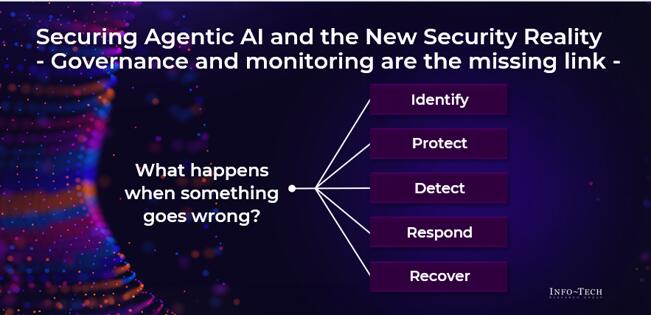
Source: Securing Agentic AI and the New Security Reality, LIVE Las Vegas 2026Info-Tech Research Group
VENDOR SPOTLIGHT:
- Acronis Brings Gen AI Visibility and Protection to the MSP Stack
- Microsoft Build 2026: What IT Leaders Need to Know
- Most Valuable Agentic AI Use Cases Highlighted at AWS Summit Toronto
- Zendesk Bets on AI That Solves, Not Just Deflects
- Cisco Makes Its Bid to Run the Agentic Enterprise at Cisco Live US 2026
UPCOMING AND RECENT EVENTS
LIVE Barcelona – Barcelona, Spain, September 22-23, 2026
LIVE Toronto – Toronto, Canada, November 10-12, 2026
LIVE Gold Coast – Brisbane, Australia, March 16-17, 2027
AI AND DATA ANALYTICS SOLUTIONS – RESOURCES
AI MarketplaceArtificial Intelligence Research Center
AI Workforce Development Program
- AI Strategy
- AI Governance, Liability & Risk
- Accelerate Adoption of Gen AI
- Drive Business Value With M365 Copilot
- Design Your Agentic AI Prototype
- Develop Your Agentic AI Prototype
- Scale and Optimize Your Agent Implementation
AI EDITOR-IN-CHIEF
Bill Wong – Info-Tech AI Research Fellow