The latest AI news from Anthropic, OpenAI, AWS, Google, Microsoft, Nvidia, Mistral, and Hugging Face and an AI customer reference from Merck and Moderna.
INFO-TECH AI INSIGHTS
AI Transformation Brief
VOL 3 | SEPT 2026
Featuring AI best practices and insights to enable our members to strategize, plan, develop, deploy, manage, and govern AI-based technologies and solutions.
In This Issue → AI in the News | AI Research Highlights | Vendor Spotlight | Upcoming Events & Resources
AI IN THE NEWS
Anthropic CEO calls for slowdown on AI development, publishes report on the misuse of Claude, and introduces Model Hardware Standard
Read Dario Amodei’s essay calling for an AI development slowdown | Report on the misuses of Claude | The Model Hardware Standard
|
On September 14, 2026, Anthropic's CEO called for a slowdown in frontier AI development. On September 11, 2026, Anthropic published a report on the misuse of Claude, detailing malicious operations disrupted between December 2025 and August 2026 across roughly 40 threat groups. On August 27, 2026, Anthropic introduced the Model Hardware Standard (MHS), an open, model-agnostic software framework. |
ANALYST ANALYSIS Anthropic’s threat report highlighted several examples of how threat actors are moving away from simple Q&A prompting toward autonomous execution and orchestration using multi-agent frameworks (such as Claude Code). The MHS framework enables AI agents to safely discover, integrate, and operate programmable physical lab and manufacturing equipment (such as robotic arms, microscopes, and liquid handlers). |
OpenAI solves complex mathematical problem using thousands of agents, announces GPT-6 Astra, and commits $1 billion to the Daybreak cybersecurity initiative
OpenAI solves complex mathematical problem with AI agents | GPT-6 Astra | $1B for Daybreak cybersecurity
|
On September 8, 2026, OpenAI solved the Navier-Stokes problem (an unsolved fluid-dynamics equation) using thousands of coordinated AI agents. On September 3, 2026, OpenAI announced GPT-6 Astra, their latest and most capable AI model. On September 3, 2026, OpenAI committed $1B to its Daybreak cybersecurity initiative, which enables verified public and private sector defenders to use advanced AI for authorized cyber defense. |
ANALYST ANALYSIS Astra represents OpenAI’s most capable model and can now operate computers end to end, meaning it can navigate software applications, fill out forms, browse the web, and execute long-horizon workflows autonomously. Access to Daybreak will help organizations review legacy code, analyze suspicious activity, identify and validate vulnerabilities, prioritize the most serious risks, and develop and test fixes. |
AWS announces partnership of $60B with Qualcomm to develop AI chips, its first Saudi Arabia cloud region, and 2 million GPU expansion with Nvidia
Qualcomm Partnership | First Saudi Arabia cloud region | GPU expansion with NVIDIA
|
On September 8, 2026, AWS partnered with Qualcomm on up to $60B of AI data center chips. On August 31, 2026, AWS announced its first Saudi Arabia cloud region, with a 50MW AI Zone commitment. On August 26, 2026, AWS expanded its partnership to Nvidia by committing to 2 million additional GPUs. |
ANALYST ANALYSIS AWS opened its first cloud region in Saudi Arabia, anchored by a dedicated 50 MW AI Zone built specifically to serve sovereign AI demand across the Gulf, extending its global infrastructure footprint into a fast-growing regional market. AWS also expanded its existing GPU partnership with Nvidia by 2 million units, extending what is already its largest single compute commitment and signaling that Nvidia hardware will remain central to AWS's AI buildout for years to come. |
Google commits AI infrastructure to Finland, announces AlphaGenome Atlas, and launches Gemini 3.8 Flash and Gemini 3.8 Flash Cyber
Google and Finland Partnership | AlphaGenome Atlas | Gemini 3.8 Flash and Gemini 3.8 Flash Cyber
|
On September 9, 2026, Google committed €13B (over $15B) to AI infrastructure in Finland. On September 8, 2026, Google announced the AlphaGenome Atlas, a database that predicts the effects of every possible single nucleotide variant in the human genome. On September 2, 2026, Google launched Gemini 3.8 Flash and Gemini 3.8 Flash Cyber optimized for agentic workflows and cybersecurity. |
ANALYST ANALYSIS Google introduced the AlphaGenome Atlas, a new tool built on DeepMind's genomics research that gives researchers access to large-scale genomic data alongside AI-driven analysis for the first time in a single named product. Google launched Gemini 3.8 Flash, positioned as its “workhorse” model, and a new Gemini 3.8 Flash Cyber, its most capable cybersecurity model, adding a faster general-purpose model alongside a dedicated security-focused version built specifically for vulnerability detection and threat analysis work. |
Microsoft announces HydraFusion and supports AI model orchestration, introduces MAI-Transcribe-2 AI model, and publishes its 2026 Responsible AI Transparency Report
Project HydraFusion | MAI-Transcribe-2 | Responsible AI Transparency Report
|
On September 4, 2026, Microsoft announced Project HydraFusion, bringing multi-model orchestration to GitHub Copilot. On September 3, 2026, Microsoft introduced MAI-Transcribe-2, its latest internally developed AI model. On September 1, 2026, Microsoft published its latest Responsible AI Transparency Report for 2026. |
ANALYST ANALYSIS MAI-Transcribe-2 is Microsoft’s latest internally developed AI model for transcription. The company will be positioning this as a solution that delivers faster, more accurate speech-to-text optimized for its ecosystem. The 2026 Responsible AI Transparency Report, its third annual report, provides insights into how Microsoft builds, tests, and governs its AI systems and the changes it made to address the new risks associated with AI. |
Nvidia acquires Hugging Face
|
On September 3, 2026, Nvidia acquired Hugging Face for $12.93B. Nvidia CEO Jensen Huang said: “Hugging Face will remain an open platform for the entire AI ecosystem. Developers will choose the models they want, the frameworks they want, the clouds and inference service providers they want and the computing platforms they want. NVIDIA compute will not be required to build on or deploy through Hugging Face.” |
ANALYST ANALYSIS Owning Hugging Face gives Nvidia visibility into which models and frameworks are gaining traction before its competitors do, intelligence that can be leveraged to guide its AI chip roadmap and CUDA ecosystem investments. Organizations building on Hugging Face’s hub will be watching closely for any pricing, access, or governance changes now that a hardware vendor, rather than a neutral platform, controls the software infrastructure much of the open-source AI community depends on. |
Mistral raises €3B to make sovereign, open-weight AI the technology frontier
|
On September 8, 2026, Mistral AI raised €3B at a ~$24B valuation. Funding was co-led by Samsung Electronics, the EU-backed Scaleup Europe Fund, and PSG Equity. This latest funding marks the largest single equity fundraising round for a European technology company in history. |
ANALYST ANALYSIS Under native EU governance, Mistral provides legal protection under GDPR regulations, shielding European companies from data access requests under the US CLOUD Act that applies to all AI models developed in the US. A significant portion of this €3 billion is being allocated directly to infrastructure. Mistral is transitioning into a “compute landlord,” investing in its own major data centers, such as an active 44MW facility near Paris and a €1.2 billion site under construction in Sweden, with a goal of building 1GW of European compute capacity by 2030. |
Moderna & Merck cancer vaccine success – personalized mRNA treatment worked in late-stage trial
|
On August 19, 2026, Moderna and Merck announced that their personalized mRNA cancer vaccine met the main goal of a large late-stage trial in melanoma. It was the first time an individualized mRNA neoantigen therapy cleared a Phase 3 trial. |
ANALYST ANALYSIS Machine learning algorithms were used to analyze raw genomic sequencing data to evaluate and identify up to 34 key targets most likely to trigger a strong immune response. |
AI RESEARCH HIGHLIGHTS
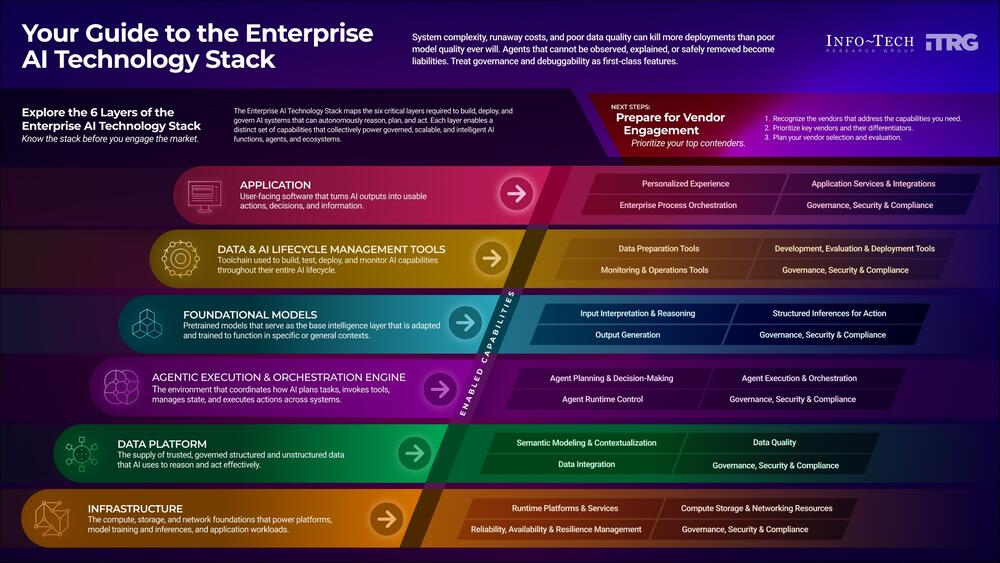
RESEARCH SPOTLIGHT: Discover the Enterprise AI Technology Stack
New!
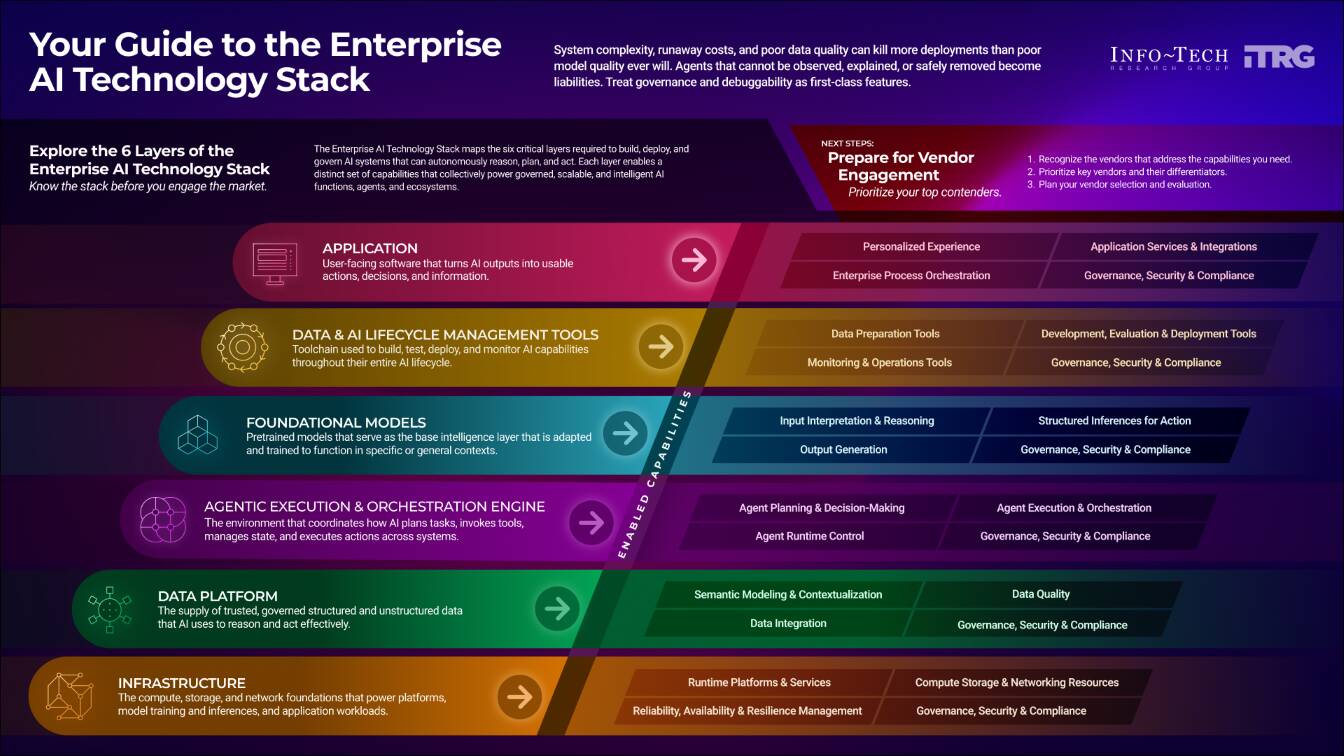
Discover the Enterprise AI Technology Stack
VENDOR SPOTLIGHT
- Overlapping AI Outages Expose an Enterprise Resilience Gap
- Esri: The Future of Analytics Is GIS
- Black Hat 2026 Trends – Security Buyers Want Proof, Not More Tools
- Veeam Adds 6 Hypervisors, Launches Cloud Archive Tier to Replace Tape
UPCOMING EVENTS
|
Info-Tech LIVE Event Registration LIVE Barcelona – Barcelona, September 22-23, 2026 |
Info-Tech IGNITE Event Registration IGNITE Washington, DC – Washinton, DC, October 1-2, 2026 |
AI AND DATA ANALYTICS RESOURCES
|
AI Strategy |
|
|
AI EDITOR-IN-CHIEF Bill Wong – Info-Tech AI Research Fellow |