Teradata Moves From AgentStack to Autonomous Knowledge Platform
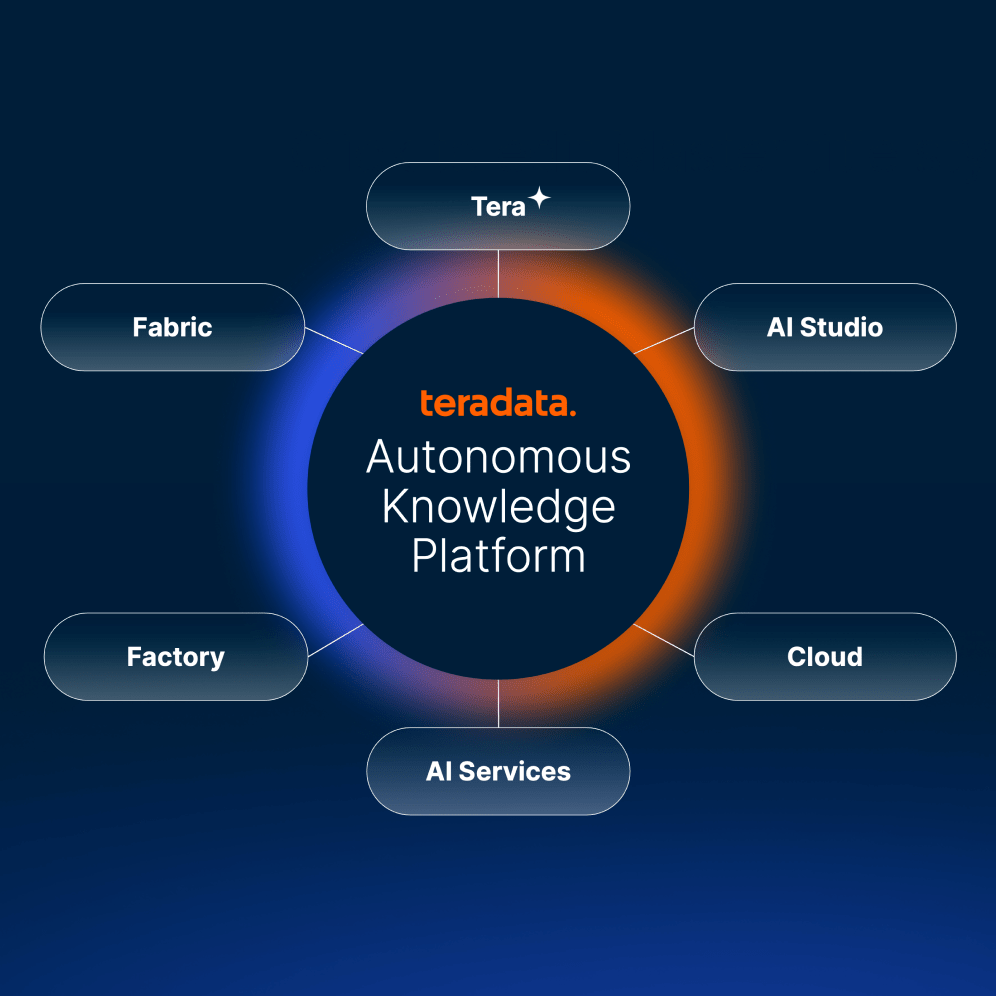
Image source: Teradata
Teradata has made two significant announcements in the first half of 2026 that together reveal a coherent, if ambitious, strategy to reposition itself as the infrastructure layer for enterprise agentic AI. In January, the company unveiled Enterprise AgentStack, a toolkit for building, deploying, and managing AI agents. In May, it followed with the Autonomous Knowledge Platform, a flagship product that consolidates its Data and Agentic AI capabilities into a unified system spanning cloud, on-premises, and hybrid environments. Neither announcement is a standalone product pivot; they are sequential chapters in the same story.
This trajectory is consistent with what the rest of the market is doing. Snowflake expanded Snowflake Intelligence and Cortex Code as its control plane for the agentic enterprise. ServiceNow and Salesforce are actively building their agentic AI platforms via acquisitions and in-house development. Microsoft built its IQ layer and AI Foundry on top of it. Teradata’s two-step approach – build the agent lifecycle tooling first, then unify it under a knowledge-grounded platform – is a structurally reasonable sequence, though the execution timeline introduces risk.
What Teradata Actually Announced
Enterprise AgentStack, launched in January, introduced four components: AgentBuilder for creating agents (supporting both no-code frameworks like Karini AI and pro-code options like LangGraph and CrewAI), Enterprise MCP for secure data discovery and integration using the Model Context Protocol standard, AgentEngine as the Kubernetes/Docker-based runtime for deploying agents in production, and AgentOps for centralized monitoring, governance, policy enforcement, and human-in-the-loop controls. Prebuilt agents for use cases like customer lifetime value analysis and SQL optimization were included out of the box.
The Autonomous Knowledge Platform, announced in May, absorbs those capabilities and raises the ambition considerably. The new additions include Teradata AI Studio, a unified environment for the full AI lifecycle from data to models to agents, and Tera, a natural language workspace that gives business users, data teams, and developers a common interface grounded in governed enterprise context. Tera includes three modes: Tera Analyze for data analysis, Tera Code for development, and Tera Claw for multi-agent orchestration (the last arriving in research preview by year-end). A new suite of platform automation agents – Sizing, Telemetry, FinOps, Tuning, and Compute – handles infrastructure self-management. On the infrastructure side, Teradata Cloud now pairs always-on Active Compute with on-demand Elastic Compute, and a Connected Data Foundation adds open table format support for Apache Iceberg and Delta Lake. Teradata Factory extends the platform on premises via a Dell PowerEdge and Nvidia AI Enterprise integration for organizations with strict data residency requirements.
Where Teradata Sits in the Competitive Field
The central strategic bet across both announcements is the Knowledge Graph, Teradata's mechanism for encoding industry-specific semantics, data lineage, and business context so that AI agents have more than raw data to reason from. This is the right problem to solve. As we noted in earlier publications, most agentic platforms keep common semantics inside database models and code, which limits how well agents can generalize across enterprise contexts. Teradata's Knowledge Graph approach puts it in the same camp as ServiceNow (data.world's ontology and knowledge graph), Salesforce (Informatica's knowledge graph), and Microsoft's IQ layer.
The Enterprise MCP component from AgentStack is worth noting separately. Model Context Protocol (MCP) is an open standard for connecting AI models to enterprise data, and Teradata building an enterprise-grade MCP implementation – with security, metadata discovery, semantic search, and SQL generation – is the foundation for further platform scalability and interoperability with other systems.
The hybrid deployment angle is Teradata's most distinctive differentiator against cloud-native competitors. Snowflake, Databricks, and most other agentic AI platforms are cloud-first with on-premises as an edge case. Teradata Factory runs AI where the data lives, with NVIDIA compute. This directly addresses regulated industries where cloud residency is not an option. The caveat is timing: Factory availability is "later this year," and Tera Claw is research preview only. When the platform will become production-ready remains unclear.
Our Take
Together, Enterprise AgentStack and the Autonomous Knowledge Platform represent the most complete agentic AI roadmap Teradata has produced, and the hybrid deployment story is genuinely differentiated in a market that has largely written off on-premises as legacy. For existing Teradata customers, the pitch is compelling: mission-critical data is already there, agents can act on it without replatforming, and governance is embedded across the stack by design.
Buyers evaluating Teradata should pressure-test three things:
- Knowledge Graph substance vs. positioning. The competitive differentiation Teradata claims rests heavily on the depth and quality of its industry-specific Knowledge Graph. Prebuilt industry models, semantic lineage, and domain frameworks are only an advantage if they map meaningfully to the buyer's actual data and business logic. Request a proof of concept scoped to your industry before treating this as a given.
- The availability calendar is not the delivery calendar. Teradata Cloud (Q3 2026), Teradata Factory (later in 2026), and Tera Claw multi-agent orchestration (research preview, year-end) are on different timelines. Organizations with near-term agentic AI mandates should build their plans around what is shipped, not what is announced.
- Business control of agent behavior, not just monitoring. AgentOps handles governance well on the observability and compliance side, with audit trails, policy enforcement, and human-in-the-loop checkpoints. The harder question, which no vendor has fully answered yet, is whether business owners (not engineers) can define agent behavior, guardrails, and conflict resolution rules declaratively. Teradata's current tooling still leans toward developer configuration. That gap matters as agent deployments scale beyond the teams that built them.
The partner integrations – Karini AI, Pinecone, Unstructured, WisdomAI – are sensible additions that extend coverage without Teradata having to build everything. Whether they are genuinely deep integrations or surface-level connectors is worth verifying in any proof of concept. For net-new evaluators, the competitive field is crowded and Teradata's sales motion will need to demonstrate the Knowledge Graph advantage practically, not just conceptually.
