A Closer Look at Google's Agentic Data Cloud Enhancements in H1-2026
Info-Tech has already provided a brief summary of updates to Agentic Data Cloud announced by Google in April 2026. Here’s a closer look at some of the updates important from the perspective of Data and Analytics.
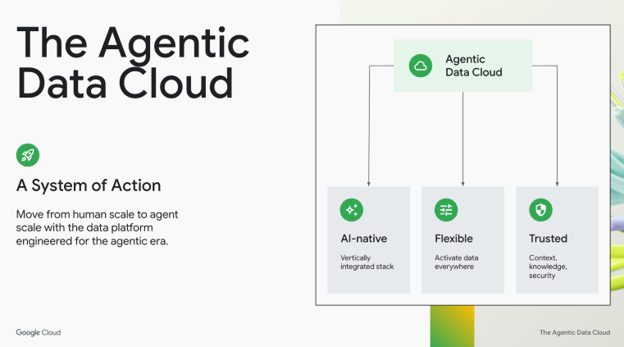
Image source: Google
Knowledge Catalog (KC): An evolution of Dataplex Universal Catalog that maps and infers business meaning across the entire enterprise data estate via aggregation, continuous enrichment, and search.
- Aggregation (mostly in GA): KC collects technical metadata from the foundational systems, including BigQuery, AlloyDB, Spanner, Cloud SQL, Firestore (preview), and Looker (preview). It also supports integrations with third-party catalogs like Atlan, Collibra, Datahub, Ab Initio, and Anomalo.
- Third-Party Application Visibility (preview): KC shall get visibility into applications, operating systems, and AI platforms, including Palantir, Salesforce Data360, SAP, ServiceNow, and Workday.
- Unified BigQuery measures and LookML semantic foundation (preview): KC shall pull BigQuery measures and LookML together into a single, governed semantic foundation.
- Enrichment (preview): KC provides continuous data enrichment via mining structured schemas, query logs, and BI semantic models and extracting entity relationships from unstructured data with the help of Gemini.
- Search (GA): KC provides high-precision semantic search using Google’s hybrid search stack. Built on the same advanced query-rewriting and machine-learning technologies that power Google Search, it evaluates a prompt and instantly ranks and returns the right context to agents in real-time. The global search respects metadata access permissions as defined in the source systems, ensuring agents can only retrieve and act on the assets they are explicitly authorized to see.
The Knowledge Catalog powers the Deep Research Agent (preview) available in Gemini Enterprise. This agent can perform multistep reasoning across Google Cloud data platforms, internal documents, and web assets to answer complex questions with citations and precision.
Cross-Cloud Lakehouse: Fully managed Iceberg storage providing open-source flexibility plus performance, scale, governance, and multimodal processing.
Key Capabilities
- Zero-Copy Architecture: Data stored in Amazon S3 or Azure can be directly queried from Google Cloud without building complex ETL pipelines.
- AI-Native Context: Gemini-powered tools and autonomous agents can be applied to your remote data for closed-loop, cross-cloud reasoning.
- Unified Governance and Metadata: The architecture uses remote Apache Iceberg REST catalogs to discover and synchronize metadata instantly.
- Performance and Cost Optimization: Uses specialized, localized caching on Google Cloud storage for subsequent queries, cutting down egress charges and network latency.
BigQuery enhancements: Reverse ETL for BigQuery, BigQuery Graph, BigQuery fluid scaling, ObjectRef (processing unstructured data alongside structured via SQL/Python), and Conversational Analytics in BigQuery.
- Reverse ETL for BigQuery: Instant sync back to production apps, i.e. insights generated in BigQuery can now flow directly into AlloyDB or Spanner (the databases powering live applications) with one click, so customer-facing systems can act on analytics in near real-time, not next-day.
- BigQuery Graph: A new graph capability lets BigQuery map how entities relate to each other (customers, products, transactions), giving AI agents the context to reason across connections rather than isolated data points.
- BigQuery fluid scaling: Pay only for what you use, to the second; compute now scales automatically and bills per second, cutting the cost of over-provisioning for unpredictable workloads.
- ObjectRef: One platform for structured and unstructured data, i.e. documents, images, and other unstructured content can now be queried alongside traditional tables using standard SQL or Python, removing the need for separate pipelines.
- Conversational Analytics in BigQuery: Conversational Analytics feature lets business teams ask questions about their data in plain English instead of writing queries. It's built with governance in mind – the answers are auditable and traceable back to the underlying data – and goes beyond simple Q&A to support predictive insights and reasoning that spans both structured data (like sales tables) and unstructured data (like documents or support tickets).
Our Take
1. The maturity inside Knowledge Catalog varies across its main components. Aggregation and Search are genuinely GA, but Enrichment (the part doing the actual semantic heavy lifting) is still in Preview, as is the Third-Party Application Visibility (Palantir, SAP, ServiceNow, Workday) and the unified BigQuery measures and LookML semantic foundation. For a CIO evaluating this today, the practically available capability is "smarter, governed, hybrid-search metadata catalog with permission-aware retrieval,” while the "understands your business semantics end-to-end" story is still six to twelve months from GA maturity.
2. Reverse ETL for BigQuery is a near-real-time mirroring, not an LTAP claim. Google isn't claiming single-engine convergence here; it's explicitly a one-way sync from the analytical engine (BigQuery) back into operational stores (AlloyDB, Spanner). This fits the broader industry pattern of vendors linking analytical and transactional data stores, though Google's approach keeps the two systems separate and copies data between them, rather than merging them into one engine.
3. The Cross-Cloud Lakehouse confirms the Iceberg format war is over – and reframes the real fight as catalog interoperability. Google isn't pushing a proprietary table format; it's building zero-copy access on remote Apache Iceberg REST catalogs against data sitting in S3 or Azure. That's a "connect to your catalog, wherever it lives" posture – clear evidence that governance-layer strategy (whose catalog wins default authority) is the 2026 battleground, not table-format lock-in.
4. Knowledge Catalog's third-party catalog integrations (Atlan, Collibra, Datahub, Ab Initio, Anomalo) signal a "meta-catalog" strategy, not a rip-and-replace one. This approach lowers switching friction for enterprises already invested in incumbent governance tooling, but it also means the actual system of record for governance may still sit outside Google's stack, i.e. do not assume that Knowledge Catalog becomes the enterprise's single source of semantic truth – it's additive, not (yet) authoritative.
5. ObjectRef and Conversational Analytics are commoditization signals, not differentiators. Multimodal SQL-plus-Python querying and natural-language BI are both becoming table-stakes features across Snowflake, Databricks, and Fabric roughly simultaneously. The interesting story is that the "assembly tax" of stitching together separate vector/NL/multimodal tools keeps shrinking industry-wide, which changes the buying calculus for anyone still evaluating best-of-breed stacks.
6. BigQuery Graph is Google's answer to the ontology/knowledge-graph land grab – the same competitive space Fabric IQ's Ontology and ADK-driven reasoning occupy, and where Palantir has a multiyear head start. Google's move keeps graph reasoning inside the warehouse rather than requiring a separate graph database, which is architecturally tidy, but it's in Preview and would be worth checking back on query-language maturity or interop with GQL/openCypher standards before treating it as competitive with Fabric IQ Ontologies.
7. Fluid scaling is parity, not leadership. Per-second serverless billing has been available from Snowflake and Databricks for a while; Google closing that gap removes a cost objection but isn't a wedge feature.
