Cognigy Now Central to NiCE’s Agentic Operating Model
Last year, at NiCE’s 2025 Analyst Summit, the wheels were in motion for the future of customer experience. NiCE outlined its foundation for end-to-end CX orchestration, highlighting the growing importance of data integrity and governance as organizations prepare to manage AI agents at enterprise scale. Moreover, Cognigy, a German-based conversational AI platform, had just been acquired by NiCE.
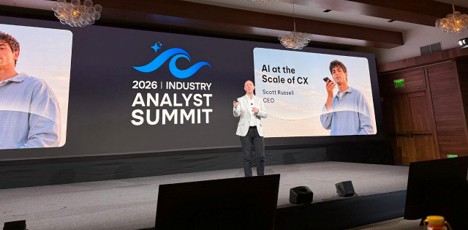
2026’s Analyst Summit demonstrated the fruits of this labor. Cognigy is now central to CXone’s agentic operating model, CX orchestration is leaving the traditional CCaaS category behind, and agentic AI is causing buyer personas to shift from CX leaders to the broader executive team (CEOs, COOs, CIOs, and leads for enterprise architecture, data, and AI). While NiCE announced agent generation and testing advances at Nexus in March, and the Agentic Engagement Plane and Guardian AI at NiCE World in June, the 2026 Analyst Summit demonstrated how these developments fit together.
This note examines how Cognigy is reshaping NiCE’s platform and development roadmap, why personal AI agents introduce new orchestration requirements, and what the expanding scope means for enterprise buyers evaluating NiCE beyond traditional CCaaS capabilities.
Cognigy Provides the Agentic Core With Two Deployment Paths
NiCE framed its go-to-market strategy around a single agentic core, NiCE Cognigy, with two ways to adopt the solution:
- Keep your stack, add the agentic core: Organizations retain their existing CCaaS and add Conigy’s agentic capabilities on top. This strategy is not new; NiCE stated last year that Cognigy could remain standalone.
- One operating model: Organizations adopt CXone and Cognigy as an integrated platform.
NiCE described their platform as a feedback loop that improves itself: tools that analyze interaction data to find automation opportunities and generate agents for them. Three components make up the platform’s coordination and control plane:
- Agentic Engagement Plane: the orchestration layer that authenticates, mediates, routes, and governs engagement among customers, employees, personal AI agents, enterprise AI agents, and third-party systems. In essence, the Agentic Engagement Plane coordinates humans and AI working on the same platform.
- Guardian AI: monitors AI and human actions in real time and applies compliance guardrails. NiCE emphasized one standard of accountability for human and AI agents, with Guardian AI able to intervene in AI-driven engagement.
- Experience Memory: maintains customer context across the ongoing journey.
NiCE also highlighted a voice-to-voice capability built on GPT-Live-1, in which the AI agent reasons and talks at the same time. For example, the AI agent now keeps the conversation going while it retrieves information instead of pausing.
Congigy and agent building is so central to the NiCE platform that we can soon expect the user interface to be organized around AI agents. This will be coupled with handheld, nontechnical guidance for quickly getting relevant agents up and running, alongside assisting with these agents’ lifecycles. These developments directly pertain to addressing adoption barriers for agent creation and maintenance.
NiCE’s demonstration of a refund AI agent showed how the pieces connect. The automated agent builder learns the refund process; then, the generated AI agent shows what it has learned, the steps it is assembling, and where it sourced them. Guardian AI then runs evaluation and simulation of the AI agent. The AI agent is first deployed alongside humans, and a supervisor approves it before it goes live. Finally, workforce forecasting registers the new AI agent and proactively recommends staffing changes.
That last step is telling when we think about the future of work in CX. Deploying an AI agent automatically updates the staffing forecast, and in this example the forecast implied fewer human agents or less seasonal hiring required. NiCE does not frame this as workforce reduction, but the direction is clear: CIOs and COOs should treat AI deployment and workforce planning as one decision, not two.
The Rise of Personal AI Agents
NiCE argued that personal AI agents (it cited products such as Muse, Grok Bot, Instinct, Perplexity Comet, and OpenAI Dots) will multiply interaction demand. Because these agents are persistent and tireless, consumers will effectively own their journeys, and volume will rise. In NiCE’s view, this new reality favors full CX orchestration platforms over point automations of single tasks.
With this context, NiCE highlighted its involvement in the emerging Personal Agent Protocol (PAP) initiative. Announced by Meta and Sierra with industry partners, the protocol addresses how personal agents discover businesses, authenticate customers, and operate within permissions through websites, APIs, or company agents. The initiative has now produced a public draft. PAP remains an emerging specification rather than an established interoperability standard. However, NiCE is demonstrating market leadership by being among the inaugural partners.
CIOs (Explicitly) Become the Buyer
CIOs, COOs, enterprise architects, and data and AI teams have long influenced contact center investments. NiCE’s ambition to become an Enterprise CX AI Platform has finally made the role of technology and operations leaders explicit in the buying proposition.
This broader buying group reflects the authority that NiCE’s CX AI platform demands. An AI agent that issues a refund needs access to customer records, eligibility rules, and transaction systems. Its actions affect financial controls and operational processes beyond the contact center. The resulting challenge is architectural coordination, given CRM, service management, and enterprise AI platforms may already orchestrate parts of the same customer journey. Organizations must decide which platform maintains context, applies business rules, executes transactions, and records the outcome.
To come full circle, NiCE’s two deployment paths for Cognigy provide that necessary flexibility. Organizations can evaluate Cognigy against a defined automation need while retaining their existing CCaaS, or assess the broader value of an integrated CXone operating model.
Our Take
NiCE’s 2026 Analyst Summit demonstrated once more that NiCE remains a market leader in CX technology. Moreover, we cannot understate how important Cognigy will be for NiCE to maintain its acceleration. Cognigy is becoming integral to how NiCE connects interaction intelligence, automation, governance, and workforce operations.
CCaaS remains a useful procurement category for telephony, routing, channels, workforce capabilities, and contact center reliability. However, the category of CCaaS is increasingly insufficient to describe NiCE’s full value proposition. For instance, NiCE Cognigy’s two deployment paths make this distinction explicit: Customers can buy agentic capabilities while retaining another third-party CCaaS platform. That supports treating contact center infrastructure and agentic orchestration as related purchasing decisions with potentially different suppliers. CCaaS is becoming one component of a broader CX architecture, and these boundaries are becoming less useful for evaluating enterprise automation decisions.
After all, CCaaS providers increasingly compete with conversational AI specialists, CRM vendors, and enterprise automation platforms for responsibility over customer workflows. These vendors approach the opportunity from different starting points: managing interactions, maintaining customer records, or executing business processes. Their offerings may overlap without being interchangeable. For buyers, the starting point should be the customer outcome and the work required to achieve it. An organization seeking better routing and workforce management faces a different purchasing decision from one seeking to automate refunds across customer service, order management, and payment systems. The latter requires evaluation across traditional software categories, with clear decisions about which platform coordinates the workflow and which systems retain authority over individual actions.
NiCE’s integrated proposition is compelling: Shared interaction data, agent capabilities, and workforce operations reduce the effort required to automate and improve service. Its standalone Cognigy path offers an alternative for organizations where replacing their underlying contact center would add unnecessary cost or disruption. Buyers should compare these two approaches through a single end-to-end use case, measuring integration effort, operational ownership, and total cost per successfully resolved issue. The strategic question is how much responsibility to give NiCE within the broader CX architecture and whether that responsibility produces measurable advantages over the alternatives.
Market convergence will test NiCE’s commitment to focus. As CEO Scott Russell clarified at the summit, NiCE does not intend to become a CRM vendor; its strategy depends on depth in customer engagement and interoperability with adjacent systems. That focus is a strength, although competitors are expanding into the same territory. Genesys is advancing enterprise agentic orchestration, while Salesforce’s announced agreement to acquire Cresta would bring voice agents, conversation intelligence, and agent assistance closer to the CRM. NiCE’s opportunity is to demonstrate that specialized CX capabilities deliver better resolution across enterprise systems than buyers could achieve through their existing CRM platform.
