Our systems detected an issue with your IP. If you think this is an error please submit your concerns via our contact form.
Streamline Security Detection & Response Outsourcing
Cut through vendor noise during MDR selection by focusing on outcomes, capabilities, and requirements.
AI-enabled attacks are rising, but economic uncertainty has tightened the supply of cybersecurity talent, budget, and resources that CISOs need to fight them. In this challenging environment, many organizations are outsourcing key security services to managed detection and response (MDR) providers. But the complexity of procurement can consume more time and bandwidth than many organizations can afford today. Use our four-phase methodology and practical supporting tools to craft a streamlined, disciplined MDR procurement process upfront – and avoid months of frustration down the road.
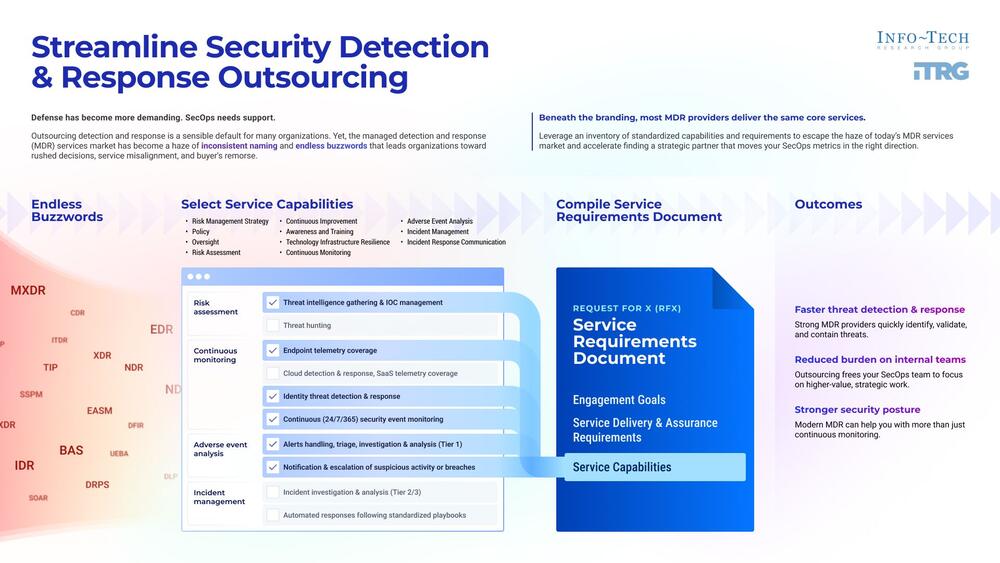
Beyond the branding, buzzwords, and acronyms used by MDR providers, most deliver the same core services. Cut through the vendor marketing hype by leveraging an inventory of standardized capabilities and requirements. Rather than rushing into a contract you’ll regret, focus on strategic discussions to find a provider – whether that’s a managed service provider (MSP), managed security service provider (MSSP), or MDR specialist – that will meet your baseline needs, align with your vision, and commit to being an accountable partner.
1. MDR procurement is a consolidation opportunity.
Modern MDR providers deliver services beyond basic threat detection and response that may overlap with existing capabilities in your vendor environment. Leverage MDR procurement as a strategic opportunity to consolidate security vendor sprawl.
2. Communicate your desired outcomes early.
Service providers should be judged primarily on their ability to deliver measurable outcomes, not on their specific tools or methods. Include desired outcomes in your service requirements early so providers can understand your expectations and demonstrate how their offerings align with your needs.
3. Precise requirements will simplify the evaluation process.
Make sure your requirements are as clear, detailed, and specific as possible. This helps to cut through vendor marketing noise, makes vendor comparisons easier, and streamlines the entire process of evaluating providers.
4. Consider potential trade-offs when choosing an MDR technology model.
Some MDR providers may only allow you to use their tools, resulting in rip-and-replace costs and integration issues for your organization. Although other providers may take a hybrid approach that permits you to use some of your existing tools, this may limit the amount of responsibility and risk you can offload to the provider. Consider these technology implications carefully.
Use this step-by-step blueprint to reduce the effort and complexity of MDR procurement.
Our framework offers a detailed roadmap to create an MDR procurement process that is both efficient and effective. Use our methodology and actionable tools to:
- Prepare: Start by defining service scope and documenting your internal environment.
- Set outcomes: Select engagement goals and metrics, then outline goals, KPIs, and service level requirements (SLRs).
- Procure: Define service requirements, compile a service requirements document, and evaluate, select, and negotiate with providers.
- Implement & Govern: Implement and deploy your selected MDR solution, then govern and manage provider performance.
Research & Tools
1. Streamline Security Detection & Response Outsourcing Storyboard – A comprehensive PowerPoint deck that maps out a new approach to MDR procurement, from selecting service requirements through choosing a provider and governing their performance.
This storyboard shows you how to:
- Start with a standard capability inventory to quickly define your requirements.
- Use a structured set of factors to filter the market and accelerate shortlisting by focusing on vendors aligned to your size, industry, and preferred service model.
- Define goals and metrics early, then use them to continuously govern providers and ensure ongoing alignment and value.
2. MDR Service Design Tool – An Excel template to define what you want in an MDR provider and clearly communicate those specific needs and requirements to one or multiple providers.
This tool helps you:
- Define desired responsibilities, goals, alignment factors, and capabilities in an MDR provider.
- Generate fit-for-purpose service requirements.
- Select engagement metrics to hold an MDR provider accountable.
3. MDR Service Requirements Template – A Word document that communicates the information in the MDR Service Design Tool in a non-Excel format. Share it with vendors so they understand your MDR requirements.
This template helps you collect information from MDR vendors about:
- How they would support your organization in achieving your goals for MDR service and improving your internal KPIs.
- Whether they can meet your specific SLRs.
- How well they can meet your requirements for service delivery and service capabilities.
4. MDR Vendor Evaluation Workbook – An Excel template that supports informed provider selection by comparing responses from various MDR vendors in a quantitative method.
This workbook allows you to:
- Assign a score to each vendor based on their responses in different categories.
- Assign higher or lower importance to certain categories of questions.
- Compare vendors against each other based on their scores in every category.