
Negotiate Safe AI Contracts to Prevent Bill Shock
Case studies in caution: Don’t sign AI consumption contracts you don’t understand.
Agentic AI is shifting enterprise software costs from human seats to machine-driven execution that can turn routine AI usage into multi-million-dollar overages. In this new economic model, vendors define the billable events, control the meters, and reserve the right to change the pricing logic mid-cycle. Use this structured framework to establish your agentic financial governance before signing AI contracts that leave you open to unexpected costs and limited recourse.
Many organizations are entering AI agreements without the legal, procurement, or technical resources to pressure-test billing rules, usage assumptions, and cost exposure before signing. FinOps can monitor and optimize usage after deployment, but it cannot fix contract terms that were never defined clearly in the first place. CIOs, procurement, legal, and finance teams must understand the economic architecture of agentic AI before they commit.
1. Govern the economics of autonomous execution.
Most procurement and budgeting practices were built for headcount pricing and quietly underestimate the bill. With agentic AI, you pay for what the software does, not how many people use it. Build controls for machine-driven tasks, recursion, and model selection from the start, so spend stays tied to business value.
2. Agentic pricing complexity is a risk multiplier.
When billing rules are vague or live in vendor-controlled documentation, the vendor decides what they mean. Before signing, negotiate billing definitions, tier triggers, fair-use thresholds, pricing-change protections, and dispute mechanisms – while you still have leverage.
3. Forecasting is a pre-signing discipline.
If normal and worst-case consumption cannot be modeled in advance, you are agreeing to whatever the bill becomes. Simulate usage before deployment and negotiate protections against tier moves, pricing changes, and shifting billing definitions.
Use this framework to mitigate risk in your AI contracts.
Move from reactive billing shock to structured AI financial governance. This research includes a four-phase framework, cautionary case studies, contract language guidance, governance RACI, dispute playbook, and a comprehensive contract risk workbook to help identify hidden cost drivers, assess contractual exposure, and negotiate stronger protections before deployment.
- Understand how you are billed. Decode the pricing model, hidden cost drivers, and vendor logic that determine the invoice.
- Assess contract exposure. Pressure-test billing definitions, recursion treatment, audit rights, dispute paths, and lock-in risk.
- Design financial guardrails. Run forecast simulations, set thresholds, throttles, and kill switches, and assign ownership across business, legal, procurement, finance, FinOps, security, and architecture.
- Establish ongoing market intelligence. Track vendor change logs, new case studies, and quarterly pricing-risk updates as models, meters, and tiers evolve.
Negotiate Safe AI Contracts to Prevent Bill Shock
Don’t sign AI consumption contracts you don’t understand.
EXECUTIVE BRIEF
Analyst Perspective
A new economic model for enterprise software, not just a new feature layer.

Vendors are moving you from predictable seats to consumption-based meters they define and control. Billable events now include task completions, tool calls, retries, and tier escalations – units you can't forecast and can’t audit. The rate cards, stable units, and reconciliation methods procurement has relied on for two decades no longer hold.
This is a structural risk, not an operational one. The vendor sets the billable event, owns the meter, and can change pricing logic faster than your contract cycle allows you to respond. Once workflows are embedded and switching cost is high, leverage to renegotiate is gone.
FinOps cannot rewrite ambiguous terms. Clear definitions, consumption caps, audit rights, pricing-change protections, and dispute mechanisms must be negotiated pre-signing and built into the system design, before you’ve scaled and lost leverage.
John Donovan
Principal Research Director, I&O
Info-Tech Research Group
Executive summary
Your Challenge |
Common Obstacles |
Info-Tech’s Approach |
|---|---|---|
Organizations are being asked to approve agentic AI platforms where spend is no longer tied to predictable seats but to autonomous execution (tokens, tasks, tool calls, retries, model-tier escalation). This means a “small” workflow change can create nonlinear consumption, invoice shock, and limited recourse, especially when billing definitions are ambiguous, metering is vendor-controlled, and pricing logic can evolve faster than your contract cycle. |
Forecasting is unreliable because “usage” is not a stable unit (a task isn’t atomic and can include sub-calls and loops).
|
Info-Tech looks at this as an economic architecture and governance problem, not a tooling issue. Using a four-phase framework:
|
Info-Tech Insight
Agentic AI shifts software economics from human seats to autonomous execution. When billing scales with machine-driven tasks, recursion, and model selection, governance must evolve from per-user controls to architectural and contractual guardrails.
AI cost management is failing
Unexpected AI charges |
Forecasting AI costs is broadly inaccurate |
AI billing risk |
|---|---|---|
| 65% | 56% | 94% |
of IT leaders report unexpected charges from usage-based or consumption pricing in AI software costs, often 30%-50% higher than budgeted due to token overages, API rate charges, and unpredictable usage behavior. |
of companies miss AI cost forecasts by 11%-25%, and nearly 24% miss by more than 50%, making budgeting highly unreliable. |
of IT decision-makers say they struggle to manage cloud and associated AI costs, with 44% noting limited visibility into expenditures. |
Challenges in managing agentic AI contracts
Organizations are entering agentic AI agreements without the financial controls, contractual safeguards, and forecasting mechanisms required to manage variable, intelligence-driven pricing models.
If left unaddressed, this exposes enterprises to:
- Budget volatility
- Escalating operational costs
- Contract disputes
- Reduced negotiating leverage
- Long-term vendor lock-in
The market is moving faster than FinOps maturity — and enterprises are signing contracts they do not fully understand.
Traditional technology acquisition models assume human-triggered usage, not autonomous execution.

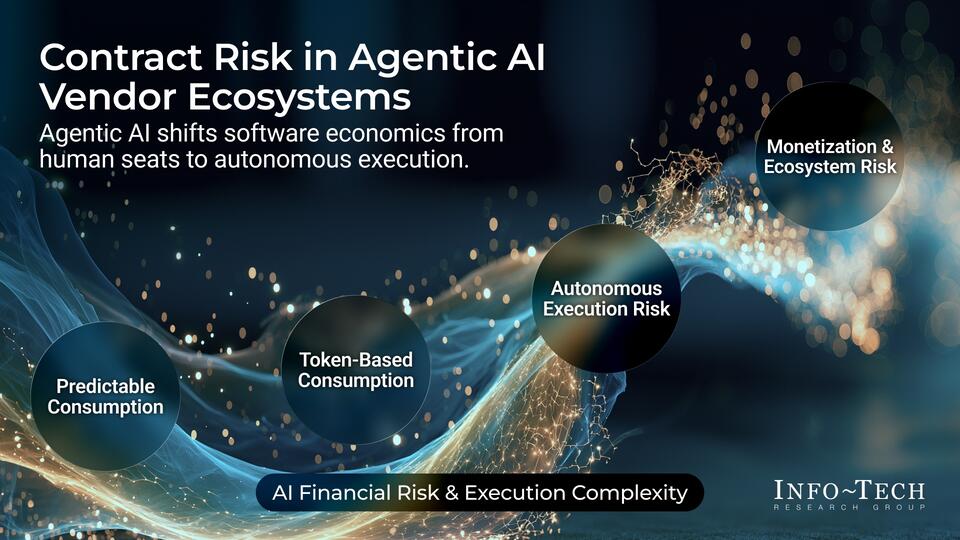
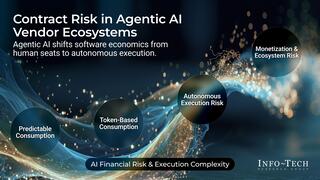
Agentic AI financial risk: contract evolution

The evolution of AI financial risk
Level 1: Predictable Consumption
Low Maturity/Low Risk
- Seat-based or simple usage pricing
- Limited AI automation
- Costs are linear and forecastable
- Minimal need for specialized controls
Level 2: Token-Based Consumption
Emerging AI Use
- Token or API-based pricing
- Early variability in cost
- Limited visibility into consumption drivers
- Complicated monitoring required
Level 3: Autonomous Execution Risk
Agentic AI Begins
- Task- or outcome-based pricing
- AI agents executing workflows
- Recursion and chaining increase cost unpredictability
- Forecasting becomes difficulty
Level 4: Monetization & Ecosystem Risk
High Maturity/High Risk
- Abstraction layer pricing (tasks + tokens + third-party models)
- Embedded marketplace, partner, or sponsored elements
- Cross-vendor dependencies
- Costs become nonlinear and opaque
A multi-layer governance model
As AI systems move from predictable consumption to autonomous execution, organizations must evolve from static contract management to dynamic, cross-functional financial governance.

Insight Summary
Agentic AI changes the economics of enterprise software
With agentic AI, you pay for what the software does, not how many people use it. Most procurement and budgeting practices were built for headcount pricing and quietly underestimate the bill. You need new controls, built for autonomous billing from the start.
Agentic AI pricing complexity itself is a risk multiplier
Pricing complexity isn’t just confusing; it's a risk in its own right. When billing rules are vague, the vendor decides what they mean. Get the billing mechanics into the contract before you sign. Once you've deployed, you've lost the leverage to fix it.
Forecasting must be treated as a pre-signing discipline
Forecast before you sign, not after. If you can’t model normal and worst-case usage in advance, you’re agreeing to whatever the bill turns out to be. AI pricing changes faster than contracts do, so negotiate protection against tier moves and changing definitions up front. However, this breaks down immediately as new use cases demand novel agentic workflows that vary in complexity, data sources, etc. so beware!
Agentic AI consumption models: Insights and decision guidance

About Info-Tech
Info-Tech Research Group is the world’s fastest-growing information technology research and advisory company, proudly serving over 30,000 IT professionals.
We produce unbiased and highly relevant research to help CIOs and IT leaders make strategic, timely, and well-informed decisions. We partner closely with IT teams to provide everything they need, from actionable tools to analyst guidance, ensuring they deliver measurable results for their organizations.
What Is a Blueprint?
A blueprint is designed to be a roadmap, containing a methodology and the tools and templates you need to solve your IT problems.
Each blueprint can be accompanied by a Guided Implementation that provides you access to our world-class analysts to help you get through the project.
Talk to an Analyst
Our analyst calls are focused on helping our members use the research we produce, and our experts will guide you to successful project completion.
Book an Analyst Call on This Topic
You can start as early as tomorrow morning. Our analysts will explain the process during your first call.
Get Advice From a Subject Matter Expert
Each call will focus on explaining the material and helping you to plan your project, interpret and analyze the results of each project step, and set the direction for your next project step.
Unlock Sample ResearchContributors
- One anonymous contributor
 Negotiate SaaS Agreements That Are Built to Last
 Master the MSA for Your Managed Services Providers
 Understand Common IT Contract Provisions to Negotiate More Effectively
 Master Contract Review and Negotiation for Software Agreements
 Improve Your Statements of Work to Hold Your Vendors Accountable
 Prepare to Negotiate Your Generative AI Vendor Contract
 Negotiate Safe AI Contracts to Prevent Bill Shock
