
Make EA Governance an Engine for Better Decisions
Right-sized governance means faster delivery and better-managed risks without the trade-off.
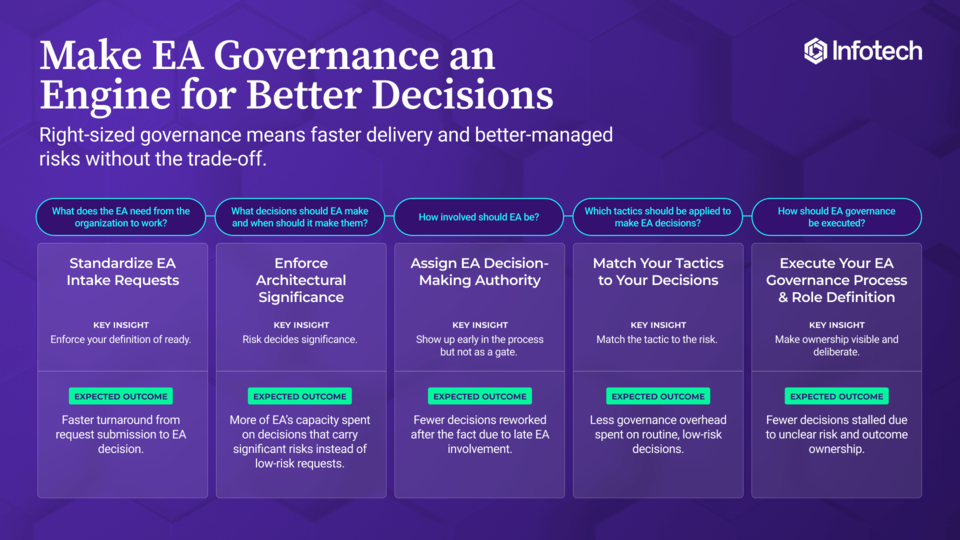
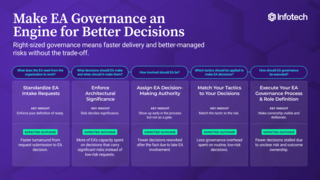
Enterprise architecture (EA) leaders face pressure to accelerate value-driven outcomes while maintaining governance, security, and compliance. Yet most organizations are using an EA governance model that wasn’t designed for the new risks introduced by AI. This outdated governance model can slow innovation and lead to critical architecture decisions being made without adequate oversight. Use our practical framework for EA governance to enable the teams doing the work to confidently make safe architecture decisions without requiring constant EA involvement.
Traditional governance models cause innovation bottlenecks, reinforcing perceptions of EA as a control function instead of a trusted business advisor. To avoid making EA the default in every decision, embed governance directly into your organization’s operating model. Clearly define when EA involvement is required, leveraging guidance and guardrails to rebrand EA as an agency of enablement and empowerment rather than enforcement.
1. Architecture decisions belong to the organization.
Embedding EA directly into the operating model pushes appropriate decision-making authority out to the teams that are best positioned to own it. This allows EA decisions to move at the speed of the business while guardrails catch the risks that stakeholders worry most about.
2. Not every decision deserves EA’s attention.
Don’t spread EA’s resources thin across routine, low-risk requests. Instead, anchor architectural significance to risk exposure, applying that measure consistently across every EA request. This focuses EA’s attention on the decisions that could hurt the organization rather than innocuous, low-stakes requests.
3. Governance without consequence is just documentation.
Back every EA governance tactic with clear authority and consequences the moment it is applied. Putting teeth behind every tactic ensures governance findings get acted on instead of being sidelined and quietly ignored.
Use this step-by-step blueprint to enable governed EA decision-making at the speed of the business.
Our comprehensive framework helps organizations define appropriate tiers of EA involvement, from authoritative to delegated, to ensure EA is focused on the decisions and activities that matter. Use this step-by-step approach to:
- Set the EA context by describing your EA practice strategy and assessing your EA governance maturity.
- Outline your EA intake by stating your EA intake criteria.
- Define architectural significance to indicate the degree of EA participation based on the risk of the EA request.
- Reveal your EA governance decisions. Capture your EA engagement model and describe your EA governance needs.
- Match your tactics to your decisions. Align EA tactics to your governance needs, map your EA governance process, define your EA governance roles, plan EA governance communications, roadmap your EA governance initiatives, and complete your EA governance handbook.
Member Testimonials
After each Info-Tech experience, we ask our members to quantify the real-time savings, monetary impact, and project improvements our research helped them achieve. See our top member experiences for this blueprint and what our clients have to say.
9.4/10
Overall Impact
$63,924
Average $ Saved
38
Average Days Saved
Client
Experience
Impact
$ Saved
Days Saved
AgWest Farm Credit, FLCA
Guided Implementation
10/10
$13,799
20
The recurring engagement allows for grounded in my organization information relevant to us. This is invaluable and key to making these engagements.
Vancouver Shipyards. Co. Ltd.
Guided Implementation
8/10
N/A
10
Within the current phase of the engagement, I believe there is a lot of added value and progress to support myself and my team. Still, there are so... Read More
CAF - Corporacion Andina de Fomento
Guided Implementation
9/10
$37,400
18
Mimecast North America, Inc.
Guided Implementation
10/10
$136K
20
Wayne quickly grasped the issues, he had challenging questions that lead to him forming a picture and he then fed back some of the frustrations tha... Read More
Intoxalock
Guided Implementation
10/10
$68,500
120
Choosing the best parts of the experience is challenging, as all my time spent working with Wayne has been excellent and critical to navigating the... Read More
Delta Dental of Washington
Guided Implementation
10/10
$13,600
N/A
I appreciated hearing about experiences implementing TOGAF and the recommendation to look elsewhere.
FirstRand Bank Ltd.
Guided Implementation
9/10
$68,000
20
The tools and engaging with the InfoTech expertise has helped to fast track some of our processes and inputs that we required on building the busin... Read More
Toronto Community Housing Corporation
Guided Implementation
8/10
$25,000
20
Best: The rich collection of relevant EA and ARB materials. Understanding the importance of the awareness and communication elements for implementi... Read More
About Info-Tech
Info-Tech Research Group is the world’s fastest-growing information technology research and advisory company, proudly serving over 30,000 IT professionals.
We produce unbiased and highly relevant research to help CIOs and IT leaders make strategic, timely, and well-informed decisions. We partner closely with IT teams to provide everything they need, from actionable tools to analyst guidance, ensuring they deliver measurable results for their organizations.
What Is a Blueprint?
A blueprint is designed to be a roadmap, containing a methodology and the tools and templates you need to solve your IT problems.
Each blueprint can be accompanied by a Guided Implementation that provides you access to our world-class analysts to help you get through the project.
Need Extra Help?
Speak With An Analyst
Get the help you need in this 4-phase advisory process. You'll receive multiple touchpoints with our researchers, all included in your membership.
Guided Implementation 1: Outline Your EA Intake
- Call 1: Scope the objectives, reach, and vision of your EA practice.
- Call 2: Review the maturity of your EA governance.
- Call 3: Review EA request intake.
Guided Implementation 2: Define Architectural Significance
- Call 1: Discuss your definition of architectural significance.
Guided Implementation 3: Reveal Your EA Governance Decisions
- Call 1: Review EA’s engagement across the organization and the decisions EA will make.
Guided Implementation 4: Match Your Tactics to Your Decisions
- Call 1: Brainstorm tactics to enable EA decision-making.
- Call 2: Discuss your EA governance target state.
- Call 3: Review your EA governance handbook.
Contributors
- Alan Mitchell, Senior Manager Global Cities Centre of Excellence, KPMG Canada
- Ian Gilmour, Associate Partner, EA Advisory Services, KPMG Canada
- Djamel Djemaoun Hamidson, Senior Enterprise Architect, CBC/Radio-Canada
- Sterling Bjorndahl, Director of Operations, eHealth Saskatchewan
- Huw Morgan, IT Research Executive, Enterprise Architect
- Serge Parisien, Manager Enterprise Architecture, Canada Mortgage Housing Corporation
- Alex Coleman, Chief Information Officer, Saskatchewan Workers’ Compensation Board
- L.C. (Skip) Lumley, post-career, formerly Senior Principle at KPMG Canada
- Tim Gangwish, Enterprise Architect, Elavon
- Darryl Garmon, Senior Vice President, Elavon
- Steve Ranaghan, EMEIA business engagement, Fujitsu
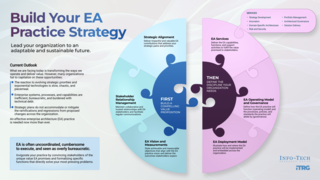 Build Your EA Practice Strategy
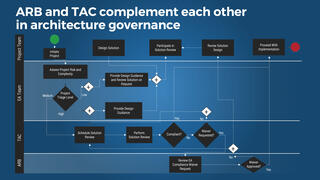 Agile Enterprise Architecture Operating Model
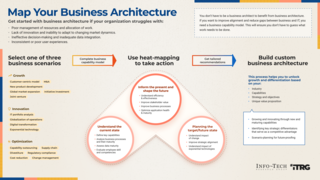 Map Your Business Architecture
 Drive Digital Transformation With Platform Strategies
 Make EA Governance an Engine for Better Decisions
 Excel Through COVID-19 With a Focused Business Architecture
 Create Stakeholder-Centric Architecture Governance
 Enterprise Architecture Trends
 Prepare for AI Regulation
 Establish Your Adaptive AI Governance Program: From Principles to Practice
 Build a Better Enterprise Architect
