How to Get on a Board
A CIO’s guide to landing a paid board seat.
For CIOs, the path to a paid board seat is rarely straightforward. Becoming board-ready can require years of intentional preparation, yet many aspiring directors spend time on development that doesn’t match what boards are looking for. This research provides a practical approach to the CIO-to-board transition by offering insights into how boards assess and select candidates. Designed for use with a counselor or as an independent resource, it guides CIOs in building a development roadmap tailored to the specific board role they are pursuing.
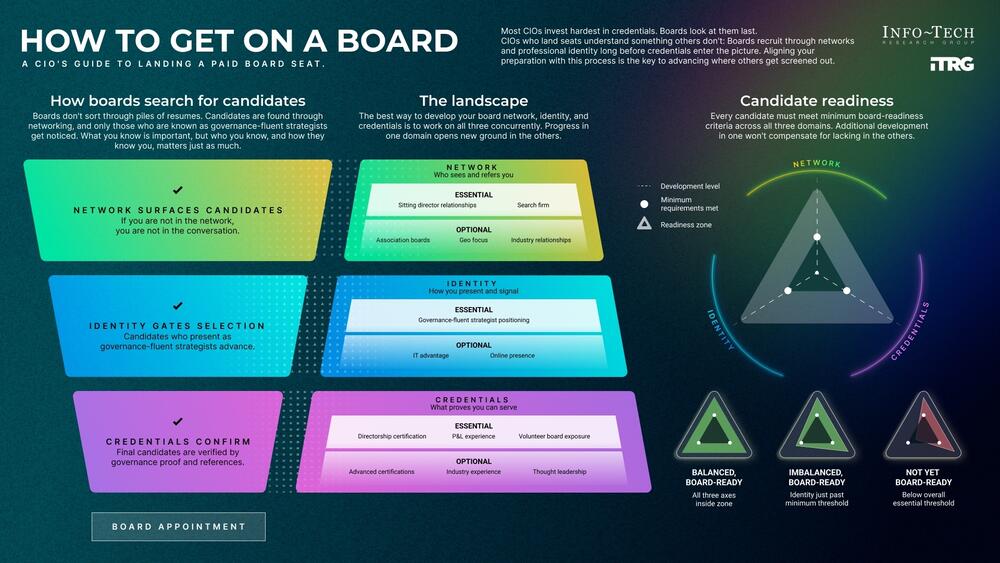
Board service represents a fundamental career shift, and the preparation is structurally different from any other career transition. Without a clear understanding of how boards identify and evaluate candidates, CIOs often focus on credentials, not realizing boards typically evaluate credentials last. Reframing board readiness around three domains – network, professional identity, and credentials – helps CIOs focus on the gaps that could keep them from being considered.
1. Preparing for board service requires a professional identity shift.
CIOs tend to ask what certifications, classes, or CV updates they need. Stronger credentials alone will not reposition you for board service. Boards evaluate candidates through a sequence of steps involving trusted networks and retained search firms. These connections surface governance-fluent strategists who can contribute beyond technology.
2. Board readiness depends on balanced development across three domains.
Every aspiring director must meet minimum requirements across their network, professional identity, and credentials. Additional development in one area cannot compensate for a significant gap in another. Prioritize activities that strengthen multiple domains to make better use of your development time.
3. There is no universal roadmap to board readiness.
Preparation for board service must be tailored to your goals and your current board-readiness. A CIO targeting private equity–backed boards will need a different roadmap than one pursuing a public company board. Clarifying your goal helps you focus your preparation most effectively.
Use this research to build a roadmap to board readiness
This research equips CIOs to prepare strategically for board roles through practical diagnostics and a structured roadmap. Complete the diagnostic independently or with a counselor to identify gaps across your network, professional identity, and credentials. Guided reflection questions support the assessment, while AI prompts accelerate roadmap development to turn the findings into actionable next steps.
- Clarify your goal and direction by defining the type of board you are targeting and why board service is the right path for you.
- Assess your board readiness by evaluating your network, professional identity, and credentials.
- Build your roadmap and choose your next steps by sequencing your development activities and establishing a realistic timeline, revisiting the roadmap as your experience and opportunities evolve.
Research & Tools
1. How to Get on a Board – A guided assessment to help CIOs prepare for board service and build a practical development roadmap.
This research offers insight into how boards identify and evaluate candidates and the factors that shape board readiness. Evaluate your readiness by completing the diagnostic questions with a counselor or work through the guided activities independently.
- Clarify your target board position and examine why directorship is the right path for you.
- Assess your readiness across your network, professional identity, and credentials.
- Turn your development gaps into a sequenced roadmap with a clear next step.
2. Board CV Template – A tool to help you present your experience and value from the board’s perspective.
A board CV is fundamentally different from an executive resume. Use this template to focus on governance and organizational outcomes, then update the document as your development advances.
- Develop a board-level headline and value proposition.
- Highlight your governance experience, credentials, and board-relevant contributions.
- Leave placeholders for development gaps and fill them as you complete your roadmap.
INFOTECH
How to Get on a Board
A CIO’s guide to landing a paid board seat
COUNSELOR COACHING DECK
Executive summary
Your Challenge
You are aiming for a board seat as the next step in your career, but the path is unclear:
- There is no roadmap for moving from CIO to board member.
- The path to a paid board seat is structurally different from any other career transition.
- Without a clear roadmap, you risk losing years in scattered preparation that ultimately doesn’t match what boards are looking for.
Common Obstacles
Without knowing how boards actually select candidates, many CIOs make mistakes that have nothing to do with a lack of ability:
- Most CIOs invest hardest in credentials – the last thing boards actually evaluate.
- Technology leaders face unique perception challenges: Boards look for governance-fluent strategists, not technologists.
- The network you’ve built as a CIO will not serve you as an aspiring board member.
Info-Tech’s Approach
Infotech’s approach clarifies how boards really source their members so you can structure your preparation accordingly:
- Demystifying the candidate selection process helps you structure a clear and comprehensive development roadmap.
- A counselor-facilitated diagnostic clearly positions you against the selection criteria for your target board position.
- AI-supported roadmap building gets you out of planning and into action quickly.
How to use this deck
This deck will guide you through the following steps, from goal-setting to identifying the best development initiative to do next.

Each working slide includes:
- Reflection questions to work through on your own or with your coach
- Infotech insight to build your understanding
- Next steps clearly outlined to guide you through this deck’s activities and beyond
- AI prompts to enhance your workflow
- For coaches, the speaker’s notes section includes points to listen for in your coachee’s reflectio
Your goal and your “why”
Reflection Questions
- What is your goal? What kind of board position are you aiming for? Consider the organization type, industry, business challenges, etc.
- Why is this the right next step in your career?
- What is your current plan to get there?
- How do you see yourself transitioning from a technology focus to a business and governance focus?
- What legal and financial risks do you anticipate? What is your plan for mitigating them?
- What other career steps have you considered aside from board directorship?
Infotech Insight
There is no fixed endpoint to board-readiness development. However, there are minimum essential readiness criteria, as well as a point of diminishing returns further down the line. Both depend on where you’re aiming.
A CIO targeting PE-backed boards will have a different roadmap than one targeting public company boards. Clarifying your goal enables you to target your preparation most effectively.
Most boards review fewer than 20 resumes when filling a position (MFDF, 2025). Only the candidates with the most targeted fit make it onto the shortlist.
Next Steps
- (Optional) Consider alternative career paths, such as advisory board membership. See the AI prompt in Appendix A.
- Review Infotech’s board readiness framework.
This content is exclusive to members.
Sign up to continue reading the full blueprint, or sign in if you already have an account.
Our systems detected an issue with your IP. If you think this is an error please submit your concerns via our contact form.