Our systems detected an issue with your IP. If you think this is an error please submit your concerns via our contact form.
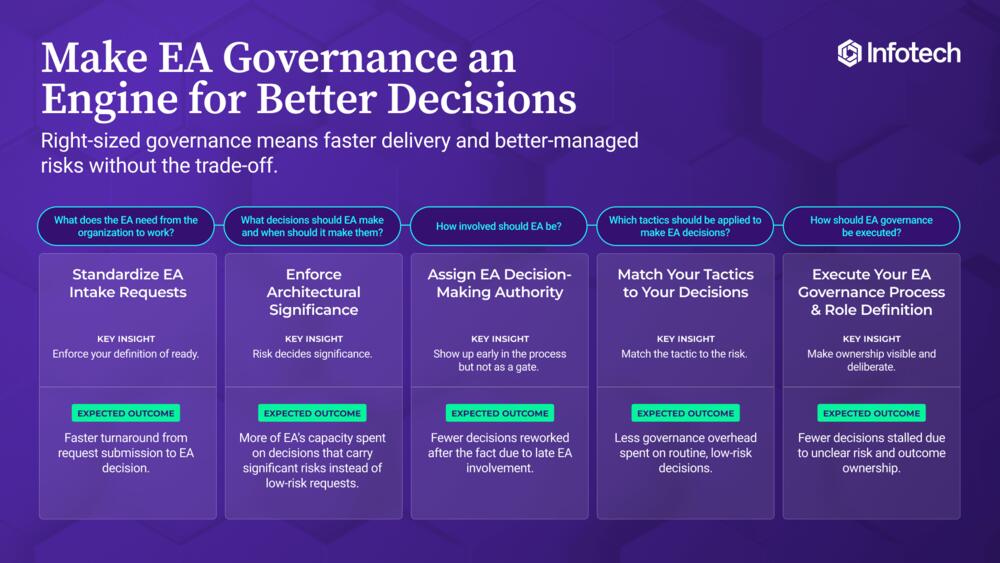
Make EA Governance an Engine for Better Decisions
Right-sized governance means faster delivery and better-managed risks without the trade-off.
Enterprise architecture (EA) leaders face pressure to accelerate value-driven outcomes while maintaining governance, security, and compliance. Yet most organizations are using an EA governance model that wasn’t designed for the new risks introduced by AI. This outdated governance model can slow innovation and lead to critical architecture decisions being made without adequate oversight. Use our practical framework for EA governance to enable the teams doing the work to confidently make safe architecture decisions without requiring constant EA involvement.
Traditional governance models cause innovation bottlenecks, reinforcing perceptions of EA as a control function instead of a trusted business advisor. To avoid making EA the default in every decision, embed governance directly into your organization’s operating model. Clearly define when EA involvement is required, leveraging guidance and guardrails to rebrand EA as an agency of enablement and empowerment rather than enforcement.
1. Architecture decisions belong to the organization.
Embedding EA directly into the operating model pushes appropriate decision-making authority out to the teams that are best positioned to own it. This allows EA decisions to move at the speed of the business while guardrails catch the risks that stakeholders worry most about.
2. Not every decision deserves EA’s attention.
Don’t spread EA’s resources thin across routine, low-risk requests. Instead, anchor architectural significance to risk exposure, applying that measure consistently across every EA request. This focuses EA’s attention on the decisions that could hurt the organization rather than innocuous, low-stakes requests.
3. Governance without consequence is just documentation.
Back every EA governance tactic with clear authority and consequences the moment it is applied. Putting teeth behind every tactic ensures governance findings get acted on instead of being sidelined and quietly ignored.
Use this step-by-step blueprint to enable governed EA decision-making at the speed of the business.
Our comprehensive framework helps organizations define appropriate tiers of EA involvement, from authoritative to delegated, to ensure EA is focused on the decisions and activities that matter. Use this step-by-step approach to:
- Set the EA context by describing your EA practice strategy and assessing your EA governance maturity.
- Outline your EA intake by stating your EA intake criteria.
- Define architectural significance to indicate the degree of EA participation based on the risk of the EA request.
- Reveal your EA governance decisions. Capture your EA engagement model and describe your EA governance needs.
- Match your tactics to your decisions. Align EA tactics to your governance needs, map your EA governance process, define your EA governance roles, plan EA governance communications, roadmap your EA governance initiatives, and complete your EA governance handbook.
Research & Tools
1. Make EA Governance an Engine for Better Decisions Storyboard – A detailed PowerPoint deck that guides you through the methodology to build a governance framework enabling EA and non-EA teams to make safe, compliant architecture decisions.
This storyboard enables you to:
- Build a flexible architectural significance framework, by defining three to five risk dimensions with explicit thresholds directly mapped to levels of EA involvement.
- Design an EA engagement model that adds the most value, so that EA is not the default in every conversation.
- Match your governance tactics to your decision tier, by applying specific tactics only when the combination of risks calls for them.
2. EA Governance Handbook Template – A Word-based tool to define how your EA practice governs architectural decisions across the organization.
Use this template to establish:
- When and how EA engages with initiatives, projects, and decisions.
- The bodies, processes, and instruments used to guide and enforce architectural direction.
- The policies and standards that constrain and inform architectural choices.
- How governance decisions and architectural guidance are communicated across the organization.
3. EA Governance Maturity Assessment Tool – An Excel tool to assess your organization’s present state of EA governance maturity and identify your target state.
This tool assists you in:
- Evaluating your current level of EA governance maturity.
- Defining the target EA governance maturity state for your organization.
- Indicating gaps that must be filled to achieve your target state.
4. EA Policy Template – A Word file that communicates important EA documentation to guide EA across your organization.
Use this template to define and enforce your organization’s:
- EA policies, standards, and roles.
- EA compliance requirements.
- EA governance processes and decision outcomes.
5. Architecture Review Board Charter – A Word file to support decision-making by EA governing bodies during governance board reviews.
This tool helps establish your Architecture Review Board’s:
- Purpose, scope, and authority.
- Membership composition.
- Review criteria.
6. Architecture Review Decision Log – An Excel file to track all decisions that arise throughout the course of any project or EA request.
This tool allows you to:
- Track architecture governance decisions.
- Document approvals, exceptions, rationale, and impact.
- Create a transparent record of decision-making.
Member Testimonials
After each Info-Tech experience, we ask our members to quantify the real-time savings, monetary impact, and project improvements our research helped them achieve. See our top member experiences for this blueprint and what our clients have to say.
9.5/10
Overall Impact
$63,924
Average $ Saved
38
Average Days Saved