The Government of Canada’s AI for All strategy is strong on rhetoric. Alberta has shipped theirs as open-source code. The Velocity Papers are the first defensible, in-production blueprint for an agentic public service, and they change the question for every other jurisdiction across Canada from one of strategic intent to one of strategic implementation.
Every government technology leader Info-Tech advises is being asked to do more with less. Most of them see their core problem as debt: the 40-year-old systems, undersized teams, out of date skills, the modernization backlog, and the maintenance tax that consumes the budget before a single new service is built. The challenge I have come to see is that this is the diagnosis for yesterday’s problems. The Government of Alberta’s Velocity Papers, announced July 6, 2026, show that there is a clear path to breaking free from these constraints not in theory, but in practice.
Janak Alford, Alberta’s Deputy Minister of Technology and Innovation, shared the papers with Info-Tech before their public release to showcase practical, actionable approaches to building an agentic IT organization. Reading them sent me back to the first article I wrote for Info-Tech, in 2017, on measuring software throughput. The punchline of that piece leaned on an Eli Goldratt line I’ve come to call Goldratt’s Law: “If you produce something, but don’t sell it, it’s not throughput.” Nine years later, Alberta’s work shows a new way to not only measure throughput, but increase it 10-fold.
Alberta Industrialized Government Software Delivery
The Velocity Papers document how Alberta built an agentic IT organization at scale. Rather than convene a committee, the province assembled a cross-government group of self-described AI maximalists to test tools and codify what survived, then built an AI factory on their own open-source Pronghorn platform1. It converted thousands of pages of standards and architecture into machine-readable constraints, embedded them in automated delivery pipelines2,3, and paired human teams with orchestrated agents that code, test, secure, and check compliance4,5. Governance moved upstream6, delivery cycles fell from months to days7, and auditability strengthened rather than eroded.
The catalyst was a finding most governments in Canada wrestle with every day. Alberta determined that most newly built applications failed basic accessibility, security, and quality standards8, and they failed despite the documentation and the oversight. In a delivery system that relies on manual interpretation and late-stage inspection, noncompliance is not the exception, it is the default. Alberta’s response was to treat software delivery as manufacturing rather than a bespoke craft9, with standards as executable constraints enforced continuously by the system rather than inspected after the fact.
The Constraint Was Never the Technical Debt
Technical debt is a symptom, not the disease. An organization accumulates it because it never had the capability or capacity to build correctly the first time, or to retire the backlog once it formed10. This isn’t news – my team spelled the pattern and solutions out in Streamline Application Management in 2020. At the time, the binding constraint on public-sector digital ambition has always been the scarcity of human and financial capital, and a public service built to deliver across a vast geography feels that scarcity acutely. In the language of the staples economy, Canadian government IT has long been a hewer of wood, its scarce capability and capacity consumed in maintenance and toil rather than in building. The debt and the scarcity are the same fact observed at two different times.
Scarcity Did Not End, It Moved
It is tempting to read Alberta’s results as the arrival of post-scarcity in government technology. That reading is wrong. The agentic model does not eliminate the constraint, it relocates it. Alberta is explicit that compute is now the binding input, with token agreements it expects to exceed and infrastructure it cannot secure quickly enough11. Judgment becomes scarce in a different way, since the bottleneck is no longer whether the work can be built but whether a person can govern and own what the agents produce12. Alberta states the principle directly: AI is an amplifier, not a replacement, and accountability stays with people13. Governed data and public trust are constrained as well, and trust is not restored on the timeline of a breach.
What changed is not the existence of scarcity but its elasticity. For the first time the binding constraint is something capital can relieve, on a cost curve that falls each quarter. That was never true of the human-capital constraint, which no government could buy its way out of at any useful speed.
Goldratt’s Law Comes Due
Goldratt’s Theory of Constraints distinguishes exploiting a constraint, wringing more output from the existing bottleneck, from elevating it, investing to break the bottleneck outright. Two decades of Agile practice were an exploitation play: better methods for extracting throughput from scarce, expensive developers. The agentic model is an elevation, because it replaces the scarce resource with an elastic one. Goldratt’s fifth step is the one that matters here. When you break a constraint it does not disappear, it moves, and the discipline is to find the next one.
Once building is abundant, the constraint slides downstream to the place “How to Measure Throughput” was pointing. When developers were the bottleneck, throughput was gated at production. When agents make production abundant, throughput is gated at realization, at whether the institution can adopt, govern, and trust what has been built14. Produce a hundred applications the organization cannot absorb and you have not generated throughput, you have generated inventory. “If you produce something, but don’t sell it, it’s not throughput” was a measurement footnote in 2017. In an agentic public service it is the governing constraint.
Portfolio Management Must Change Its Object
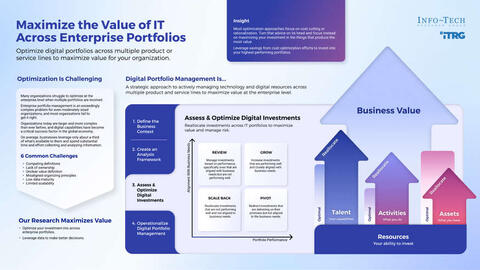
For 12 years my work, including the enterprise portfolio research I developed with Kim Osborne Rodriguez in How to Maximize the Value of IT Across Portfolios, has treated digital portfolio management as the disciplined allocation of scarce supply across competing demand. We organized it around four portfolios: Resources, the ability to invest; Talent, the capabilities; Activities, the work; and Assets, what the organization holds. The agentic shift rewires two of them at the root. Resources becomes elastic as compute substitutes for capital-bound capacity. Talent now includes a fleet of agents alongside the workforce (that you must develop into an AI capable one)15. The supply side the discipline was built to ration is no longer the binding scarcity.
A portfolio we have always treated as background now moves to the foreground: the constraints themselves. The object of portfolio management shifts from allocating scarce capacity across demand to identifying which constraint will bind next and positioning intellectual and financial capital against it before it does. This is a material change to the discipline, not a refinement of it, and it favors the organizations that recognize the shift first.
Recommendation: Lead the Portfolio of Constraints
Government technology leaders should reframe their portfolio practice around the migration of constraints rather than the rationing of supply. In practice, that means managing compute, judgment, governed data, and institutional trust as distinct portfolios with distinct elevation mechanisms16,17, and accepting that capital relieves the first and does little for the others. The leadership task is to read the migration and move resources ahead of it, while holding the optionality to absorb the constraint shifts that cannot be forecast, such as a model-access or supply-chain disruption.
I would reverse this recommendation under one condition: if the cost of compute stops falling and the supply constraint rebinds, the traditional rationing discipline returns to the center of the practice. On current evidence, that is not the trajectory.
From Intention to Action
The Government of Canada’s AI for All strategy supplied the intent. Alberta has supplied the implementation, built-in production, and published for other governments to adopt. The companion discipline, leading an organization whose constraints will not hold still, is the discipline that Canadian IT leaders need to embrace right now to make the change happen. That discipline is a portfolio-management problem before it is anything else – the strategic decision to stop investing in a delivery model bound by a constraint that no longer exists. Goldratt calls this the inertia trap. The last thing a nation wrestling with a productivity crisis can afford to do is to give in to inertia. We need to drive technology change at an exponential pace. For every other jurisdiction in Canada, the question has moved from strategic intent to strategic implementation, and the Velocity Papers provide the working code AND comprehensive documentation18 to increase your pace by an order of magnitude.
The Bottom Line
A 10-fold increase in pace is available today. I said in my review of Canada’s AI for All strategy that the gap between this and the status quo is not a technology gap. It is a decision gap. Making that decision shifts the constraint, and our responsibility as IT leaders is to manage a new portfolio of constraints in a new way.
Info-Tech is here to help you do just that.
See Also
- How to Measure Throughput and Win the Business' Trust
- Streamline Application Management
- Maximize the Value of IT Across Enterprise Portfolios
- AI Workforce Development
Footnotes
- The Velocity Papers No. 08 – The AI Factory: Design and Ideation [Pronghorn]
- The Velocity Papers No. 06 – The Well-Built Harness
- The Velocity Papers No. 16 – Technical: Anatomy of a Template
- The Velocity Papers No. 07 – Red, Blue, Green, and Yellow Agents
- The Velocity Papers No. 09 – The AI Factory: Orchestration and Observation [Nexus]
- The Velocity Papers No. 13 – Establishing a Builder Culture
- The Velocity Papers No. 10 – The AI Factory: Measuring Project Delivery [The Velocity Game Engine]
- The Velocity Papers No. 02 – The Cyber Imperative
- The Velocity Papers No. 05 – The Four Approaches to AI Modernization
- The Velocity Papers No. 01 – The Two-Billion-Dollar Ship of Theseus
- The Velocity Papers No. 11 – The Agentic Technology Stack
- The Velocity Papers No. 14 – The Compression Problem
- The Velocity Papers No. 12 – The AI Academy: Investing in People
- The Velocity Papers No. 15 – Measuring Failure and Success
- The Velocity Papers No. 12 – The AI Academy: Investing in People
- The Velocity Papers No. 11 – The Agentic Technology Stack
- The Velocity Papers No. 15 – Measuring Failure and Success
- The Velocity Papers No. 18 – Technical: The Canvas