
Time Study
Avoid burnout by being smarter with your time.
- In ESG’s 2018 report “The Life of Cybersecurity Professionals,” 36% of participants expressed the overwhelming workload was a stressful aspect of their job.
- Organizations expect a lot from their security specialists. From monitoring the threat environment, protecting business assets, and learning new tools, to keeping up with IT initiatives, cybersecurity teams struggle to balance their responsibilities with the constant emergencies and disruptions that take them away from their primary tasks.
- Businesses fail to recognize the challenges associated with task prioritization and the time management practices of a security professional.
Our Advice
Critical Insight
- The majority of scheduled calendar meetings include employees and peers.
- Our research indicates cybersecurity professionals spent the majority of their meetings with employees (28%) and peers (24%). Other stakeholders involved in meetings included by myself (15%), boss (13%), customers (10%), vendors (8%), and board of directors (2%).
- Calendar meetings are focused on project work, management, and operations.
- When asked to categorize calendar meetings, the focus was on project work (26%), management (23%), and operations (22%). Other scheduled meetings included ones focused on strategy (15%), innovation (9%), and personal time (5%).
- Time management scores were influenced by the percentage of time spent with employees and peers.
- When participants were divided into good and poor time managers, we found good time managers spent less time with their peers and more time with their employees. This may be due to the nature of employee meetings being more directly tied to the project outputs of the manager than their peer meetings. Managers who spend more time in meetings with their employees feel a sense of accomplishment, and hence rate themselves higher in time management.
Impact and Result
- Understand how cybersecurity professionals allocate their time.
- Gain insight on whether perceived time management skills are associated with calendar maintenance factors.
- Identify common time management pain points among cybersecurity professionals.
- Identify current strategies cybersecurity professionals use to manage their time.

About Info-Tech
Info-Tech Research Group is the world’s fastest-growing information technology research and advisory company, proudly serving over 30,000 IT professionals.
We produce unbiased and highly relevant research to help CIOs and IT leaders make strategic, timely, and well-informed decisions. We partner closely with IT teams to provide everything they need, from actionable tools to analyst guidance, ensuring they deliver measurable results for their organizations.
What Is a Blueprint?
A blueprint is designed to be a roadmap, containing a methodology and the tools and templates you need to solve your IT problems.
Each blueprint can be accompanied by a Guided Implementation that provides you access to our world-class analysts to help you get through the project.
Contributors
- Alain Bouit, CISO, Oregon State Treasury
- Amanda Bluett, Director of Cyber Defense for APAC, CBRE
- Bob Turner, CISO, University of Wisconsin- Madison
- Carl Stolfi, Senior Vice President – Information Security & Compliance, Global Partner LP
- Chris Borders, Systems Security Engineer, Anne Arundel Community College
- Claude Sam-Foh, Chief Enterprise Architect, Financial Services Commission of Ontario
- Clay Jenkins, Information Security and IT Operations Leader
- Dennis Murathaty, Director and Chief Security Officer, World Intellectual Property Organization
- Dwayne Stevens, Vice President of Information Security, WestCare Foundation
- John Pomeroy, Head of Risk Management, Cyber Security & Compliance, City of Toronto
- John Jessop, Associate director, Affiliate Information Security Program, Planned Parenthood of Southern New England
- Linda Vigesaa, CIO/CTO – Mt Hood Community College
- Michael Welch, CISO
- Rich Yates, Head of IT Risk and Governance, ISG Central Services
- Rob Chester, Information Security Manager, Pollard Banknote Limited
- Rob Morse, CIO/CTO, Platte River Power Authority
- Scott Moser, Senior Director, Cybersecurity & Deputy CISO, Caesars Entertainment
- Steve Yurich, Information Security Manager
- Toi Fields, Managing Director of Information Security
- Warren Seet, Head of Information Security, Auckland Transport
- Wes Knight, CISO
- 18 anonymous contributors
 Assess and Manage Security Risks
 Assess Your Cybersecurity Insurance Policy
 Achieve Digital Resilience by Managing Digital Risk
 Prevent Data Loss Across Cloud and Hybrid Environments
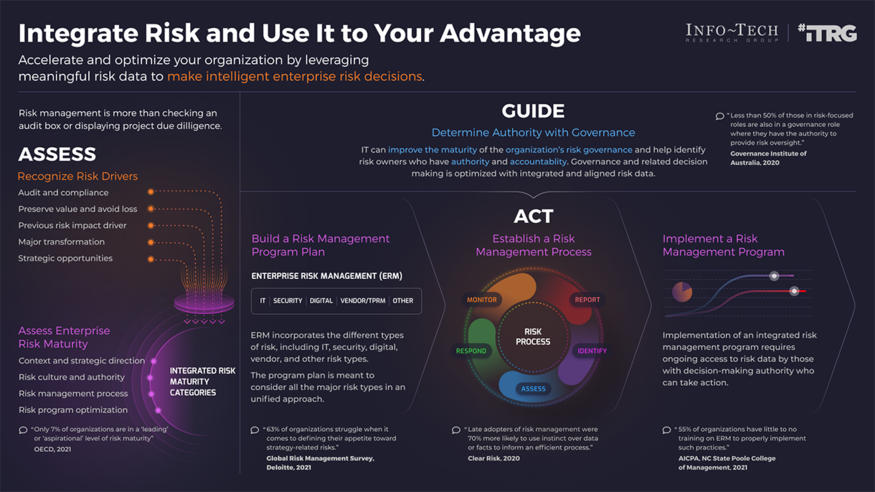 Build an IT Risk Management Program
 Develop and Deploy Security Policies
 Fast Track Your GDPR Compliance Efforts
 Build a Security Compliance Program
 Embed Privacy and Security Culture Within Your Organization
 Establish Effective Security Governance & Management
 Improve Security Governance With a Security Steering Committee
 Develop Necessary Documentation for GDPR Compliance
 Reduce and Manage Your Organization’s Insider Threat Risk
 Satisfy Customer Requirements for Information Security
 Master M&A Cybersecurity Due Diligence
 Integrate IT Risk Into Enterprise Risk
 Present Security to Executive Stakeholders
 Deliver Customer Value by Building Digital Trust
 Address Security and Privacy Risks for Generative AI
 Protect Your Organization's Online Reputation
 Develop an AI Compliance Strategy
 Get Started With AI Red-Teaming
 Achieve CMMC Compliance Effectively
 Building Info-Tech’s Chatbot
 Building the Road to Governing Digital Intelligence
 An Operational Framework for Rolling Out AI
 Discover and Classify Your Data