
Fast-Track Your Enterprise Service Design
Design a sustainable enterprise service customers want to use, employees want to support, and the organization wants to finance.
IT has a unique ability to see connections across the organization and how information flows through its systems. That makes IT ideally positioned to lead service design – but it’s often brought into the process far too late. To take the lead on this from the beginning, IT must adopt a “service-first” mindset. With our step-by-step guide, IT leaders can design coherent, sustainable services that fully meet the needs of their organization, employees, and customers.
Digitization is not transformation. Simply digitizing services loses sight of what customers really want, frustrates employees who must support and deliver the service and wastes your organization’s precious resources. Don’t just digitize enterprise services – design them to ensure they deliver value. Learn how IT can make that critical shift and evolve from technology provider to enterprise service orchestrator.
1. Avoid disastrous, short-sighted design investments.
Fully assess before you invest; clearly define your service’s context and scope. Start by gaining an understanding of the problem your service solves, the resources it requires, and the stakeholders needed to build, operate, and improve it. If you spend just enough time on this upfront, you’ll avoid making a disastrous investment in the wrong services.
2. Don’t let the customer’s voice get lost.
Whatever service you’re creating, the approach is the same: design your service around the customer’s journey, needs, and experiences. While stakeholder value is important, customer-centricity should be the focal point of your service design.
3. Identify and align key skills, technology, and processes.
Enterprise services don’t operate in a vacuum; they can’t service and support customers without the proper mix of skills, processes, and technology in place. Be sure to incorporate those crucial elements into your service design accordingly.
4. Embrace reusability for faster, better design.
Identify existing components, skills, and processes that are already effective in your organization, then reuse them wherever possible in new service design. This reduces waste, saves money, and speeds up delivery time. Keep the ball rolling by designing brand new components with future reuse in mind.
Use this actionable blueprint to design and orchestrate enterprise services, not just digitize them.
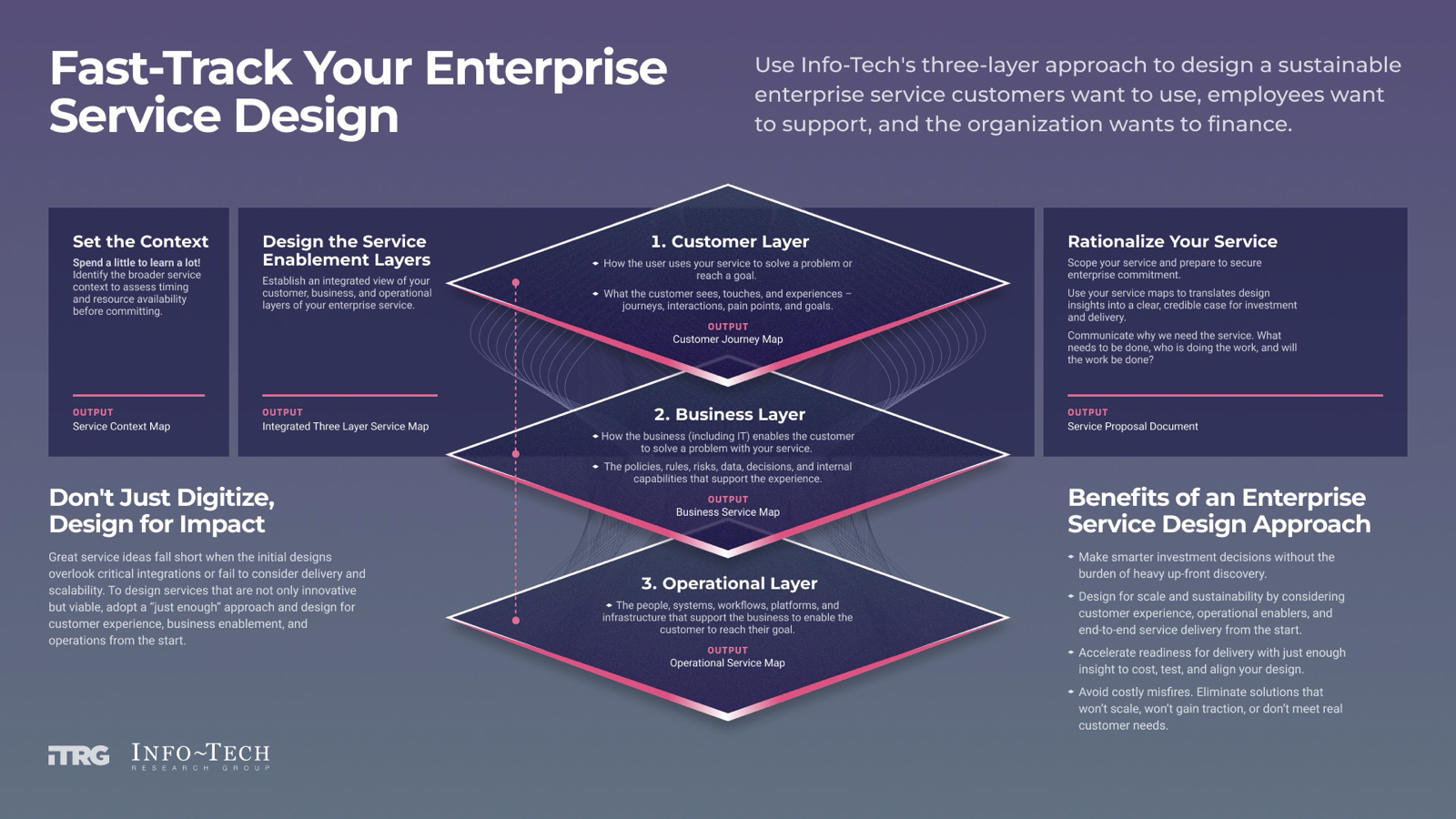
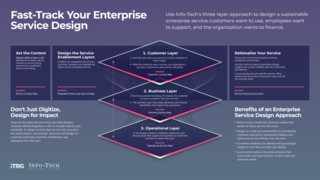
Follow our three-layer service design framework to create resilient, efficient enterprise services.
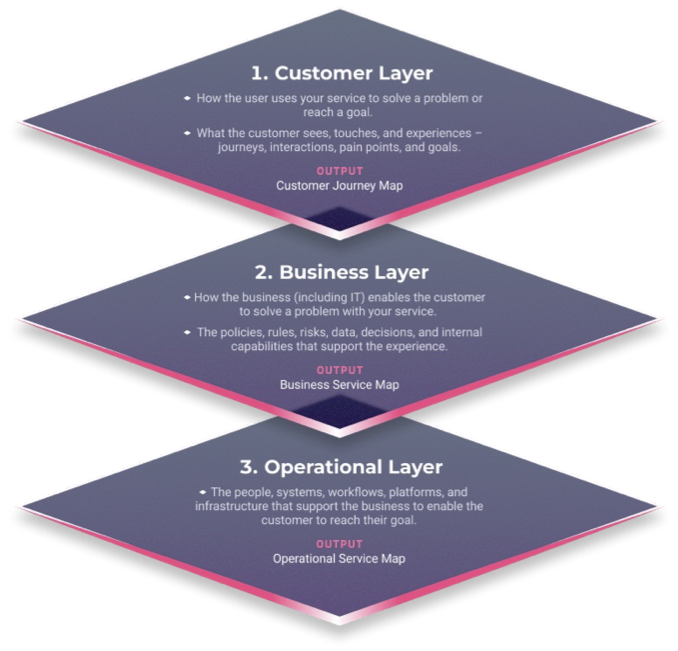
- Design services to solve real customer problems based on what the customer sees, touches, experiences, and interacts with, including their goals and pain points.
- Achieve enterprise-wide sustainability by aligning service design with the organization’s goals, roles, processes, rules, risks, data, decisions, and internal capabilities.
- Build sustainable systems at the operational level by incorporating the people, workflows, platforms, and infrastructure that support the organization in enabling the customer to reach their goal.
Fast-Track Your Enterprise Service Design
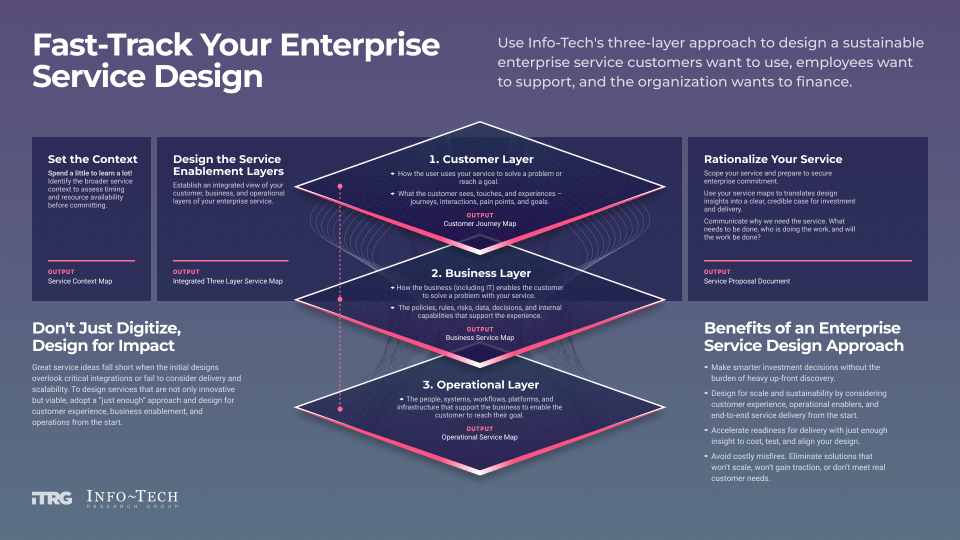
Use Info-Tech’s three-layer approach to design a sustainable enterprise service customers want to use, employees want to support, and the organization wants to finance.
Analyst perspective
IT has what it takes to become an enterprise service orchestrator.

Exceptional enterprise services are not merely built; they are orchestrated. True service design recognizes, aligns, and unifies the complex interplay of systems, people, and processes to craft a single, seamless flow of value to the customer. This holistic view not only creates a superior customer and employee experience, but also reveals opportunities for reuse, driving down costs and reducing technical debt.
Too often, however, services are not designed but merely digitized – analog processes are forced into a digital wrapper without reevaluating critical touchpoints, handoffs, and experiences. This creates a ripple effect of dysfunction: employees invent inefficient workarounds, internal expediency trumps customer needs, and the experience for both customers and employees becomes fragmented and frustrating.
This is where IT must evolve from a technology provider to an enterprise service orchestrator.
And IT may not realize it yet, but they have what it takes! More than any other function, IT has a unique, cross-functional view of how information flows through the organization. They understand the systems, the data, and the teams who rely on them. This positions IT as the natural conductor to collaborate with business peers and design services that are coherent, efficient, and customer-centered. An IT-led design breaks down silos, reduces waste, and replaces the "us vs. them" mentality with a shared mission.
But to lead this transformation, IT must shift from a "technology-first" to a "service-first" mindset. By leveraging proven frameworks like Info-Tech’s three-layer approach, IT can architect the cohesive services that define a modern organization. IT is so much more than the technology it supports – it is the engine of great service design.
Executive summary
Your Challenge
Organizations often digitize but fail to design services. In other words, they translate existing analog processes, tools, and exchanges into digital ones but fail to:
- Incorporate key integrations.
- Apply existing skills, processes, and tools.
- Involve the right people in the design process from the start.
Too often, what has the potential to become a great service results in a fragmented customer and employee experience, increased technical debt, and scrambling to meet unrealistic expectations.
Common Obstacles
This happens because services are designed without:
- Visibility into all the people, processes, and technology that make up a service.
- Involvement of the customer, the business, and IT together to understand the whole service ecosystem.
- IT’s expertise as a specialized business contributor that provides crucial insights that shape the service.
Enterprise services cannot be great at enabling a customer to reach their goals or solve their problems if they continue to bump up against these obstacles.
Info-Tech’s Approach
The solution to these challenges is to design not digitize:
- Leverage Info-Tech’s Three-Layer Service Design framework to build resilient, efficient enterprise services that include customer, stakeholder, IT, and operational elements from the start.
- Foster collaboration and break down silos across the organization with a focus on enabling the customer.
- Ensure customer-centricity and early IT involvement at each stage of the design.
Info-Tech Insight
Great design is not a fragmented one-off; it integrates people, systems, and data to provide a coherent, resilient, and sustainable customer and employee experience.
IT leaders are uniquely positioned to lead the organization in enterprise service design
- IT’s ability to see the connections across the organization: integrations across systems, and the flow of information (including financial) through those systems makes IT uniquely qualified as a service design leader. It is also IT’s experience understanding and executing on business needs (not technology) that provides IT with insight into the wider enterprise service context.
- To do so, IT leaders need to change the way they view services (and themselves) in order to successfully lead great service design. They need to think bigger. Services are not just about IT solutions – they are about how the organization enables the customer to reach their goals. IT cannot wait until business decisions are made before they get involved.
- Once IT reorients themselves around this way of thinking, they can promote a better service design approach – one that moves closer to the customer and unites internal teams to orient their goals, activities, and roles around enabling the customer.
The bottom line: IT must play to its strengths, but not the obvious ones. IT’s specialized understanding of the organization and its connections and integrations provides a unique opportunity to lead enterprise service design and build services that customers want to use, the business wants to support, and the organization wants to finance.
88%
of CIOs say their role is becoming more digital and innovation focused.
Source: Foundry, 2025
Great enterprise design can only be accomplished if organizations overcome the following obstacles:
- Seeing IT as only technology providers and supports. IT has unique abilities crucial to good service design: they see integrations and they understand information flow better than anyone in the organization.
- Designing services around business needs or issues and forgetting that the service does not exist without the customer. Business activities enable customers to use your service to reach their goals.
- Not understanding what problem the service solves or the service’s wider context and therefore not being able to determine if you have the resources to design, operate, and improve it.
- Shying away from the service owner role: without a single point of accountability, you risk building a service everyone or no one owns. Either way, your service quickly becomes a “Frankenstein monster” as you struggle to address various organizational asks.
Organizations forget their customers and fail to meet objectives too often
45%
Almost half of federal governments surveyed fail to assess if their services address user needs throughout the service design and delivery cycle
Source: OECD, 2024
70%
70% of digital transformations fail to achieve their stated objectives.
Source Forth, Ringel, Michael, et al
Exceptional service requires designing beyond the digital surface
INFO-TECH’S SERVICE MATURITY CONTINUUM
LEVEL 1: ANALOG
- Traditional methods used to deliver the service. Manual processes, paper-based forms, in-person transactions.
LEVEL 2: DIGITIZED
- Interactions and inputs transitioned to digital channels with minimal changes to the underlying processes or staff involvement.
LEVEL 3: DIGITALIZED
- Workflows and business processes reimagined with a focus on user-friendliness and efficiency. Integrations established between disparate systems needed in the end-to-end process.
LEVEL 4: AUTONOMIZED
- Select interactions and decisions automated in the end-to-end process. Service adaptation possible based on user behavior and/or preferences. Analytical Capabilities shift from purely historical to forecast.
LEVEL 5: INTEROPERABLE
- Are dynamically personalized and can interact with external systems or data sources without manual intervention. Enables highly complex end-to-end process execution enterprise-wide.
Digitization is not enough to get value – and is the reason many transformations fail
Many organizations today have made progress by digitizing services, but digitization often results in underlying inefficiencies, siloed data and workflows, and poor user experiences. On the surface services may appear modernized, but they actually fail to deliver sustained value.
Don’t just digitize, design at three levels for high-maturity services
The future of services is autonomized and interoperable. Achieving this requires deliberate service design at three interconnected layers:
- Customer: Ensuring services solve the customer’s real problems in a usable way.
- Business: Designed for enterprise-wide scalability though aligned goals, roles, and processes.
- Operational: Built for sustainable systems through the right data, technology, and skills.
This is a key reason why CIOs, CDOs, and even emerging roles like the Chief Digital Services Officer are being tasked with the mandate of enterprise service design.
Info-Tech’s approach
Use Info-Tech’s three-layer approach to design a sustainable enterprise service
The Info-Tech difference:
Deliver strategically aligned services designed for resilience and efficiency.
- Save time and money: spend minimal upfront time analyzing and scoping to know which services are worthwhile investing in.
- Deliver maximum value: get to know your customer then align business activities around enabling them.
- Fortify and optimize: identify and incorporate organization-wide service integrations and reuse opportunities.
- Connect: Dissolve organizational silos and collaborate as one team where IT contributes their specialized knowledge.
Info-Tech’s methodology for fast-tracking your enterprise service design
Phase Steps |
1. Define Your Service's Context and Scope
|
2. Discover the Customer Layer
|
3. Identify the Business Layer
|
4. Identify the Operational Layer
|
5. Analyze, Finalize, and Communicate
|
Phase Outcomes |
|
|
|
|
|
Insight Summary
Use Info-Tech’s three-layer approach to design a service that your customer wants to use, your employees want to support, and your organization wants to finance.
Overarching insight
Don’t just digitize, design! Great design is not a fragmented one-off; it integrates people, systems, and data to provide a coherent, resilient, and sustainable customer and employee experience.
Phase 1
Define your service’s context and scope: Spend just enough time upfront to avoid investing in the wrong services. Understand the problem your service solves, the resources it requires, and the stakeholders it needs to build, operate, maintain, and improve it before you invest in its design.
Phase 2
Get as close to your customer as possible: Without the customer, your service has no purpose. Design your service around real customer needs and experiences.
Phase 3
Ensure no customer action happens in a vacuum: Orchestrate every business goal, action, and technological choice in concert with the customer’s journey, but align your design to stakeholder value to guarantee organizational resilience and long-term sustainability.
Phase 4
Identify and align key skills, technology, and processes that enable the business to support your customer and enable your customer to use your service. Good service design centers around human goals and activities, but services cannot operate without the hidden systems underpinning them.
Phase 5
Describe your service’s clear value, timelines, and risks to secure approval and support. It is not enough to design a service and extract profound insights from it if you cannot secure approval and funds to implement it.
Blueprint deliverables
Each step of this blueprint is accompanied by supporting deliverables to help you accomplish your goals:
Service Context Map
Quickly understand your service’s context and viability so you know if the timing is right, if you have the resources to proceed, and if you have the right people in the room to design it.
Service Proposal Document
Communicate your service’s purpose and value for approval and funding.
Key deliverable:
Integrated Customer Journey Blueprint
A tool that aligns your service’s customer, business, and operational layers to provide key insights into your service’s size, scope, and requirements for next steps.
Blueprint benefits
IT Benefits
- Provides IT with the opportunity to demonstrate the value they bring to the customer and the business.
- No more last-minute scrambling: Brings IT to the “front of the house” with the customer to build in crucial IT technical, security, and resource components early, reducing technical debt, and lowering resource costs.
- Fosters better collaboration and teamwork that counters the “us vs. them” reaction.
Business Benefits
- Requires minimal time to reveal just enough detail to test service viability and extract key insights to understand next steps and secure approval and funding.
- Uncovers key integrations to avoid later bottlenecks, dissatisfaction, and costly workarounds.
- Aligns and focuses internal activities on enabling customer goals thus reducing organizational barriers that fragment the customer experience and dishearten employees.
Measure the value of this blueprint
Measurable Benefit |
What to Measure |
How to Measure |
When to Measure |
| Provides IT with the opportunity to demonstrate the value they bring to the customer and the business. | Business leaders consult the CIO/IT more often for advice on enterprise business service improvement and design. | Baseline the number of times the CIO is asked for business input into enterprise/business services to either improve or design them prior to this work. Measure again and subtract the difference. | A month after the work is completed and the vision is put into action. |
| IT consulted early to build in crucial IT technical, security, and resource components early, reducing technical debt, and lowering resource costs. | Less last-minute scrambling where IT is not involved in service design and must try their best to accommodate late. | Baseline how often last-minute involvement happens and monitor for a decrease over time. | After two or three services are designed. |
| Fosters better collaboration and teamwork that counters the “us vs. them” reaction. | Positive sentiment from the business toward IT and vice versa. | Listen for us vs. them phrases like “they don’t get it” or “IT doesn’t listen.” | One month after services are designed. |
| Tests service viability and extracts key insights to understand next steps and secure approval and funding. | Ability to determine if a service is worth investing in. | After investing approximately eight hours in understanding a service’s context, you are able to understand how big it is, if you have the right resources, if the timing is right, and what the problem is you are trying to solve. | After completing the Service Context Map. |
| Uncovers key integrations and reuse opportunities. | Identified systems, processes, services for reuse and integration. | Complete and derive insights from your Integrated Service Blueprint as outlined in the research. | After completing the Integrated Service Blueprint. |
Case study
INDUSTRY
Utilities
SOURCE
Anonymous
Do you recognize yourself in this story?
Challenge
The organization launched a new renewable energy permit service but excluded IT from the initial design, viewing them solely as a technology provider measured on budget, not business outcomes. IT was engaged only when deadlines were imminent, leaving no time for strategic design.
Complication
This forced IT into an impossible choice:
- Deliver a sub-optimal service on time, damaging its reputation.
- Overwork its team to deliver a functional solution, absorbing all the technical debt and employee burnout without credit.
Results
Outcome: The organization chose the second path. Although the initiative was successful and customer needs met, the result was a fragile, "digitized-not-designed" service that was impossible to reuse, creating significant technical debt and throw-away work. The rushed process led to resentment and overwork for employees and most likely a less optimal experience for customers.
Strategic Solution: This waste is preventable. When IT is empowered to lead service design from the outset, their cross-functional knowledge of systems and information flow becomes a strategic asset. An IT-led, collaborative approach replaces last-minute emergencies with the intentional creation of coherent, sustainable, and resilient enterprise services.
Info-Tech offers various levels of support to best suit your needs
DIY Toolkit
"Our team has already made this critical project a priority, and we have the time and capability, but some guidance along the way would be helpful."
Guided Implementation
"Our team knows that we need to fix a process, but we need assistance to determine where to focus. Some check-ins along the way would help keep us on track."
Workshop
"We need to hit the ground running and get this project kicked-off immediately. Our team has the ability to take this over once we get a framework and strategy in place."
Executive & Technical Counseling
"Our team and processes are maturing; however, to expedite the journey we'll need a seasoned practitioner to coach and validate approaches, deliverables, and opportunities."
Consulting
"Our team does not have the time or the knowledge to take this project on. We need assistance through the entirety of this project."
Diagnostics and consistent frameworks are used throughout all five options.
Guided Implementation
What does a typical GI on this topic look like?
Scoping
|
Phase 1
|
Phase 2
|
Phase 3
|
Phase 4
|
Phase 5
|
A Guided Implementation (GI) is a series of calls with an Info-Tech analyst to help implement our best practices in your organization.
A typical GI is 8 to 12 calls over the course of 4 to 6 months.
Workshop overview
Contact your account representative for more information.
workshops@infotech.com 1-888-670-8889
Steps |
Day 1Understand the Service Context1.1 Describe the service (goals, challenges, desired outcomes, service owner) 1.2 Discover your service’s wider context (resources, customers stakeholders, external influences) 1.3 Confirm service viability |
Day 2Map the Customer Layer2.1 Identify core service stages 2.2 Build service personas 2.3 Map how your customer uses your service 2.4 Identify customer questions, emotions, touchpoints 2.5 Identify service opportunities |
Day 3Map the Business, IT, and Operational Layers3.1 Define how the business & IT enable the customer 3.2 Review what success looks like and document risks, blockers, constraints, dependencies 4.1 Identify operational enablers |
Day 4Extract Insights & Prepare to Secure Support5.1 Revisit and reassess your service design and context 5.2 Scope and finalize the service 5.3 Identify IT strategy risks |
Day 5Next Steps and Wrap-Up (offsite)Complete in-progress deliverables from previous four days. Set up review time for workshop deliverables and to discuss next steps. |
Deliverables |
|
|
|
|
|
Glossary of terms
Customer
Someone who uses your services.
-
Business Customer
- Internal organization customers: HR, Finance, Marketing, Legal, etc.
-
Enterprise Customer
- External organization customers: students, shoppers, constituents, etc.
Service
- All the activities, apps, processes, data, resources, and technology assembled into coherent, ready-to-use packages and delivered to individuals or businesses to address a need or enable them to do something.
- Services deliver something of value to customers, often in real time and through many different customer touchpoints and interactions.
- In this way, the close connection between the organization and the customer forms the customer experience.
Enterprise, Business, and Digital Services
- Enterprise Services: Services the organization’s customers consume, e.g. student registration services.
- Business Services: Services the business (internal departments) consume, e.g. HR, Finance, or Legal.
- Digital Services: Services that use digital technologies, e.g. online taxes, online student registration, or online shopping. Digital services often bring IT closer to the enterprise customer.
Product
- The outcome of a production process that addresses customer needs and goals.
- The customer relationship is not as closely connected as it is with a service.
Value
- What a service provides to a customer.
- A customer does not care about the effort it takes you to deliver the services, only about the value of the service to them.
- Services are distinct from products mainly in how organizations and the customers create value together (often in real time) to form a customer experience.
A customer is someone who uses your services
-
Organization
-
Service
-
Customer
- This blueprint uses the most basic definition of customer to mean anyone who uses your services. Some may find this word distasteful because it has long been associated with exchanging money and some industries do not involve a direct exchange of money for services.
- To deal with this, service providers often use synonyms like client, consumer, patron, user, partner, or replace customer with more industry-specific terms: patient, student, employee, prospect, donor, benefactor, constituent.
- Ultimately, the term you use does not matter, as it is more important to understand that you are creating a service to bring value to someone who uses it. You are welcome to replace customer with any term you feel comfortable with, so long as the definition remains unchanged.
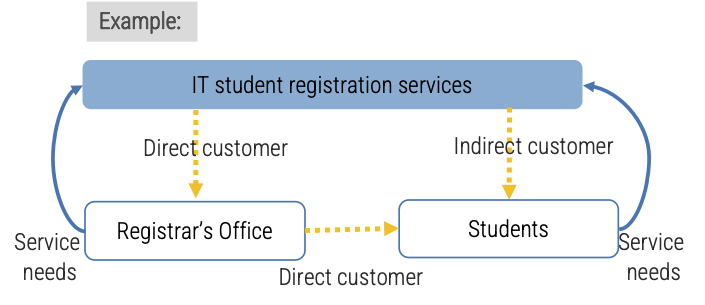
A customer can be direct or indirect
It is essential to understand the needs and goals of all customers as sometimes they conflict, and you must determine how to prioritize needs and resolve these conflicts. In this higher education example, the service has a direct customer (the Registrar’s Office) and an indirect customer (students).
Phase 1
Define Your Service’s Context and Scope
This phase will walk you through the following activities:
Describing your service
Discovering your service’s wider context
Confirming your service’s viability
This phase involves the following participants:
CIO/CDO
Business SMEs
Customer representatives
IT experts with exposure to customer-facing services, e.g. BA/BSAs, Architects, PMs
Service owner
UX designers
About Info-Tech
Info-Tech Research Group is the world’s fastest-growing information technology research and advisory company, proudly serving over 30,000 IT professionals.
We produce unbiased and highly relevant research to help CIOs and IT leaders make strategic, timely, and well-informed decisions. We partner closely with IT teams to provide everything they need, from actionable tools to analyst guidance, ensuring they deliver measurable results for their organizations.
What Is a Blueprint?
A blueprint is designed to be a roadmap, containing a methodology and the tools and templates you need to solve your IT problems.
Each blueprint can be accompanied by a Guided Implementation that provides you access to our world-class analysts to help you get through the project.
Need Extra Help?
Speak With An Analyst
Get the help you need in this 5-phase advisory process. You'll receive multiple touchpoints with our researchers, all included in your membership.
Guided Implementation 1: Define Your Service’s Context and Scope
- Call 1: Scope requirements, objectives, and your specific challenges.
- Call 2: Describe the service.
- Call 3: Service’s wider context & service viability.
Guided Implementation 2: Discover the Customer Layer
- Call 1: Service stages & persona.
- Call 2: Customer goals and activities.
- Call 3: Customer questions, touchpoints, and emotions.
- Call 4: Discuss opportunities.
Guided Implementation 3: Identify the Business Layer
- Call 1: Business goals, activities, and roles.
- Call 2: IT goals, activities, and roles.
- Call 3: Desired outcomes and associated risks.
Guided Implementation 4: Identify the Operational Layer
- Call 1: Business goals, activities, and roles.
- Call 2: IT goals, activities, and roles.
- Call 3: Desired outcomes and associated risks.
Guided Implementation 5: Analyze, Finalize, and Communicate
- Call 1: Key abilities.
- Call 2: Key technical systems.
- Call 3: Revisit design and context and complete proposal document.
Contributors
- Trevor Banks, Manager, Digital Organisational Design, The Treasury Board of Canada Secretariat
- Isa David, Director, Digital Talent Development, The Treasury Board of Canada Secretariat
- Thomas Kearney, Senior Analyst, Digital Organisational Design, The Treasury Board of Canada Secretariat
- Liz McKeown, Director General, Digital Community Management, The Treasury Board of Canada Secretariat
- Stefany Singh, Chief Digital Officer, BC Energy Regulator (BCER)
- Lily Yan, Director, Business Process Architecture, PointClickCare
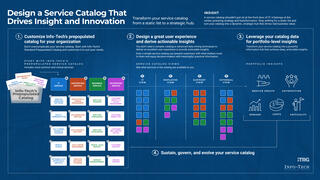 Design a Service Catalog That Drives Insight and Innovation
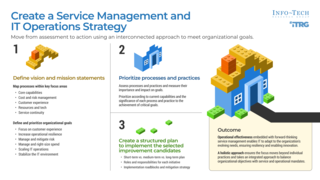 Create a Service Management and IT Operations Strategy
 Develop a Plan to Pilot Enterprise Service Management
 Create a Service Management Roadmap
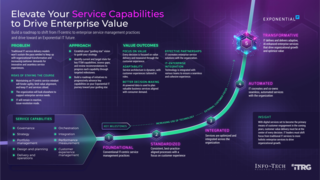 Elevate Your Service Capabilities to Drive Enterprise Value
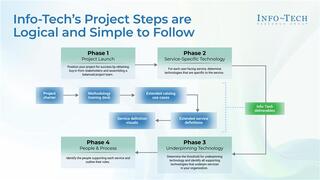 Create an IT View of the Service Catalog
 Initiate Your Service Management Program
 Develop Meaningful Service Metrics
 IT Service Management Selection Guide
 Service Management Integration With Agile Practices
 Define Your Enterprise IT and Digital Services
 Fast-Track Your Enterprise Service Design