
Augment Your DevOps Pipeline With AI
Embed AI strategically across your CI/CD pipeline to accelerate value, improve quality, and empower engineers.
The potential value of AI within CI/CD pipelines is significant, but most organizations struggle to determine where it can have the greatest impact and whether their pipelines are ready to support it. While AI can improve the speed and quality of software delivery, applying it indiscriminately can amplify existing weaknesses rather than resolve them. This research helps DevOps teams assess pipeline readiness, prioritize high-value AI opportunities, and build a practical roadmap for introducing AI safely and strategically.
AI can augment code review, intelligent testing, release risk scoring, deployment decisions, and observability, but these capabilities deliver value only when supported by a stable and well-governed pipeline. Rather than applying AI across every stage, DevOps teams should identify where the pipeline is ready for AI and prioritize the opportunities based on value, effort, and delivery risk.
1. Make your CI/CD pipeline AI-ready before making it AI-driven.
Organizations often overestimate their pipeline maturity because they lack a shared view of how the pipeline works today and which stages are stable enough for AI augmentation. Define your CI/CD pipeline baseline before introducing AI. Without this baseline, there is no reliable system for AI to support or optimize.
2. Start where AI delivers the greatest value.
Identify and prioritize the pipeline stages where AI can improve speed and quality without increasing delivery issues. Evaluating opportunities based on readiness, value, effort, and risk helps you focus AI investment on the DevOps activities most likely to deliver measurable value.
3. AI can scale bad decisions as quickly as good ones.
AI can accelerate the pipeline, but it can also move flawed decisions further through the delivery process. To keep teams in control, define which actions AI can take independently and where human review is required. This way, AI supports speed and better delivery instead of amplifying existing flaws.
Use this methodology to augment your DevOps pipeline with AI
This research walks you through a structured approach to evaluating your CI/CD pipeline readiness for AI. It includes readiness assessment and pipeline mapping guidance to help you identify the right AI opportunities for your specific pipeline activities. Follow this methodology to produce practical outputs, such as a pipeline inventory, opportunity map, readiness score, and action plan, to help your team launch a focused pilot and communicate your roadmap successfully.
- Know your pipeline by building a shared understanding of your CI/CD pipeline baseline and fundamentals.
- Assess readiness and map AI opportunities by evaluating candidates based on value, effort, and delivery risk.
- Create a pilot plan by establishing guardrails around the selected AI pilot.
Augment Your DevOps Pipeline With AI
Embed AI strategically across your CI/CD pipeline to accelerate value, improve quality, and empower engineers.
Analyst perspective
AI can supercharge your CI/CD pipeline, but only if you're ready for it.
You probably shouldn't inject AI into your CI/CD pipeline.
The pipeline is where changes are validated for release, and introducing non-deterministic AI there puts reliability, security, and compliance on the line. The industry agrees: 73% of organizations don't use AI in their pipelines at all (JetBrains Blog, 2026), and rightfully so; most simply aren't ready.
But if you are ready, it can be a game-changer.
Teams with mature pipelines (that may include strong branching hygiene, test automation, and observability) are using AI to predict build failures, prioritize tests, and cut through flaky-test noise. Early adopters report deployment frequency up 40% with incidents down 30% (Logiciel, 2025). The differentiator isn't the technology; it's readiness. Build the discipline first, then let AI amplify it.

Caleb Pittman
Research Specialist, Applications Delivery and Management
Info-Tech Research Group
Executive summary
Your Challenge
- AI adoption in CI/CD lags far behind developer workflows. Most developers use AI daily, yet 73% of organizations keep it out of pipelines entirely, widening the gap between individual productivity and delivery performance (Help Net Security, 2026).
- Functional pipelines are not necessarily AI-ready. Shipping code reliably is not the same as supporting AI-driven testing, deployment, or governance. Teams often overestimate their readiness.
- AI without foundational maturity increases instability. Teams introducing AI into immature pipelines see higher throughput paired with higher failure rates. AI does not fix weak processes but exposes and amplifies them (DORA, 2024).
Common Obstacles
- Teams lack clarity on where AI fits in the pipeline. Among teams withholding AI from pipelines, 19% cite a lack of use cases as the primary barrier (Gearset, 2025). The problem is decision paralysis about which stage to use AI in first, not tooling availability.
- There is a lack of trust in AI-generated pipeline outputs. Of organizations holding AI out of CI/CD pipelines, 36% cite lack of trust in AI-generated results (Help Net Security, 2026).
- No structured guidance exists for governing AI in the pipeline. Without guardrails, teams risk tool fragmentation and amplified process weaknesses that are harder to detect than human errors.
Info-Tech's Approach
Only inject AI into your CI/CD pipeline if you're ready. Follow Info-Tech's approach:
- Know your pipeline. Establish a shared understanding of CI/CD pipeline fundamentals and map your current state across the build, test, deploy, and observe stages.
- Assess readiness and map AI opportunities. Complete Info-Tech's Pipeline Readiness Assessment and determine feasible AI capabilities to add.
- Create a pilot plan. Build a prioritized action plan, select a qualified AI pilot, establish governance guardrails, and commit to a 30-day execution plan.
Info-Tech Insight
The promise of AI within CI/CD pipelines is significant, but most organizations are not positioned to take advantage of it. While capabilities like intelligent testing and predictive deployments are accessible, they rely on a level of pipeline consistency and control that is often missing. Make your CI/CD pipeline AI-ready before making it AI-driven. Without this foundation, AI will amplify instability rather than improve outcomes.
Evaluate AI opportunities in your pipeline
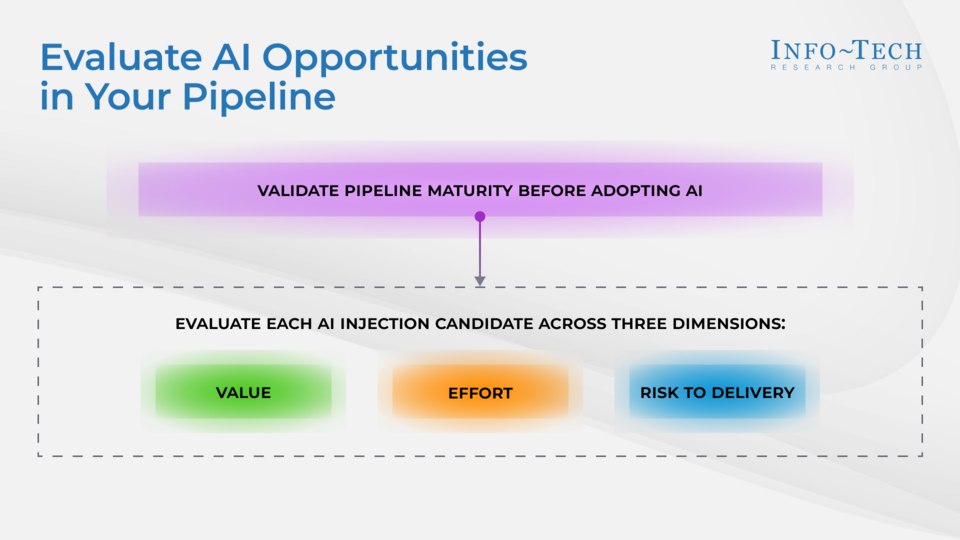
Ensure that your CI/CD pipeline is mature enough for AI injection, then carefully evaluate candidates.
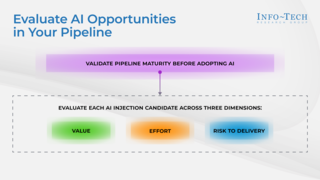
Validate pipeline maturity before adopting AI.
AI amplifies a pipeline's strengths and flaws, so fundamentals must come first.
Evaluate each AI injection candidate across three dimensions.
There are countless potential AI injections that could be made into a CI/CD pipeline, each with its own benefits and drawbacks. Weighing value, effort, and risk together shows which injections are worth making and which could cause more harm than good.
Value
Estimate the value this injection would deliver.
Where would it deliver the biggest gains in speed or quality?
Effort
Assess the effort needed to build and adopt it.
What skills, tooling, and integration would it demand?
Risk to delivery
Weigh the risk it poses to safe, compliant delivery.
Could a failure stall releases or slow our recovery?
Case study: Self-healing pull requests
INDUSTRY
Software (Search and Cloud Infrastructure)
SOURCE
Elasticsearch Labs
Elastic
Elastic is the software company behind Elasticsearch and Elastic Cloud. Its Control Plane team runs cloud.elastic.co and maintains a monorepo with about 500 actively updated dependencies.
Self-Healing Pull Requests Initiative
Renovate already automated dependency updates, bumping 41% of dependencies in six months. But broken builds still pulled engineers off planned work, making failed pull requests the pipeline's bottleneck.
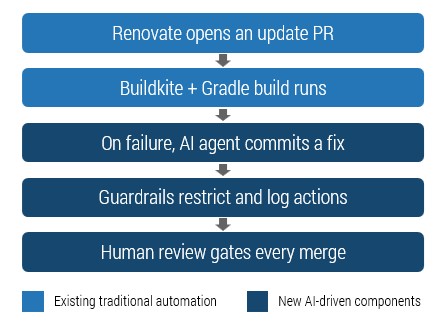
The team added an AI agent to its Buildkite and Gradle pipeline: When an update breaks the build, the agent reads the logs, iterates on a fix, and commits it back to the pull request. Nothing merges without human review.
Results
In its first month, covering 45% of dependencies, the agent fixed 24 broken pull requests and saved an estimated 20 days of engineering work. Elastic is now expanding it to all pull requests.
How the self-healing pull request pipeline works:
Renovate opens an update PR
Buildkite + Gradle build runs
On failure, AI agent commits a fix
Guardrails restrict and log actions
Human review gates every merge
Existing traditional automation
New AI-driven components
Measure the ongoing success of your CI/CD pipeline
Track outcomes across delivery speed, deployment stability, and pipeline efficiency.
01. Are we shipping faster?
Whether the pipeline gets changes into production quickly. For example:
- Deployment frequency: How often code is successfully released to production per day or week.
- Lead time for changes: Time from a code commit to it running safely in production.
02. Is the pipeline reliable?
Whether deployments stay stable and recover fast when they break. For example:
- Change failure rate: Share of deployments that cause an incident or require a rollback.
- Mean time to recovery (MTTR): Average time to restore service after a failed deployment.
03. Is the pipeline healthy?
Whether pipeline runs are efficient and dependable day to day. For example:
- Build success rate: Percentage of pipeline runs that pass without manual intervention.
- Pipeline duration: Average end-to-end time for a build, test, and deploy cycle.
Insight summary
Overarching insight
The promise of AI within CI/CD pipelines is significant, but most organizations are not positioned to take advantage of it. While capabilities like intelligent testing and predictive deployments are accessible, they rely on a level of pipeline consistency and control that is often missing. Make your CI/CD pipeline AI-ready before making it AI-driven. Without this foundation, AI will amplify instability rather than improve outcomes.
Step 1 insight
Organizations often overestimate their pipeline maturity because they lack a clear shared view of how it works. Define your CI/CD pipeline baseline before introducing AI. Without this baseline, there is no reliable system for AI to support or optimize.
Step 2 insight
Don't apply AI across your entire pipeline indiscriminately. Use Info-Tech's Pipeline Readiness Assessment to identify and prioritize which steps are suitable for AI injections.
Step 3 insight
AI in the pipeline does not reduce the need for human judgment; it raises the stakes. Without defined checkpoints, rollback paths, and clear accountability, AI accelerates both good and bad decisions. Design every AI-augmented stage with explicit human oversight. Speed without control is not progress; it is risk operating at scale.
Tactical insight
A pipeline diagram is only useful if it is honest. Teams cannot accurately assess readiness from an idealized process diagram that hides imperfections. Map the pipeline as it actually operates, not as the team wishes it operated. Do that first, and the real AI opportunities become clear.
Tactical insight
Measure before you automate. Communicate AI value in terms stakeholders understand. Many AI initiatives lose momentum because teams focus on technical outputs instead of business outcomes. Establish baseline metrics and success criteria before introducing AI so you can demonstrate its impact on delivery, quality, and efficiency.
Info-Tech's methodology for augmenting your DevOps pipeline with AI
| 1. Know Your Pipeline | 2. Assess Readiness & Map AI Opportunities | 3. Create a Pilot Program | |
|---|---|---|---|
| Phase Steps |
|
|
|
| Phase Outcomes | Shared understanding of CI/CD anatomy and a completed pipeline inventory – the substrate AI will later map to. | AI opportunity map by pipeline stage, a scored readiness profile, and a prioritized opportunity list gated by readiness. | An owned action plan, a focused AI pilot, a governance framework, and a stakeholder-ready 30-day commitment. |
Blueprint deliverables
Each step of this blueprint is accompanied by supporting deliverables to help you accomplish your goals:
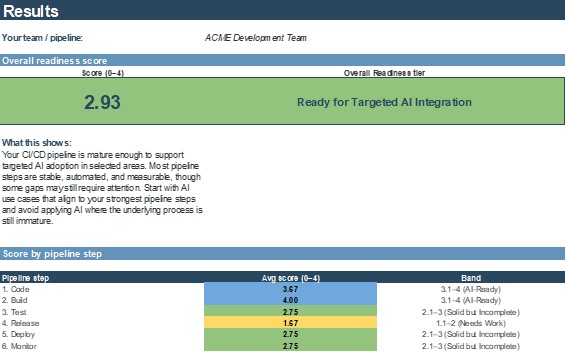
Pipeline Readiness Assessment
Complete a simple assessment to determine if you are ready to inject AI into your CI/CD pipeline.
Key deliverable:
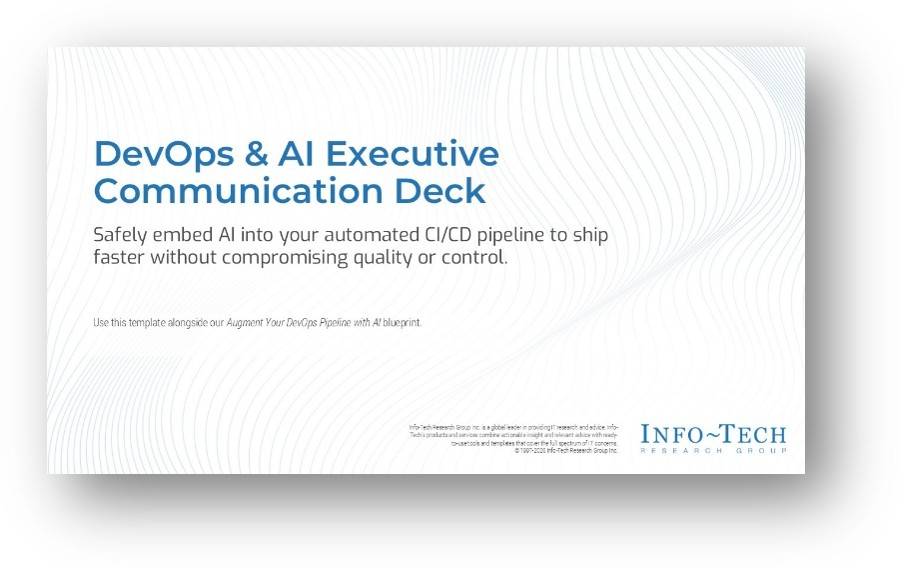
DevOps & AI Executive Communication Deck
Effectively communicate your vision for an AI-augmented CI/CD pipeline.
Blueprint benefits
| Build an AI-Ready Pipeline Foundation | Prove and Communicate AI Value |
|---|---|
| You'll build a functional CI/CD baseline, assess pipeline maturity, and identify readiness gaps across key dimensions. Then you'll map AI opportunities to the right stages and prioritize use cases by value, effort, and risk. | You'll also translate AI-driven pipeline improvements into stakeholder-facing outcomes and build a defensible roadmap for AI augmentation, defining a focused 30-day pilot, establishing guardrails and ownership, and building confidence before scaling AI across the pipeline. |
Step 1
Know Your Pipeline
Activities
1.1 Define your pipeline improvement objectives
1.2 Map your current CI/CD pipeline
This step involves the following participants:
- DevOps Team Leads
- Engineering Managers
- IT Leaders/CIOs
- Pipeline Owners
- Release Managers
- Platform Engineers
- QA/Test Automation Leads
- Software Development Managers
Outcomes of this step
- A scoped pipeline and two to three prioritized improvement objectives in the DevOps & AI Executive Communication Deck
- A customized visual diagram of your current CI/CD pipeline in the DevOps & AI Executive Communication Deck
Augment Your DevOps Pipeline With AI
Step 1 > Step 2 > Step 3
Info-Tech Insight
Step 1
Organizations often overestimate their pipeline maturity because they lack a clear shared view of how it works. Define your CI/CD pipeline baseline before introducing AI. Without this baseline, there is no reliable system for AI to support or optimize.
Why the pipeline is AI's highest-leverage point
AI multiplies the volume, speed, and risk of change, and all of it passes through the CI/CD pipeline.
CI/CD PIPELINE → PRODUCTION
90% of technology professionals use AI in their work, which has led to higher software delivery throughput (DORA, 2025).
78% of organizations report developers are writing and committing code faster with AI (GitLab, 2026).
43% of organizations cannot reliably tell AI-generated code from human-written code in their own codebase, which makes the pipeline's automated gates the last dependable checkpoint before production (GitLab, 2026).
Ship code from commit to production
A CI/CD pipeline is the automated path every code change travels from a developer's commit to live production. Each stage runs its own checks, so problems surface early and only validated work moves forward. This turns release into a repeatable, low-risk routine, rather than a manual event.
Integrate
Merge and build each commit, then run automated tests so defects surface within minutes.
Deliver
Package the tested build into a versioned, deployable release artifact.
Deploy
Promote that release through staging to production with consistent, repeatable steps.
Learn
Monitor live performance and feed the signals back to guide the next change.
See how code has traditionally run through the pipeline
CI/CD stands for Continuous Integration and Continuous Delivery/Deployment. Traditionally, these pipelines are structured as a fixed sequence of stages, each one gating the next:
Code → Build → Test → Release → Deploy → Monitor
A change only advances once the prior stage passes, so quality is enforced at every step.
CI (stages 1-3): Code, Build, and Test automatically merge and verify every change.
CD (stages 4-6): Release, Deploy, and Monitor ship those verified changes to users safely.
| 1 | Code: Developers commit their changes to a shared repository, where version control tracks every edit and merges everyone's work together. |
| 2 | Build: The system automatically compiles the source and packages it into a single runnable artifact ready to test. |
| 3 | Test: Automated tests check the build for bugs, broken features, and security flaws before it can go further. |
| 4 | Release: The approved artifact is versioned and stored, creating a trusted, ready-to-ship copy any environment can pull. |
| 5 | Deploy: That release is pushed to staging and then production using the same repeatable steps every time, reducing human error. |
| 6 | Monitor: Once live, the system watches performance, errors, and usage, feeding real-world signals back into the next change. |
About Info-Tech
Info-Tech Research Group is the world’s fastest-growing information technology research and advisory company, proudly serving over 30,000 IT professionals.
We produce unbiased and highly relevant research to help CIOs and IT leaders make strategic, timely, and well-informed decisions. We partner closely with IT teams to provide everything they need, from actionable tools to analyst guidance, ensuring they deliver measurable results for their organizations.
What Is a Blueprint?
A blueprint is designed to be a roadmap, containing a methodology and the tools and templates you need to solve your IT problems.
Each blueprint can be accompanied by a Guided Implementation that provides you access to our world-class analysts to help you get through the project.
Need Extra Help?
Speak With An Analyst
Get the help you need in this 3-phase advisory process. You'll receive multiple touchpoints with our researchers, all included in your membership.
Guided Implementation 1: Know Your Pipeline
- Call 1: Scope requirements, objectives, and your specific challenges.
Guided Implementation 2: Assess Readiness and Map AI Opportunities
- Call 1: Review pipeline diagram and begin maturity assessment.
- Call 2: Review results of maturity assessment and discuss potential injections.
Guided Implementation 3: Create a Pilot Program
- Call 1: Create list of priorities and lay out future roadmap.
- Call 2: Discuss potential AI pilots.
- Call 3: Finalize executive communication deck.
 Build a Software Quality Assurance Program
 Optimize Your SQA Practice Using a Full Lifecycle Approach
 Optimize Applications Release Management
 Automate Testing to Get More Done
 Leverage Gen AI to Improve Your Test Automation Strategy
 Augment Your DevOps Pipeline With AI