Adaptive AI Governance Roadmap: From Principles to Practice
Prepare your organization for agentic AI and tomorrow’s AI technologies and solutions.
Book This Workshop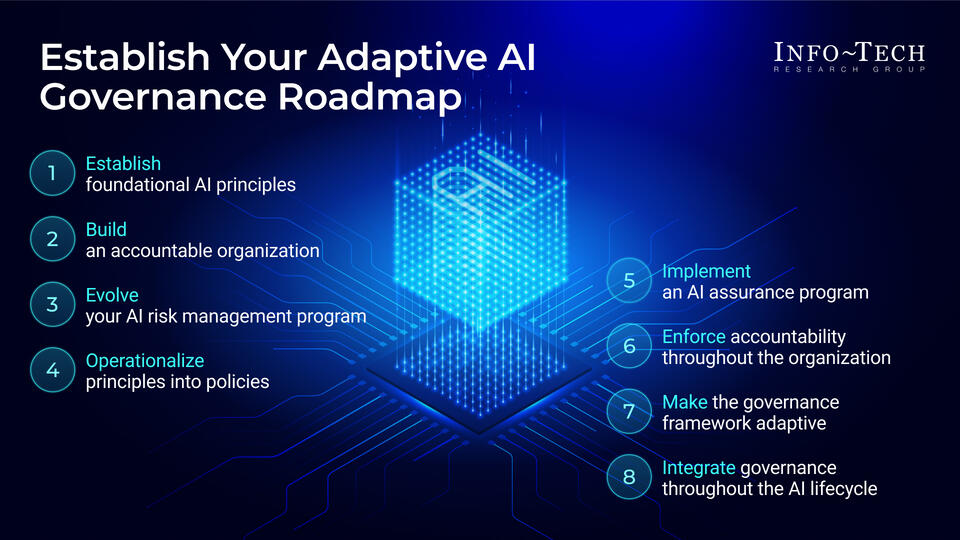
Not implementing an AI governance roadmap will:
- Increase the risk of failure surrounding your AI initiatives.
- Put the organization under greater risk of liability due to improper use of AI.
- Stifle the ability to scale AI effectively. At best, inconsistent levels of AI governance will appear in different parts of the organization.
Successfully implementing an AI governance roadmap will:
- Provide a consistent and stable operating approach throughout the organization.
- Allow you to effectively push your AI practices to the scale of the organization.
- Minimize the risk of legal and financial liability due to publicly well-understood practices.
Book Your Workshop
Onsite Workshops offer an easy way to accelerate your project. If you are unable to do the project yourself, and a Guided Implementation isn’t enough, we offer low-cost onsite delivery of our Project Workshops. We take you through every phase of your project and ensure that you have a road map in place to complete your project successfully.
Book NowModule 1: Review Current AI Strategy and Governance
The Purpose
Key Benefits Achieved
| Activities: | Outputs: | |
|---|---|---|
| 1.1 | Review the organization's current AI governance model. |
|
| 1.2 | Review the organization's existing AI strategy and roadmap. |
|
| 1.3 | Draw an inventory of applicable legal and regulatory requirements. |
|
Module 2: Establish Foundational AI Principles and Governance
The Purpose
Key Benefits Achieved
| Activities: | Outputs: | |
|---|---|---|
| 2.1 | Level-set on the goals of AI governance and current AI governance maturity. |
|
| 2.2 | Determine and define foundational AI principles for the organization. |
|
| 2.3 | Identify key strategic, tactical, and operational elements of the organization’s AI governance structure. |
|
| 2.4 | Define mandate, roles, and responsibilities. |
|
| 2.5 | Develop a charter for your executive-level committee. |
|
Module 3: Define AI Governance Framework
The Purpose
Key Benefits Achieved
| Activities: | Outputs: | |
|---|---|---|
| 3.1 | Identify any risk and compliance requirements. |
|
| 3.2 | Assess the organization’s AI risk tolerance. |
|
| 3.3 | Recommend AI governance procedure and policy framework. |
|
| 3.4 | Recommend an AI assurance framework. |
|
| 3.5 | Establish accountability structure for AI applications. |
|
Module 4: Integrate Governance Into the AI Lifecycle
The Purpose
Key Benefits Achieved
| Activities: | Outputs: | |
|---|---|---|
| 4.1 | Define AI governance adaptability and resilience requirements. |
|
| 4.2 | Define key AI governance requirements for each stage of the AI lifecycle. |
|
Module 5: Build an AI Governance Implementation Roadmap
The Purpose
Develop a roadmap and communication plan to proactively govern AI.
Key Benefits Achieved
Implement a dynamic, system-oriented, and continuous-monitoring governance model.
| Activities: | Outputs: | |
|---|---|---|
| 5.1 | Identify AI governance implementation initiatives. |
|
| 5.2 | Develop a high-level AI governance implementation roadmap. |
|