
Infrastructure and Operations Priorities 2026
Infrastructure meets IT’s moment.
Turn change and disruption into resilience.
AI, cybersecurity risk, and regulatory change are poised to be big disruptors for enterprise IT in 2026. Infrastructure and operations (I&O) leaders must counter those challenges with a technology-first action plan to manage risk while streamlining and stabilizing operations from several angles. As economic volatility continues, I&O needs to reset its approach to cloud, AI ROI, and the ongoing skills gap to bolster resilience in the year ahead.
The Infrastructure & Operations Priorities 2026 report outlines five critical initiatives to help I&O leaders break free of the technical debt, legacy systems, and manual processes that are preventing many organizations from becoming high-performing enterprises.
Five top priorities for I&O leaders in 2026
Infrastructure & Operations Priorities 2026 is based on real-world case studies, in-depth executive interviews, and the results of Info-Tech’s Future of IT survey and diagnostic benchmark reports. This new report explores five key priorities for infrastructure and operations strategy in the coming year, plus practical steps to turn your I&O roadmap into reality.
1. Rethink Cloud Operations
Optimize hybrid, multicloud, and edge strategies.
Refresh your cloud operations framework to reflect the way IT is delivered now. Don’t merely reassess cloud technology; adopt a unified, holistic approach to cloud architectures, governance, and workflows by embracing new ways of working, such as DevOps, platform engineering, and site reliability engineering.
2. Maximize AI ROI With FinOps
Better manage AI experimentation costs with FinOps.
As many organizations tighten their budgets next year, FinOps will become more important than ever for AI projects. Drive ROI on AI initiatives by using FinOps to monitor AI-related cloud spend and optimize cloud resource allocation for AI workloads.
3. Regain Control Through Observability
Go beyond traditional approaches to monitoring.
Hybrid work, cloud-based environments, and rapid technological evolution necessitate a new approach to monitoring that aligns with business goals. Traditional monitoring tools generate boatloads of data points but not all of them lead to valuable insights. Achieve the right level of monitoring and observability that’s more proactive, inferential, insight-driven, and contextual.
4. Embrace AI-Enhanced IT Operations
Define key AIOps use cases.
Info-Tech data suggests IT teams still spend one-third of their time on maintenance. Leverage automated and autonomous AIOps to reduce team toil, improve processes, and work toward end-to-end visibility. Just make sure AIOps initiatives are aligned with organizational goals, not merely IT operational improvement.
5. Invest in a Culture of Curiosity
Build critical skills for the future now.
Emerging technologies are evolving quickly, the skills gap has become a chasm, and neither can be fully addressed by traditional hiring and outsourcing. Invest in people rather than just technology by building an internal culture of continuous learning, adaptability, knowledge transfer, and knowledge collaboration.
INFRASTRUCTURE & OPERATIONS PRIORITIES 2026
INTRODUCTION
Analyst Perspective
Infrastructure meets IT's moment.
It may not surprise you to learn that in Info-Tech's most recent Future of IT Survey, respondents told us that AI or other emerging technologies were most likely to disrupt business over the next year, with cybersecurity incidents and government-enacted regulatory changes rounding out the top three. The prospect of change and disruption requires IT and infrastructure leaders to seize IT's moment: counter global uncertainty, disruption, and transformation with a technology-first action plan that eliminates wasted spend, invests in high-value capabilities, builds an adaptive IT workforce, and applies operational data to deliver the insights needed to adapt IT initiatives on the fly.
Organizations that can improve performance by streamlining and stabilizing operations will be more resilient to change and disruption because they will be able to recover more quickly, reduce downtime, and allocate resources more strategically. However, these goals can be stymied by systemic inefficiencies. Is Infrastructure & Operations prepared to manage risk and optimize operations?
In this Infrastructure & Operations Priorities Report, we have developed five priorities that address the need to manage risk and optimize operations from several angles: Rethink Cloud Operations, Maximize AI ROI With FinOps, Regain Control Through Observability, Embrace AI-Enhanced IT Operations, and Invest in a Culture of Curiosity.

Emily Sugerman
Senior Research Analyst,
Infrastructure & Operations
Info-Tech Research Group
INTRODUCTION
Moving from trends to priorities
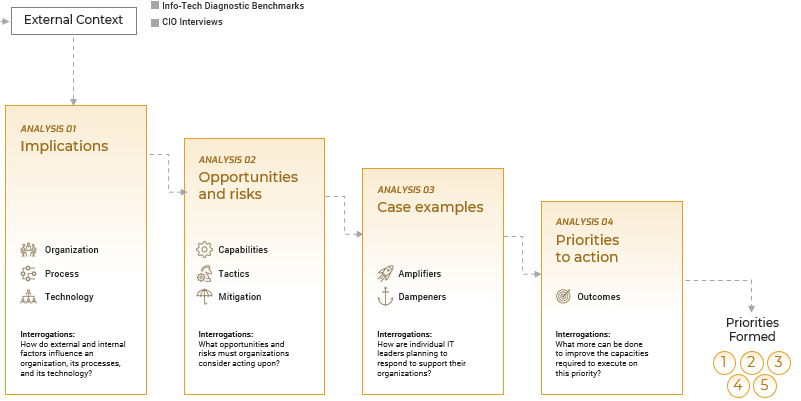
Understand the infrastructure & operations priorities by analyzing both how I&O leaders respond to trends in general and how specific I&O leaders responded in the context of their organization.
CONTEXTUAL INSIGHTS
A priority is created when external factors hold strong synergy with internal goals and an organization responds by committing resources to either avert risk or seize opportunity.
PRIORITY INSIGHTS
For each priority, this report will examine how I&O leaders are responding to the implications of the external trends impacting their organization. We'll consider the capabilities that play a role in responding to the opportunities and threats and suggest an initiative to improve them. Case studies from I&O leaders planning for 2026 provide specific insight, and Info-Tech resources are recommended to help clients take action on priorities.
INTRODUCTION
Methodology
We gathered the data in this report from the following sources:
Future of IT 2026 Survey
Info-Tech Research Group conducted the Future of IT 2026 Survey between May and June 2025. The online survey received 738 responses from IT decision-makers across a broad range of industries and regions, with a focus on North America. Each chart included in the report will specify the sample size received for the specific question or respondent group.
Info-Tech Diagnostics
Diagnostic benchmark reports including the End User Satisfaction, IT Staffing Assessment, and the IT Management & Governance Diagnostic reflect Info-Tech member results for the period of August 1, 2024 to July 31, 2025. Sample sizes for specific metrics will be provided where data from these diagnostics are used in this report.
Priorities Interviews
Info-Tech analysts conducted in-depth interviews with IT leaders between August and October of 2025 to collect insights on priority-making and agenda-setting for 2026. Use the linked Info-Tech research to dive deeper into these topics and help turn the roadmap into reality.
INTRODUCTION
Optimizing operations requires IT maturity
Delivering value and ROI is not optional: Can IT deliver?
Fortunately, 39% of Future of IT Survey respondents believe that IT can generate an exponential increase in value in 2026 (n=522). This kind of value delivery requires a commensurate level of IT maturity, and respondents largely see themselves as positioned to innovate and partner with the business. Almost 60% placed themselves in the top two categories: IT is an innovator (26.5%) and IT is a business/organization partner (31.6%). This confidence is encouraging, especially considering the challenging business environment many enterprises face.
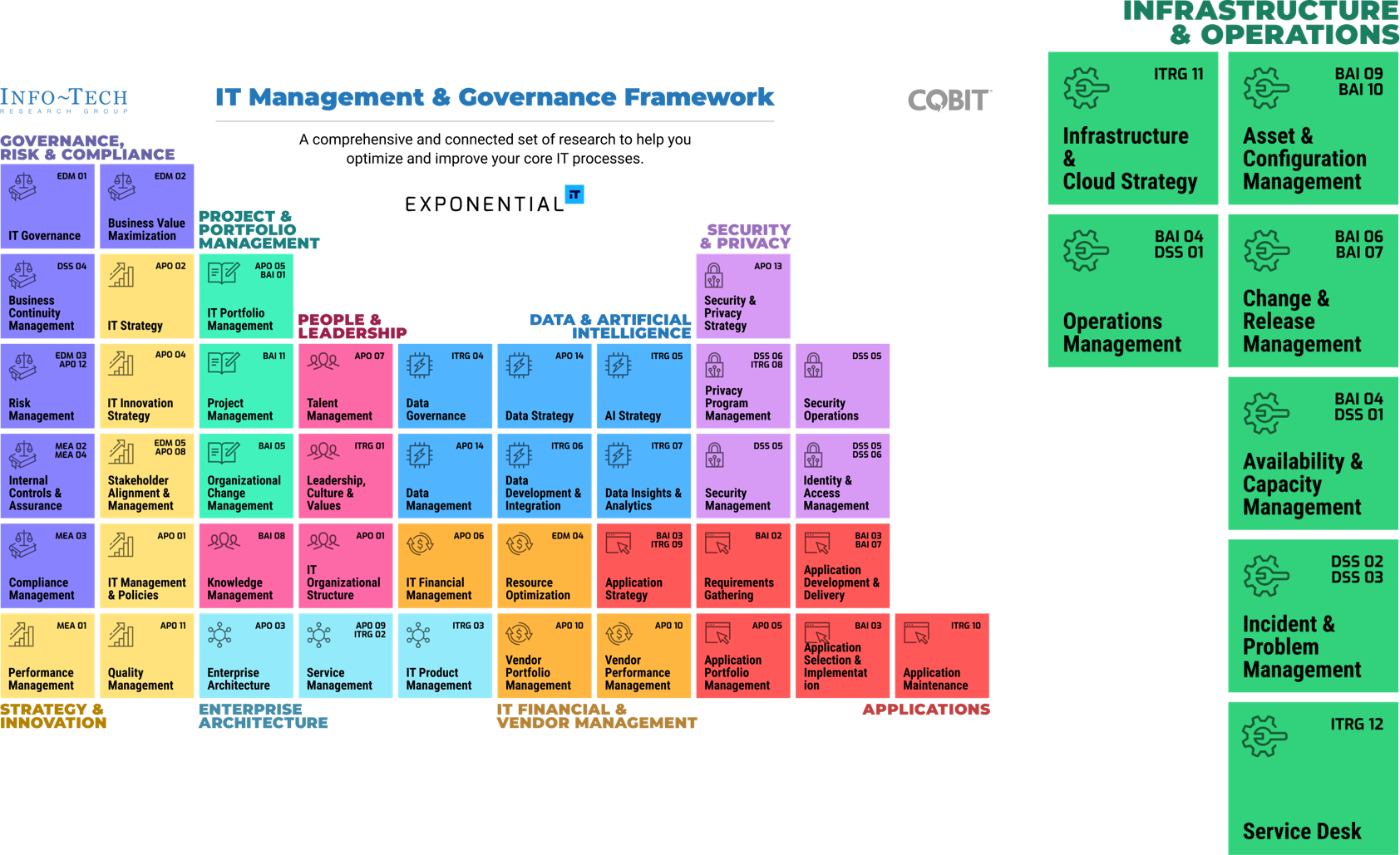
Infrastructure & Operations comprises several core IT management and governance capabilities.
For IT to deliver on its promised value, the core processes need to not only be in place but also be mature. To effectively execute on these capabilities, I&O leaders must establish a clear direction for modernization and high-level planning.
What best describes your current level of IT maturity?
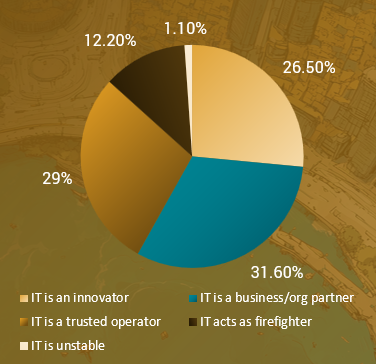
Future of IT 2026 Survey; All organizations n=525
INTRODUCTION
Yet key challenges stand in the way of infrastructure innovation
Driving innovation requires breaking the cycle of technical debt and inefficient processes, but operational inefficiency and legacy systems eat up the very time needed to transform and modernize.
In an economic landscape that requires enterprises to operate as leanly and cost-effectively as possible, organizations hamstrung by technical debt and ineffective core processes will be at risk of failing to deliver value. This urgency is reflected in what Future of IT Survey respondents told us they were prioritizing in 2026: the reduction of technical debt (52%), the optimization of cloud workloads (45%), and the mitigation of risks in relationships with critical infrastructure vendors (44%). Meanwhile, 44% plan to prioritize managing and mitigating risk in service management and IT operations.
We also asked respondents for the top three challenges likely to interfere with infrastructure and operations objectives in 2026. The top answers here also reflect an urgency to move out of a risky and inefficient firefighter mode: ineffective core processes (46%), lack of skilled personnel (43%), and interoperability issues (35%). Close behind, tied for fourth were budgetary constraints (34%) and the inability to scale infrastructure to meet demand (34%). Elsewhere, 30% of respondents cited outdated infrastructure (legacy systems) as a challenge likely to interfere with cybersecurity objectives (n=157).
Delivering innovation securely is challenging when one is bound to technical debt, pressure to prioritize speed and delivery, and manual, inefficient processes. Breaking and escaping that cycle will be what sets high-performing enterprises apart.
Top 3 Future of IT infrastructure priorities for 2026
1 Reduce technical debt (52%)
2 Optimize cloud workloads (45%)
3 Mitigate risks in relationships with critical infrastructure vendors (44%)
Top 3 Future of IT infrastructure challenges for 2026
1 Ineffective core processes (46%)
2 Lack of skilled personnel (43%)
3 Interoperability issues (35%)
Future of IT 2026 Survey; All organizations n=216
INTRODUCTION
Back to basics:
Delivering on core I&O capabilities
Organizations are often challenged to execute on core infrastructure capabilities.
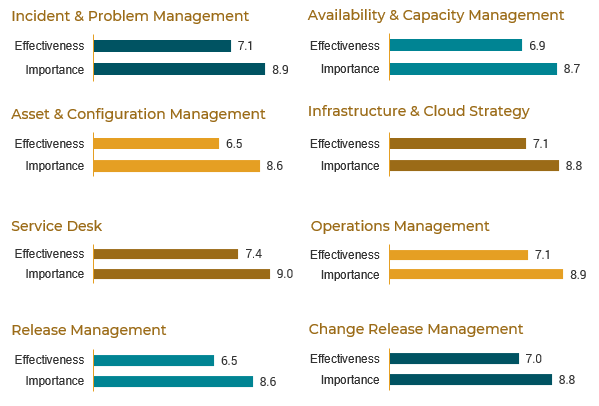
The first step to IT maturity is the execution of core infrastructure capabilities. Info-Tech's IT Management & Governance Diagnostic asks IT teams to rate their own performance executing eight core infrastructure and operations capabilities and to rate their perception of the importance of these capabilities, each on a separate ten-point scale, with an average effectiveness score of 62% across all eight capabilities (n=254 organizations).
Over the last year, the I&O capability with the largest perceived gap between importance and effectiveness was Asset & Configuration Management. On the other end of the scale, Service Desk was the capability with the smallest gap between importance and effectiveness. Indeed, Service Desk returned the smallest gap between importance and effectiveness across all 50 capabilities on Info-Tech's IT Management & Governance Framework.
Our End User Satisfaction Diagnostic data also reflects the strength of the Service Desk and its value to be leveraged in seizing IT's moment. End users reported 86% satisfaction with Service Desk Effectiveness and 85% satisfaction with Service Desk Timeliness (n=66 organizations).
INTRODUCTION
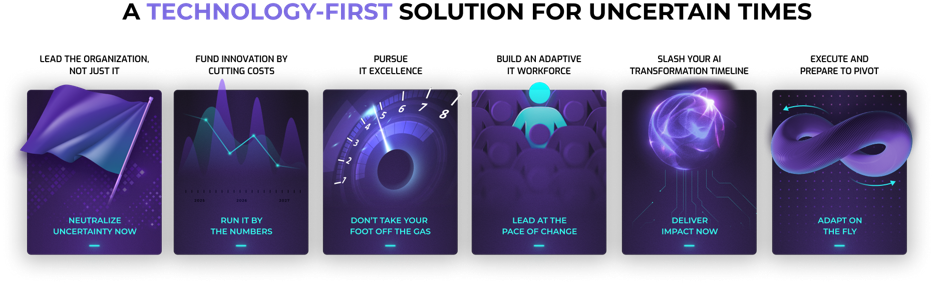
Priorities 2026: Seize IT's moment with a technology-first action plan
IT can leap from now to next by mitigating risks, optimizing costs, and unlocking resources to drive innovation and AI transformation.
INTRODUCTION
Add your priorities to your infrastructure roadmap
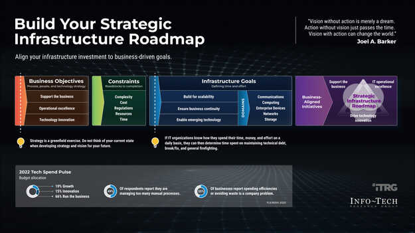
Identify the priorities you want to pursue and add them as initiatives to your infrastructure roadmap for 2026.
The old days of tactical and reactive IT operations need to change. The IT team must become strategic and proactive in its planning and execution of key initiatives. These strategic objectives need to align to the organization's vision and goals.
Use the priorities in this report as a jumping-off point to building your own strategic infrastructure roadmap. Set the long-term direction, build a framework for decision-making, create a foundation for operational planning, and be able to explain to the business what you are planning. Your roadmap is a basis for accountability and sets out goals and priorities for the future.
FEATURED RESEARCH:
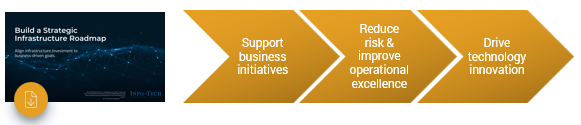
Build a Strategic Infrastructure Roadmap
PRIORITY 01
Rethink Cloud Operations
Optimize hybrid, multicloud, and edge strategies
Modernize cloud operations to meet IT's moment
We asked Future of IT Survey participants about their infrastructure priorities for 2026. Forty-five percent indicated plans to optimize cloud workloads: the second most popular response. Respondents also expressed interest in unified management: 29% of our survey respondents aim to unify hybrid clouds under a single command and control toolset in 2026. Hybrid cloud environments are widespread: third-party reports show hybrid cloud adoption rates (applying the same service model across multiple cloud delivery models, e.g. public cloud and private on-premises cloud infrastructure) range anywhere from 17%1 to 70%2. Multiple public cloud environments are also prominent, with third-party data indicating that 14% of organizations make use of multiple public clouds (with no hybrid cloud) and that 55% of those who pursue a hybrid cloud strategy also use multiple public clouds.2
Hybrid and multicloud environments can lead to complex and fragmented infrastructure. Given this complexity, infrastructure leaders should assess whether their existing approach to cloud operations truly supports hybrid and multicloud architectures and ecosystems or if their approach should be reimagined. This rethinking involves not only new technology but also moving away from traditional, siloed infrastructure management and adopting modern ways of working like DevOps, site reliability engineering (SRE), and platform engineering.
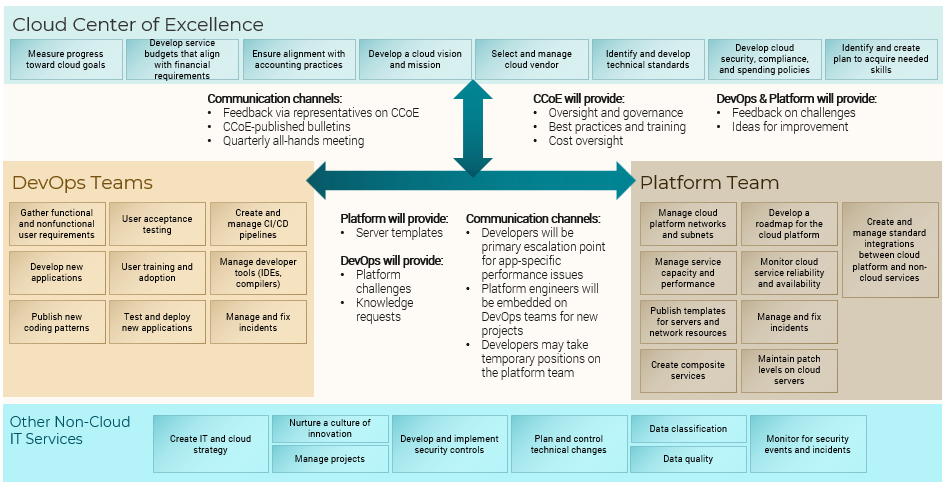
Modern cloud operations offer a holistic, unified framework that defines roles and responsibilities for each cloud workflow category across service models and deployment models. The framework is reinforced by key operational pillars (performance, reliability, cost effectiveness, security, and operational excellence). It integrates new ways of working, governance structures that bear responsibility for oversight of cloud initiatives, and a plan for how the organization will acquire the skills needed to support the cloud environment.
What are your biggest IT infrastructure priorities for 2026?
45% Optimize cloud workloads
29% Unify hybrid clouds under a single command and control toolset
Future of IT 2026 Survey; n=216
1. Rackspace, 2025
2. Flexera, 2025
Time to refresh operational processes to reflect the way IT is delivered now
Organizations that lifted and shifted from the data center often replicate the same architecture in the cloud without optimizing for cloud capabilities. Though this approach has the advantage of getting out of the data center quickly, it will not necessarily be as performant or cost-effective, leading to fewer long-term benefits. Optimizing means rightsizing, ensuring the appropriate pricing model is in use, and becoming more cloud native. In a nutshell: Organizations should be modernizing as they move to the cloud.
This modernization does not just involve rearchitecting but also redesigning cloud operations. The cloud also requires a shift in mindset and processes for which organizations are not always prepared. Rebuilding cloud operations involves mapping and organizing cloud work by breaking it down into workstreams. The type of cloud work the organization does will differ depending on whether you build with PaaS and IaaS, host with IaaS, or consume with SaaS, but regardless of your predominant workstream, cloud operations should align to the key pillars of cloud operations established by top cloud providers (Performance, Cost Optimization, Reliability, Security & Privacy, and Operational Excellence).
The cloud operations framework should visualize what kind of cloud work is done, who performs it, and how the work delivers organizational value. It shows the key work areas involved (such as DevOps, cloud platform, and cloud center of excellence, pictured), the roles and responsibilities associated with each, and how the work areas should communicate and collaborate.
See the next slide for an example of a cloud operations framework for an organization that is building cloud services.
FEATURED RESEARCH:
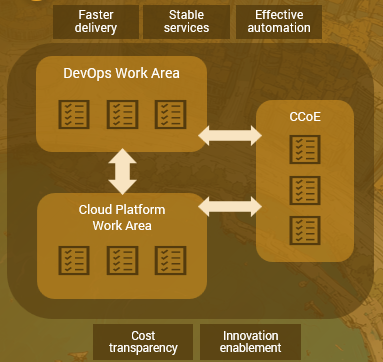
Design cloud operations around "work areas" that define who is responsible for what tasks and how work areas should interact to best facilitate desired business outcomes.
Cloud operations diagram example
Opportunities
DEFINING CLOUD OPERATIONS IS KEY TO EFFECTIVELY MANAGING CLOUD INFRASTRUCTURE
In the wake of global volatility and uncertainty, organizations build resilience by defining a cloud operations model that accommodates multiple service models (infrastructure-as-a-service, platform-as-a-service, and software-as-a-service) and deployment models (hybrid, multicloud, and edge computing). Yet, hybrid and multicloud environments are not always the result of deliberate strategy; siloed teams that adopt different cloud solutions may unintentionally introduce complexity, making operational consistency and effective hybrid cloud management more important than ever.
DELIVER MORE CLOUD VALUE
Defining a cloud operations framework brings strategic design and creates new value:
- Better define the key roles and work involved in operating cloud services in your organization.
- Deliver faster and more effective cloud services that are more secure.
- Increase flexibility: Remove infrastructure provisioning as a bottleneck.
- Enable innovation: Create sandboxes/innovation practices to experiment with and develop new functionality on cloud platforms.
- Optimize costs: Eliminate wasted cloud spend.
- Improve operational efficiency and standardize services and processes across the organization.
“If you're just using the cloud like another data center, then all you've got is a more expensive data center. You do have to modernize and optimize – if not, then you're actually potentially making things worse. The juice won’t be worth the squeeze, and you might as well have stayed where you were.”
Nabeel Sherif
Principal Advisory Director
Info-Tech Research Group
Risks
Establishing a cloud operations framework is important to document areas of ownership and responsibility. If teams don't have clear guidance and defined processes regarding how cloud workflows should be set up and run, teams will make their own decisions and introduce complexity, making management more difficult.
RISKS OF REDESIGNING CLOUD OPERATIONS
However, redesigning cloud operations can come with its own risks. Reconstructing on-premises operations in the cloud can undermine the benefits of cloud-native approaches.
RISKS OF MULTICLOUD
Embracing multicloud can also introduce risks:
- Organizations must determine if the greater expense of multicloud is worth it to mitigate occasional downtime.
- The service model affects the ease of managing a multicloud ecosystem with multiple providers. For instance, diversifying IaaS providers will be more challenging than diversifying providers for SaaS workloads while also requiring additional complex skill sets to manage multiple IaaS platforms. As a result, organizations may face additional challenges acquiring the right combination of cloud skills.
- A healthy multicloud ecosystem also requires organizations to manage risks and maintain oversight across each environment, duplicating effort and time required of existing staff. The increased complexity will impact cloud security, adding new requirements for security tools and capabilities, as "each cloud provider approaches security differently in terms of security policies and shared responsibility models, and the onus falls on internal teams to identify and compensate for those differences" (Pluralsight, 2024).
LEGACY NETWORK INFRASTRUCTURE
Twenty-eight percent of Future of IT Survey respondents indicate that modernizing network infrastructure is a 2026 priority. Legacy networks can pose a challenge to the goal of optimizing cloud workloads if they cannot support hybrid or multicloud architectures, rapid rehoming of workloads, or distributed edge workloads.
28% of organizations are prioritizing modernization of network infrastructure
Future of IT 2026 Survey; n=216
CASE STUDY
Design against cloud dependency
October 2025 AWS Outage
VENDOR/REGION CONCENTRATION AS A SINGLE POINT OF FAILURE
On October 20, 2025, an AWS outage in the US-EAST-1 region led to widespread downtime and interruptions to customers of its cloud services. Amazon reported a resolution to the service disruptions later the same day, and Amazon's share price was not significantly affected (New York Times, 20 Oct. 2025). The impact was shouldered by customers, as media coverage focused on the risk of vendor or regional concentration that can arise from the dominance of a few large companies in the cloud provider market. In an interview with GeekWire, Vaibhav Tupe commented that "This outage shows that even the largest cloud providers are vulnerable when failure occurs at the control-plane level [. . .] It raises fundamental questions about over reliance on a single provider or region and may accelerate demand for multi-cloud and multi-region architectures as a baseline expectation for resilience." These are not new concerns; for instance, similar warnings about cloud dependency emerged in July 2024, when Microsoft and AWS experienced global outages on the same day.
TAKEAWAYS
Mitigations and lessons learned will depend on whether you build, host, or consume. The cloud providers themselves can do the most to "develop different competing infrastructures within their own ecosystems" and "isolate critical networking components more aggressively to prevent cascading failures when cores systems malfunction" (GeekWire, 2025). Multicloud redundancy may make sense for those who build their own applications and have a microservices, autoscaling, and container-based environment. For others with more traditional deployments, multicloud redundancy may become too expensive and complex. Ultimately, organizations need to perform a disaster recovery plan business impact analysis to identify the workloads that are too risky for extensive downtime and that would trigger business continuity procedures for failure or alternative architectures.
A well-designed cloud operating model can help organizations proactively address these risks by aligning cloud operations with the well-architected frameworks established by top cloud providers. Designing against cloud dependency falls under two key pillars of cloud operations, reliance and performance efficiency, and could result in evaluating your region dependencies to determine if adopting service availability across multiple regions should be a core design principle in your cloud operations.
From priorities to action
BEGIN WITH THE CLOUD STRATEGY
Take a practical approach to building a cloud strategy rooted in business alignment, governance maturity, and pattern-driven decision-making. By identifying best-practice patterns (i.e. design principles), and proactively avoiding common anti-patterns, IT leaders can transform cloud complexity into a structured framework for execution.
FEATURED RESEARCH:
Empower Your Business With a Proven Cloud Strategy
DESIGN A MODERN CLOUD OPERATING MODEL
After establishing the strategy, prepare for "day two" in the cloud. Assess your key workflows and their maturity for "life in the cloud," identify the work that must be done to deliver value in cloud services, and design cloud operations by defining key cloud work areas, the work they do, and how they should share information and interact.
FEATURED RESEARCH:
EMBRACE THE INEVITABILITY OF MULTICLOUD
Find the right balance between the expense and complexity of multicloud and the greater choice, flexibility, and agility that it can offer.
FEATURED RESEARCH:
Embrace the Inevitability of Multicloud
I&O Workforce Development Guiding Insights
Select the right cloud service model for each workload
Design the right operating model to support your mix of cloud service models
Don't neglect your data centers
PRIORITY 02
Maximize AI ROI With FinOps
Better manage AI experimentation costs with FinOps
FinOps matters more than ever with AI
AI experimentation is important to discovering valuable use cases. For instance, almost half of Future of IT respondents indicate they are currently using agentic AI and plan to increase this usage. However, AI experimentation is inherently expensive and risky. As organizations tighten their budgets and demand the case for ROI on projects before they can get off the ground, FinOps practices are essential to monitor spend and enable rapid failure of unsuccessful projects, especially if pricing models shift from per seat licenses to pay-as-you-go: "As enterprises integrate AI into core workflows, building agents, copilots, and other complex decision tools, each query becomes more compute-hungry. And when millions of users are involved, those costs scale fast. The result: Software companies may struggle to keep charging flat monthly fees if AI usage and compute costs spike and become wildly uneven across their customer bases" (Business Insider, 2025).
Teams that are experimenting with AI will require significant training and inference compute time, spiking capacity and using a good deal of storage. Organizations need to apply lessons learned from cloud computing now that the magnitude of risk can be even greater.
The FinOps framework recognizes AI as a distinct scope alongside public cloud, SaaS, data center, and licensing ("Framework," FinOps Foundation). This addition shows how this methodology does not apply strictly to cloud and that AI is significant enough to be distinct within this framework of cost management. Organizations could benefit from a FinOps practice that empowers users to optimize spend and ensure ROI on projects that are under a lot of scrutiny and need to prove their value.
Spending plans: Agentic AI
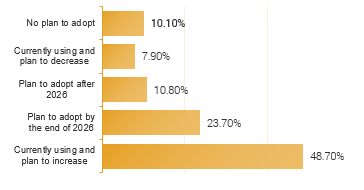
Future of IT 2026 Survey; n=507
Payment models impact how FinOps is implemented
Effective IT financial management and cost optimization means organizations must understand their vendor payment model mix. Organizations use a variety of payment models for IT services. Each has its benefits and drawbacks.
For instance, 76% report they use subscription per user/license vendor payment models. Subscription payment models have predictable costs, making it easier to forecast and budget. Optimizing these costs would involve reviewing and rationalizing licenses to right-size seats.
For the 19% who use consumption-based or usage-based pricing, management of the consumption-based model's variability is important. The onus is on the customer to actively monitor use through usage tracking, alerts, and forecasting tools.
The top factor influencing preferences for a particular vendor payment model was predictable costs (68%), while 62% said their biggest area of risk related to the organization's critical infrastructure vendors is unanticipated increases in licensing or renewal costs. The importance of cost predictability reinforces the need to add visibility and the ability to be proactive for services that are billed on a metered basis.
Most common types of vendor payment models
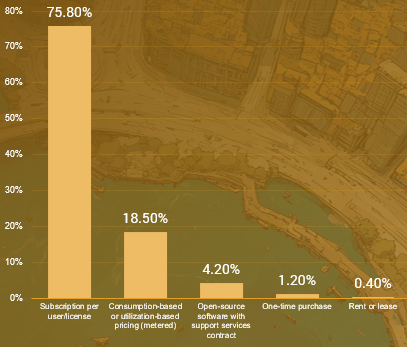
Future of IT 2026 Survey; n=260
About Info-Tech
Info-Tech Research Group is the world’s fastest-growing information technology research and advisory company, proudly serving over 30,000 IT professionals.
We produce unbiased and highly relevant research to help CIOs and IT leaders make strategic, timely, and well-informed decisions. We partner closely with IT teams to provide everything they need, from actionable tools to analyst guidance, ensuring they deliver measurable results for their organizations.
What Is a Blueprint?
A blueprint is designed to be a roadmap, containing a methodology and the tools and templates you need to solve your IT problems.
Each blueprint can be accompanied by a Guided Implementation that provides you access to our world-class analysts to help you get through the project.
Talk to an Analyst
Our analyst calls are focused on helping our members use the research we produce, and our experts will guide you to successful project completion.
Book an Analyst Call on This Topic
You can start as early as tomorrow morning. Our analysts will explain the process during your first call.
Get Advice From a Subject Matter Expert
Each call will focus on explaining the material and helping you to plan your project, interpret and analyze the results of each project step, and set the direction for your next project step.
Unlock Sample ResearchContributors
- Adam Caylor, Deputy CIO & Executive Director of Infrastructure & Operations, Johnson County Community College
- Thomas Ferrucci, CIO, Natco Home Group
- Meriah Gille, CIO/COO, Seattle Indian Health Board
- Nadir Khan, CTO, C.I.KNOW
- Mario Poier, Director of IT Infrastructure and Service Delivery, Northern Alberta Institute of Technology
- Dr. Chelma Sliep, Director Infrastructure and Operations, Information and Communication Systems, University of Johannesburg
- 6 anonymous contributors
 Exploit Disruptive Infrastructure Technology
 2020 Infrastructure Priorities Report
 Infrastructure & Operations Priorities 2022
 Create and Implement an IoT Strategy
 Infrastructure and Operations Priorities 2023
 Infrastructure & Operations Priorities 2024
 Infrastructure & Operations Priorities 2025
 Building Info-Tech’s Chatbot
 Assessing the AI Ecosystem
 Building the Road to Governing Digital Intelligence
 Bring AI Out of the Shadows
 The AI Vendor Landscape in IT
 An Operational Framework for Rolling Out AI
 Infrastructure and Operations Priorities 2026
