
Identify and Respond to Credible Threats Arising From Global Uncertainty
Proactively manage the impact of macro uncertainties on your organization.
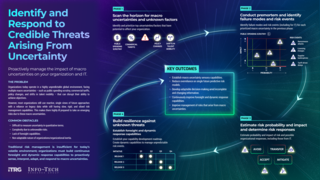
Traditional risk programs are no match for today’s macro-level volatility and uncertainty. New and unknowable threats are emerging from weak signals, rippling across systems, and demanding quick responses even with incomplete data. Rather than rely on single-future risk models, organizations must broaden their outlook to more flexible multi-future ones. Use this step-by-step framework to evolve your entire organization’s relationship with uncertainty to a dynamic approach that can adapt and respond quickly as conditions change.
Organizations must move beyond reactive mitigation, embedding proactive risk detection, management, and mitigation into their DNA – and leaders across multiple disciplines must become comfortable with acting on limited information. By embracing this dynamic approach, organizations can move from fearing uncertainty to dancing with it, leaving them nimble and future-ready in the face of both certain and unforeseeable risks.
1. A single-future outlook can blind your strategy.
Organizations that treat uncertainty as something to be modeled and managed like traditional risk are setting themselves up to be blindsided. Overreliance on single-future scenarios discourages constructive dissent, overlooks weak signals, and instills false confidence, making it harder to respond to changing circumstances. Foresight demands more than data – it requires the ability to plan when data is scarce and pivot when needed.
2. Readiness requires more than reaction.
When it comes to uncertainty, most organizations are still trapped in reactive cycles, treating disruption as an exception rather than an expectation. Building continuous foresight means embedding early sensing, operational awareness, and dynamic response into working practices across the organization and its technology.
3. Agility before accuracy.
Perfect understanding is a luxury. IT leaders must nurture the ability to make confident decisions amid ambiguity. When new information surfaces, organizations must then be ready to reframe, revise, and redirect without hesitation – success now depends less on certainty and more on adaptability.
Use this step-by-step research to overcome uncertainty with a proactive strategy
Our research provides tools and examples to help you identify the risks and responses needed to deal with macro-uncertainties as well as the capabilities and roles your organization will need to be more proactive and dynamic. Use this step-by-step approach to strengthen your organization’s ability to evaluate emerging threats, uncover root causes of failure, and respond to uncertainty in real-time.
- Scan the horizon for macro uncertainties to identify those with the most potential to affect your organization.
- Conduct a premortem exercise to identify the failure scenarios and risk events that matter most.
- Identify risk events, probability, and impact to chart out possible responses across various organizational units, including IT.
- Develop your key capabilities roadmap to close gaps and identify areas of improvement to foster a dynamic and integrated risk response.
Identify and Respond to Credible Threats Arising From Global Uncertainty
Proactively manage the impact of macro uncertainties on your organization.
Analyst perspective
Uncertainty hits differently than measurable risk; manage it accordingly.

"In a world of deep uncertainty, the ability to adapt is more important than the ability to predict."
– Roger Spitz, risk expert and author of Disrupt With Impact: Achieve Business Success in an Unpredictable World
When dealing with a world shaped by macro uncertainties and rapid change, our traditional risk management frameworks are no longer sufficient. These legacy approaches often focus inward — documenting internal failures, assigning ownership, and producing metrics and reporting — without integrating external risk intelligence. They are also not at the level of dynamism that is needed to rapidly pivot and respond to unknowable risks due to macro uncertainties. Moreover, traditional risk management tends to rely on quantitative models that predict a single future outcome, but this can foster a false sense of security, leaving organizations vulnerable to blind spots and reactive decision making. In today’s volatile environment, uncertainty must be understood not just as measured risk but as something dynamic that is to be sensed, interpreted, and then responded to.
To truly thrive amid uncertainty, organizations must embed new capabilities into their DNA — ones that allow them to dance with uncertainty rather than fear it. This includes developing proactive sensing mechanisms to detect weak signals and emerging patterns, cultivating cognitive flexibility to hold multiple futures in mind, and embracing provisional knowledge that allows plans to evolve as new information emerges. Leaders must be comfortable making decisions with incomplete information and be prepared to revise their understanding as conditions change. Organizations need to be adaptable.
Ultimately, building foresight and agility into the organization is not a one-time exercise — it’s a continuous, collective capability. Business and technology teams must collaborate to identify macro uncertainties, assess their potential impacts, and respond holistically. This requires a mindset shift from managing risk as a static metric to navigating uncertainty as a dynamic opportunity. By strengthening sensory, operational, and response capabilities, organizations can move beyond reactive postures and become resilient, adaptive, and future-ready.
This research provides you with a step-by-step methodology to help you develop a foresight capability that can work in both scenarios — when you have data (qualitative and quantitative) to inform future scenario development as well as in the absence of robust data — and develop integrated and agile capabilities to respond more dynamically to macro uncertainties.
Anubhav (Anu) Sharma
Principal Director, Research Development
Info-Tech Research Group
Executive summary
|
Your Challenge |
Common Obstacles |
Info-Tech’s Approach |
|---|---|---|
|
Today, organizations face a complex global environment and experience high unpredictability. There are several macro uncertainties at play that can affect an organization’s objective realization, such as:
Organizations need a mechanism to proactively assess these uncertainties, identify their effects on the industry and the organization, and holistically respond to them. |
It is difficult to precisely quantify complex uncertainty and its effect on organizations. To assess particular uncertainties, we can look at historical data, but there is no guarantee that what we find will be relevant, timely, or unbiased. Hence, utilizing conventional quantitative models or traditional risk management methods fails to deliver good results when it comes to assessing macro uncertainties. In addition, there are unknowable risks, which are not something that we can identify beforehand, and organizations are not equipped to handle them. Organizations lack foresight capabilities to identify weak macro signals and assess impacts. Organizations are not adaptable and are unable to respond more dynamically to threats from uncertainties. |
Organizations need a foresight capability that can work both when you have data (qualitative and quantitative) to inform future scenario development as well as in the absence of robust data, and they need to develop integrated and agile capabilities to respond dynamically to risks.
|
Info-Tech Insight
At the complexity level of macro uncertainties, organizations need to work closely across business departments and technology teams to first understand the effects and then holistically respond to them. This capability of first assessing macro uncertainties in an ongoing and collective manner and then responding dynamically needs to become a part of an organization’s DNA to help the organization navigate today’s uncertain and volatile environment and achieve its goals.
Today, organizations are facing an unpredictable environment, with uncertainty spiking across the globe
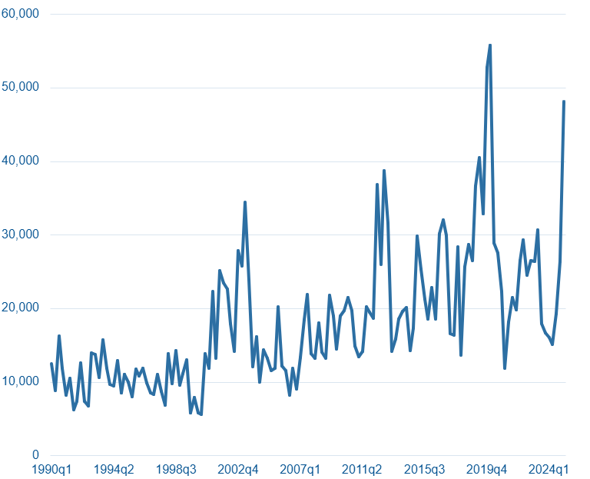
Source: The World Uncertainty Index is a measure that tracks uncertainty across the globe by text mining the country reports of the Economist Intelligence Unit. The index is available for 143 countries.
There are multiple macro uncertainties at play
| 1. Public spending scrutiny | 2.Commercial tariffs |
3. Other policy changes |
|---|---|---|
|
US: The Department of Government Efficiency (DOGE) is a new agency using agile audits to target waste and prioritize contracts aligned with administration goals. |
US:
Canada:
|
Government transitions can bring about a change in direction on a variety of policy areas.
|
…and many others
Sources: 1 Penn Wharton, 2025; 2 Government of Canada, 2024; 3 The Guardian, 2025; 4 Yale University, 2025; 5 World Trade Organization, 2025; 6 Grain Journal, 2025;
7 Public Policy Forum, 2025.
This creates a climate of variability for multiple industries
|
PUBLIC SECTOR |
Federal policy shifts, funding changes, compliance and procurements risks |
TRANSPORTATION & LOGISTICS |
Driver/labor shortage, unpredictable demand patterns, increased equipment and maintenance costs |
|---|---|---|---|
|
MANUFACTURING |
Increased production and input costs, supply chain disruption, trade uncertainty, reduced capital and growth |
RETAIL |
Supply chain disruption, changing consumer behavior, tariff complexities, pressure of profit margins |
|
HEALTHCARE |
Federal budget cuts, policy changes for HIPAA regulation and AI deregulation |
CONSTRUCTION |
Changing policy landscape, supply chain disruption, labor shortage, increased material costs, contract disputes |
|
HIGHER EDUCATION |
Government policy disruptions, enrollment changes, research funding cuts, dismantling of support systems |
This uncertainty affects organizational value creation across different value drivers
|
ORGANIZATIONAL VALUE CREATION |
|||||
|---|---|---|---|---|---|
|
Value drivers |
Revenue acceleration |
Cost optimization |
Asset efficiency |
Customer satisfaction |
Improved risk & resilience |
|
|
|
|
|
Info-Tech Insight
Organizations need a feasible mechanism to proactively assess these uncertainties, identify their effects on their industry and organization, and holistically respond to them. In addition, organizations need to improve their capabilities so that they can be more dynamic in the way they work and manage these uncertainties on an ongoing basis.
When dealing with macro uncertainties, traditional risk management frameworks and single future predictive models are not enough.
- Organizations do not have the right foresight capabilities to identify macro uncertainties, understand their impact, and respond holistically to them.
- Traditional risk management systems are mostly internally focused and are not equipped to handle unknowable risks arising from macro uncertainties, as they are not adaptable.
- It is hard to quantify macro uncertainties, especially when there are few or zero historic precedents. Overreliance on one future model leads to bad results.
- These situations may, at times, lead to decision paralysis as organizations follow a “wait and see” approach for more information, which can turn out to be harmful in the achievement of organizational objectives.
84% Percent of participants unable to recall how their organization define and prioritize emerging risks.
60% Percent of participants who don't believe they have access to the insights needed to understand and action emerging risks.
80% Percent of participants who don’t believe they have the data and models needed to understand and quantify the materiality, leaving leaders uncertain about where to allocate capital. Top performers are exploring approaches such as war gaming.
Source: Navigating a complex risk landscape — North America overview, Emerging and Interconnected
Risks Survey, wtwco.com
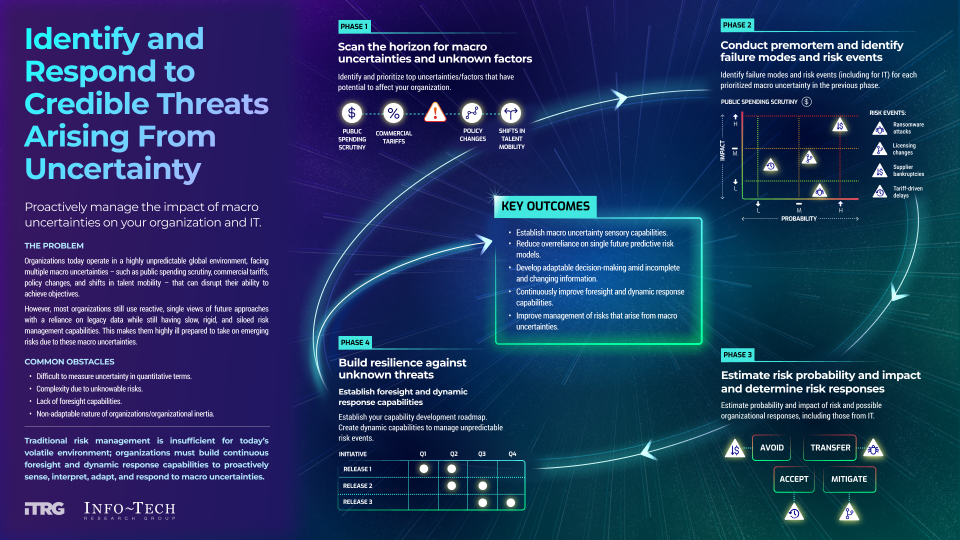
Info-Tech’s approach helps you overcome key challenges
Identify and respond to credible threats arising from global uncertainty.
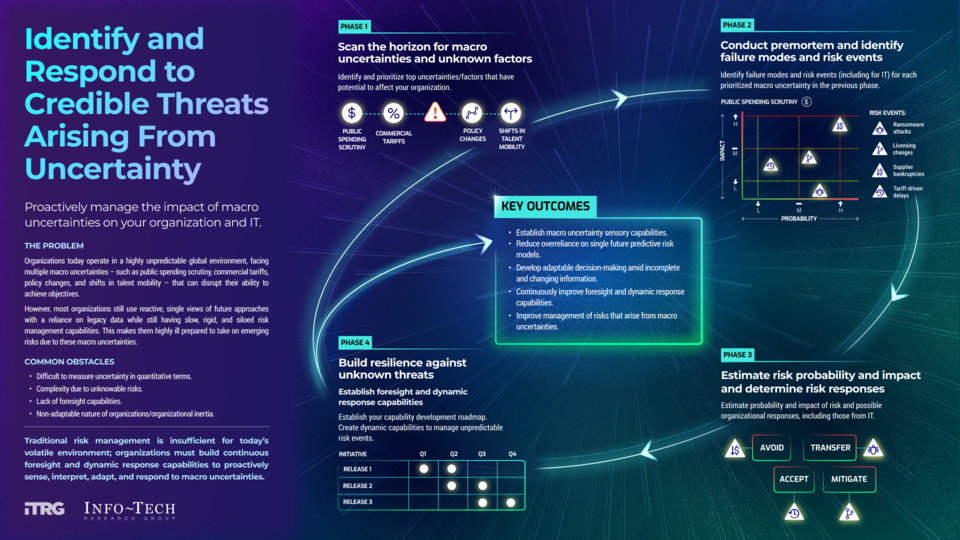
Phase 1: Scan the horizon for macro uncertainties and other unknown factors.
Phase 2: Conduct premortem and identify failure modes and risk events.
Phase 3: Estimate risk probability and impact and determine risk responses.
Phase 4: Establish foresight and dynamic response capabilities.
Organizations need to have a foresight capability that can work in two scenarios – both when you have data (qualitative and quantitative) to produce future scenarios as well as in the absence of robust data — and develop agile operational capabilities to respond more dynamically to macro uncertainties.
- Start assessing the impact of macro uncertainty on your organization by building a foresight capability tailored for macro uncertainties.
- Estimate the impact of macro uncertainties on your organization through this foresight capability.
- Estimate risk probability and impact, if possible, for knowable risks.
- Develop a roadmap of initiatives to improve foresight capabilities as well as respond more dynamically to unknowable risks.
JPMorganChase has been employing similar methods successfully in managing uncertainty
Thinking “Future Back”
INDUSTRY: Banking
SOURCE: JP Morgan Website
- Traditional forecasting methods in finance often rely on back testing and linear extrapolation, which fall short in today’s volatile and rapidly evolving environment. The human brain’s inherent biases — such as normalcy and status quo bias — further hinder proactive strategic planning.
- J.P. Morgan introduced “future back” thinking, also known as back casting, which involves envisioning preferred future scenarios and working backward to identify present-day actions. This methodology includes:
- Horizon scanning to detect weak signals — early indicators of future trends, the first seeds or symptoms of a change that usually needs another 10 years to mature into a trend and, if identified soon enough, can represent a huge competitive advantage because you can adjust your strategic priorities sooner.
- Neuro-foresight, which examines how cognitive biases affect our ability to imagine and plan.
- Exploration of exponential technologies, such as biocomputing and affective computing, to understand their potential impact on business models and society.
Results
Cultural shift: Executives at J.P. Morgan are increasingly adopting future back thinking, moving from “business as usual” to “disruption as usual.”
Strategic advantage: Early identification of weak signals has enabled the firm to adjust priorities and explore new revenue streams ahead of competitors.
Enhanced decision making: By recognizing cognitive biases and embracing uncertainty, leaders are better equipped to navigate complex, non-linear futures.
Driving innovation: J.P. Morgan has been successful in innovating through initiatives in areas like space pharma and synthetic biology, pushing the boundaries of traditional finance and technology intersections.
Our methodology: Identify and respond to credible threats arising from global uncertainty
|
1. Scan the horizon for macro uncertainties and other unknown factors. |
2. Conduct premortem and identify failure modes and risk events. |
3. Integrate with enterprise risk register, estimate risk probability and impact, if possible, and determine responses. |
4. Establish foresight and dynamic response capabilities. |
|
|---|---|---|---|---|
|
Phases |
1.1 Conduct horizon scanning. |
2.1 Conduct a premortem to identify possible failure scenarios, cause of failures, and role of organization/IT in those possible failures. Document related knowable risk events and scenarios. |
3.1 Integrate identified risk events with enterprise risk register and set your risk likelihood and impact scales. |
4.1 Evaluate current capability maturity for foresight and dynamic responses and identify gaps. |
|
Outcomes |
Identify top uncertainties and factors that have the potential to affect your organization. |
For each prioritized macro uncertainty in Phase 1, identify failure modes and risk events (including for IT). |
Based on analysis done in Phase 2, estimate probability and impact of risk and possible organizational responses, including from IT. |
Establish your capabilities improvement map. |
|
Tools/templates |
Horizon scanning and potential impact analysis |
Premortem analysis. |
Risk Register Template (Matching Enterprise Risk Register Template) |
Capabilities Assessment Template, Roles Evaluation Template, map template |
Keep these key insights in mind as you execute on this research
|
Insight 1 |
The risk of certainty: overreliance on single future models can blind us. When we treat all uncertainty as measurable risk, we invite blind spots. We rely too heavily on models with one future in mind, overlook weak signals, and create cultures where any challenge to the view developed is suppressed. This confusion undermines decision making and makes it harder to respond when conditions change. Organizations need to have a foresight capability that can work in both scenarios – when you have data (qualitative and quantitative) as well as in the absence of robust data – and develop agile operational capabilities to respond more dynamically to macro uncertainties. |
|---|---|
|
Insight 2 |
From reaction to readiness: embed continuous foresight in the enterprise. Traditional approaches to uncertainty have largely been reactive and only consider response. For macro uncertainties, we need to be more proactive and strengthen our sensory, operational, and response capabilities to better deal with them. Organizations need to work closely across business departments and technology teams to identify macro uncertainties, understand their effects, and then holistically respond to them. This is not a one-time exercise: the capability to first assess macro uncertainties in an ongoing and collective manner and then respond dynamically needs to become part of an organization’s DNA to help the organization navigate today’s uncertain and volatile environment and achieve its goals. |
|
Insight 3 |
Agility over accuracy: adaptable decision making amid incomplete understanding. Organizations and their leaders need to become comfortable making decisions when their understanding is incomplete and subject to revision. Organizational leaders need to be more adaptable so that when new information comes up, they can respond quickly and change direction, accepting that there will be uncertainty while making these decisions. |
Blueprint deliverables
Each step of this blueprint is accompanied by supporting deliverables to help you accomplish your goals.
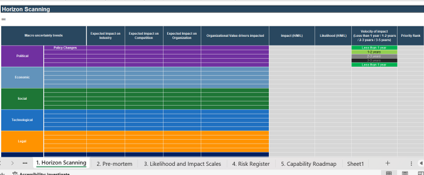
Uncertainty Foresight Workbook
An Excel tool that matches each step of our analysis methodology and helps you arrive at impact on the organization as well as list key capabilities that improve both foresight and response to unknowable risks.
Key deliverable:
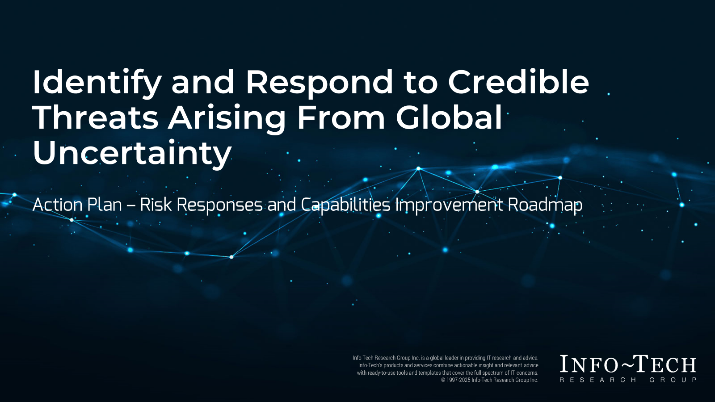
Communication deck on macro uncertainties action plan
Communicate on uncertainties identified, their possible impact, organizational responses, including from IT, and capabilities to be developed.
Measuring organizational impact
What metrics can you track to measure the organizational impact of following the methodology proposed in this blueprint?
|
Metric |
Target |
Actual |
|
Percent of risk events identified proactively vs. reactively |
||
|
Number of compliance and audit gaps identified |
||
|
Financial impact estimates or changes in organizational drivers due to organizational disruption from macro uncertainties |
||
|
Participation rate of key stakeholders across teams in macro uncertainty foresight capability |
||
|
Progress on foresight and agile capabilities improvement map |
||
|
Progress on IT’s role in setting up foresight, responses, and capabilities development |
Measuring impact of this blueprint
What metrics can you track to measure the immediate impact of following the methodology proposed in this blueprint?
|
Metric |
Target |
Actual |
|
Time/effort saved in identifying macro uncertainties, developing responses, and developing capabilities map |
||
|
Dollar value saved |
||
|
Experience rating from stakeholders involved |
Info-Tech offers various levels of support to best suit your needs
|
DIY Toolkit |
Guided Implementation |
Workshop |
Executive & Technical Counseling |
Consulting |
|---|---|---|---|---|
|
“Our team has already made this critical project a priority, and we have the time and capability, but some guidance along the way would be helpful.” |
“Our team knows that we need to fix a process, but we need assistance to determine where to focus. Some check-ins along the way would help keep us on track.” |
“We need to hit the ground running and get this project kicked off immediately. Our team has the ability to take this over once we get a framework and strategy in place.” |
“Our team and processes are maturing; however, to expedite the journey we’ll need a seasoned practitioner to coach and validate approaches, deliverables, and opportunities.” |
“Our team does not have the time or the knowledge to take this project on. We need assistance through the entirety of this project.” |
Diagnostics and consistent frameworks are used throughout all five options.
Guided Implementation
What does a typical GI on this topic look like?
|
Call #1: Scope requirements, objectives, and your specific challenges. |
Call #2: Conduct horizon scanning. Call #3: Evaluate impact on industry and organization. |
Call #4: Prioritize trends and factors. Call #5: Conduct a premortem to identify failure modes. |
Call #6: Identify risk events. Call #7: Set risk scales and add risk impact and probability estimates. |
Call #8: Document risk responses. Call #9: Evaluate current state of foresight and dynamic capabilities. Call #10: Develop capabilities improvement map. |
A Guided Implementation (GI) is a series of calls with an Info-Tech analyst to help implement our best practices in your organization.
A typical GI is 10 calls over the course of 3-4 months.
Workshop overview
Contact your account representative for more information.
workshops@infotech.com 1-888-670-8889
Pre-Work | Day 1 | Day 2 | Day 3 | Day 4 | Day 5 | |
Activities | Scan the horizon for macro uncertainties and other unknown factors. | Evaluate impact on organization. | Conduct premortem and identify failure modes and risk events. | Estimate risk probability and impact and determine responses. | Establish foresight and dynamic response capabilities. | Next steps and |
0.1 Conduct horizon scanning. | 1.1 Ensure completeness of the list of macro uncertainties. | 2.1 Conduct a premortem to identify possible failure scenarios, cause of failures, and role of organization/IT in those possible failures. | 3.1 Integrate identified risk events with enterprise risk register and set your risk likelihood and impact scales. | 4.1 Evaluate current capability maturity for foresight and dynamic responses and identify gaps. | 5.1 Complete in-progress deliverables from previous four days. | |
Deliverables |
|
|
|
|
|
|
Phase 1
Scan the Horizon for Macro Uncertainties and Other Unknown Factors
|
Phase 1 |
Phase 2 |
Phase 3 |
Phase 4 |
|---|---|---|---|
|
Scan the Horizon for Macro Uncertainties and Other Unknown Factors. |
Conduct Premortem and Identify Failure Modes and Risk Events. |
Integrate With Enterprise Risk Register, Estimate Risk Probability and Impact, if Possible, and Determine Responses. |
Establish Foresight and Dynamic Response Capabilities. |
This phase will walk you through the following steps:
1.1 Conduct horizon scanning.
1.2 Evaluate impact on industry and organization.
1.3 Prioritize macro uncertainty trends and factors.
This phase involves the following participants:
- IT/risk leader and/or their delegates
- Business leaders and/or their delegates
- Strategic intelligence analysts
Step 1.1
Conduct horizon scanning
This step involves the following participants:
IT/risk leader and/or their delegates
Business leaders and/or their delegates
Strategic intelligence analysts
Outcomes of this step
Identify and document key macro uncertainties and other unknown factors at play through external risk intelligence and brainstorming.
About Info-Tech
Info-Tech Research Group is the world’s fastest-growing information technology research and advisory company, proudly serving over 30,000 IT professionals.
We produce unbiased and highly relevant research to help CIOs and IT leaders make strategic, timely, and well-informed decisions. We partner closely with IT teams to provide everything they need, from actionable tools to analyst guidance, ensuring they deliver measurable results for their organizations.
What Is a Blueprint?
A blueprint is designed to be a roadmap, containing a methodology and the tools and templates you need to solve your IT problems.
Each blueprint can be accompanied by a Guided Implementation that provides you access to our world-class analysts to help you get through the project.
Need Extra Help?
Speak With An Analyst
Get the help you need in this 1-phase advisory process. You'll receive multiple touchpoints with our researchers, all included in your membership.
- Call 1: Scope requirements, objectives, and your specific challenges.
- Call 2: Conduct horizon scanning.
- Call 3: Evaluate impact on industry and organization.
- Call 4: Prioritize trends and factors.
- Call 5: Conduct a premortem to identify failure modes.
- Call 6: Identify risk events.
- Call 7: Set risk scales and add risk impact and probability estimates.
- Call 8: Document risk responses.
- Call 9: Evaluate current state of foresight and dynamic capabilities.
- Call 10: Develop capabilities improvement map.
Contributors
2 anonymous contributors
 Optimize IT Governance for Dynamic Decision-Making
 Maximize Business Value From IT Through Benefits Realization
 Build an IT Risk Management Program
 Review and Improve Your IT Policy Library
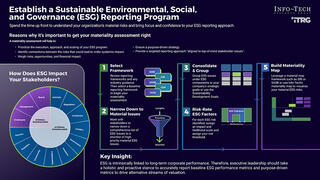 Establish a Sustainable ESG Reporting Program
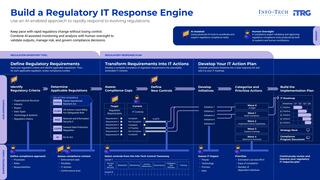 Build a Regulatory IT Response Engine
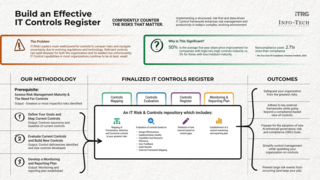 Build an Effective IT Controls Register
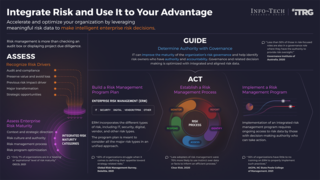 Integrate IT Risk Into Enterprise Risk
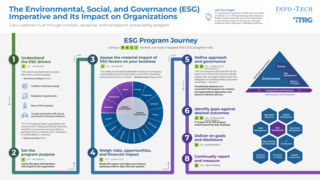 The ESG Imperative and Its Impact on Organizations
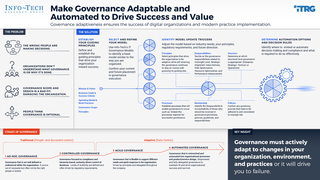 Make Your IT Governance Adaptable
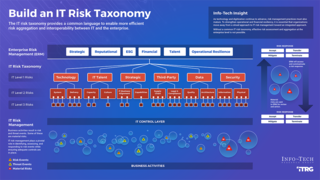 Build an IT Risk Taxonomy
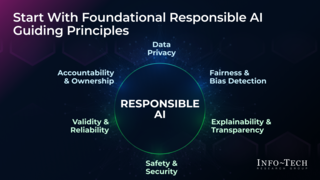 Prepare for AI Regulation
 Building the Road to Governing Digital Intelligence
 Identify and Respond to Credible Threats Arising From Global Uncertainty
 GRC Software Selection Guide
 Establish Your Adaptive AI Governance Program: From Principles to Practice
 Build an Integrated Enterprise Risk Management Program
 Govern Enterprise AI Agents While Preserving Innovation
 Execute Data-Driven Risk Assessments
