
Build Your S/4HANA Migration Plan
Turn complexity into clarity to make informed S/4HANA migration decisions.
With SAP’s end of mainstream maintenance for ECC approaching, migration to S/4HANA is no longer a question of “if,” but a question of “how” and “how well.” For many organizations, the easiest path is to leave the migration decisions to implementation partners – a move that could prove to be the riskiest. This research provides a structured approach to help SAP and ERP leaders make informed strategic decisions and walk into migration conversations with full understanding of the interdependencies between critical migration decisions and their long-term implications.
S/4HANA migrations are large-scale, complex transformations with requirements and implications that are often not fully understood. A technical implementation partner is essential to execute the migration; however, they do not have the organizational context to make strategic decisions – a responsibility that must remain with your organization. While there is no one path to a perfect migration, there is certainly a wrong one: migrating without understanding the associated risks and trade-offs.
1. Do not underestimate the scope.
S/4HANA migrations should be treated as full ERP transformations, not simply system upgrades. Migration stakeholders must understand the current state and define clear success metrics to support informed decision-making throughout the migration journey.
2. Decisions cannot be made in isolation.
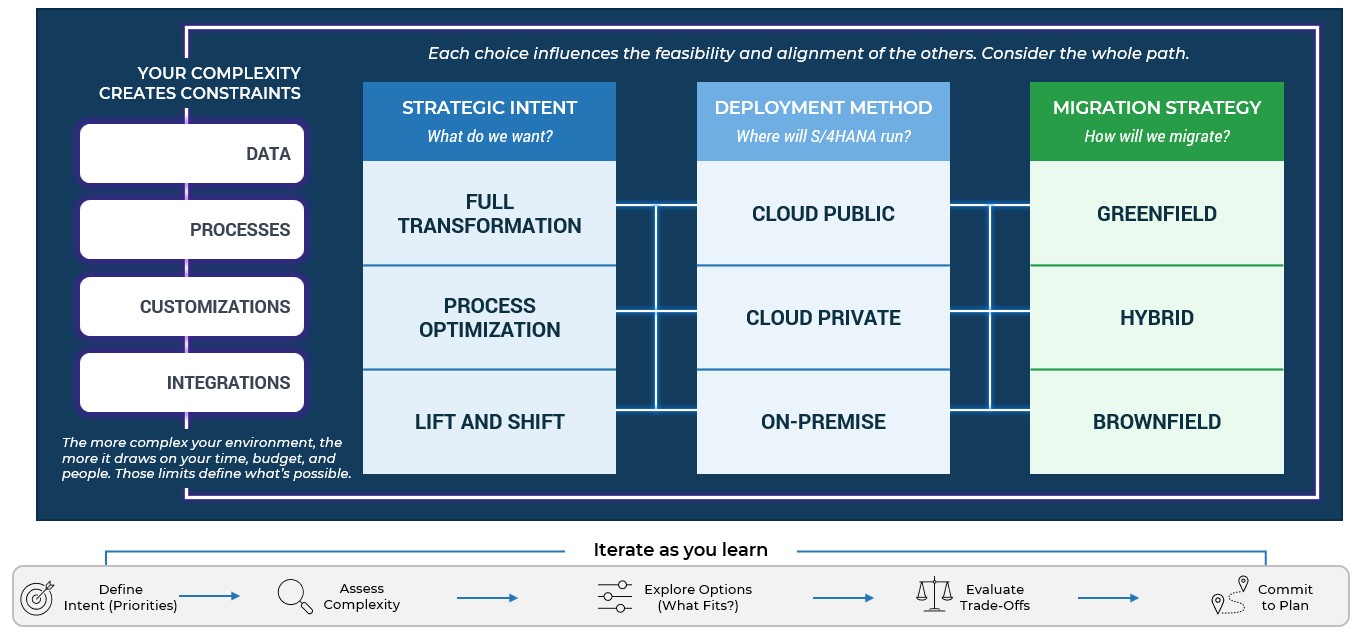
Critical S/4HANA migration decisions are deeply interconnected. Optimizing for one often introduces constraints on another. Evaluate the migration path holistically, weighing what you may be giving up against the value you expect to gain.
3. Ownership cannot be outsourced.
Implementation partners can support technical delivery, but the organization must provide the direction, maintain alignment, and ensure the migration stays anchored to business objectives. Leaders must stay accountable for the decisions that shape long-term ERP value.
Leverage this research to build an informed S/4HANA migration path
This research provides a structured methodology, along with practical tools and guided assessments, for SAP internal teams to translate strategic intent, readiness, and complexity into a cohesive, pressure-tested plan. This enables the team to own critical migration decisions before engaging with implementation partners.
- Discover your current SAP landscape by understanding your internal constraints, defining your strategic intent, and assessing your current complexity.
- Define your migration path by assessing the benefits and trade-offs, enabling you to select the optimal migration plan based on your migration priorities.
- Prepare your migration by formalizing governance processes and creating a clear communication plan to hand over to your implementation partner.
Build Your S/4HANA Migration Plan
Turn complexity into clarity to make informed S/4HANA migration decisions.
Analyst Perspective
S/4HANA migration is a system of decisions, not a sequence.
With SAP's end of mainstream maintenance for ECC approaching at the end of 2027, S/4HANA migration is no longer a question of if, it's a question of how, and how well. The technical work can be outsourced. The decisions that shape it cannot.
What makes this uniquely difficult is that no migration decision stands alone. Deployment model, migration approach, strategic intent, technical complexity and organizational capacity – each choice and reality changes the constraints on the others. Failure is not obvious; it evolves as the project drifts from the plan. Timelines stretch, budgets grow, and the original ambition quietly shrinks into something easier to deliver. This rarely happens because execution was poor. It happens because decisions were made in isolation, without anyone ever pressure-testing the whole path.
There is no "perfect" migration plan, only the one that fits your intent and organization. Your implementation partner brings technical skill and delivery experience, but they do not know your organization, your culture, or what success looks like in your context. That knowledge is yours.
This blueprint provides a structured approach to help you walk into the implementation partner conversation knowing what you want, understanding how your decisions connect, and ready to own the outcome, because long after the partner has moved on, you will be the one living with the choices that are made.

Mia Scherba
Research Analyst, Data & Applications
Info-Tech Research Group
Executive summary
Your Challenge
- ECC's end of maintenance is fast approaching, and organizations that plan to migrate must act now. S/4HANA implementations are multiyear transformations; every delay increases timeline pressure, cost, and delivery risk.
- Many organizations lack experienced internal personnel to lead an S/4HANA migration. Between that and the project's size and complexity, many organizations do not know where to begin with decision-making.
- Implementation partners enable your technical execution, but they cannot define what success looks like for your organization. The knowledge of your people, processes, and priorities resides internally and must guide the migration.
Common Obstacles
- Oversimplifying the Migration
Moving to another SAP product creates the illusion that migration will be simple. Underestimating transformation impact leads to insufficient remediation of data, processes, customizations, and integrations, increasing risk to timelines and go-live success. - Process Change Resistance
Organizations prioritize technical execution and underestimate the change management required to drive adoption of new processes across the organization. - Over-Reliance on Implementation Partners
The volume and complexity of decisions cause organizations to struggle to distinguish which decisions they own, leading them to defer critical choices.
Info-Tech's Approach
- Understand Your Current System
Assess both your current ECC technical complexity and your organization's readiness for change to guide your migration plan. - Define Your Migration Intent
Establish the "why" behind your migration. Use this moment intentionally to define what kind of organization you want to be after the migration. - Evaluate Trade-Offs and Choose Your Plan
Assess your migration path holistically to understand the trade-offs that are inherent in your selection. Identify which decision combinations are aligned with one another or are invalid combinations. Choose a path aligned to your intent, complexity, and priorities.
Info-Tech Insight
There is no single "right" path to migrate to S/4HANA, but there is a wrong one: migrating without understanding the trade-offs. The organizations that succeed are the ones who knew the price before they paid it.
Your challenge
This research is designed to help organizations define a clear and effective S/4HANA migration plan.
- SAP's ECC end of mainstream maintenance is fast approaching, with support ending in 2027 and limited extended support available until 2030. To address this reality, your organization has committed to moving its ERP to S/4HANA.
- S/4HANA migrations are large-scale, complex transformations whose requirements and implications are often not fully understood.
- They span multiple years, require significant financial investment, and impact critical business processes across the organization. Any missteps in this project can have substantial consequences for your organization and its operations.
- A technical implementation partner is essential to execute the migration. However, they do not have the expertise to be the strategic decision-maker; that role belongs to your organization. You must define your own direction, shaping the target state, priorities, and trade-offs, because you will ultimately own the outcomes and must live with the long-term implications.
To successfully migrate from ECC to S/4HANA, you must proactively direct your migration by understanding the full journey and making the critical strategic decisions that determine your path forward.
65% of current ECC users are still not fully migrated to S/4HANA.
Source: Precisely, 2026
92% of users who have migrated to S/4HANA exceeded their timeline expectations.
Source: CIO.com, 2025
Common obstacles
These barriers make this challenge difficult to address for many organizations:
- Underestimating an S/4HANA migration as a technical system upgrade rather than a full ERP transformation that widens the scope of considerations.
- A lack of internal personnel experienced in S/4HANA migrations to understand the interdependencies between critical migration decisions.
- Failing to complete a comprehensive current-state assessment to understand the level of effort required to remediate and transition data, processes, customizations, and integrations.
- Over-relying on implementation partners to define scope and make critical decisions, despite inherent biases toward their own methodologies, tools, and vendor ecosystems.
- Underestimating the scale of change management required across the organization to drive adoption of the new platform.
55% of organizations state that implementation was more complex/time-consuming than expected.
Source: ASUG, 2025
49% of total S/4HANA go-live costs are attributed to implementation partners.
Source: ASUG, 2025
What is SAP S/4HANA?
SAP S/4HANA is SAP's flagship enterprise resource planning (ERP) software.
The software ties together all the different functions of the business into one unified system with a shared database so everyone is working from the same data in real time. S/4HANA is the current generation of SAP's ERP, built on SAP's own in-memory database called HANA, which makes it much faster than older versions.
Source: SAP Press, n.d.
CORE MODULES:
Finance (FI)
Manages financial reporting, accounting, and compliance, providing a real-time, unified view of financial data through the Universal Journal.
Controlling (CO)
Supports internal cost planning, reporting, and monitoring to help management make informed decisions about profitability and performance.
Materials Management (MM)
Handles procurement, inventory management, and warehousing, including vendor evaluation, invoice verification, and material valuation.
Sales & Distribution (SD)
Manages the order-to-cash process, including sales order processing, pricing, shipping, billing, and customer service.
Production Planning (PP)
Facilitates the planning, scheduling, and execution of manufacturing processes.
Human Capital Management (HCM)
Covers personnel administration, talent management, payroll, time management, and training.
Understand the key features of S/4HANA
Unified Data Model
All business data lives in one simplified structure, eliminating the duplicated and fragmented tables that made ECC slow, complex and difficult to report from.
Modern User Experience
SAP's old transaction-based interface is replaced with a clean, role-based design (Fiori) that works on any device and shows people only what they need to do their job.
Integration with AI
S/4HANA is built to connect directly with SAP's AI tools so intelligent automation and predictions run inside your business processes, not as a separate system bolted on afterward.
Integrated Business Processes
Financial and operational planning happens on the same live data as day-to-day transactions, so there is no longer a gap between what the plan says and what the system reflects.
Embedded Analytics
Reports and dashboards run directly against live transactional data in real time, eliminating overnight data extracts, separate reporting systems, and waiting until the data warehouse catches up.
Source: ASUG, 2024
S/4HANA has significant capability differences compared to ECC
Understanding the key differences between the two ERPs is essential to planning a smart migration and unlocking the capabilities that drive real value.
| ECC | S/4HANA | |
|---|---|---|
| Database | Any (Oracle, SQL Server, DB2, etc.) | SAP HANA only (in-memory, column-store database) |
| Data Processing | Batch processing; runs reports overnight or on a schedule | Real-time processing; analytics run instantly on live data |
| Data Model | Complex, with many redundant aggregate tables (e.g. totals tables) | Simplified – redundant tables removed; Universal Journal merges FI + CO |
| User Interface | SAP GUI – traditional desktop interface, transaction-code driven | SAP Fiori – modern, role-based web/mobile UI with tile-based launchpad |
| Deployment | On-premise only | On-premise, cloud (public/private), or hybrid |
| AI/Analytics | Limited; requires separate BI tools (SAP BW) | Built-in AI, machine learning, and embedded analytics |
| Reporting | Separate reporting layer required; data latency common | Live reporting from transactional data; no separate layer needed |
| Performance Speed | Slower for large datasets; relies on indexes and aggregates | Significantly faster due to in-memory HANA database |
| End of Support | Mainstream maintenance ends 2027 (extended maintenance until 2030) | Actively developed and supported |
Migrating to S/4HANA is as complex as choosing a new ERP system
- A common misconception about S/4HANA migrations is that it is a technical upgrade, simply moving from one SAP product to another. However, it is vastly different.
- An S/4HANA migration is a completely new replatforming that requires defining new ways of working, cleansing data, and running effective change management in your organization.
This is as complex as choosing an entirely new ERP outside of SAP, which is a completely viable option.
For this research, however, we focus exclusively on migrating from ECC to S/4HANA.
Additional Info-Tech resources for ERP selection

Info-Tech's methodology for building your S/4HANA migration plan
| 1. Discover Your Current SAP Landscape | 2. Define Your Migration Path | 3. Prepare Your Migration | |
|---|---|---|---|
| Phase Steps | 1. Identify your internal project team 2. Define your strategic intent 3. Assess your technical complexity |
1. Select your deployment method 2. Select your migration strategy 3. Analyze implications and accept trade-offs |
1. Formalize project governance 2. Define rollout expectations 3. Establish partnership expectations and controls |
| Phase Outcomes | A clear view of your organization's internal capabilities, technical complexity, and constraints, providing the foundation for defining a feasible and aligned migration plan. | A clearly defined and validated migration path, along with identified Phase 0 activities required to be completed by the implementation partner. | A validated and execution-ready migration plan to enable a controlled, aligned, and successful migration. |
Insight summary
There is no perfect migration plan
There is no single "right" plan for S/4HANA migrations, but there is a wrong one: migrating without understanding the trade-offs. Success comes from making deliberate decisions and owning their long-term implications.
Do not underestimate the scope
S/4HANA migrations are commonly underestimated as system upgrades, but they carry the complexity of full ERP transformation. Organizations that succeed first establish an understanding of where they are and where they want to go, enabling informed decisions and reducing the risk of common migration failures.
Decisions cannot be made in isolation
The critical S/4HANA migration decisions are deeply interconnected – optimizing for one often introduces constraints on another. Look at the migration plan holistically and balance what you are giving up and what value you are gaining.
You don't have to do everything, but you must lead it
You will not be able to complete your migration alone. External partners support your technical delivery, but you must retain control of the path forward. Your role is not to execute every detail but to provide direction, maintain alignment, and ensure the migration stays anchored to your objectives.
Ambition must match capacity
Perfect technical execution alone does not deliver value – adoption does. Without organizational buy-in, even the best technical migrations fail to deliver impact. Align your ambitions to your organization's readiness for change or invest in building that readiness.
Costs aren't eliminated, they're deferred
What you do not remediate in your current landscape does not disappear, it is simply deferred. These costs will resurface as implementation delays or higher long-term operating costs. It is a choice to address them up-front or prepare to absorb them later.
Blueprint deliverables
Each step of this blueprint is accompanied by supporting deliverables to help you accomplish your goals:
S/4HANA Project Management Worksheet
Document your project management team and governance processes to guide your migration plan.
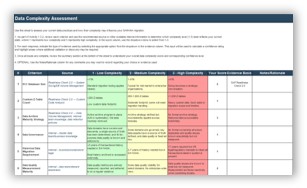
S/4HANA Complexity Assessment
Leverage this tool to assess and understand your current technical ERP complexity.
S/4HANA Decision Guide
Leverage Info-Tech's decision template to assess the trade-offs and benefits of each migration plan.
Key deliverable:
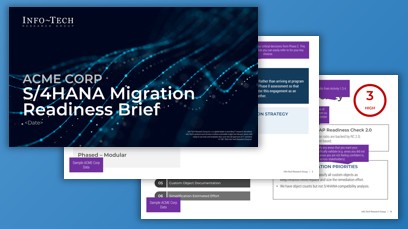
S/4HANA Migration Readiness Brief
A customizable presentation that clearly communicates your migration goals to your implementation partner.
Measure the value of this blueprint
Leverage this blueprint's methodology and tools to define your migration intent, make informed trade-offs, and build an S/4HANA plan that aligns to your organization and guides implementation.
| Outcome | Value |
| Reduced rework | Make deliberate, aligned decisions early to avoid revisiting migration scope, reworking design choices, and incurring unnecessary delays. |
| Controlled scope and migration plan | Clarify the decisions owned by the organization versus the implementation partner, reducing overreliance and maintaining control over key design outcomes. |
| Future-state designed system | Align your migration decisions not just to your current constraints but to your future-state priorities to avoid repeated change efforts and retrofitting. |
| Structured handoff to implementation partners | Onboard your implementation partner with confidence by packaging decisions, governance structures, and rollout approach into a clear migration plan. |
Measure the value of this blueprint
Leverage this blueprint's methodology and tools to complete your own preliminary plan and mitigate the risks of scope expansion mid-program.
55% of S/4HANA projects exceed original budget.
Source: Horvath Partners, 2025
60% experience planning overruns averaging 30% longer.
Source: Horvath Partners, 2025
35% of overruns are driven by scope expansion.
Source: Anchor Group, 2026
| Company Size | Average Total Project Cost | Conservative Savings (15%) | Average Overrun Avoided (30%) |
| Mid-Market | $800K to $8M | $120K to $1.2M | $240K to $2.4M |
| Large Enterprise | $10M+ | $1.5M | $3M+ |
NOTE: The cost of an S/4HANA migration varies significantly by migration plan and remediation efforts.
Build your S/4HANA migration plan
Define your migration plan before engaging implementation partners – do not outsource your direction. Own the migration plan up-front to retain control and ensure partners execute your vision, not theirs.
DISCOVER
STRATEGIC INTENT
Lift and Shift | Process Optimization | Digital Transformation
INTERNAL READINESS
Change Appetite & Management
DATA READINESS
PROCESS STANDARDIZATION
CUSTOMIZATION COMPLEXITY
INTEGRATION LANDSCAPE
DEFINE
DEPLOYMENT METHOD
Cloud Private | Cloud Public | On-Premise
MIGRATION STRATEGY
Greenfield | Brownfield | Hybrid
ROLLOUT APPROACH
Big Bang | Phased – Geography | Phased – Modular | Global Template | Two-Tier ERP
DRIVE
INTERNAL TEAM
PROJECT GOVERNANCE
Project Manager | Project Sponsor | Process Owners | Data Lead | Technical Architect | Change Management Lead
EXTERNAL TEAM
TECHNICAL EXECUTION
System Integrators | Implementation Partner
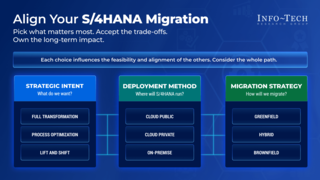
Align Your S/4HANA Migration
Pick what matters most. Accept the trade-offs. Own the long-term impact.
There is no single "right" plan for S/4HANA, but there is a wrong one: migrating without understanding the trade-offs. Success comes from making deliberate decisions and owning their long-term implications.
Use external support for your technical execution
This research does not aim to replace the need for a technical executor. Instead, it aims to support your conversations and help you get through the Phase 0 planning.
- An S/4HANA migration is a full ERP transformation requiring deep technical, functional, and project delivery expertise that most organizations do not have in house. Engaging an implementation partner or systems integrator (SI) is not optional; it is standard practice.
- Most organizations rarely undergo ERP transformations, so it makes sense that this expertise is not present in your organization. During your transformation, you must continue to keep your daily operations running, and not hiring external support may deplete your internal resources.
- The risk is not in hiring a partner – it's in hiring one before you understand your own direction.
61% of companies that are migrating to S/4HANA or have migrated have used external IT consultants/executors.
Source: Horvath Partners, 2025
You don't have to do everything, but you do have to lead it
The complexity of an S/4HANA migration leads organizations to feel like handing off decision-making to their implementation partner is the right thing to do. However, complexity is not a reason to cede control – it's the reason you cannot afford to.
When organizations defer decisions to their partner, they don't eliminate the complexity – they just lose visibility into how it is being resolved. The partner makes choices that are reasonable for delivery but may not be right for the organization.
Info-Tech Insight
Your implementation partner is there to execute. You are there to lead. The organizations that get this right don't do more – they stay present at the decisions that matter and never mistake their partner's confidence for their own clarity.
What happens when you step back
- Scope drifts toward what the partner knows how to deliver.
- Decisions get made by default rather than by design.
- The migration optimizes for go-live, not for long-term fit.
- Intent erodes gradually, without a single moment you can point to.
What leading looks like
- Arriving at every key decision point with a position.
- Understanding the trade-offs well enough to push back when needed.
- Knowing which decisions are yours to own versus delegate.
- Anchoring against intent throughout the migration.
Focus on your decisions, not execution
S/4HANA migrations often stall not because of technical execution but due to a lack of clarity on key decisions and how they shape the migration. Without a structured approach, organizations default to reactive decision-making during implementation or defer critical choices to implementation partners – reducing control and increasing risk.
Budget overruns
Timeline delays
Post go-live instability
Adoption resistance
The most common failure patterns trace back to poor planning and deferred decision-making, not system defects.
More than 60% of companies experience deviations in budget, schedule, and result quality during S/4HANA migration.
Source: Horvath Partners, 2025
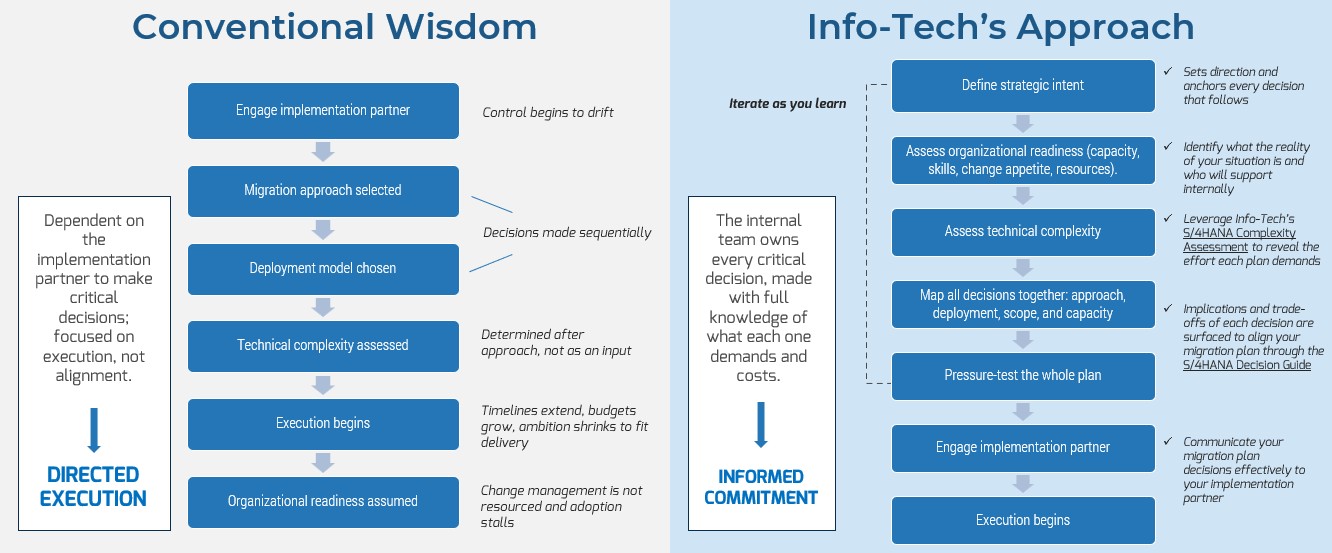
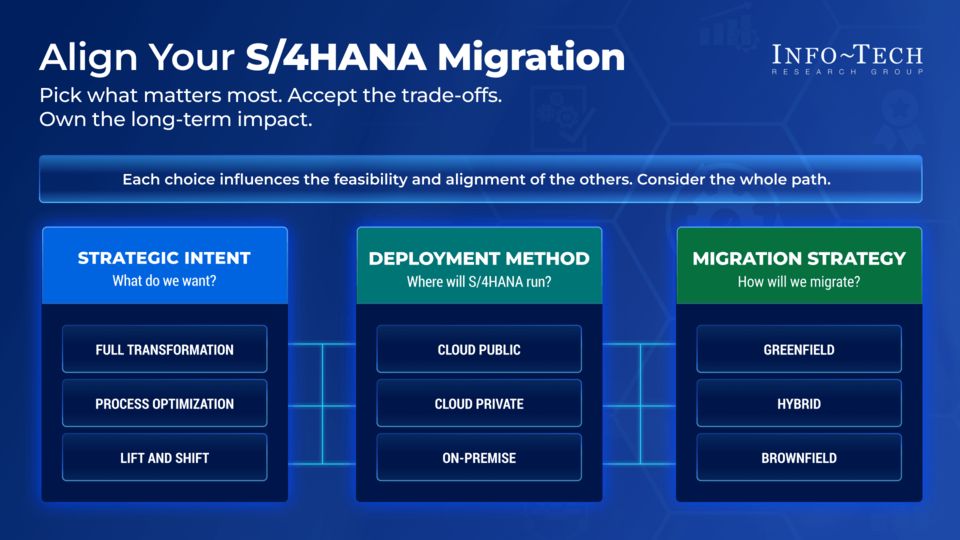
Leverage Info-Tech's methodology to build an informed S/4HANA migration plan
About Info-Tech
Info-Tech Research Group is the world’s fastest-growing information technology research and advisory company, proudly serving over 30,000 IT professionals.
We produce unbiased and highly relevant research to help CIOs and IT leaders make strategic, timely, and well-informed decisions. We partner closely with IT teams to provide everything they need, from actionable tools to analyst guidance, ensuring they deliver measurable results for their organizations.
What Is a Blueprint?
A blueprint is designed to be a roadmap, containing a methodology and the tools and templates you need to solve your IT problems.
Each blueprint can be accompanied by a Guided Implementation that provides you access to our world-class analysts to help you get through the project.
Need Extra Help?
Speak With An Analyst
Get the help you need in this 3-phase advisory process. You'll receive multiple touchpoints with our researchers, all included in your membership.
Guided Implementation 1: Discover Your Current SAP Landscape
- Call 1: Understand the current system and define the project management team.
- Call 2: Establish vision, scope, and goals. Define your strategic intent.
- Call 3: Assess your current technical complexity.
Guided Implementation 2: Define Your Migration Path
- Call 1: Evaluate and select your deployment method and migration strategy.
Guided Implementation 3: Prepare Your Migration
- Call 1: Define your project governance processes and metrics.
- Call 2: Define your migration rollout approach and prepare your migration readiness brief.
- Call 3: Summarize results and plan next steps.
Contributors
- Akhil Cherukuri, SAP Digital Transformation Specialist
- Kunal Bhat, SAP Lead, Spin Master
- Abhi Bhosekar, Senior Consultant, DCB Financial Services
- Esteban Remecz, CIO, Maxion Wheels
- Marconi Magalhaes, Director of IT/SAP Lead, Maxion Wheels
- Thomas Breton, Senior Director IT and Transformation, duBreton Inc.
 Get the Most Out of Your Microsoft Dynamics Finance and Operations
 Build an ERP Strategy and Roadmap
 Select an ERP Implementation Partner
 Get the Most Out of Your ERP
 Select an Enterprise Application
 2020 Applications Priorities Report
 Sync or Sink: Aligning IT and HR for the Future of Work
 Project & Portfolio Management Software Selection Guide
 Build Your S/4HANA Migration Plan
