Databricks Is No Longer Just a Data Company
Databricks is moving into cybersecurity and marketing technology, adding AI agent management on top of its existing data business. The pitch: one platform for everything. Databricks opened up the data layer and the catalog, so the switching cost shifted to the operational layer: the workflows and security rules built on the platform, and the agents running on top of them.
Databricks built its business storing and analyzing data at scale. At the Data + AI Summit 2026, the company announced it is now competing in five distinct software markets: data infrastructure, cybersecurity, customer marketing, AI agent management, and database software. The move is a direct challenge to Splunk, Salesforce, and Snowflake all at once.
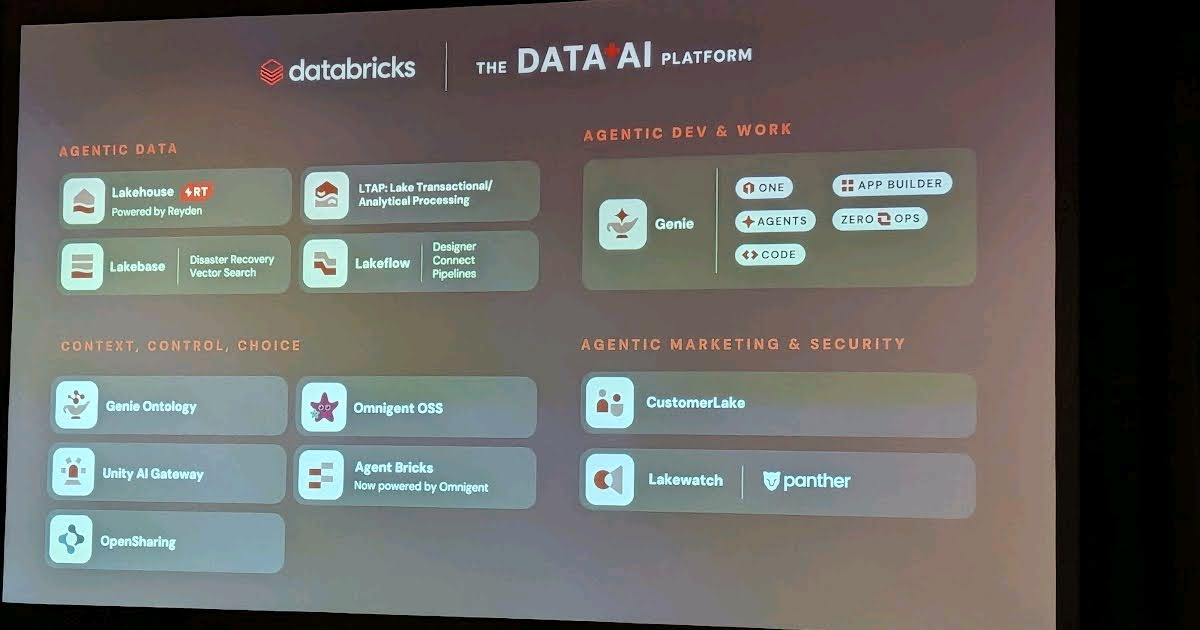
The company's financials support the ambition. Databricks reported annualized revenue above $5.4 billion, growing at 65% year over year as of February 2026. That growth rate is unusual at that revenue scale. It reflects strong demand for a single platform that can run data analysis and AI workloads together, rather than stitching together separate tools.
What Databricks Actually Announced
A security product called Lakewatch. Most enterprise security teams use tools that charge by how much data they store, which leads teams to delete old records and skip logging certain systems to control costs. Lakewatch separates storage from processing charges, so organizations can keep more data without a proportional cost increase. Databricks claims this can reduce total security software costs by up to 80% compared to incumbents. Anthropic, the AI safety company, uses Databricks for its own security operations.
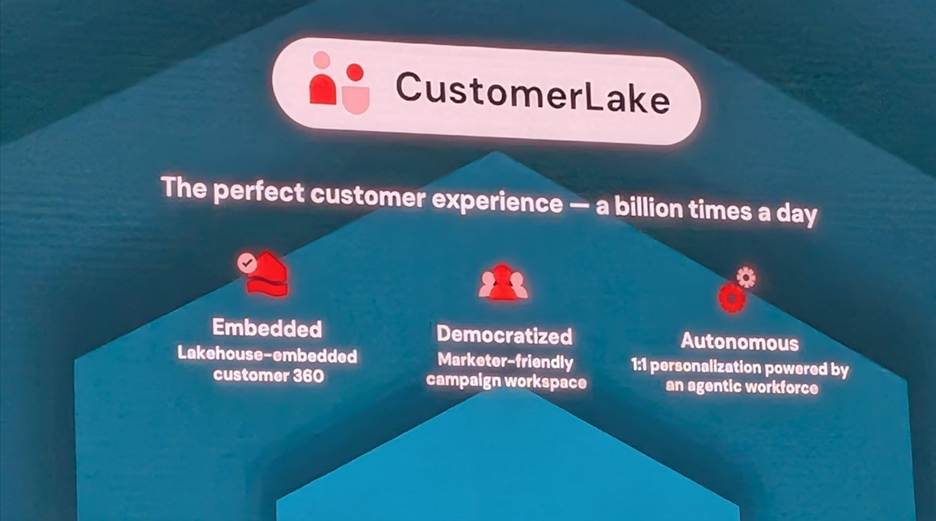
A marketing data product called CustomerLake. Companies currently run separate systems to collect customer data, analyze it, and then activate it in email or advertising campaigns. Each handoff between systems introduces delay and data loss. CustomerLake runs all three steps inside the same Databricks environment. The identity-matching layer comes from Acxiom, covering 260 million people in the United States, and campaign delivery runs through Bloomreach. Databricks supplies the infrastructure; partners supply the customer data and channel execution.
An AI agent management tool called Omnigent. As companies deploy AI coding assistants and automated agents, they face a new control problem: Each agent runs separately, with its own permissions and costs, and there is no single view across all of them. Omnigent is a free, open-source tool that sits above any AI agent and enforces one set of rules across every agent: access, spending limits, and network permissions. The free release is intentional. If engineering teams adopt Omnigent as their standard, the natural next step is tighter integration with Databricks’ other products.
A new database architecture called LTAP. Lakebase, Databricks’ Postgres-based operational database, has been available since 2025, so it isn’t this year’s news. The 2026 announcement is Lake Transactional/Analytical Processing (LTAP), which unifies transactional and analytical data on a single copy of storage in the lake, alongside new Lakebase capabilities such as cross-region disaster recovery and Git-style branching. Traditional applications keep their operational database separate from the analytics platform, which forces teams to copy data between the two before it can be used together. Lakebase puts a transactional database inside the Databricks environment, so the same data backs live applications and analytics without a separate copy.
An ontology layer called OntoRank. AI agents answer business questions better when they understand how a company’s data connects, not just where it is stored. OntoRank builds an ontology graph of an organization’s data and uses a ranking algorithm, similar to the way web search ranks pages, to surface the parts of that graph most relevant to a given question. Databricks uses it internally to give its own AI assistant business context across millions of data points.
A convergence of data formats. Databricks and its main open-source competitor, Apache Iceberg, will align on a shared technical foundation in their next versions. For organizations storing data in either format, this reduces the friction of moving between platforms. Databricks has also opened the governance layer: Unity Catalog is open-source and free, and it now interoperates with engines like Spark and catalogs like Apache Polaris, so the catalog itself locks an organization in far less than it used to. The harder cost to escape sits one level up, in the access policies, security detection rules, and campaign agents tuned to a specific deployment.
Why This Matters
The consolidation offer is real, but so is the lock-in. Databricks is offering CIOs a single governance layer across data, security, marketing, and AI agents. For organizations already running Databricks for analytics, the incremental cost of adding Lakewatch or CustomerLake is low. The governance rules and access controls are already in place.
These new products could still underperform. Lakewatch, CustomerLake, and Omnigent are all newly launched. None have multiyear production records at large scale. An organization that consolidates five vendor relationships into Databricks gains simplicity and loses negotiating leverage at the same time.
The open data format story obscures the real switching cost. Databricks has made it easier to move raw data files off its platform, but it has not made it easier to move the workflow logic, security detection rules, or campaign agents built on top of those files. Audit portability at the workflow level, not just the data level, before signing an expanded contract.
Our Take
Databricks has a credible case for platform consolidation among organizations already running it for data and AI workloads. The new products extend a governance model that’s already in place rather than requiring a new deployment. The expansion into security and marketing adds real value if the underlying data platform is Databricks to begin with.
The risk is concentration. Five software categories in one vendor relationship means five categories of exposure if pricing, support, or product direction changes after consolidation. The free and open-source releases, Omnigent and the format convergence story, lower the cost of entry. They do not lower the cost of exit once operational workflows are built on the platform.
For CFOs, the 80% security information and event management (SIEM) cost reduction claim is worth testing against a real workload before negotiating. For CIOs, the catalog decision matters most: Databricks’ catalog, Unity Catalog, controls data access across every tool in the environment. Apache Polaris, an open alternative cocreated by Snowflake and Dremio, is the other option. With Unity Catalog now open-source and interoperable, locking into it is no longer a one-way door.
Before expanding the Databricks contract, map which workflows would need to be rebuilt if the relationship ended. That exercise will clarify how much consolidation is worth paying for.
