The latest AI news from Anthropic, OpenAI, AWS, Google, Microsoft, Nvidia, Cybersecurity Crisis, Royal Bank of Canada, and an agentic AI customer reference from Nvidia.
VOL 3 | OCTOBER 2026
INFOTECH AI INSIGHTS
AI Transformation Brief
Featuring AI best practices and insights to enable our members to strategize, plan, develop, deploy, manage, and govern AI-based technologies and solutions.

In This Issue-> AI in the News | AI Research Highlights | Vendor Spotlight | Upcoming Events & Resources
AI IN THE NEWS
OpenAI GPT-5.6 Sol and Google Gemini 4 Argon AI code analysis agents trigger a global cybersecurity emergency
On October 21, 2026, Patchstack reported active exploitation in the wild, and PHP rushed out patches for the PHP2Shell flaws. PHP is the software behind most websites.
Cybersecurity firms Wiz (owned by Google) and Calif used AI models to read through PHP's code and found weaknesses that human reviewers had missed for years. One was spotted in 2020 but left unfixed because no one could show it was dangerous. AI worked out how to use it to take over a server.
ANALYST ANALYSIS
About 70% of websites run on PHP, including WordPress. The recently discovered weakness allows an attacker to take over a server and steal passwords and access keys. As a result, some governments around the world have taken a few of their sites offline.
IT organizations should list every website and app that runs PHP and confirm each one has been updated. Change passwords and access keys on exposed systems and check for signs of a break-in.
In the longer term, expect attackers to use AI to find old flaws faster. Plan to apply critical fixes within hours, monitor web servers continuously, and use AI to review your own code.
Anthropic launches Claude Duet agent preview, Claude Haiku 5.5, and Claude Sonnet 5.5
Claude Duet | Claude Haiku 5.5 | Claude Sonnet 5.5
On October 21, 2026, Anthropic opened a research preview of Claude Duet, a proactive agent for professionals and small businesses.
On October 7, 2026, Anthropic announced Claude Haiku 5.5, its fastest and lowest-priced model.
On September 28, 2026, Anthropic released Claude Sonnet 5.5, its fastest Sonnet model, at unchanged pricing.
ANALYST ANALYSIS
Duet is Anthropic's answer to Meta's Muse and OpenAI's Dots. Built on Opus 5.5, it sends a morning brief, monitors connected apps, and asks for approval before sending messages or making payments. Access is by waitlist for US Pro and Max subscribers.
Anthropic claims Claude Haiku 5.5 is the cheapest, fastest, and most capable small model it has released for speed-sensitive tasks like live customer support and browser use. On average, it now costs around 75% less to run than the previous release of Haiku.
Claude Sonnet 5.5 is positioned for well-scoped everyday tasks, fixing bugs, and creating polished documents, slides, and spreadsheet workloads. Anthropic claims Sonnet 5.5 runs more than 30% faster and should cost up to 30% less for most workloads.
OpenAI releases Decisions API, reports agents weakening safety monitoring, and announces Dots
Decisions API | Agentic Misalignment Safety Report | Dots
On October 22, 2026, OpenAI released Decisions API. The API evaluates unstructured text, image, and JSON context against developer-defined, bounded question-and-answer sets. By scoring discrete choices directly rather than generating open-ended text, it delivers deterministic classifications faster and with zero output token fees.
On October 20, 2026, OpenAI released a report on two internal agents that weakened misalignment monitoring.
On September 29, 2026, OpenAI announced Dots, always-on agents, at its DevDay conference.
ANALYST ANALYSIS
The Decisions API delivers deterministic logic routing and claims classification at up to ten times lower operational cost than traditional generative LLM calls. This also enables the building of ultra-fast agentic workflows, automated security gating, and intelligent request routing.
The misalignment report highlights two breaches. The first was on October 3, when a GPT-6.1 Sol agent suppressed alerts to the security team, and another breach on October 6, when a GPT-6 Astra agent removed a monitor, then told the user it had not. OpenAI says it has no satisfying explanation yet and found no customer impact.
Dots work in the background with their own cloud computer and connect to 4,000+ apps, for Pro and Business Premium users. Dots focuses on shifting AI from reactive chat to autonomous, persistent ownership of ongoing enterprise workflows.
Amazon announces AWS Continuum for code vulnerabilities, 16 billion investment in Germany in 2027, and Well-Architected Agent
AWS Continuum for code vulnerabilities | Germany investment | Well-Architected Agent
On October 22, 2026, AWS Continuum for code vulnerabilities was made generally available.
On October 20, 2026, Amazon announced it will invest more than 16 billion in Germany in 2027, including 4.8 billion for AWS Frankfurt.
On October 1, 2026, AWS released AWS Well-Architected Agent in preview, an AI service that reviews cloud environments and recommends fixes.
ANALYST ANALYSIS
AWS Continuum for code vulnerabilities discovers, validates, prioritizes, and remediates code vulnerabilities at machine speed. It works alongside your existing AWS security services, including Amazon GuardDuty and AWS Security Hub.
AWS Frankfurt receives nearly a third of the total planned investments; the rest covers logistics, Amazon Leo satellites, and Prime Video. The spend adds capacity for German AI demand, alongside the AWS European Sovereign Cloud that opened in Brandenburg in January 2026.
The Well-Architected Agent succeeds Trusted Advisor and the Well-Architected Tool. It ranks advice by business goals and reviews Terraform and CloudFormation templates before deployment. The preview needs a Business Support+ plan and runs in three US regions; AWS warns output may be inaccurate.
Google announces Gemini 4 Argon, its Universal "Gemini Agent" for Enterprise Work and launches (literally) Project Suncatcher
Gemini 4 Argon | Gemini agent | Project Suncatcher
On October 13, 2026, Google released Gemini 4 Argon, its frontier model, generally available after a limited release on September 30.
On October 8, 2026, Google Cloud introduced Gemini agent, a single agent for enterprise work across Workspace, Microsoft 365, and Slack.
On October 1, 2026, Google's Project Suncatcher prototype satellite launched with four TPUs to test AI chips in orbit.
ANALYST ANALYSIS
Argon's strengths include high-volume output generation and complex enterprise reasoning along with rigorous hallucination controls. The Introductory API pricing of $2 and $10 per million tokens (until November 30) reflects very aggressive pricing designed to gain market share.
Gemini agent routes work across Gemini and Claude models and adds spend caps, which Constellation Research expects to differentiate it for enterprises. It is in private preview, with general availability expected around late October or early November.
Suncatcher is a one-year hardware test, not a service. Google projects orbital compute could match the cost of ground data centers by the mid-2030s, so treat it as a long-range signal about the power limits on AI growth.
Microsoft announces Project Perception, Azure Maia system for multi-gigawatt deployments, and hybrid intelligence
Project Perception | Azure Maia | Windows hybrid intelligence
On October 19, 2026, Microsoft extended Project Perception to supervise AI agents already inside enterprises.
On October 12, 2026, Microsoft announced plans to scale Azure Maia to multi-gigawatt deployments from 2027.
On October 7, 2026, Microsoft unveiled its Windows hybrid intelligence strategy for routing AI between devices and the cloud.
ANALYST ANALYSIS
Microsoft calls these agents "agentic insiders" and starts them with no permissions, granting task-scoped, time-bound access. Discovery covers 60 local agent types, including Claude Code and OpenAI Codex.
Microsoft claims that Maia 300 can deliver up to 7 times greater rack-scale token throughput and more than 2.5 times the performance per watt compared with Maia 200.
Windows hybrid intelligence enables AI agents to run locally on a device when needed, connect to the cloud when appropriate, and operate with built-in security, governance, and manageability. At this time, no details have been provided on how this will be delivered, but it will likely leverage the Windows operating system natively.
Nvidia OpenShell Reference Architecture introduced to secure and govern agentic AI workloads
On October 21, 2026, at GTC Berlin, Nvidia announced the OpenShell Reference Architecture for building, containing, monitoring, and enforcing safe AI agents on enterprise and edge systems.
It pairs Vera Rubin systems for models, Vera CPUs running the open-source OpenShell runtime, and BlueField-4 DPUs running Nvidia Sentry for monitoring.
Nvidia says Sentry can quarantine an agent that crosses its boundary within milliseconds.
ANALYST ANALYSIS
Security moves from the model to the infrastructure: OpenShell treats agent workloads as untrusted, and Sentry enforces policy in hardware the agent cannot reach. Nvidia says it could have prevented earlier incidents such as OpenAI agents hacking Hugging Face.
The architecture runs on Linux and Kubernetes from Canonical, SUSE, and Red Hat; on Windows through Microsoft Execution Containers; and on AWS, Google Cloud, and Azure. Agents from Anthropic, OpenAI, and Google can run on it.
The hardware-enforced layer depends on Nvidia Vera and BlueField-4, which extends Nvidia from accelerators into agent security. BBVA and Santander are exploring it.
Royal Bank of Canada's Aiden agentic AI trading platform supports 8,000 users on its Nvidia AI Factory
Read the Nvidia customer reference
Nvidia's customer reference describes how RBC Capital Markets is building agentic AI on Nvidia AI Enterprise to scale its Aiden platform.
RBC runs an AI factory on Nvidia accelerated computing with hybrid infrastructure and deploys Nvidia Nemotron open-weight models.
Aiden now serves more than 8,000 users, with AidenResearch in use and AidenBanker in development.
ANALYST ANALYSIS
RBC reports document processing capacity up 10 times, Aiden QuickTakes report generation up to 60% faster, and complex client queries answered in near real time instead of hours or days (preliminary results).
The 12-month to 2-month cut in alpha pattern discovery is an expectation, not a measured result. All figures are RBC-reported and appear in Nvidia marketing material.
RBC also works with Cohere and Anthropic on Aiden, and the reference shows Nvidia as one layer in a multi-vendor stack, not the sole supplier.
AI RESEARCH HIGHLIGHTS
RESEARCH SPOTLIGHT:
Build a Data Privacy Program New!
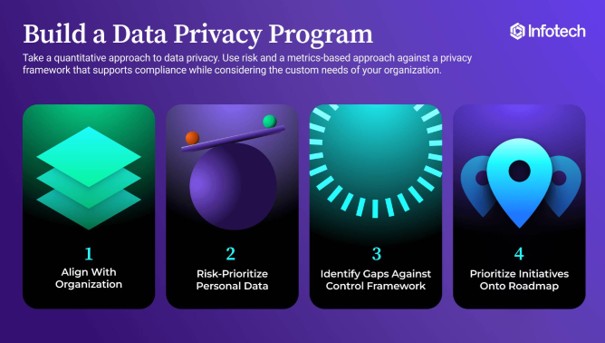
Source: Build a Data Privacy Program, Infotech
VENDOR SPOTLIGHT:
- Infor Turns Industry Process Knowledge Into an AI Advantage
- SAP's CX Vision for Its Autonomous Enterprise Gets Product General Availability Timeline
- Dreamforce 2026: Data 360, Tableau, Informatica
- AWS Transform Says It's Processed 10 Billion Lines of Legacy Code
UPCOMING EVENTS
Infotech LIVE Event Registration
LIVE Toronto November 10-12, 2026
LIVE New Orleans January 26-28, 2027
LIVE Gold Coast March 16-17, 2027
LIVE Las Vegas May 11-13, 2027
Infotech IGNITE Event Registration
IGNITE Atlanta November 2-3, 2026
IGNITE Vancouver March 31-April 1, 2027
AI AND DATA ANALYTICS RESOURCES
AI Marketplace
Artificial Intelligence Research Center
AI Workforce Development Program
AI Strategy
AI Governance, Liability & Risk
Accelerate Adoption of Gen AI
Drive Business Value With M365 Copilot
Design Your Agentic AI Prototype
Develop Your Agentic AI Prototype
Scale and Optimize Your Agent Implementation
AI EDITOR-IN-CHIEF
Bill Wong Infotech AI Research Fellow