
Digital Disruption
with Geoff Nielson


Our Guest Bala Muthiah Discusses
Will AI Replace Software Engineers? Here’s What Lyft’s Engineering Director Says
Is AI really replacing software engineers, or just changing how they work?
On this episode of Digital Disruption, we’re joined by Bala Muthiah, Director of Engineering at Lyft.
Bala sits down with Geoff to cut through the hype around AI in software development and explore what’s actually changing inside high-performing engineering teams. From vibe coding and AI-powered prototyping to production-ready systems, productivity gains, and the reality behind 10x (or 100x) engineer claims, Bala shares a grounded perspective on why true improvements are closer to 10% to 20%, not exponential overnight disruption. They discuss engineering leadership in the AI era, bridging skeptics and evangelists, why value creation matters more than lines of code, the importance of customization over out-of-the-box AI, data privacy and governance responsibilities, the growing digital divide, and the critical role of curiosity, culture, and trust in building modern tech teams.
Bala is a technology leader who builds high-performing teams and AI that enhances human connection. Beyond his technical leadership, he serves as a startup advisor and served as an advisory board member at Defy Ventures (nonprofit focused on prison reform), reflecting his belief that community impact and innovation should grow together. He emphasizes that AI with humans in the forefront shapes everything he does. AI. He promotes positive aspects of AI while recognizing that leaders must guide its development responsibly.
00;00;00;25 - 00;00;28;12
Geoff Nielson
Hey everyone! I'm super excited to be sitting down with Bala Muthiah. He's the Director of Engineering at Lyft and advisor to tech startups that Bala has built and scaled. Game changing products is super cool. But what really got my attention is his ability to blend that with a focus on people and building high performing cultures. I want to ask him what he sees as the future of engineering teams, and if I is ready to write the obituary of the software developer, or if something gentler is coming.
00;00;28;15 - 00;00;41;00
Geoff Nielson
What is a thought leader like Lyft already doing that we should be learning from? And how should we as leaders be adapting to this brave new world? Let's find out.
00;00;41;02 - 00;00;57;17
Geoff Nielson
I wanted to say a big thank you for joining us today. Maybe jumping right into it, you know, can you tell me a little bit about your outlook for technology and AI in the coming year, in the years ahead, and maybe specifically how it relates to the work you're doing and, you know, engineering as a field.
00;00;57;19 - 00;01;27;01
Bala Muthiah
Yeah. Thank you. Thanks for having me, Jeff. Great to be here. I would say the time we are in, it's definitely the most exciting time from a technology evolution. Like, we have seen a lot of things, right? From digital transformation to mobile social, a lot of stuff. But I believe this one is really pivotal. I know we have this habit of saying this every time, but this time I feel this is, changing everyone directly in a much more accelerated way.
00;01;27;03 - 00;01;56;10
Bala Muthiah
Coming to engineering, that's my bread and butter. I can day in and day out, see what's happening. Like last year, what we were planning to do and how the tools were, and just few buttons in what happens. So it is very, very rapidly changing and people are picking up. So I would say it's a period of creation. A lot of things are getting created and that's where we come in as leaders to make sure we create the right things, we create with the right people, and we create for the people.
00;01;56;13 - 00;02;02;21
Bala Muthiah
So overall, I would say one of the most exciting times, ever in technology era.
00;02;02;24 - 00;02;21;09
Geoff Nielson
So how do you see it specifically as you think about the role of engineers and the role of, you know, leaders of engineering teams? You know, what are some of the impacts? How is it changing people's their jobs? Maybe both in terms of the, the way they're approaching problems and then maybe also their level of productivity in your mind.
00;02;21;12 - 00;02;43;04
Bala Muthiah
Yeah, yeah. Like before, I'll come to that point, like one thing that is largely changing or it's on the shoulders of leaders now, is there are two camps, right? There's one camp which is super excited. Hey, like, we want to get everything done tomorrow. And with AI we can finish things in 30 minutes. Like days are now looking like weeks and months.
00;02;43;06 - 00;03;18;20
Bala Muthiah
And the other where people who have been working in this using technology, engineering craft, they there are some skeptical, camps. As a leader, I believe it's our job now to bridge these two. And hey, we need dreamers. We need people at that level to dream. At the same time, there is a ground reality. So this is where leaders now play an even more crucial role on bridging these two, camps and how it converge or how it is being looked at is, of course, you talked about productivity, right?
00;03;18;21 - 00;03;40;18
Bala Muthiah
That's the first thing everyone is coming at. Can I do things faster? A lot of things are focused on how fast can I build, how quickly can I ship something to the market? So as leaders, I look at or I use the lens of value creation more than output. Like what outcome are you creating? Yes, I can create 20 features.
00;03;40;20 - 00;03;59;00
Bala Muthiah
Are we creating at a rate where users are not even able to use it and fully consume and give you the feedback? As we all know, we are building things for end users and consumers and customers. If they're not giving you feedback, if you don't have a way to get the feedback, no matter how fast you build, it becomes a nice.
00;03;59;02 - 00;04;20;19
Bala Muthiah
So that's where we come in. Like use a proper lens to measure what productivity actually means and what we want out of teams, what we want out of market. So overall, like being more intentional is the word I keep telling my team, like, how are we being intentional in everything we are doing because we are going really fast?
00;04;20;22 - 00;04;44;23
Geoff Nielson
I really like your approach in terms of bridging the gap. And I'm, you know, I talk to lots of people who are on both sides of the gap from, you know, the dreamers who want everything right now and think this is completely changing the way, you know, every aspect of a company runs, you know, and the people who are saying, you know, let's slow down and then really deeply understand what's going on here with the first camp.
00;04;44;25 - 00;05;13;08
Geoff Nielson
One of the things that you hear about a lot is this notion of a vibe coding, and that the technical craft that's been historically done by developers and engineers just doesn't really matter anymore. And, you know, I've seen the obituary written for, you know, software development is a practice, you know, more and more frequently now. And, you know, I mean, I'll tell you my opinion, which is that I'm a little bit skeptical of that.
00;05;13;08 - 00;05;27;05
Geoff Nielson
But I'm curious from your perspective in the fray, in a world that bridges, you know, these two sentiments, how are you finding it? What is it good for? What is it not good for? And what do you think is the the outlook for this whole profession now?
00;05;27;11 - 00;05;47;16
Bala Muthiah
Very true, is like a reality we are walking into every meeting now, these days. It reminds me when Google came some of the doctor's offices actually started putting a board which said my medical degree is better than your Google search, right? Because at that point we go to doctor and say, oh, I see these two symptoms. I think it could be this.
00;05;47;21 - 00;06;09;18
Bala Muthiah
I think it could be that. And then doctors are like, okay, okay, hold on. Yes, you are right. But there's a bigger picture. I feel engineers are now going through that phase with vibe coding, because vibe coding actually has democratized software development. Like anybody can come and do within like few problems within few minutes, regardless of role and level.
00;06;09;20 - 00;06;55;04
Bala Muthiah
And it's good for prototyping. It's good to show something. Traditionally, if a product manager has something or a designer has something, they have to create an artifact. That took a lot of time just to convey an idea. Right now, that cycle can be reduced drastically to show a prototype quickly. However, when we want to talk about production izing it, actually putting it out there where it can get shipped and stay afloat without getting, sunk is that's the piece where we should be cautious and not really do so identifying areas where it's less risky, like if you have internal tools, if you have things that you can use to show something to others within to
00;06;55;04 - 00;07;23;21
Bala Muthiah
build things like tools are okay to use lip coding and stuff. If until we have a proper guardrail right, we cannot just put it into production code because it's going to impact depends upon the industry, the repercussions could be huge. Talking about medical or talking about sensitive security stuff, it's really risky. So identifying like low risk areas, internal areas that are not too dangerous to put out.
00;07;23;26 - 00;07;50;02
Bala Muthiah
It's a very good place to practice. Also that's a good practice ground. So you can take that out and go and do it in the real world. So that's why I give it giving it to experts like people who have done the craft. Like you said, they can actually understand. Okay, how can I use this to accelerate with proper guardrails, with proper systems and mechanisms so things doesn't go out of proportion and blow out?
00;07;50;04 - 00;08;17;15
Geoff Nielson
If you work in it? Infotech research Group is a name you need to know no matter what your needs are. Infotech has you covered a strategy covered. Disaster recovery covered. Vendor negotiation covered. Infotech supports you with the best practice research and a team of analysts standing by ready to help you tackle your toughest challenges. Check it out at the link below and don't forget to like and subscribe!
00;08;17;17 - 00;08;37;10
Geoff Nielson
And I think you and I are basically of the same mind that there are a lot of good uses for it. But you know, production environment code and systems at scale are probably not the first place to be to be using vibe coding. But which makes complete sense. One of the one of the kind of macro level questions that's coming up.
00;08;37;10 - 00;09;05;21
Geoff Nielson
And we're seeing it play out in, you know, labor market stats and, you know, company press releases is whether these new tools decrease our reliance on software developers and whether they, you know, create a world where, you know, we just need fewer software developers. You know, the idea being, well, if there's higher productivity, then, you know, maybe we need few fewer people and they can do, you know, the same or they can do more.
00;09;05;23 - 00;09;17;18
Geoff Nielson
I'm curious on your perspective on that. Are you seeing the trends here and saying, oh, great. You know, this is a world where, you know, it's going to be a smaller team or is that, you know, in some way just fundamentally misguided?
00;09;17;20 - 00;09;38;27
Bala Muthiah
I, I would say it's still in the learning phase. So I know some people are on the edge taking more bolder decisions. But, on the other side, I would say people are cautious because all the researchers that are coming out like the long running ones, like long running research. And when I say long running, I'm talking about a year long that that's the age we are in.
00;09;38;29 - 00;10;00;09
Bala Muthiah
And with large scale like Stanford has a study, MIT has a study. The productivity is coming somewhere around 10 to 15%, maybe 20% max in some areas purely in engineering angle, right? Not in other functions. So companies at this point, there are some who are like boldly making statements. And like you said, every earnings statement now comes with AI.
00;10;00;11 - 00;10;34;26
Bala Muthiah
Without AI, there's no earnings statement that gets completed. Quarterly earnings are always having some AI, especially tech companies, are talking about, oh, 50% of my code is done. 70% of my code is done with AI. So then that begs the question, oh, then what are the other people doing? Are you creating more than what's, consuming aspect? I think fortunately, people are not using AI as a reason to cut the team size and still operating in a model where, okay, let's start creating more output.
00;10;34;29 - 00;10;56;01
Bala Muthiah
Right? If I have ten people team, I'm just gonna have seven people who deliver the same verses, or ten people can deliver more than what they used to deliver before still in that camp. But I really am not confident that that is going to be the forever camp, because there might be a shift when say, oh, I'm just going to make a decision and then come back.
00;10;56;04 - 00;11;15;21
Bala Muthiah
We have seen this again and again where preemptively jumping to a decision and rolling back. So that is common. And if we have to be vigilant and that's where leaders come in. Like being realistic about what you want to promise. What do you think is going to happen before calling a hunt. Because this is dealing with people and life and industry economy.
00;11;15;21 - 00;11;19;09
Bala Muthiah
This is like macro impacts for this.
00;11;19;11 - 00;11;39;20
Geoff Nielson
I, I, I agree with that. And, you know, it's interesting to me and I find myself coming back to that number you quoted, which is kind of a 15 to 20% productivity gain. And one of the reasons I find that so interesting is, first of all, that the conversation is focused so much around productivity and even, you know, the piece that sort of rubs me the wrong way.
00;11;39;20 - 00;12;03;29
Geoff Nielson
As somebody who's worked, you know, with developers very closely before is, as you said, like people talking about like 80% of their code is written by AI. And this notion that you can measure the the value of software development by like how much code is written, just just like, you know, for, for, you know, people like us who have been there like it's it feels a little bit silly.
00;12;04;05 - 00;12;25;10
Geoff Nielson
And so I'm curious from your perspective, what what are the top traits that you think are important in a software developer? What's more important than ever? What should a great software developer be spending their time doing or thinking about? If it's not just, you know, hands on keyboards for, you know, 40 or 80 hours a week?
00;12;25;12 - 00;12;47;01
Bala Muthiah
Yeah. Yeah, totally. It's true. Like we are still in the industrial mindset measuring output by throughputs. Okay. How many, soaps did they make today? How many cars do they make today? That becomes the count that for software. Actually, this has been a practice even before. Once upon a time. You talked about a clock, right? Killer lines of code.
00;12;47;07 - 00;13;12;14
Bala Muthiah
That was actually a measure in some companies back in the days. And they moved away when companies like Google and, Facebook came into being, like, they really redefined those performance metrics. And now if you look at the software development lifecycle, like coding is really not the constraint. Like if you look at the whole thing, nobody says, oh, it's going to take so much time to code like nobody ever said.
00;13;12;14 - 00;13;37;16
Bala Muthiah
No, it it's always other activities. It's always about, oh, coordinating, checking, testing, validating, verifying and like aligning. Those are the things that are going to take time. That's why the gain is ten, 15% maybe. Yeah, I can now let my AI agent write a unit test, which I would spend maybe half a day to write, or I could do it right.
00;13;37;16 - 00;13;59;09
Bala Muthiah
So that's where we are seeing the gains. Realistically. The other part is still real. To your question, what should a software engineer focus more on in continuing continuing to have the curiosity is going to be the key. An engineer is defined by curiosity, always like you have to be curious when something is working or not working, you have to be curious.
00;13;59;11 - 00;14;20;26
Bala Muthiah
We have had this time in the day where sometimes we write something and then it works magically, and then you are. And a true engineer will not be convinced. I don't think it should be working. Maybe something is wrong. Let me try something right. Keep the curiosity. Because now, more so than ever, you are actually looking at a code that is written by a machine that is written by a piece of code.
00;14;20;26 - 00;14;44;08
Bala Muthiah
So being curious to understand and there are companies which are talking about debugging is dead. You can just regenerate. All we need is prompt. Yes. Those are the companies selling them. So they are able to say that more tokens, more money. So being curious and having a more critical mindset, as always, engineers are considered as the pessimist in the room ever like they are going to be.
00;14;44;08 - 00;14;57;29
Bala Muthiah
Oh, this is not possible. That's the cautious pessimism that's needed. Keep that curiosity and then whatever your workflow is, apply that. Then you know if you are curious, will identify everything.
00;14;58;02 - 00;15;29;25
Geoff Nielson
It makes sense to me and I'm thinking as well about something you said earlier about being this bridge and being intentional with what you're building. Yeah. How important is it to you, Bala, that, that, that engineers and engineering teams are actually interfacing with the rest of the organization and understanding, you know, kind of the the product, the customer and the broader business context is that is that a nice to have or a need to have?
00;15;29;25 - 00;15;33;27
Geoff Nielson
And is I changing the where the value is in that role?
00;15;34;03 - 00;15;51;21
Bala Muthiah
It's a must have like since day one, right. Like it's back in the day when we had traditional waterfall, that's when, okay, there is a customer facing team and then they come to the product team and they come to an architect and they come to high level design. Then it goes to an engineer who actually codes. That is too much of a gap in between.
00;15;51;23 - 00;16;25;01
Bala Muthiah
Things were changing with agile already. Customers are part of the equation. There are companies where even scrum teams will have a customer coming to their demo. Right? Hey, sure, what I'm building get immediate feedback. That's more important. And that is what actually changed the last ten years. If you look at software evolution, especially after mobile advent of mobile and apps, it really changed because the end of the day, every engineer who has a phone and they look at their phone with so many apps and they in turn start thinking about this app doesn't look right.
00;16;25;01 - 00;16;49;13
Bala Muthiah
Oh, maybe I wish I had this thing. We are all channeling our inner product manager just by using the apps that we use in our day to day, and that makes you a better engineer. With AI, it's even more important than before, because now everyone is going to use AI in their work cycle, right from a customer to a designer, a data scientist, to a UX researcher.
00;16;49;13 - 00;17;13;00
Bala Muthiah
Every role you could think of and they are using AI in a way to help them. And the context is being built. So this is why, again, pulling customer all the way closer to engineer AI engineers going all the way in front of customer will shorten the loop and make the context more rich and valuable. If we come to the world that is being promised, where all you have to do is write prompt.
00;17;13;02 - 00;17;28;07
Bala Muthiah
In that case, that context and customer interface is going to be the critical one. Like every engineer is going to be a full blown PM. The ratios are changing. So even more important than ever before, that's that.
00;17;28;10 - 00;18;00;09
Geoff Nielson
That's exactly what's on my mind is that in this era where it's easier than ever to, you know, ship something. Yes. That that you could be subject to this notion of almost like feature slop. Yeah. Right. Where, you know, coming back again to what you said about intentionality and so, you know, from my experience, one of the places this falls down is with requirements or having some sort of North Star where the people building the product or the features actually understand the value.
00;18;00;09 - 00;18;17;02
Geoff Nielson
And you know what, what needs to be done and, and have that sort of guiding light. How do you how do you approach requirements? How do you make sure that, you know, the the team is picking the right thing to build, that they're actually building it in a way that's going to be most valuable?
00;18;17;05 - 00;18;42;11
Bala Muthiah
Yeah, it has always been data driven, right? Like within any new modern tech stack, if you're building B to C, mainly, it's highly data driven, like insights driven. You need to experiment what works, what doesn't work. Now, more so than ever, you have the ability. Now you can reach audiences with who you wouldn't have had the access to before.
00;18;42;13 - 00;19;06;18
Bala Muthiah
You can experiment with multiple variations, which was not possible back in the days. The systems that allows you to experiment. Now it's much more versatile and very, very, powerful. Same with requirements tool. Before it's a single channel, the way I would say like Univision or the PM, maybe you go close to a customer as an engineer, you talked about requirement.
00;19;06;18 - 00;19;32;24
Bala Muthiah
And when it when we talk about, okay, what are the various angles. What are we missing the various angles did it depends on the number of people in the room. That's why we talk about building diverse teams, right to have different perspectives. But now with I see there's a benefit like you can run multiple simulations, you can have them play devil's advocate and like kind of care about your hypothesis.
00;19;32;27 - 00;19;53;09
Bala Muthiah
And then you come up with something stronger and better. It's like you have a thinking tool that you can apply in so many different ways. So the requirement phase and how quickly you can test the hypothesis that cycle has shorten. So that's the fun part. Like the learning I can just do something and know what's happening right away.
00;19;53;16 - 00;20;11;18
Bala Muthiah
So that's in the instant gratification is coming. It's good. But also it's in a way, takes away some fun. I would say sometimes you take a, you build, you kind of lead up to it and then get it. So coming from old school, I miss that waiting game. But but still it has opened new doors. So there are benefits to that.
00;20;11;18 - 00;20;14;07
Bala Muthiah
I will take the benefits any day.
00;20;14;09 - 00;20;36;18
Geoff Nielson
It's really interesting. And again, it sounds like Lyft is sort of at the forefront as a number of, you know, kind of bigger tech companies are in that space. So can you just unpack a little bit what that what that process looks like, like the what when you're using these tools and maybe even get a little bit into the tools you're using there on the requirements side to, you know, build these faster and play out some of the scenarios.
00;20;36;18 - 00;20;39;26
Geoff Nielson
Just what what you know, painting a picture.
00;20;39;26 - 00;21;01;16
Bala Muthiah
Yeah, I'll tell you very, very recent, funny story. We had a design review. So designers come would would come and show their prototypes, like, meaning mockups. Okay. This is a concept. We want to solve this problem, because it's, customer facing. Right, our app that every one of us is a customer that inside the room because we all use this app to take a rideshare.
00;21;01;18 - 00;21;30;05
Bala Muthiah
So we all know very, very in-depth, we know what we want, what we don't want. We get into this room. Usually traditional design walkthroughs are being with Figma, right? I mean, I mean, I said traditional or Figma itself is not that old, but we have come to that age where everything is shortened. So people, designers would come and put 20 different screens on Figma and they'll walk through some designers would go one step above and create a prototype where you can click and play through the dummy mockup.
00;21;30;08 - 00;21;59;23
Bala Muthiah
But most traditionally it's like just 20 screens screen one, screen two, screen three, and then you get the full context. And yesterday, like how things are changing now is like we went to a recent review where the designer actually built a, prototype from their design using cursor, and pretty much built it in a framework where you can just look at your simulator screen and actually play with it real time.
00;21;59;25 - 00;22;18;29
Bala Muthiah
You can go click and see how it behaves, how the you play something, how it transitions. Everything was very, very clear and visible and real time. We are able to suggest something and make the changes. Oh what? How would it look like if this thing is about the other one? What if this panel is below? What if this payment method is on the other side?
00;22;19;05 - 00;22;45;15
Bala Muthiah
So we're able to real time discuss in that meeting instead of trying different hypotheses and end of the meeting what the designers said, was it feels we are not using Figma anymore. So this person is so into cursor to design and build and stuff like their their core part of thing is missing. Like cursor is a tool like any other tool like example that that's where things are transitioning and we are able to get very, very quick feedback and bring everyone on board very easily.
00;22;45;17 - 00;23;06;00
Bala Muthiah
Now, no matter who the person is, like the sales person or a fully technical engineer or a backend guy or someone who is in finance, everyone can come and see very quickly and able to contribute. Before that was not the case, it was hard for explaining to the audience and the translation layer was there before. But now I feel that has gone.
00;23;06;00 - 00;23;08;19
Bala Muthiah
So iterations are faster.
00;23;08;22 - 00;23;25;10
Geoff Nielson
Which is really exciting. And you know, if you come from a world where you prototype something and you miss the mark, you don't have to say, okay, you know what? We'll be back in three months. We'll be back in, you know, two weeks, right? You can say, okay, let's type something into the exact now and let's see if it can get closer.
00;23;25;10 - 00;23;32;12
Geoff Nielson
What you're looking for is it is it quite ready, do you think, to be real time or what sort of the cycle length you're seeing was tools like this now?
00;23;32;12 - 00;23;55;08
Bala Muthiah
Oh, I would say it's a yeah, it's real time, especially with the I mean, depends upon the, phase within the life cycle of the software development in design phase. It's pretty real time. So you can just go type it in thing. This is where using a tool out of box versus customizing the tool for your use case makes a huge difference.
00;23;55;12 - 00;24;14;08
Bala Muthiah
Like everyone has access to tools. If you want to use it out of the box, it is not going to give you that much value because you are restarting. So the way you prep it, prime it so it's much easier to make this quick changes. So that's the groundwork. Like these people like the design. And I talked about, they did the groundwork to get it all ready.
00;24;14;08 - 00;24;34;22
Bala Muthiah
So when we go it's bang, bang, bang quickly. You can just see real time that also, one of the reasons why the camp, the skeptical camp gets frustrated because out of the box, it's not going to work. Then you try two, three times and you give up like that's where you actually come in, put a layer on the top and make it work for you.
00;24;34;24 - 00;24;51;03
Bala Muthiah
So we have not come to a place where out of box, it will work. Of course, some companies are able to do this because they are building it from ground up, ground up. It has every context. So out of box works so now I would say real time in some of the phases in prototyping and coding. Maybe not.
00;24;51;03 - 00;24;55;27
Bala Muthiah
Real time is going to still take some time to have that high quality.
00;24;56;00 - 00;25;18;23
Geoff Nielson
Are you finding with your team? You know, the example that you gave there is, you know, you take a proprietary solution and you create, you know, sort of a custom version of it, right? It's not out of the box and it's custom to your environment. And we're hearing, you know, a lot about that. Is that where you're getting most of the value versus building any of these tools or systems yourself, or using it out of the box, or is it a more of a blend?
00;25;18;25 - 00;25;45;17
Bala Muthiah
I, I would say more of the value comes from customization. Definitely. So there are very in my day job, right? I would say even for simple, let's say I want to write a garbage document, right? To share an idea like, oh, I'm working on an organizational design. I want to learn a couple things. Even in that case, I think if the tool has context, it makes my life much easier.
00;25;45;19 - 00;26;07;24
Bala Muthiah
Otherwise it kind of goes into this zone. It knows its boundaries. If it has the context, it knows what's under my scope, what does not. So it know what, what to touch and what not to touch. So spending time to preparing and priming will make your team much more productive. It's like sharpening the ax. Analogy. Just take the time to sharpen your ax so you can cut your trees much faster.
00;26;07;26 - 00;26;10;25
Bala Muthiah
Don't just start doing it. It's not going to work.
00;26;10;27 - 00;26;27;14
Geoff Nielson
I really like that. And, it it makes complete sense. And it is a nice as you said, it's a nice way to take some of the air out of the argument of the, the skeptics and say, of course, you know, it's not just out of the box. We have to we have to put in the work to make it work for our organization.
00;26;27;16 - 00;26;55;06
Geoff Nielson
Shifting gears a little bit, Paula, when you think about when you think about lift and the role that data plays within the operating model, the business model, the organization more broadly, the role that AI plays, you know, can you tell me a little bit more about, where and how it plays a role and, you know, where maybe it's critical to the organization in a way that just, you know, the average person might not think about it.
00;26;55;09 - 00;27;21;19
Bala Muthiah
Yeah, I believe across the industry and even as a community of leaders, right. We are having it in a way we need to all step up and shoulder more responsibility in terms of ethics and compliance and how we think about stuff when it comes to data, because what end of the day we are doing with AI is we are creating a lot of data one way or the other, right?
00;27;21;22 - 00;27;45;23
Bala Muthiah
Either we are building features faster, that goes to users, and then it creates more data. So we are ethically responsible across and as a company this is like our top priority. And I'm sure most of the industry experts know and every company is putting a policy first, like, hey, having a mindset of data first, because if that breaks, everything else breaks, nothing else matters.
00;27;45;26 - 00;28;08;13
Bala Muthiah
So we need to pay more attention to data. Now it right all the way from security to privacy, like the big spectrum. Right? Security's like a third. Privacy is a key. It's not a threat. But you should not be doing this right. You cannot be doing this. Those things. It's. I in no way has made it made it easier for, access.
00;28;08;13 - 00;28;28;25
Bala Muthiah
But that's also the power, right? Like we can make it harder. Like we can be more intentional things and scenarios which we would not have thought about before to protect, we can now use to protect so we can build our gates very, very strongly, in a way that we are not thinking about it as an afterthought. Data should be front and center.
00;28;28;25 - 00;28;49;09
Bala Muthiah
And in this world we know, like we are, pretty much all the alarms are running out of books to read. And, and we are getting into the synthetic data era where data is being generated and then used for training. So this is where all the data we have is going to be more precious, and protecting it and treating it as first class design is crucial.
00;28;49;11 - 00;29;03;26
Geoff Nielson
Are there any, you know, sort of guiding principles you can share around how you, you know, conceptualized data, either the protection of it or you know, where it's useful or just how it fits into the broader, you know, strategy and, and your kind of value chain.
00;29;04;00 - 00;29;29;05
Bala Muthiah
Yeah, I'm been working with startups, too. I had one of the things we always talk about is data comes in various forms and shapes. Right. But if you don't have a systemic way to identify what is sensitive data, what is not sensitive data, it's going to be tricky. So first have a playbook for your organization. Depends upon which industry depends upon what kind of data you're dealing with.
00;29;29;07 - 00;29;51;01
Bala Muthiah
And at most like the top, most thing is always human. You should think about humans. The end of the day, we are all building things for another human in this world, right? It could be a software, but that software used by somebody, it is going to add value to someone. End of the day. In the end of every supply chain, there is a human setting, right?
00;29;51;03 - 00;30;12;12
Bala Muthiah
And if there is a data that is associated with the human in one way or the other, that's like tier zero, put it that way, right? That should be super protected and you have to have strong protocols. Then the next comes okay, transactional data, things that are transient may not make sense. Two years from now may not make sense five years from now.
00;30;12;16 - 00;30;42;06
Bala Muthiah
So that's the next level. Next one. Still data system data log whatever you want to do. But everything is leaving a breadcrumb. So every data is important. Everything is serious. But of course you can't put a protocol to treat everything is the same. So have some framework within like my framework is always like human. First, any data are on human super sensitive, then transaction and then systemic stuff and then expand it changes based on industry changes based on the role you play.
00;30;42;06 - 00;31;05;12
Bala Muthiah
What kind of model is to be fair, the laws and policies in governments are catching up. They are not a hat. This is one of the areas where technology has always been ahead of legislations and they are coming. And it's very, very hard for legislation to say what is a sensitive data, what is not. So you we all have to own and be responsible.
00;31;05;12 - 00;31;18;08
Bala Muthiah
It's common sense and the responsibility to do versus if it's not in the law. I'm going to go. So don't rely on law. It's going to catch up. So you create your own rules and like strictly follow.
00;31;18;10 - 00;31;40;13
Geoff Nielson
And it feels like it feels like given the pace of change in technology, what AI is enabling us to do, that this is becoming more pressing rather than less pressing. Do you see it as well? Does AI in some of these, you know, new tools that are out there? Do they change as you think about how they're going to impact us in the next few years?
00;31;40;19 - 00;31;45;26
Geoff Nielson
Do they change any of your principles or any of your approach, or do they just make them? You know, all the more important.
00;31;45;28 - 00;32;06;22
Bala Muthiah
I would say, is the latter is all the more important because again, humans I as a leader, you know, like the most important thing we are here to do is to be there for the humans in the society community don't want to be just having one house in the street. That is really good. Rest of the street is messy.
00;32;06;22 - 00;32;26;08
Bala Muthiah
Then you don't want to live in that house anymore, right? Your street is messy, so you have to collectively look at it. I will make it harder in some ways because of the rapid pace. That's where again, you also have. I do make it easier on the other side, right. It's on both sides. Both camps will have this.
00;32;26;10 - 00;32;37;29
Bala Muthiah
So use it and do not wait until there is a compliance layer. You need to follow a new law to follow it. This I would say all the more important than before.
00;32;38;01 - 00;32;56;25
Geoff Nielson
Makes sense. I did want to zoom out a little bit and ask you, you know, there's so much hype around AI right now. There's so many narratives about what it can do, what it can't do. And, you know, I again, I think you summed it up really nicely about having these two different camps on different ends of the spectrum in terms of the value here.
00;32;56;27 - 00;33;08;10
Geoff Nielson
What are some of the common narratives around AI right now that you're hearing more broadly out there in the media that in your experience, you know, are not true or at least are not playing out?
00;33;08;12 - 00;33;34;22
Bala Muthiah
Yeah, actually, if you had asked me this few months ago versus now, like things are changing very rapidly, like by the like every day there are things that are coming up that's changing our perspective. So to me, taking a step back, I am keeping a framework in my mind. Right. Hey, your assumptions are going to be invalidated often, so keep re evaluating your assumptions and form new assumptions.
00;33;34;22 - 00;33;48;20
Bala Muthiah
Don't stick with the same assumptions, but before. So the common narrative is on one side. It's like a boom scenario, right? Oh, A is going to create a lot of value. We are going to have.
00;33;48;22 - 00;34;14;14
Bala Muthiah
Advancements in areas like medicine, right. Like protein, unfolding. And what kind of research can happen in areas like cancer detection and stuff. This really great, great world, that's where we want to go into on the other side, the doomsday scenario of losing jobs that we're going to have people who are left out, the digital divide, which is real to like people are going to be left out, people who do not have access.
00;34;14;14 - 00;34;34;14
Bala Muthiah
There are countries and people in the world where they don't even have access to electricity today. So think about that. And what will like a very different society is like a fictional movie. So there are both sides of stories. Are there, but somewhere in between it's going to happen, right? It's going to happen. It's even there's a bubble story, right?
00;34;34;14 - 00;34;56;01
Bala Muthiah
Even if the bubble is real and if the bubble bursts, I think it will come up, come back into a way like every like every other bubble, like every other crash. So in a new form it will come a don't have preconceived assumptions and operate because things are changing. My rule of thumb now is again, be curious and keep reevaluating your assumptions.
00;34;56;06 - 00;34;59;12
Bala Muthiah
And then, you can equip yourself for better.
00;34;59;14 - 00;35;22;29
Geoff Nielson
I find myself coming back to what you were saying earlier about the 15 to 20% improvement. And, and, you know, just just, you know, kind of course. Correct. Correct me on this, but it feels like, you know, what you're saying again, here is that, somewhere between, you know, complete utopia and end of the world, we're seeing seeing steady improvement every year in this technology.
00;35;22;29 - 00;35;34;11
Geoff Nielson
Yes. And we're going to keep seeing it march ahead. And that that is the most like, you know, I'm sure there will be, you know, peaks and valleys. But that's your kind of outlook for the next handful of years. Is that a fair assessment?
00;35;34;13 - 00;35;49;16
Bala Muthiah
It's a very good summary. Yeah. That does the best way to put it. Thank you. And yeah it's there's in between and there's going to be progress. And there are areas where we want it to go faster. Like cancer research. And that will happen. Yeah. Steady progress is going to happen.
00;35;49;19 - 00;36;09;20
Geoff Nielson
Nice. I did want to ask you know, there's a lot of listeners of this program who are interested in tech and maybe they even work in tech, but not necessarily in a big tech company. They're, you know, in-house, you know, enterprise tech. And, you know, any organization in the world. What are some of the lessons that you think that Lyft could potentially teach them?
00;36;09;20 - 00;36;23;22
Geoff Nielson
Are the things that, you know, you find that your organization is actually, you know, implementing best practices in that, you know, you're most, you're most excited to share with, you know, everybody else in the community.
00;36;23;25 - 00;36;44;29
Bala Muthiah
Yeah, I there are two things I want to share, right? The first one is not necessarily about the size of the company or where you are. It's about the culture. Like oftentimes we don't look at that. When we talk about big companies, small companies are successful. Companies are game changers. Culture is going to be the differentiator for your company.
00;36;45;01 - 00;37;07;25
Bala Muthiah
Like if people working together, they feel like they are together, they feel like they belong and they are doing something great. That's a very good place to be in, right? Doesn't matter how hard the competition is, it doesn't matter how easy the competition is like that. That's a big differentiator. Culture. Like if you are building a company, if you are building anything like think about culture first.
00;37;07;25 - 00;37;33;23
Bala Muthiah
Again, coming back to my human thing, right? End of the day, it's humans coming together and doing things. So make that fun. Now more into the business side of things, I would say learn to fail fast and don't worry about pivoting. You don't want to stick to an idea just because you came up with an idea. If it doesn't work, you can always go back and change.
00;37;33;25 - 00;37;54;10
Bala Muthiah
That's what everyone wants from you too. You don't want to stick to a failed idea and beat the horse. So the culture or the mindset of failing fast, experimenting and then quickly pivoting is going to be important. Hard decisions are going to be always hard. That's where like priorities and everything comes in. So your decision making loop should be very, very short.
00;37;54;12 - 00;38;20;18
Bala Muthiah
Take a decision quickly. Move on whether it's right or wrong. Think Bezos. My five year old video of me said, bad decisions are better than delayed decisions because when it's a bad decision, you know, and then you move on. If the delayed decision are waiting and then your competition going to hit you while you wait. So decision making is a principle I strictly, keep it at a high regard to, okay, let's do this faster.
00;38;20;18 - 00;38;31;14
Bala Muthiah
Let's fail. Move on. Things and other things like tech. Depends on which industry what you are dealing with. Those are all going to follow if these two things are in place.
00;38;31;16 - 00;38;55;06
Geoff Nielson
I really like both of those. And it's, you know, it's backing us into a conversation. I did want to have around just, you know, your kind of personal philosophy of leadership, what what makes a good leader. And, you know, as you think about your role, what do you bring to the table or what should a good leader bring to the table to, you know, make their team and ultimately their organization most successful?
00;38;55;08 - 00;39;16;11
Bala Muthiah
Yeah. Yeah, it's I have always been thinking about this tool, I guess, in my journey, like, hey, what's the secret sauce or what's, silver bullet or the framework? Every time it comes down to a leader is as good as their team. So first, bringing to the table, like bringing the right people to the table, is the first job of a leader.
00;39;16;16 - 00;39;40;16
Bala Muthiah
So you make sure you build your team by bringing the right people in. And then once you have the right people as a leader, you unleash your potential right? Like everyone has a full potential, like as a leader, are you unlocking that full potential in everyone by bringing them together? By doing things that is required to be at their best.
00;39;40;19 - 00;40;06;29
Bala Muthiah
So those things, those are the two things I would say a leader can do, because you could be an expert in a field today and tomorrow. Something else might come in or completely new. Like you don't know, you are starting from scratch like everybody else. But the two aspects of having the right people in the bus and having those people fully realizing their potential is the biggest differentiator that a leader can and do bring to the table.
00;40;07;02 - 00;40;35;04
Geoff Nielson
Technology leadership strikes me as being particularly difficult, and in some ways fraught with issues. And the reason I say that and, you know, having lived it firsthand, is the skill set required to be a great engineer or a great technologist is not necessarily the same skill set. That's great to be a manager of of engineers. And I'm curious, you know, what sort of mistakes you've seen new technology leaders make.
00;40;35;06 - 00;40;42;00
Geoff Nielson
And you know what your, you know, recommendations are or would be for someone who's just stepping into that role.
00;40;42;02 - 00;41;02;16
Bala Muthiah
Or a very good question. When I became a manager, one of the things I was told was a a great leader stays a great engineer stays as an engineer, an okay engineer becomes a manager. So they always think that, oh, a great manager is someone who's an okay engineer. So they became a manager that that's not the realities or the one of the mistakes.
00;41;02;17 - 00;41;28;05
Bala Muthiah
Even back in the day I had was when you become an in manager or a leader from being an IC, an individual contributor. Thing is, you have learned certain way of doing things and, you know, certain things work. And when you come in, you assume those are going to be the only ways to do things. So if, oh, if this is not done, like how I would have done this, this is not going to work.
00;41;28;05 - 00;41;57;18
Bala Muthiah
So they step in, I oh my way, like this is how it should be done. And because I have done this and personally it has worked for me, that was one of the anti-patterns or a mindset to not have another one is the biggest one I would say is trust but verify. And like either managers have seen, either they don't trust or they trust too much and they don't verify.
00;41;57;21 - 00;42;18;21
Bala Muthiah
And both are wrong. Like you need to have a strike. A good balance trust I would say, is the one thing that every leader should earn from their team. If they do not have the trust, nothing is going to matter. Going into every conversation as a leader, your end of the day, a salesperson like you're trying to sell an idea, sell something to your team.
00;42;18;24 - 00;42;36;14
Bala Muthiah
If they don't trust you, they are not going to buy it, right. You need to build trust and make that as a foundation so you don't have to worry about how this conversation will land. If I trust you, then I know you are going to tell things that really matters to me and it's in good intention for me.
00;42;36;17 - 00;42;45;28
Bala Muthiah
So trust and verify. Having that level is rightly done is going to make a leader make like a great or break a leader.
00;42;46;00 - 00;43;08;23
Geoff Nielson
Can we can we zoom in a little bit to the trust piece? And by the way, I completely agree with you. But I'm curious if you can share a little bit more about, you know, how you do that and, you know, how do you build trust, how do you destroy trust? And, you know, can you share maybe some stories on each side around how you personally or you've how you've seen someone build or destroy trust with their team?
00;43;08;23 - 00;43;29;24
Bala Muthiah
Yeah, yeah. This is I one leader I used to work with. They say like go trust comes by foot. Lives in Ferrari. So you can easily, break. So trust happens outside of the room, outside of a transaction, outside of a conversation. So when an asset manager or a leader, you are always working towards a goal with your team.
00;43;29;27 - 00;43;51;12
Bala Muthiah
And there are hard times. So it is not always going to be, roses and everything is great if you have the trust. It's easy to have those difficult conversations, easy to say something is not working and the way something is done is not good. How to build those things is, again, it's outside the rule. Like showing that you really care.
00;43;51;18 - 00;44;15;15
Bala Muthiah
You are invested in them. You're invested in their growth. That has to happen outside and not during a transaction. Otherwise every conversation becomes heavy and burdened like you need to make sure all how how are they going to take this message? Oh, I need to also give this message is two goals. You are going to keep one goal out, which is I know how they will take it because they trust me.
00;44;15;17 - 00;44;34;13
Bala Muthiah
Then just focus on the conversation itself. How it has broken is again, not building trust and purely focused on outcomes and goals and going to a conversation. So I have seen where you and I have done this in my past, where without building the trust, I would just go and say, oh, we need to do this and this is not the way to do.
00;44;34;13 - 00;44;57;00
Bala Muthiah
And this is how to do, then they will get it. They completely lose trust and nothing works. It's a downward spiral. And I have seen the other side to someone like there is a wall, the leadership style where hey, if I say jump, you will just ask how high, right? That is actually in a good way. If you see if you have the trust.
00;44;57;03 - 00;45;19;02
Bala Muthiah
I mean, if I know this person is asking me to jump for a reason and that's going to be a good reason, then people will really ask you how high when you ask them to jump. So I tell my team to transition from, sell to tell, right? You need to sell when they don't trust you, but once they trust you, you just have to tell them.
00;45;19;09 - 00;45;38;07
Bala Muthiah
They will just know. Because if your friend tells you something, you know, okay, this is my closest friend. They are telling me for the right reason. They're not going to try to sell you. Like if they don't, if you don't trust in the selling comes in. A leader's transition should be from sell to tell. And that can only happen if you have the trust factor.
00;45;38;10 - 00;46;02;18
Geoff Nielson
How do you in that scenario, balance? Context, I guess because there's there's a scenario where you literally just say, you know, do this, do this exact thing, and there's zero context you can easily imagine, as you said, a sell world where you're completely wrapped up and, you know, telling these narratives about, you know, all this is having this grandiose impact that may or may not be true.
00;46;02;20 - 00;46;11;24
Geoff Nielson
How do you balance that? And what is the right amount of context for, you know, an individual contributor in a trusted environment?
00;46;12;00 - 00;46;36;04
Bala Muthiah
Yeah, in a trusted environment, even in a trusted environment, the context is the key. Context is gonna make a big difference as a leader, providing that context in a way it's not. I'm not going to sit and make someone fully understand the whole story. It's going to take a couple days to get even to the same page. So that's where trust will accelerate that.
00;46;36;07 - 00;46;59;26
Bala Muthiah
And one thing I strongly believe with decisions are made based on information people haven't had. Leaders have more information, so they make a certain decision. But when you want to, when you go one level down or one level up, the decision, the information level changes, like what kind of information they see you has is not one. What I have, and I see in my team might not have same.
00;46;59;28 - 00;47;17;20
Bala Muthiah
So what can we package, what can we pass and set the context. And if you do it few times then that's where trust comes in. Okay I have the context. I know how they are thinking. I know what's gonna come into play. Then it becomes much, much easier. Like you kind of give the key here, which is context and information.
00;47;17;22 - 00;47;37;28
Bala Muthiah
Make sure that the information is accessible. Information should not be protected unless it is sensitive and someone should not know something other of it should be very open. So people, I always believe that if my team has the same level of information I have, they are most likely going to take the same decision that I am going to take so that that's the differentiator.
00;47;37;28 - 00;47;41;25
Bala Muthiah
That really changed my mind, right?
00;47;41;27 - 00;47;55;18
Geoff Nielson
Is your, you know, out of curiosity, is is your team, primarily remote? Is it primarily on site? Is it a hybrid? And, you know, what's your sort of posture for, you know, the right configuration for engineering teams?
00;47;55;19 - 00;48;17;10
Bala Muthiah
I have, teams both in office and remote like, and we have, satellite, like a different location to have. Personally, I have them in New York, have a team in San Francisco, in Mexico. And then also within us there are people who are remote, so it's all over the place. I believe Covid has done that to most of the companies.
00;48;17;13 - 00;48;41;06
Bala Muthiah
Some companies are very strict about audio mandates and stuff, but for us it's much more as it's smoother in our offices and in terms of how we operate, it's it's building again, coming back to building trust or building context, some of the things are easier in person for sure. That's where for remote teams, if you have hybrid teams, a leader, you have to be more intentional.
00;48;41;08 - 00;48;58;12
Bala Muthiah
You cannot say, oh, it's hard and you are not going to do it. That's not how it works. As you know, there are a lot of things happens outside of a meeting. They talk about this meeting after meeting the way, like you go to a meeting, you walk into a meeting with the person and you talk a lot of stuff.
00;48;58;14 - 00;49;20;02
Bala Muthiah
You come out of a meeting, you talk a lot of stuff. Those are the things that actually changes mind and makes decisions in some cases. So being intentional about avoiding some of them, like if you think a person who has to be dead is not there when you are walking out of the meeting because they are remote, then refrain from having the conversation or have the conversation, but don't finish the conversation.
00;49;20;05 - 00;49;41;15
Bala Muthiah
Finish it with the other person who is not in that hallway with you. So being little more intentional is going to be crucial because we talk about technology advancement, that means the world is going to be more remote. We're going to have different people, different countries coming together to work on stuff. So don't rely on in-person one only.
00;49;41;18 - 00;49;46;25
Bala Muthiah
It's going to be a failure model, but have a hybrid and put everything into right use.
00;49;46;28 - 00;50;16;19
Geoff Nielson
I like that I like the return to the theme of intentionality. It feels. Yeah, it feels like the right approach there. I wanted to briefly address the, you know, there's a narrative in tech specifically with engineers of, you know, the ten x engineers. Yes. Or the idea that some engineers are, you know, an order of magnitude more valuable or more productive than others, which to me is as exceptionally interesting in the context of AI and in the context of, you know, 15 to 20% productivity gains.
00;50;16;21 - 00;50;36;17
Geoff Nielson
Have you seen that play out in practice? And how does it how does the, you know, capability variance of individual engineers, whether it's overall or at specific tasks, impact how you, you know, structure your teams and structure your, I guess, completion of work. Yeah.
00;50;36;19 - 00;50;55;03
Bala Muthiah
Oh good one. Like now in this I it's like 100 x. That's what people are talking about. Hey ten X is the old school, 100 X is the new school. I have seen people who were ten x in one thing, but they go to another team. They are not ten x anymore, right? And vice versa, right? I feel the ten x.
00;50;55;03 - 00;51;16;14
Bala Muthiah
I have seen some people do ten x. Not purely mathematically, but like let's say order of magnitude and it it has always come down to the environment, always come down to the people they're working with and what kind of problems they are solving. What are they excited about. So a person who is a ten X in one area may not be in another.
00;51;16;17 - 00;51;41;22
Bala Muthiah
As a leader, how do you collectively uplevel is identifying the fit. Oh, if this person going to shine and thrive and grow in that team, in that role in this time, put them there and keep it more fluid and move them around. Oftentimes as a leader, we have this called feed of, oh, I don't want to move this person because they are the only critical one.
00;51;41;22 - 00;52;08;01
Bala Muthiah
If they go, the team will crumble. Like that's actually a bad idea because you are not letting other people grow, number one, and you are not unlocking other ten X's who could be there. So always be, diligent about identifying why someone is not going next. If you again going for ten x and then move them and find out which will actually unlock them, comes back to our unleashing the full potential.
00;52;08;01 - 00;52;29;05
Bala Muthiah
Right? How will you unleash full potential? Is changing the scene or giving a different context, different problem, different skill set, different tools? That is an ideal way versus trying to make everybody ten techniques in the same environment. It will definitely break if you take a raise that could be like one, two, three top places, the top ten people done.
00;52;29;06 - 00;52;44;09
Bala Muthiah
End of the day, it's always going to be that. So environment will change. Human psychology I highly recommend people read psychology to be a better leader. Human motivations are going to be a game changer than any other leadership playbooks.
00;52;44;12 - 00;53;07;13
Geoff Nielson
Well, and it's it's interesting too, because, you know, thinking about what you had said earlier about this, this tendency toward thinking about it as an industrialization mindset just feels like that's not the right approach here, right? It feels like it has to be much more individual. That's, you know, to your point, it's not just, okay, every person is the same.
00;53;07;13 - 00;53;29;26
Geoff Nielson
And we have a playbook for doing the same thing with everybody. It's how can we figure out how to place people, how to build these teams in a way where, you know, ideally everybody can thrive? Yes, yes. No. I, I like that and it certainly resonates with me. And, you know, I that the psychology piece as well, I think is, is, is very good advice.
00;53;29;28 - 00;53;50;04
Geoff Nielson
Now, you've done a lot of work with teaching young people and, you know, helping mentor folks who are kind of coming up in this space. What's your best advice for them these days? What are the skills that you think matter right now as somebody coming into this space and becoming, you know, a technical contributor or a technical leader?
00;53;50;06 - 00;54;14;16
Bala Muthiah
Yeah, it's we talked about this little bit. One thing I would say is like, be curious because the world is changing very, very fast. Like, be curious. Don't kind of give up your curiosity. By the time you start something and you finish a book, things have changed already. Like that. That's the rapid phase we are in. Like be curious and keep an open mind.
00;54;14;16 - 00;54;42;02
Bala Muthiah
Also, I'm a little bit worried the the way things are going, we are getting more narrower and narrower and like putting ourselves in bubbles. What whatever bubble we can talk about like could be your thinking like go out of the bubble, go talk to other people who are in complete opposite of that spectrum. Like be curious about why there is another camp, why there is something else that is not similar to what you are thinking and how you are thinking.
00;54;42;02 - 00;55;09;14
Bala Muthiah
So that will give you a different perspective. Like we don't want any kind of biases built as we grow and as we, build next generation of leaders. So staying curious and trying try it out because now you have access to everything that people did not have before, like for us to even get on, get a hand on computer was very difficult versus now pretty much you can run a server in your phone and you can do everything you want.
00;55;09;17 - 00;55;23;08
Bala Muthiah
So be curious and keep trying. Like different things, experiment different things because we don't know what kind of future leaders we want yet. Like we are looking for those leaders to evolve and show us what leaders we want.
00;55;23;10 - 00;55;30;29
Geoff Nielson
What makes you hopeful and what makes you concerned about the future of the workforce and the future of work?
00;55;31;01 - 00;55;55;18
Bala Muthiah
I am hopeful that we will have a lot of uncharted territories to go solve for, and we will go solve them things that was not a thing before or people realized, or this was unsolvable, or we have learned to live with these problems and never thought about solving those problems because we know either, oh, I don't even think we can solve it's not hard or easy, but I don't think this can be solved.
00;55;55;18 - 00;56;19;04
Bala Muthiah
That kind of problems, they can solve the that's my hope. That's my excitement. What I am concerned is I am really concerned about the digital divide I talked about personally. I know we are leaving people out. We are leaving population out. Not everyone is having access as much as we say our mobile and technology is in everyone's hand, it's really not.
00;56;19;04 - 00;56;43;20
Bala Muthiah
It's really not making everyone's life different or better like that. So we there, the divide is growing and that's my only concern. And how do we go and bridge them? How do we go bring them along to us? Like I said, I don't want my home to be the only nice home in the street. I want every home in the street to be good so I can go live in that neighborhood.
00;56;43;23 - 00;56;55;18
Geoff Nielson
So how how do we bridge that divide? What what steps can we take as individuals, as businesses? You know, as a society to start bridging that gap?
00;56;55;20 - 00;57;15;13
Bala Muthiah
Get out there to understand like the go see the people. Like we don't really see people. We sometimes I, I take time to work. I look at, I try not to listen to podcasts or music or anything when I commute because I want to hear and see what's happening out there. And I see everyone is on their phone like everyone is just heads down or what.
00;57;15;17 - 00;57;39;02
Bala Muthiah
Crossing like a school bus stop the other day, every kid was with the phone heads down like I then. Remember in our school when we were waiting for bus because always like chatting, running around like kind of pulling each other's leg, that was not happening. We are putting ourselves, burning ourselves into the screens or go out, talk to people, go to areas that you wouldn't call travel and that will help you understand the difference.
00;57;39;02 - 00;57;58;19
Bala Muthiah
Once you understand the difference, once you know the problem, human mind will automatically go to solve them. You don't even have to tell them to solve the problem. Now is we don't see the problem like go see the problem and that will give you ideas that will give you inspirations. And we should create the governance and do that.
00;57;58;19 - 00;58;16;29
Bala Muthiah
Like that's why like go community volunteering. Those are going to be really great tools can like a boot camp will fully learn about something. You go to a soup kitchen and volunteer the people. You see, the kind of problems they have in your life versus the kind of problem you have in your life. Very, very different.
00;58;17;01 - 00;58;36;28
Geoff Nielson
And that that ties really nicely to the theme of curiosity. Right? And and just learning more about your environment, more about your context and, you know, enriching yourself by doing that. While there's one more just kind of question I had for you were a thing I wanted to cover that resonated with me while I was learning more about you.
00;58;37;02 - 00;58;51;24
Geoff Nielson
And I don't know if it's an original quote or if it was pulled from somewhere else, but you were talking about the notion of give before you take. What does that mean to you, and how have you put it into your practice, you know, professionally and personally?
00;58;51;24 - 00;59;15;03
Bala Muthiah
Yeah, I, this is something that really helped me grow in my career and also within my society. I would say oftentimes we go into any relationship or a transaction or anything with the mindset of what am I going to get? Like, what? What's what's in it for me? Like what what what am I going to gain here?
00;59;15;05 - 00;59;41;08
Bala Muthiah
Give before take is what I learned in terms of relationships at work. Mainly that's where it started, like when I started talking to people like sometimes I realized that you need as an engineer, right? We talked about the hardest part is working with cross-functional people, working with other teams to understand the design and stuff. We always go in and say, I want this, and we now have to think about what can I give you in the conversation?
00;59;41;10 - 01;00;07;18
Bala Muthiah
So building relationships before you actually need to work on something with them has really unlocked. Like don't make it transactional. Start building relationships. Start giving before you take. Then when there is a time where you have to take it will really, be easy and it'll be very accessible. And if everyone does this right, there's a book called What We Owe Each Other in the society.
01;00;07;21 - 01;00;33;00
Bala Muthiah
Right. Is it could be applicable outside of work, too, like we always think, oh, if I do this, will my parking lot get better? If I do this, will my, commute will get better versus, oh, collectively, can I do something where overall there is benefit? It's it is selfish, I would say, as much as it sounds, not because you are the tech, but when the tech part comes it's going to be higher.
01;00;33;02 - 01;00;57;01
Bala Muthiah
But the guilt part is very very small. And you can really compound the benefit of the take part. So that has helped me grow in pretty much every angle personal, professional, societal, all, all angles. So I keep that as my mantra. I would say not worry about what I'm getting right now. Let me guilt. And then when I need something, it will be bigger and better.
01;00;57;03 - 01;01;13;07
Geoff Nielson
That's awesome. I love that advice. I think it's so, it's so interesting. And, you know, there's a profoundness to it, as you said it, it's it is altruistic, but it's not purely selfless either, that it actually benefits. It ultimately benefits everybody at the end of the day.
01;01;13;07 - 01;01;13;20
Bala Muthiah
Yes.
01;01;13;26 - 01;01;21;28
Geoff Nielson
Bother with that. I wanted to say a big thank you for coming on to the program today. I really enjoyed this conversation. We've covered a lot of ground and really appreciate your insights.
01;01;21;28 - 01;01;31;12
Bala Muthiah
Thank you. Thanks, Jeff. It was very, very, nice being here. I'm looking forward, to the episode and the future.
01;01;31;15 - 01;01;56;26
Geoff Nielson
If you work in it, Infotech Research Group is a name you need to know no matter what your needs are. Infotech has you covered. AI strategy covered. Disaster recovery covered. Vendor negotiation covered. Infotech supports you with the best practice, research and a team of analysts standing by ready to help you tackle your toughest challenges. Check it out at the link below and don't forget to like and subscribe!




The Next Industrial Revolution Is Already Here
Digital Disruption is where leaders and experts share their insights on using technology to build the organizations of the future. As intelligent technologies reshape our lives and our livelihoods, we speak with the thinkers and the doers who will help us predict and harness this disruption.
Listen


Our Guest Robin Hanson Discusses
Robin Hanson: AI Is Probably the End of Humanity (and Why That's OK)
In this episode, economist, futurist, and The Age of Em author Robin Hanson explains one of the biggest questions humanity has faced: What happens after humans?
Listen
Our Guest Sarah O'Connor Discusses
AI CEOs Are Lying About the Future of Work. Here's What's Really Coming
Is AI actually making work better? Discover why many employees are feeling more constrained by machines instead of being empowered by them.
Listen
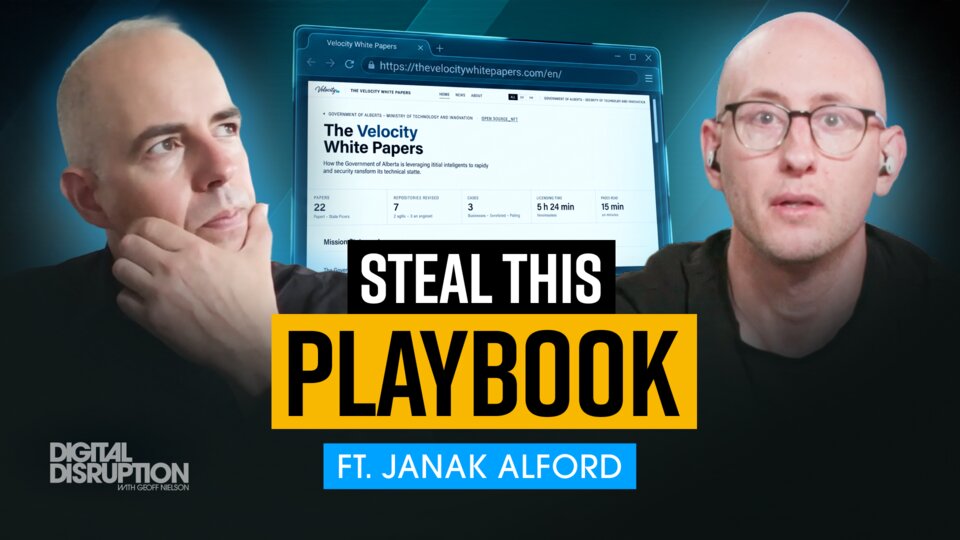
Our Guest Janak Alford Discusses
The Government AI Playbook That's Saving $2M a Week
If you're tired of AI hype and want to see what real implementation looks like, don't miss this conversation with Janak Alford, deputy minister of technology and innovation for the Government of Alberta.
Listen
Our Guest Laurence Moroney Discusses
Ex-Google AI Lead: Vibe Coding Doesn't Belong at Work
In this episode, Geoff Nielson sits down with Laurence Moroney, former Head of AI Advocacy at Google and now Director of AI at Arm, to separate AI hype from reality and discuss what software development actually looks like in the age of generative AI.