April 13, 2026 – AI has added a new layer to information management (IM) that can accelerate how organizations create, access, and use information. However, recent findings from Info-Tech Research Group show that many IM practices remain rooted in legacy approaches, limiting where AI can meaningfully improve the usability, reliability, and quality of information. The global research and advisory firm’s newly published blueprint, Leverage AI to Improve Information Management, details a structured methodology to help IT leaders build an integrated IM strategy that spans information disciplines, reduces risk, and enables AI-driven value creation across the organization.
Info-Tech’s blueprint insights indicate that AI is eroding long-standing boundaries between structured data, unstructured content, and organizational knowledge, yet most IM practices still operate in silos. Current retention and classification practices expose organizations to heightened compliance, security, and reputational risks when information is poorly classified, inaccessible, or unreliable. The firm advises organizations to adopt an integrated, type-agnostic approach to IM that prioritizes high-value information and governs it consistently.
“Leaders dealing with how AI is changing information management need to stop thinking of data in strict categories like “structured” vs. “unstructured.” That kind of black-and-white thinking limits our ability to take advantage of the latest advancements in AI,” says Nysa Zaran, a research director at Info-Tech Research Group. “Spending time debating the difference between knowledge, insight, and information doesn’t help us achieve results. The biggest shift data leaders need to get on board with is that we can now run very advanced analysis using unstructured data. We couldn’t easily do this before. It’s time to unify our approaches to managing both unstructured and structured information so that we can drive more results, more outcomes, and more value for our organizations. This means breaking down silos between how we manage “content” and how we manage “data.”
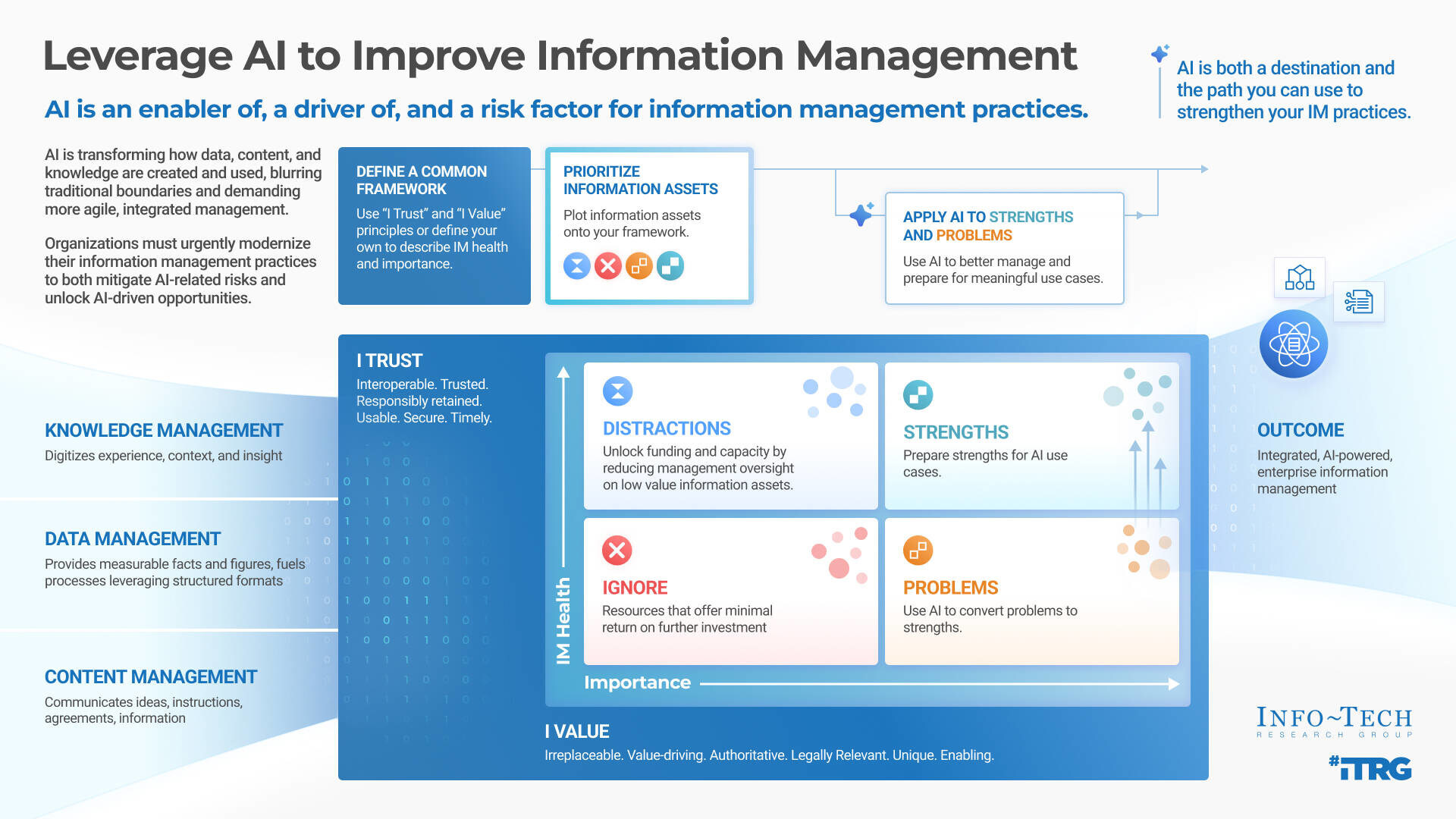
Key Information Management Challenges Facing CIOs and IT Leaders
Despite rapid AI adoption, many organizations remain unprepared for how AI is reshaping the information environment. Info-Tech’s blueprint highlights several challenges across information management practices, including:
- AI’s rapid advancement, making it difficult for leaders to prioritize initiatives and identify high-value opportunities across growing volumes of information.
- Disconnected principles across data, content, and knowledge, combined with inconsistent terminology, preventing a unified IM strategy and leading to misalignment and stalled AI readiness.
- Difficulty quantifying and communicating the value of improved IM, limiting an organization’s ability to secure investment and sustain momentum.
Info-Tech’s Practical Framework for AI-Powered Information Management
To help IT leaders modernize their IM approach, Info-Tech’s Leverage AI to Improve Information Management blueprint outlines the following four-phase methodology:
Phase 1: Set the Stage for AI-Powered Information – CIOs, information management leaders, and data and knowledge leads define key business areas, establish a unified information management framework, and prioritize information assets by identifying strengths, problems, and low-value activities.
Phase 2: Improve and Enhance – Information management, data, and enterprise application leaders apply AI capabilities to resolve high-impact challenges and enhance strengths, focusing on automation, search, and decision support.
Phase 3: Define High-Impact Initiatives – CIOs, finance leaders, and cross-functional stakeholders build a business case for AI investments by quantifying efficiency gains, cost savings, and risk reduction, and prioritizing initiatives based on value and feasibility.
Phase 4: Activate AI-Powered IM Approach – IT leadership and business stakeholders develop a roadmap with clear timelines and KPIs, and secure executive alignment to ensure successful implementation and sustained impact.
Info-Tech’s Leverage AI to Improve Information Management blueprint includes detailed frameworks, a C-Suite presentation template to earn executive buy-in, and a workbook which includes a library of IM principles, a prioritization matrix, and an ROI and business case tool. By applying the practical insights outlined in the firm’s blueprint, CIOs and IM leaders can transform their information practices into a unified, AI-enabled model that improves efficiency, reduces risk, and delivers value.
For exclusive and timely commentary from Info-Tech’s experts, including Nysa Zaran, and access to the complete Leverage AI to Improve Information Management blueprint, please contact pr@infotech.com.
About Info-Tech Research Group
Info-Tech Research Group is one of the world’s leading and fastest-growing research and advisory firms, serving over 30,000 IT, HR, and marketing professionals around the globe. As a trusted product and service leader, the company delivers unbiased, highly relevant research and industry-leading advisory support to help leaders make strategic, timely, and well-informed decisions. For nearly 30 years, Info-Tech has partnered closely with teams to provide everything they need, from actionable tools to expert guidance, ensuring they deliver measurable results for their organizations.
To learn more about Info-Tech’s HR research and advisory services, visit McLean & Company, and for data-driven software buying insights and vendor evaluations, visit the firm’s SoftwareReviews platform.
Media professionals can register for unrestricted access to research across IT, HR, and software, and hundreds of industry analysts through the firm’s Media Insiders program. To gain access, contact pr@infotech.com.
For information about Info-Tech Research Group or to access the latest research, visit infotech.com and connect via LinkedIn and X.
Media Contact
Sufyan Al-Hassan, PR Director
Info-Tech Research Group
salhassan@infotech.com | +1 (888) 670-8889 x2418