Build a Sustainable Knowledge Transfer Strategy
Transfer IT knowledge before it’s gone.
Book This Workshop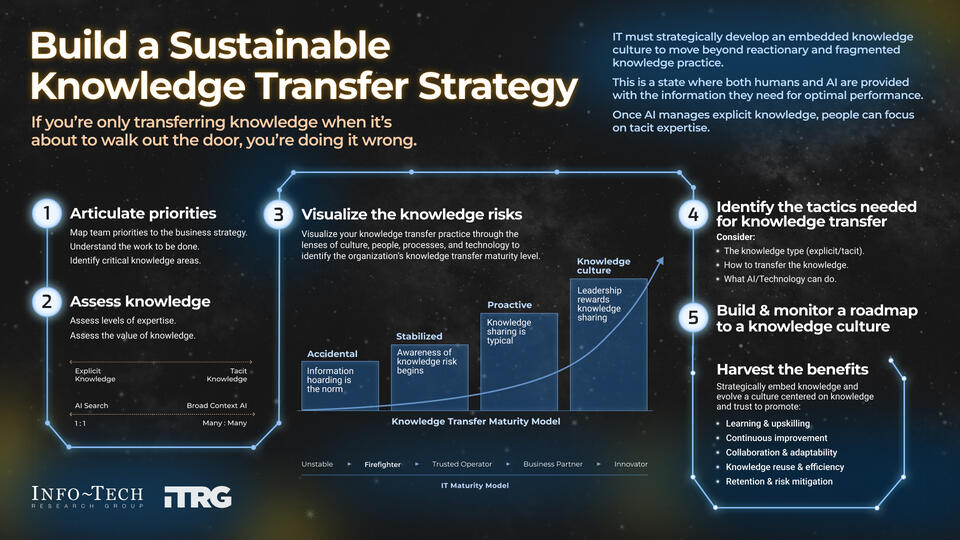
t’s difficult to sustain proactive knowledge transfer with the ongoing disruptions we’re experiencing in IT:
- Leverage knowledge transfer to encourage resilience, new ideas, and improvements.
- Build a culture and systems that encourages open knowledge exchange.
- Reuse know-how to save time, reduce costs, and improve productivity.
Embed knowledge transfer into the day-to-day to ensure continuity and growth:
- Protect and prioritize critical knowledge to ensure business continuity and resilience.
- Select the right tools and methods for capturing and transferring knowledge effectively.
Book Your Workshop
Onsite Workshops offer an easy way to accelerate your project. If you are unable to do the project yourself, and a Guided Implementation isn’t enough, we offer low-cost onsite delivery of our Project Workshops. We take you through every phase of your project and ensure that you have a road map in place to complete your project successfully.
Book NowModule 1: Define the Current and Target State
The Purpose
Establish the strategic context, goals, assess maturity and identify key metrics.
Key Benefits Achieved
Strategic context, goals, maturity, and key metrics identified.
| Activities: | Outputs: | |
|---|---|---|
| 1.1 | Create strategic alignment |
|
| 1.2 | Determine current maturity level & identify gaps |
|
| 1.3 | Identify knowledge transfer metrics |
|
Module 2: Identify Knowledge Priorities
The Purpose
Identify & prioritize critical knowledge areas and assess risks.
Key Benefits Achieved
Critical knowledge areas and assess risks. identified and prioritized.
| Activities: | Outputs: | |
|---|---|---|
| 2.1 | Use major workflow to determine knowledge areas |
|
| 2.2 | Apply IVALUE principles & weightings to determine knowledge impact |
|
| 2.3 | Map team members to knowledge areas & assess levels of expertise |
|
| 2.4 | Analyze & flag at-risk areas |
|
| 2.5 | Discuss urgency & impact |
|
Module 3: Build Knowledge Transfer Plans
The Purpose
Develop actionable transfer plans and select transfer tactics.
Key Benefits Achieved
Actionable transfer plans and select transfer tactics developed.
| Activities: | Outputs: | |
|---|---|---|
| 3.1 | Align on assessments and actions |
|
| 3.2 | Document knowledge items for prioritized knowledge areas |
|
| 3.3 | Finalize knowledge receivers |
|
| 3.4 | Select transfer tactics |
|
Module 4: Define the Knowledge Transfer Roadmap
The Purpose
Draft & finalize the knowledge transfer roadmap by assigning owners, timelines & dependencies. Also, plan for continuous improvement.
Key Benefits Achieved
Knowledge transfer roadmap drafted and finalized.
| Activities: | Outputs: | |
|---|---|---|
| 4.1 | Prioritize the sequence of initiatives |
|
| 4.2 | Complete the project roadmap |
|
| 4.3 | Prepare your communication presentation |
|
