


Develop Your Agentic AI Prototype
Develop agents with engineering best practices.
Book This Workshop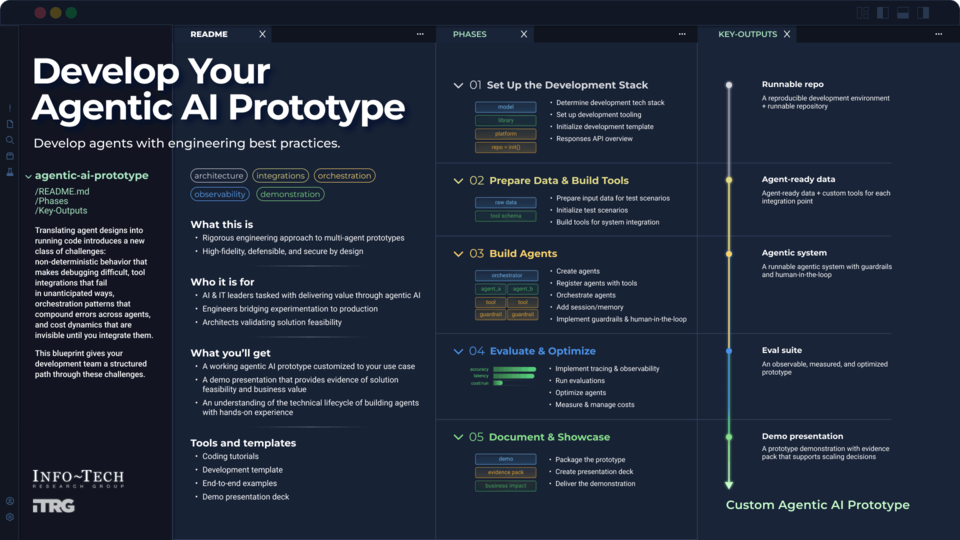
Organizations that successfully design agentic AI prototypes often stall at implementation.
- Development teams face unfamiliar tooling, non-deterministic system behavior, and integration complexity that traditional software development practices don't address.
- Without engineering discipline, promising designs become fragile demos that can't survive real-world inputs, scale beyond a single developer's laptop, or provide the evidence leadership needs to approve investment.
Click or tap here to enter text.Apply a disciplined build methodology that turns agentic AI designs into reproducible, defensible prototypes.
- Follow a structured five-phase path – set up the stack, prepare data and tools, build agents, evaluate and optimize, then document and showcase.
- Embed guardrails, human-in-the-loop checkpoints, tracing, and cost controls directly into the build so safety and observability are designed in, not bolted on.
- Deliver a working prototype with an evidence pack – eval results, cost projections, and a demo – that gives leadership the proof they need to fund scaling.
Book Your Workshop
Onsite Workshops offer an easy way to accelerate your project. If you are unable to do the project yourself, and a Guided Implementation isn’t enough, we offer low-cost onsite delivery of our Project Workshops. We take you through every phase of your project and ensure that you have a road map in place to complete your project successfully.
Book NowModule 1: Set Up the Development Stack
The Purpose
Key Benefits Achieved
| Activities: | Outputs: | |
|---|---|---|
| 1.1 | Determine agent development tech stack. |
|
| 1.2 | Set up agent development tooling. |
|
| 1.3 | Initialize agent development template. |
|
| 1.4 | Responses API overview. |
|
Module 2: Prepare Data & Build Tools
The Purpose
Key Benefits Achieved
| Activities: | Outputs: | |
|---|---|---|
| 2.1 | Prepare input data for test scenarios. |
|
| 2.2 | Initialize test scenarios. |
|
| 2.3 | Build tools for system integration. |
|
Module 3: Build Agents
The Purpose
Without rigorous engineering, agents improvise. No orchestration, no guardrails, and no memory management leads to unpredictable behavior. The agent will “make it work,” but in an inconsistent and ungoverned way.
Key Benefits Achieved
A runnable agentic system with guardrails and human-in-the-loop.
| Activities: | Outputs: | |
|---|---|---|
| 3.1 | Create agents. |
|
| 3.2 | Run agents. |
|
| 3.3 | Register agents with tools. |
|
| 3.4 | Orchestrate agents. |
|
| 3.5 | Compose your agents into multi-agent workflows using either code-driven control flow or LLM-driven handoffs, depending on the reliability and flexibility you need. |
|
| 3.6 | Implement guardrails and human-in-the-loop. |
|
Module 4: Evaluate & Optimize
The Purpose
Key Benefits Achieved
| Activities: | Outputs: | |
|---|---|---|
| 4.1 | Implement tracing and observability. |
|
| 4.2 | Run evaluations. |
|
| 4.3 | Optimize agents. |
|
| 4.4 | Establish agentic AI FinOps. |
|
Module 5: Document & Showcase
The Purpose
Key Benefits Achieved
| Activities: | Outputs: | |
|---|---|---|
| 5.1 | Package the prototype. |
|
| 5.2 | Build a user interface. |
|
| 5.3 | Summarize the implementation. |
|
| 5.4 | Document results and business impact. |
|
| 5.5 | Identify blockers and next steps. |
|
| 5.6 | Prepare the demo presentation. |
|