Deliver Digital Products at Scale
Deliver value at the scale of your organization through defining enterprise product families.
Book This Workshop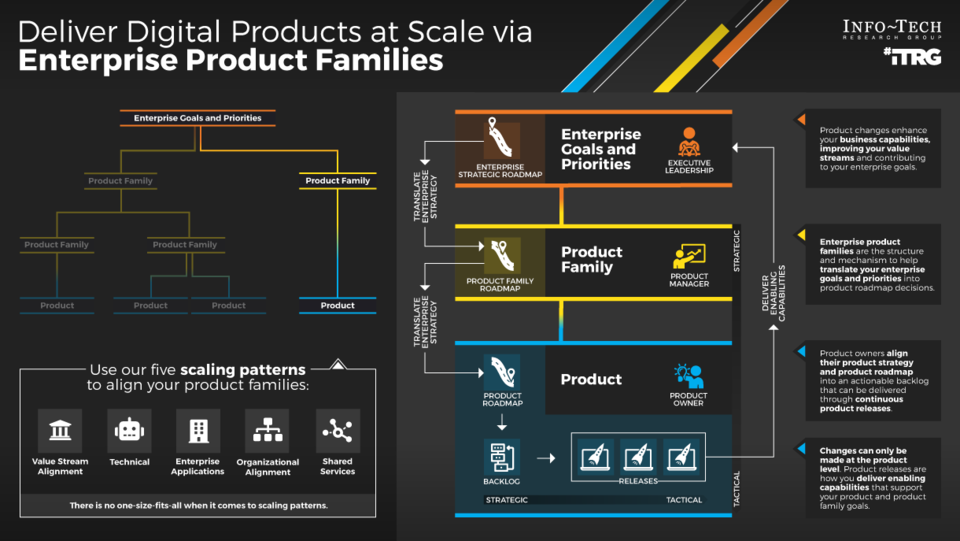
As you are continuing your product transition, you may run into challenges:
- Your stakeholders do not understand the importance of product delivery and the rigor required to go along with it.
- Even in cases where you have viable product practices for a single product, this quickly falls apart and fails to scale when applying the same practices to a second product and beyond.
- Organizations expect you to do more with less and are unsympathetic to your team not having a clear understanding of how to scale your product delivery practices.
- Product governance is often seen as bureaucracy, not as the enabler of scale, value delivery, and cross-product coordination.
Delivering digital products at scale has the following impacts:
- You're able to communicate and manage the commitments for many products en masse, which helps you think strategically instead of being caught up in tactical details.
- You have a well-defined list of product families with the flexibility to add and remove products to them without having a dramatic and linear impact on your organization’s ability to communicate and plan.
- You align your organization on a clear definition of product governance, evaluate your current and target maturity levels, clarify roles and accountability, and leverage the right success metrics to track progress.
Book Your Workshop
Onsite Workshops offer an easy way to accelerate your project. If you are unable to do the project yourself, and a Guided Implementation isn’t enough, we offer low-cost onsite delivery of our Project Workshops. We take you through every phase of your project and ensure that you have a road map in place to complete your project successfully.
Book NowModule 1: Become a Product-Centric Organization
The Purpose
- Define products in your organization’s context and explore product families as a way to organize products at scale.
Key Benefits Achieved
- An understanding of the case for product practices
- A concise definition of products and product families
| Activities: | Outputs: | |
|---|---|---|
| 1.1 | Understand your organizational factors driving product-centric delivery. |
|
| 1.2 | Establish your organization’s product inventory. |
|
| 1.3 | Determine your approach to scale product families. |
|
| 1.4 | Define your product families |
|
Module 2: Ensure Alignment Between Products and Families
The Purpose
To strengthen product family roadmap communication and alignment through stakeholder engagement and clear value definition.
Key Benefits Achieved
- Improved stakeholder communication through a structured engagement plan.
- Clear, consistent product family roadmaps that reflect business value.
- Stronger alignment between individual products and their product families.
| Activities: | Outputs: | |
|---|---|---|
| 2.1 | Leverage product family roadmaps |
|
| 2.2 | Use stakeholder management to improve roadmap communication |
|
| 2.3 | Configure your product family roadmaps |
|
| 2.4 | Confirm product family to product alignment |
|
Module 3: Establish Effective Product Governance
The Purpose
This phase enables your organization to align on a shared definition of product governance, assess current and target maturity levels, and understand the key tasks and risks associated with advancing. It clarifies roles, responsibilities, and accountability to ensure strong ownership of product governance. Additionally, it helps you discover your product governance operating model and establish success metrics grounded in both qualitative and quantitative measures.
Key Benefits Achieved
- Achieve organizational alignment on a shared and clear definition of product governance.
- Gain insight into current and target maturity levels to guide improvement efforts.
- Clarify roles, responsibilities, and accountability to strengthen ownership of product governance activities.
- Identify your best-fit product governance operating model.
- Identify the right success metrics to measure progress.
| Activities: | Outputs: | |
|---|---|---|
| 3.1 | Define product governance |
|
| 3.2 | Understand your current and target maturity level |
|
| 3.3 | Clarify accountability |
|
| 3.4 | Identify your product governance operating model |
|
| 3.5 | Define product governance success |
|
Module 4: Bridge the Gap Between Product Families and Delivery
The Purpose
Define how your organization will deliver product families by assessing readiness, selecting a delivery model, and planning communication and next steps.
Key Benefits Achieved
- Clear operating and delivery model aligned to your organization’s maturity
- Defined roadmap and funding approach to guide transformation
- Structured communication plan and next steps to launch the strategy
| Activities: | Outputs: | |
|---|---|---|
| 4.1 | Assess your organization’s delivery readiness |
|
| 4.2 | Understand your delivery options |
|
| 4.3 | Determine your operating model |
|
| 4.4 | Identify how to fund product delivery |
|
| 4.5 | Learn how to introduce your digital product family strategy |
|
| 4.6 | Communicate changes on updates to your strategy. |
|
| 4.7 | Determine your next steps |
|
Module 5: Advisory: Next Steps and Follow-Up (post-workshop)
The Purpose
Advance the product family operating model through communication, pilot evaluation, and targeted support.
Key Benefits Achieved
- Clear organizational understanding of product families and roadmaps
- Refined transformation roadmap based on pilot insights
- Targeted support to strengthen product ownership and planning
| Activities: | Outputs: | |
|---|---|---|
| 5.1 | Execute communication plan and product family changes |
|
| 5.2 | Review the pilot family implementation and update the transformation roadmap |
|
| 5.3 | Begin advisory calls for related blueprints |
|