Build Your AI Risk Management Roadmap
Develop your AI risk management framework to mitigate risk and drive value for your AI investments.
Book This Workshop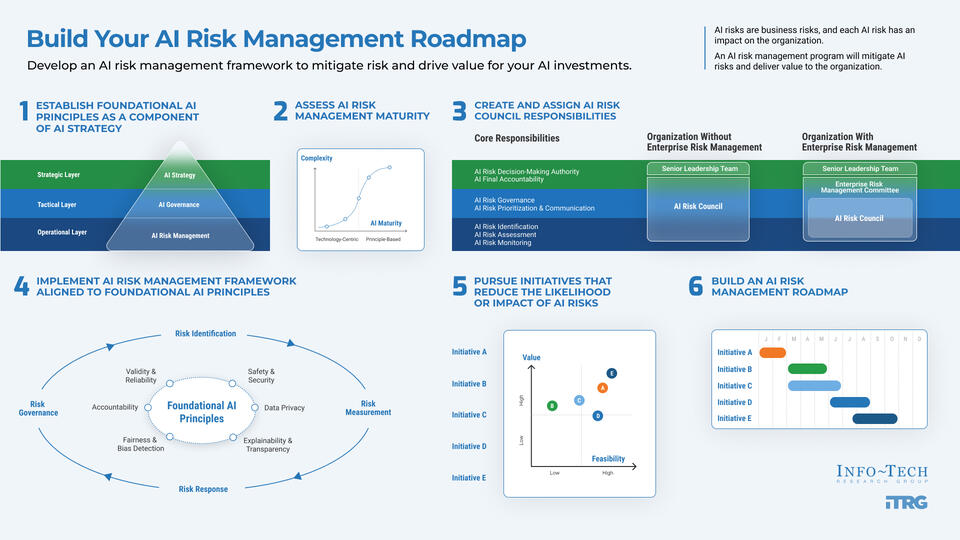
Without a formal process to manage AI risks, organizations will be challenged with:
- Identifying risks associated with the introduction of generative AI throughout the AI lifecycle.
- Assessing AI risks and the likelihood of their occurrence and their potential impact to the organization.
- Managing and mitigating new and unique risks associated with AI systems such as hallucinations, AI model attacks, and deepfakes.
Users of the AI Risk Management Framework are expected to benefit from:
- A structured framework for an organization’s AI risk management activities.
- Explicit processes for making go/no-go AI system commissioning and AI deployment decisions.
- Enhanced organizational culture that prioritizes the identification and management of AI system risks and potential impacts to individuals, communities, organizations, and society.
Book Your Workshop
Onsite Workshops offer an easy way to accelerate your project. If you are unable to do the project yourself, and a Guided Implementation isn’t enough, we offer low-cost onsite delivery of our Project Workshops. We take you through every phase of your project and ensure that you have a road map in place to complete your project successfully.
Book NowModule 1: AI Risk Fundamentals
The Purpose
Frame AI risks and review AI risk fundamentals and frameworks.
Key Benefits Achieved
- Overview of AI risk management, foundational AI principles, and AI risks and frameworks
- Define foundational AI principles
- AI risk management vs. enterprise risk management programs
- Risk management frameworks for AI
| Activities: | Outputs: | |
|---|---|---|
| 1.1 | Assess current AI risk management maturity. |
|
| 1.2 | Identify challenges and pain points. |
|
| 1.3 | Develop goals for the AI risk management program. |
|
Module 2: Govern AI Risks
The Purpose
After completing the Governance function, organizations will have a purpose-driven culture focused on risk understanding and management.
Key Benefits Achieved
- Review AI risk governance functions
- Review AI risk actors in the organization
| Activities: | Outputs: | |
|---|---|---|
| 2.1 | Create the AI risk council. |
|
| 2.2 | Align your AI risk taxonomy. |
|
| 2.3 | Determine the risk culture of your organization. |
|
| 2.4 | Define the organization’s risk appetite and tolerance. |
|
| 2.5 | Complete the RACI chart. |
|
Module 3: Identify AI Risks
The Purpose
After completing the Identification function, users should have sufficient contextual knowledge about AI system impacts to inform an initial go/no-go decision about whether to design, develop, or deploy an AI system.
Key Benefits Achieved
- Review AI risk identification functions
- Review generative AI risk types
- Use the AI lifecycle to define AI risk context
| Activities: | Outputs: | |
|---|---|---|
| 3.1 | Identify relevant AI risks. |
|
| 3.2 | Identify risk events. |
|
| 3.3 | Determine the threshold for (un)acceptable risk. |
|
| 3.4 | Select a technique to measure reputational cost. |
|
| 3.5 | Perform root cause analysis. |
|
| 3.6 | Create a likelihood scale. |
|
| 3.7 | Assess risk severity level. |
|
Module 4: Measure AI Risk
The Purpose
After completing the Measure function, objective, repeatable, or scalable test, evaluation, verification, and validation (TEVV) processes including metrics, methods, and methodologies are in place, followed, and documented.
Key Benefits Achieved
- Review AI risk measurement functions
- Review key risk indicators
| Activities: | Outputs: | |
|---|---|---|
| 4.1 | Develop key risk indicators. |
|
| 4.2 | Identify metrics and targets to meet objectives. |
|
| 4.3 | Establish the reporting schedule. |
|
Module 5: Respond to AI Risks
The Purpose
After completing the Response function, plans for prioritizing risk and regular monitoring and improvement will be in place.
Key Benefits Achieved
- Review AI risk response functions
- Review AI incident response plans
| Activities: | Outputs: | |
|---|---|---|
| 5.1 | Develop risk responses to positive and negative AI risks. |
|
| 5.2 | Identify current AI risk controls. |
|
| 5.3 | Assign a risk owner for each risk event. |
|
| 5.4 | Identify factors that contribute to the severity of the AI risk. |
|
| 5.5 | Identify, analyze, and select risk responses. |
|
| 5.6 | Obtain executive approval for risk action plans. |
|
| 5.7 | Socialize the Risk Report. |
|
| 5.8 | Finalize the Risk Management Program Manual. |
|
Module 6: Develop the Roadmap
The Purpose
Develop the AI risk management roadmap.
Key Benefits Achieved
Determine next steps and communication approach. Include an executive presentation to present the AI risk management roadmap to the executive leadership team.
| Activities: | Outputs: | |
|---|---|---|
| 6.1 | Develop the AI risk management roadmap. |
|
| 6.2 | Determine next steps and communication approach. |
|