
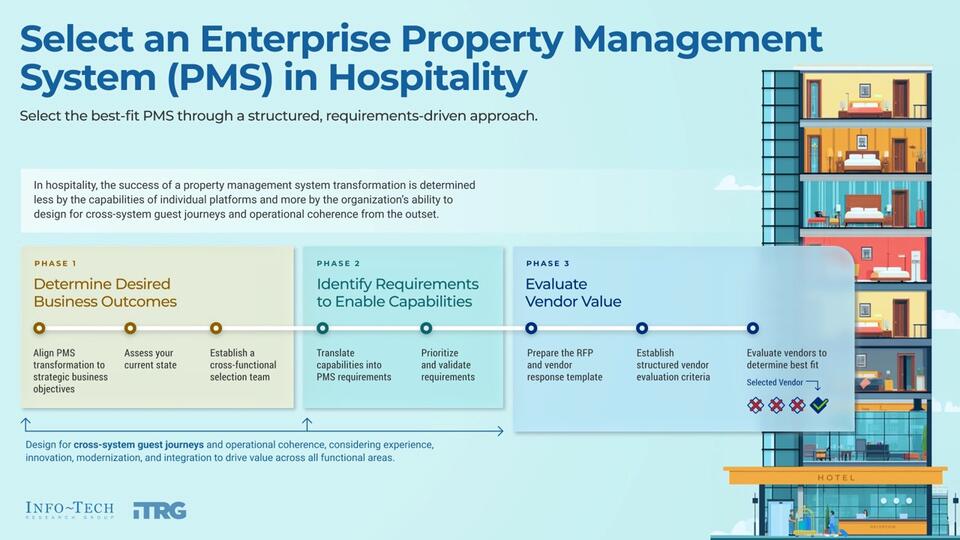
Select an Enterprise Property Management System in Hospitality
Select the best-fit PMS through a structured, requirements-driven approach.
- PMS requirements gathering is often siloed, with limited considerations of the end-to-end guest and employee journey, leading to poor system integration across functions.
- Many organizations lack visibility into what is possible, resulting in incomplete requirements that misdirect PMS selection and lead to systems requiring extensive workarounds.
- PMS selection is complex and costly, and organizations often find that systems fail to fully meet their needs, delivering only marginal ROI.
- Organizations often lack the expertise and capacity to effectively evaluate, select, and implement a PMS, resulting in agreements that fail to meet operational and strategic needs.
Our Advice
Critical Insight
In hospitality, the success of a property management system transformation is determined less by the capabilities of individual platforms and more by the organization's ability to design for cross-system guest journeys and operational coherence from the outset.
Impact and Result
Property management system selection must be driven by organizational strategy, building for cross-system guest journeys and operational coherence.
- Develop a cross-functional selection team and align on strategic business objectives to define how a new PMS will enable their achievement.
- Define and prioritize functional and non-functional requirements using business capabilities.
- Develop the PMS RFP, conduct structured demos, and evaluate vendors to select the best fit.
About Info-Tech
Info-Tech Research Group is the world’s fastest-growing information technology research and advisory company, proudly serving over 30,000 IT professionals.
We produce unbiased and highly relevant research to help CIOs and IT leaders make strategic, timely, and well-informed decisions. We partner closely with IT teams to provide everything they need, from actionable tools to analyst guidance, ensuring they deliver measurable results for their organizations.
What Is a Blueprint?
A blueprint is designed to be a roadmap, containing a methodology and the tools and templates you need to solve your IT problems.
Each blueprint can be accompanied by a Guided Implementation that provides you access to our world-class analysts to help you get through the project.
Need Extra Help?
Speak With An Analyst
Get the help you need in this 3-phase advisory process. You'll receive multiple touchpoints with our researchers, all included in your membership.
Guided Implementation 1: Build organizational alignment
- Call 1: Align PMS needs to business objectives.
- Call 2: Assess PMS selection readiness and scope.
- Call 3: Assemble a cross-functional team.
Guided Implementation 2: Define and prioritize PMS requirements
- Call 1: Discuss and document functional requirements until all areas are completed (as many calls as necessary).
- Call 2: Discuss and document non-functional requirements until all areas are completed (as many calls as necessary).
Guided Implementation 3: Build the RFP, evaluate vendors, and select PMS
- Call 1: Prepare the RFP overview and coverage.
- Call 2: Document the detailed services and support required within the RFP.
- Call 3: Finalize RFP instructions for respondents and configure the template.
- Call 4: Establish evaluation criteria for vendor assessment.
- Call 5: Prepare the pricing workbook as part of the RFP Package and issue the RFP.
- Call 6: Evaluate written RFP responses and compare vendors.
- Call 7: Analyze and compare pricing with a five-year TCO.
- Call 8: Pick top three vendors with the highest RFP score to conduct demos.
- Call 9: Build demo scripts and conduct demos for evaluation.
- Call 10: Score demos and scenarios.
- Call 11: Select the preferred vendor based on highest combined score consisting of the RFP response and demo evaluations.
- Call 12: Inform vendors whether they were accepted or rejected.
Contributors
- John Forelli, Chief Information Officer , Ocean Casino Resort
- Patrick Tinklenberg, Vice President Information Technology, Sycuan Casino Resort
- Anonymous Contributor of a Global Enterprise Hotel Chain
- Anonymous Contributor of a Canadian Integrated Resort
- Anonymous Contributor of a US Integrated Resort
