
Present a Defensible IT Budget in Retail Banking
Leverage a capability-based model to justify IT spend allocation.
- Retail banking IT leaders are under increasing pressure to explain how IT spend is distributed to support business value, not simply how much is being spent.
- IT budgets organized by cost center, project, or technology obscure how spend supports core banking capabilities.
- Traditional benchmarks mislead because banks differ structurally by size, jurisdiction, product mix, and regulatory exposure.
- Without a capability-based decision frame, budget conversations become fragile, technology-centric debates that fail to withstand executive, audit, or regulatory challenge.
Our Advice
Critical Insight
Reframe budget discussions around capability‑based coverage, making IT spend distribution transparent and rationalized. By aligning spend to nuanced industry layers, leaders can clearly articulate why budgets look the way they do and confidently explain risk, value, and strategic intent under scrutiny.
Impact and Result
- Normalize IT spend across top retail banking capabilities and overlay regulatory obligations, importance, competitiveness, and transformation intent.
- Provide directional peer context adjusted for structural differences rather than prescriptive benchmarks.
- Produce CFO- and regulator-ready narratives that clearly explain why IT spend is distributed as it is.
Present a Defensible IT Budget in Retail Banking
Leverage a capability-based model to justify IT spend allocation.
Analyst perspective
The budget isn't the problem; the explanation is.

Most retail banking IT leaders don't have a spending problem; they have an explanation problem. The money is going to the right places, but the rationale is locked inside IT, expressed in language that doesn't travel to the boardroom.
That gap becomes dangerous when boards reach for peer benchmarks never designed for your operating model. A deliberate investment in risk protection looks like overspend. A strategic transformation initiative looks discretionary. Without a capability-based frame, IT leaders end up defending line items instead of telling a value story.
This approach shifts analysis from cost centers to capabilities, then layers on what matters; regulatory obligations, operational criticality, and conscious considerations. The result is a narrative that holds up when the CFO, auditor, and regulator all ask why.
Elizabeth Silva Smulski
Research Lead, Industry Practice
Info-Tech Research Group
Executive summary
Your Challenge |
Common Obstacles |
Info-Tech’s Approach |
|---|---|---|
Retail banking IT leaders are under increasing pressure from boards, regulators, and executive peers to explain how IT spend is distributed to support business value, not simply how much is being spent. However, without a capability‑based decision frame that aligns IT budgets to regulatory obligations, operational priorities, and risk exposure, these explanations quickly collapse under scrutiny. As a result, budget conversations become fragile, technology‑centric debates that fail to withstand executive, audit, or regulatory challenge. |
IT budgets are organized by cost center, project, or technology, obscuring how spend supports core banking capabilities. Traditional benchmarks mislead because banks differ structurally by size, jurisdiction, product mix, and regulatory exposure. Optimization and cost‑cutting narratives fail when spend is driven by nondiscretionary regulatory, operational, and risk obligations. IT leaders lack a clear, defensible way to explain why IT spend is distributed as it is and why certain allocations persist under regulatory, operational, and risk realities. |
Info‑Tech helps retail banking CIOs, CTOs, and CDOs rationalize IT spend by providing a capability‑based explanation of how budgets are distributed under scrutiny. We deliver a clear, defensible explanation of IT spend grounded in banking capabilities, obligations, and risk by:
|
Info-Tech Insight
Reframe budget discussions around capability‑based coverage, making IT spend distribution transparent and rationalized. By aligning spend to nuanced industry layers, leaders can clearly articulate why budgets look the way they do and confidently explain risk, value, and strategic intent under scrutiny.
Close critical gaps in how IT spend is justified
IT spend scrutiny is intensifying, but most banks lack the framework to respond.
1. No common language between IT and the board
Budgets are presented in technology terms rather than business capabilities. Executives are asking why are we spending this much? and IT can’t answer in language that executives trust.
2. Spend allocation lacks defensible rationale
Without tagging each capability by regulatory exposure, operational criticality, and risk concentration, there is no way to explain what can’t move, what must move, and what is a deliberate trade-off.
3. No peer context to explain divergence
When spend differs from industry norms, leaders need directional signals to show whether divergence is intentional or not.
4. Trade-offs are implicit, not documented
Every budget is a set of trade-offs. Without a register that names what was deprioritized, in favor of what, and at what risk level, decisions can’t be defended under audit.
IT Spend in retail banking has grown ~9% annually compared to ~4% revenue growth, creating structural pressure to justify spend as costs outpace top-line growth.
Source: The Financial Brand, 2025
74% of chief risk officers cite technology and cyber risk as a top enterprise risk category, highlighting IT spend as risk coverage, not just operational overhead.
Source: ProSight Financial Association, 2025
Justify IT spend across competing pressures
Replace misleading benchmarks with a capability-based framework.
- Rationalize how IT spend is distributed (not just how much) under board, regulator, and executive scrutiny.
- Replace fragile, tech-centric budget debates with a capability-based decision framework tied to obligations, operations, and risk exposure.
- Avoid misleading benchmarks that break due to structural differences (size, jurisdiction, product mix, regulatory exposure).
- Make spend legible across the operating model by mapping it to core retail banking capabilities vs. cost centers/projects/technologies.
Off-the-shelf benchmarks routinely mislead because they ignore operating model, maturity, and regulatory exposure differences.
Source: Sedulo Group, 2026
Leverage the Retail Banking Industry Business Reference Architecture
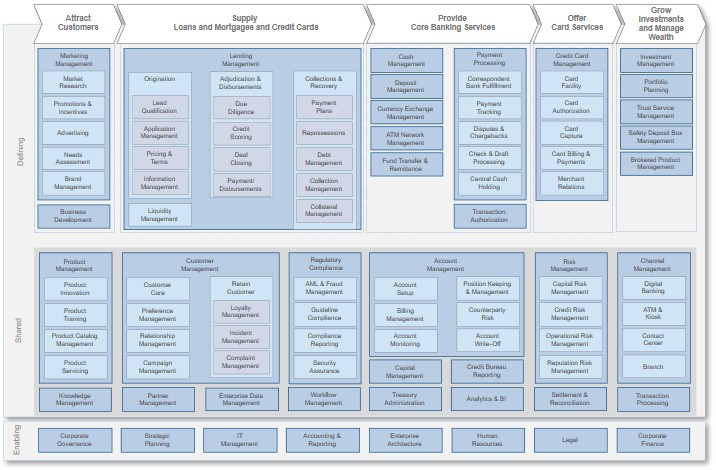
Download the Retail Banking Industry Business Reference Architecture
The business reference architecture describes what the organization does and why through business functions, capabilities, and value streams, aligning business operations, capabilities, and strategy across the organization and providing a common baseline that everyone in the organization understands.
When IT spend is anchored to the business reference architecture, technology leaders can defend budgets in the language of business strategy, not technology line items. It also shifts how the business sees IT: not as a cost center but a key enabler whose budget directly supports the capabilities and outcomes the organization depends on.
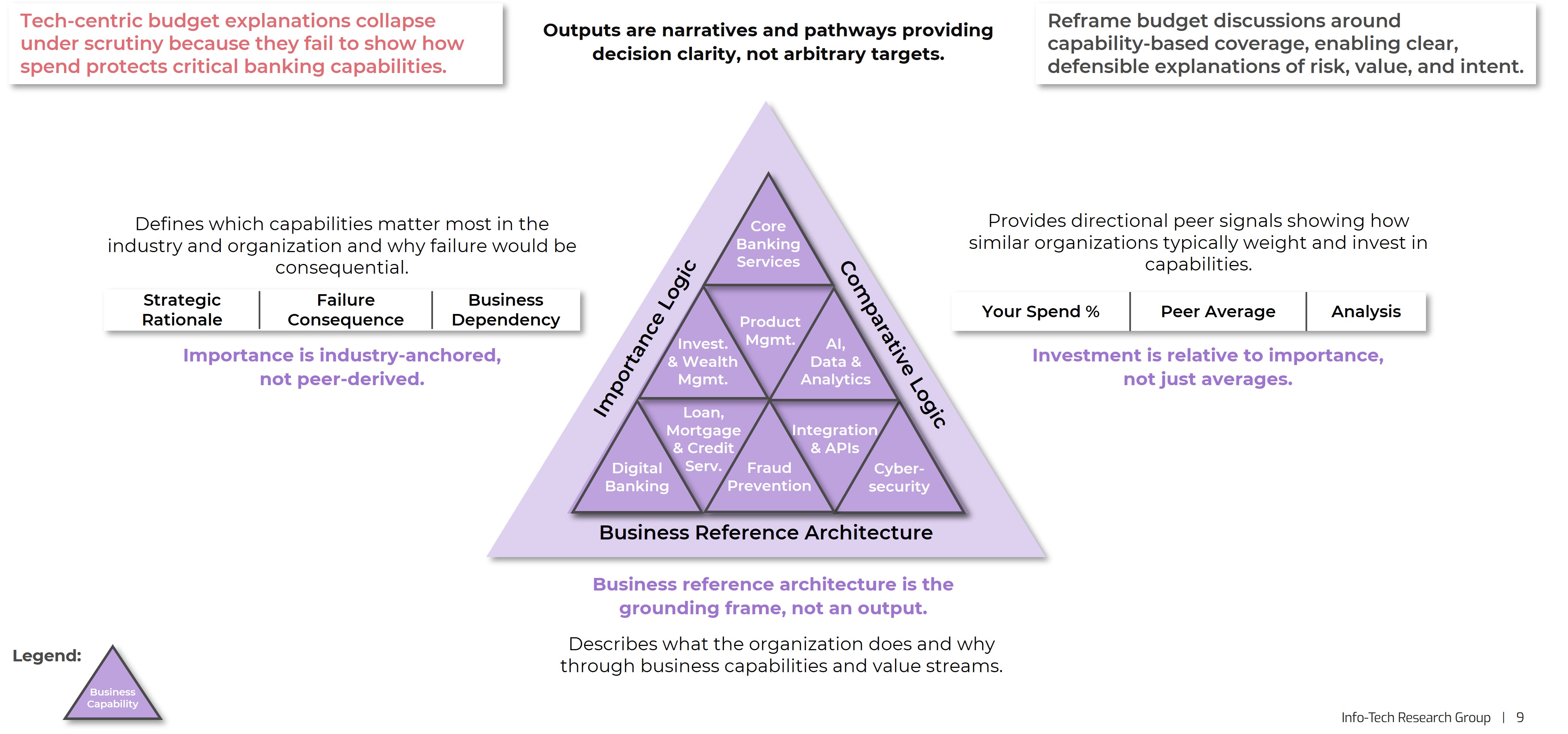
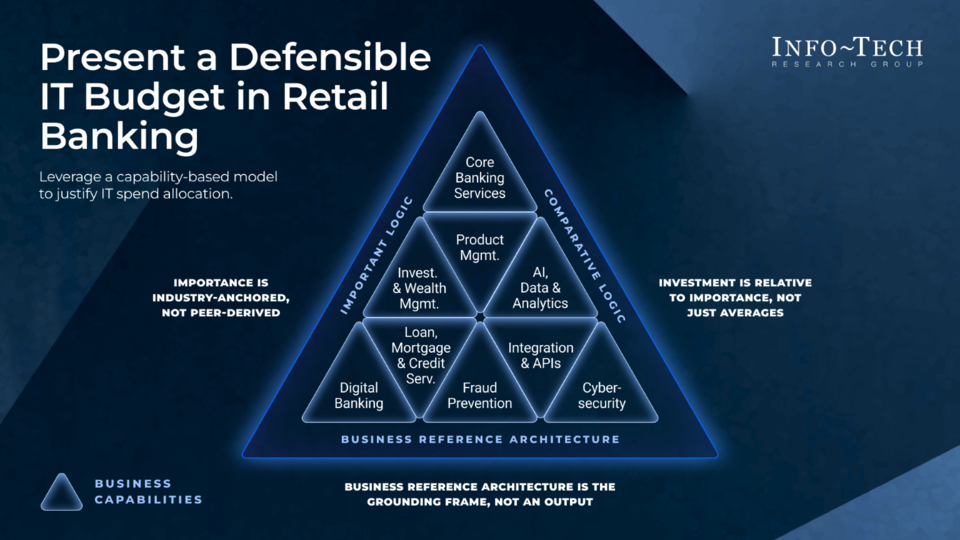
Ground the IT budget in 15 core capabilities
Map IT spend to each of the capabilities on Info-Tech's Retail Banking Industry Business Reference Architecture.
Core Banking & |
Customer Experience |
Risk, Security |
Data, Intelligence |
Technology Platform |
Core Banking Services |
Digital Banking |
Cybersecurity |
AI, Data & Analytics |
IT Infrastructure |
Loan, Mortgage & Credit Services |
Customer Relationship Management |
Regulatory Compliance |
Product Management |
Integration & APIs |
Investment & Wealth Management Services |
Customer Onboarding |
Fraud Prevention |
Contact Centers |
DevOps/Application Development |
Info-Tech’s approach
Leverage a capability-based model to justify IT spend.
A capability‑based model explains why IT spend is distributed the way it is, grounded in retail banking capabilities, regulatory and operational obligations, and risk exposure, so IT leaders can rationalize budgets under board, executive, and regulatory scrutiny.
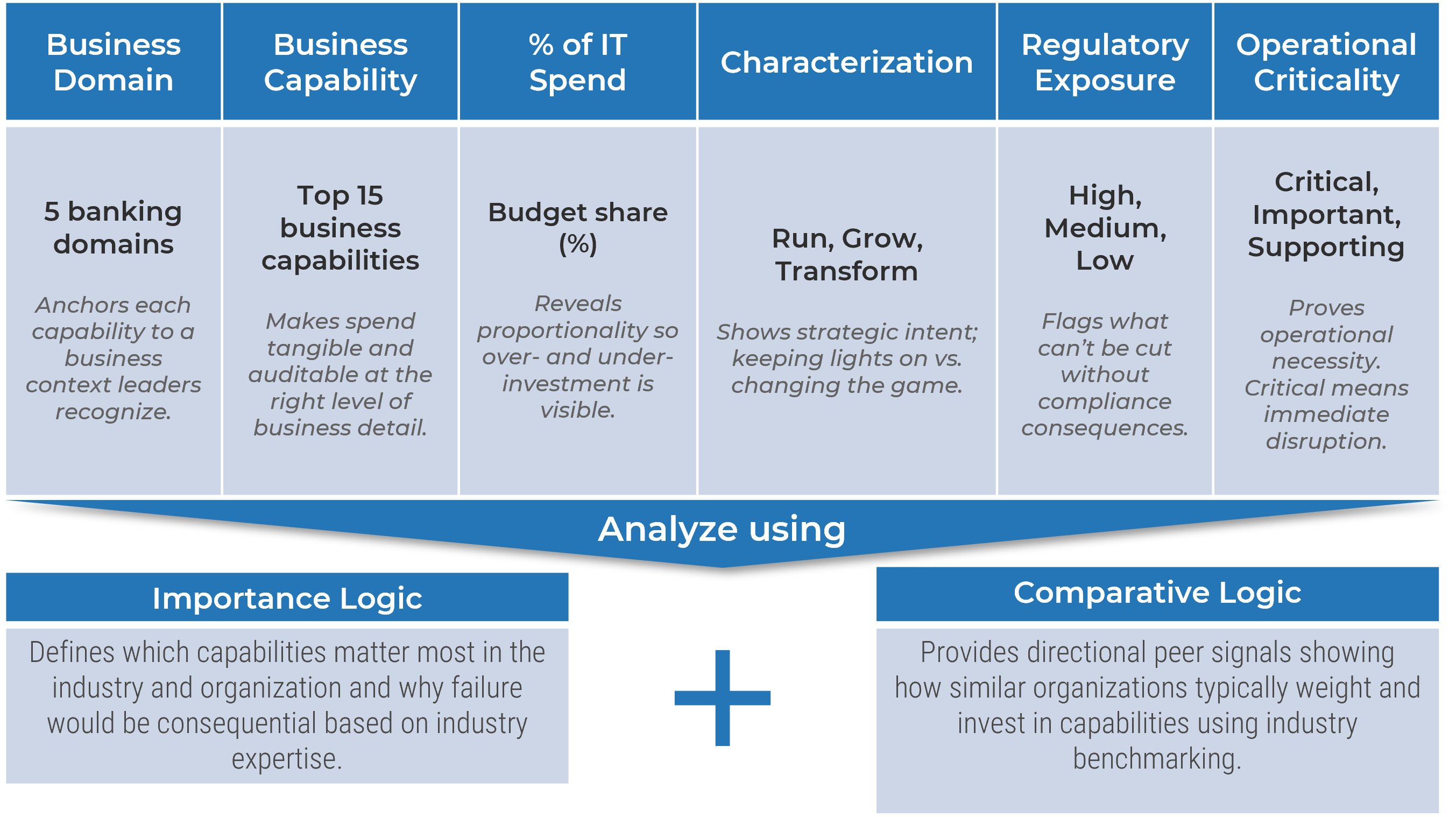
The Info-Tech difference:
- Create a decision-ready rationalization. A clear explanation leaders can repeat under scrutiny from board/audit/regulatory entities.
- Develop a transparent spend story grounded in banking capabilities, obligations, and risk, not generic optimization narratives.
- Have directional peer context, not targets, to explain why the bank looks different and whether that divergence is intentional.
- Leverage a practical presentation that supports executive conversations, answering why spend is shaped this way, what can’t move, and what must be addressed.
Present a Defensible IT Budget in Retail Banking
Leverage a capability-based model to justify IT spend allocation
Info-Tech’s methodology for presenting a defensible IT budget in retail banking
1. Frame Challenge |
2. Capture Data |
3. Build Narrative |
|
Steps |
Complete the Contextual Data tab in the Retail Banking IT Spend Survey. |
Complete the Capability Spend Data tab in the Retail Banking IT Spend Survey. |
An Info-Tech analyst conducts the analysis and reviews survey results. |
Outcomes |
A complete contextual profile that maps who the budget must convince, what organizational factors shape the conversation, and which strategic commitments already constrain the narrative. |
A fully tagged capability spend model that shows how the IT budget is allocated, what regulatory and operational risks it carries, and what constraints prevent reallocation. |
A board-ready spend narrative grounded in peer benchmarks and considerations that can withstand executive, audit, or regulatory scrutiny. |
Insight summary
Overarching insight
Reframe budget discussions around capability‑based coverage, making IT spend distribution transparent and rationalized. By aligning spend to nuanced industry layers, leaders can clearly articulate why budgets look the way they do and confidently explain risk, value, and strategic intent under scrutiny.
Phase 1 insight
A defensible budget story starts before the numbers. Identifying who the budget must convince, what pressures are driving the conversation, and which strategic commitments already lock spend determines whether the narrative lands or collapses under the first question.
Tactical insight
Most IT leaders know intuitively which spend is locked, but that knowledge lives in their heads, not in a document. Until constraints are formally cataloged by type, flexibility, and effort to unlock, budget conversations will default to why can't you just cut this?
Tactical insight
A budget that survives one board meeting is a presentation. A budget that survives every board meeting is a model. The capability-based framework is designed to be repeatable, when priorities shift or new pressures emerge, the same structure absorbs the change without rebuilding the story from scratch.
Blueprint deliverables
Each step of this blueprint is accompanied by supporting deliverables to help you accomplish your goals:
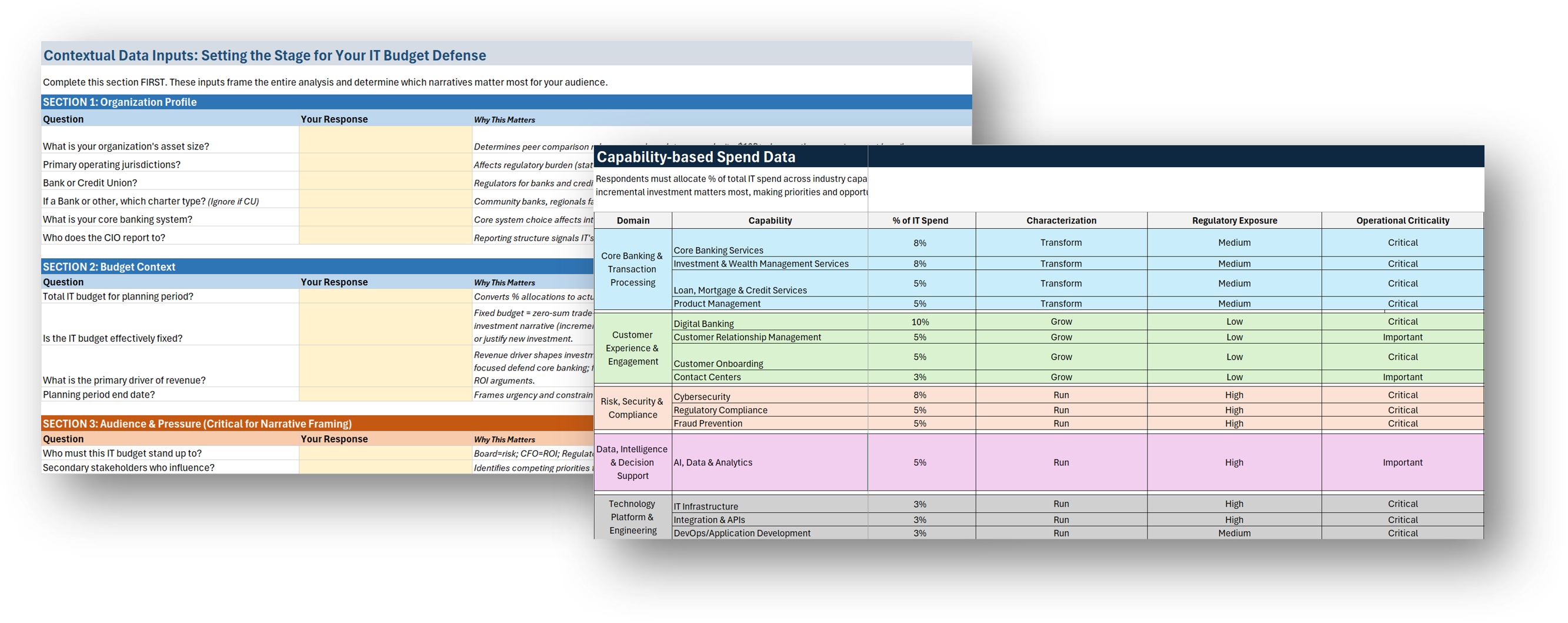
Retail Banking IT Spend Survey
This workbook captures your IT spend and strategic context so Info-Tech can build a defensible budget narrative for the board. Your input here directly shapes the final presentation.
Key deliverable:
Retail Banking IT Budget Board Presentation Template
This practical board presentation that supports executive conversations, answering why spend is shaped this way, what can’t move, and what must be addressed.
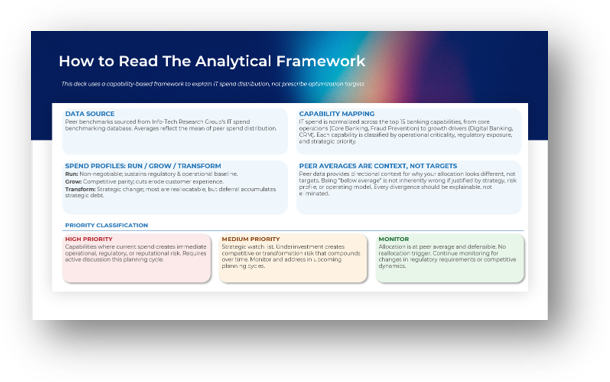
Enable capability-led spend analysis
The final presentation will:
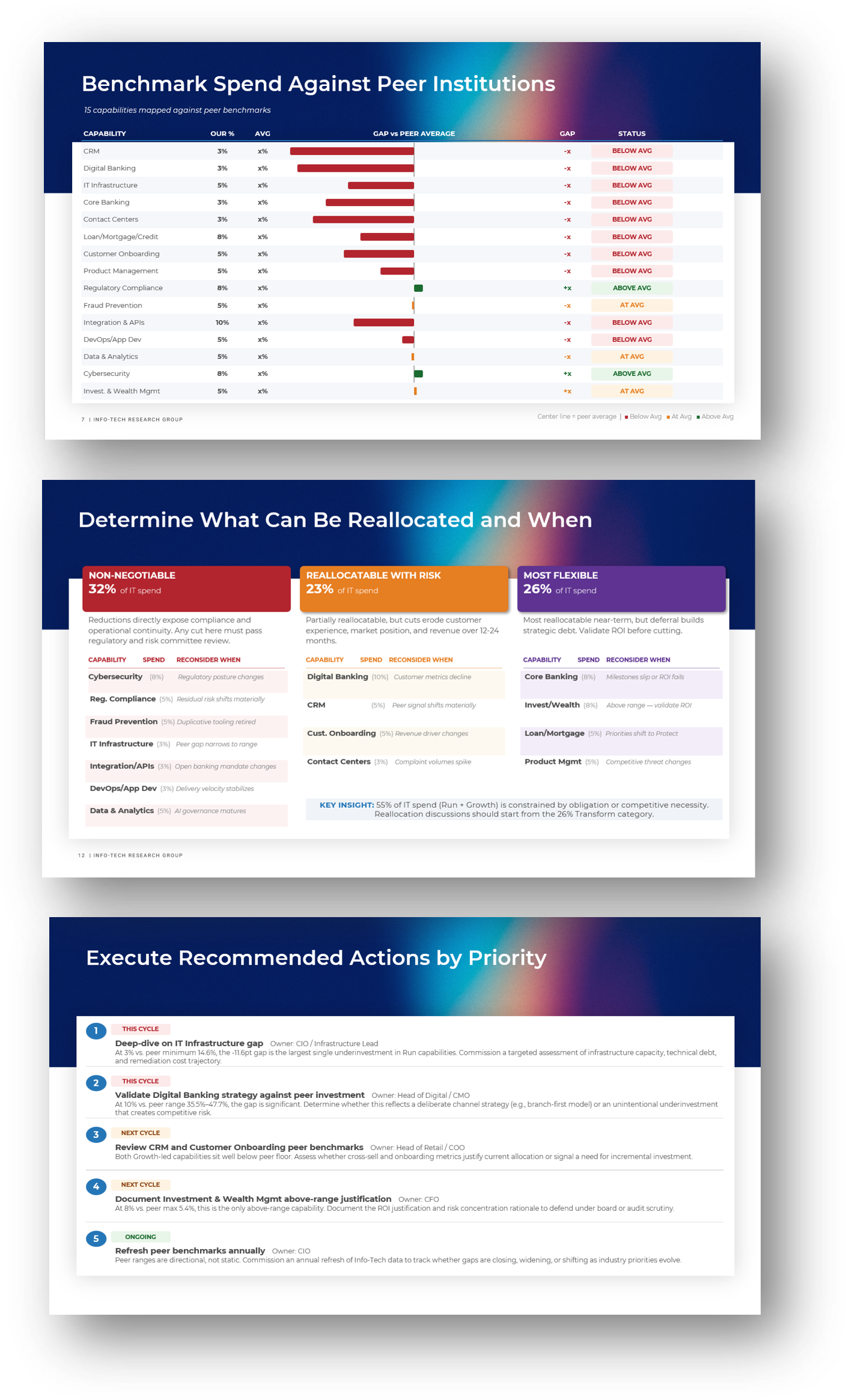
- Normalize IT spend across top retail banking capabilities to show distribution clearly.
- Provide a capability-based explanation of IT spend that aligns budgets to regulatory obligations, operational priorities, and risk exposure.
- Classify spend distribution patterns into run-led, growth-led, and transform-led profiles based on how spend is distributed across core banking capabilities.
- Highlight why spend is distributed the way it is, why some spend can’t be reallocated, why divergence from peers can be reasonable, and when to reconsider spend distribution.
Info-Tech Insight
Peer benchmarks are most dangerous when used as targets. This model uses them as directional signals, surfacing where divergence is intentional and where it deserves a second look.
Measure what a defensible IT spend capability model delivers
Output |
Associated Value |
|
|---|---|---|
Capability‑Based IT Spend Distribution |
Normalized view of IT spend mapped to top industry capabilities, classified as Run, Grow, or Transform. |
Makes IT spend transparent and explainable; shifts conversations from cost centers to business capabilities. |
Obligation and Risk Alignment by Capability |
Regulatory exposure, operational criticality, and risk concentration overlaid on spend. |
Explains why spend is necessary, not discretionary; strengthens defensibility with executives and regulators. |
Directional Peer Patterns |
Qualitative context showing where spend is more concentrated, lighter, or intentionally different. |
Reduces unhelpful benchmark pressure; validates defensible divergence instead of forcing conformity. |
Explicit Trade‑Offs and Opportunity Costs |
Clear articulation of what is funded, deferred, or constrained and which risks are accepted. |
Forces accountable decision‑making; enables leaders to own and defend trade‑offs under scrutiny. |
Run/Grow/Transform Mix |
Clear view of how spend is oriented toward risk protection, operational stability, or transformation. |
Aligns budgets to strategic intent; clarifies why spend persists or shifts over time. |
Defensible Board Presentation |
A concise, repeatable story explaining why budgets look the way they do. |
Reduces decision friction; increases executive confidence and credibility. |
1. Complete the Contextual Data Tab
1-2 hours
- Open the Retail Banking IT Spend Survey and navigate to the Inputs – Contextual Data tab. Review the four sections: Organization Profile, Budget Context, Audience & Pressure, and Strategic Context.
- Complete Organization Profile: asset size, charter type, number of branches, core banking system, CIO reporting structure, and operating jurisdictions.
- Complete Budget Context: total IT spend, revenue, IT spend as a percentage of revenue, and the fixed vs. flexible split. Identify key revenue drivers and cost structure characteristics.
- Complete Audience & Pressure: Identify who the budget must convince (Board, CFO, regulators), the primary pressure trigger, and the decision timeline.
- Complete Strategic Context: Top 3 strategic priorities, known regulatory changes impacting the capability, major committed initiatives, and any recent incidents influencing stakeholder perception.
Download the Retail Banking IT Spend Survey
Input | Output |
|---|---|
|
|
Materials | Participants |
|
|
2. Complete the Capability Spend Data tab
1-2 hours
- Open the Retail Banking IT Spend Survey and navigate to the Inputs – Capability Spend Data tab. Review the 15 core banking capabilities organized across 5 business domains.
- Allocate a percentage of IT spend to each capability. Use best estimates where precise figures aren't available.
- Classify each capability as Run (maintain operations), Grow (expand performance), or Transform (fundamentally alter the capability).
- Tag each capability with its regulatory exposure (High/Medium/Low), operational criticality (Critical/Important/Supporting), and risk concentration (Yes/No).
- Complete the written explanation section for capabilities where spend cannot easily shift constraint type, flexibility rating, effort to unlock, and impact if removed.
Download the Retail Banking IT Spend Survey
Input | Output |
|---|---|
|
|
Materials | Participants |
|
|
3. Conduct the analysis
1 week (analyst-led)
- An Info-Tech analyst applies two layers of logic against the 15 business capabilities defined by the Retail Banking Industry Business Reference Architecture:
- Importance logic – defines which capabilities matter most in the industry and why failure by underinvestment would be consequential.
- Comparative logic – provides directional peer signals showing how similar institutions weight and invest in capabilities.
- For each capability, the analyst assesses whether spend divergence is intentional or an unexamined gap, using contextual data and constraints to explain why.
- The analyst builds considerations and synthesizes everything into a board-ready IT spend narrative that connects business capability spend to a business rationale.
Download the Retail Banking IT Budget Board Presentation Template
Input | Output |
|---|---|
|
|
Materials | Participants |
|
|
Next steps
Your narrative is built – now put it to work.
1 .Rehearse the narrative with an analyst or executive counselorPressure-test each slide against likely board, CFO, and audit questions before the live session.
2. Socialize with key stakeholders individually
Brief influential stakeholders before the formal presentation to surface objections early.
3. Present to the key audience
Deliver the capability-based spend narrative with peer context and the trade-off register as evidence.
4. Capture feedback and update considerations
Document new constraints, redirected priorities, or accepted risks from board discussion.
5. Reuse the framework next fiscal
Refresh spend allocations and peer signals annually to track change and new direction.
Related Info-Tech research
Build Your IT Cost Optimization Roadmap
This blueprint will help you understand your IT cost optimization mandate, identify your journey, assess your IT spend across four levers, develop your IT cost optimization roadmap, and craft a related communication strategy.
Create a Transparent and Defensible IT Budget
This blueprint applies Info-Tech’s proven ITFM Cost Model to the IT budgeting process and offers five phases that cover the purpose of your IT budget and what it means to your stakeholders, key budgeting resources, forecasting, selecting and fine-tuning your budget message, and delivering your IT budget executive presentation for approval.
IT Spend and Staffing Benchmarking: Realign Resources for Success
Explore the critical importance of an IT Spend and Staffing Assessment. Hear why delivering your strategy successfully is contingent on understanding and adjusting your spend and resource allocation.
Research Contributors
Anonymous Contributor
Director of Technology Financial Management
Corporate US Bank
Anonymous Contributor
Director of Financial Management
Credit Union
About Info-Tech
Info-Tech Research Group is the world’s fastest-growing information technology research and advisory company, proudly serving over 30,000 IT professionals.
We produce unbiased and highly relevant research to help CIOs and IT leaders make strategic, timely, and well-informed decisions. We partner closely with IT teams to provide everything they need, from actionable tools to analyst guidance, ensuring they deliver measurable results for their organizations.
What Is a Blueprint?
A blueprint is designed to be a roadmap, containing a methodology and the tools and templates you need to solve your IT problems.
Each blueprint can be accompanied by a Guided Implementation that provides you access to our world-class analysts to help you get through the project.
Need Extra Help?
Speak With An Analyst
Get the help you need in this 3-phase advisory process. You'll receive multiple touchpoints with our researchers, all included in your membership.
Guided Implementation 1: Frame Challenge
- Call 1: Complete the Contextual Data tab in the Retail Banking IT Spend Survey.
Guided Implementation 2: Capture Data
- Call 1: Complete the Capability Spend Data tab in the Retail Banking IT Spend Survey.
Guided Implementation 3: Build Narrative
- Call 1: Review results with an Info-Tech analyst, including benchmarks,
considerations, and narrative.