Fast-Track Your DERMS Business Case
Speed up the process to justify the need for a distributed energy resources management system (DERMS) solution.
To support grid modernization, utility leaders are facing challenges in:
- Determining the necessity of DERMS; recognizing the growth of DERs in their service territory.
- Evaluating the benefits of DERMS for their organization to align with the evolving energy landscape.
- Understanding how DERMS can integrate with their existing grid infrastructure due to limited familiarity with its technical intricacies.
Our Advice
Critical Insight
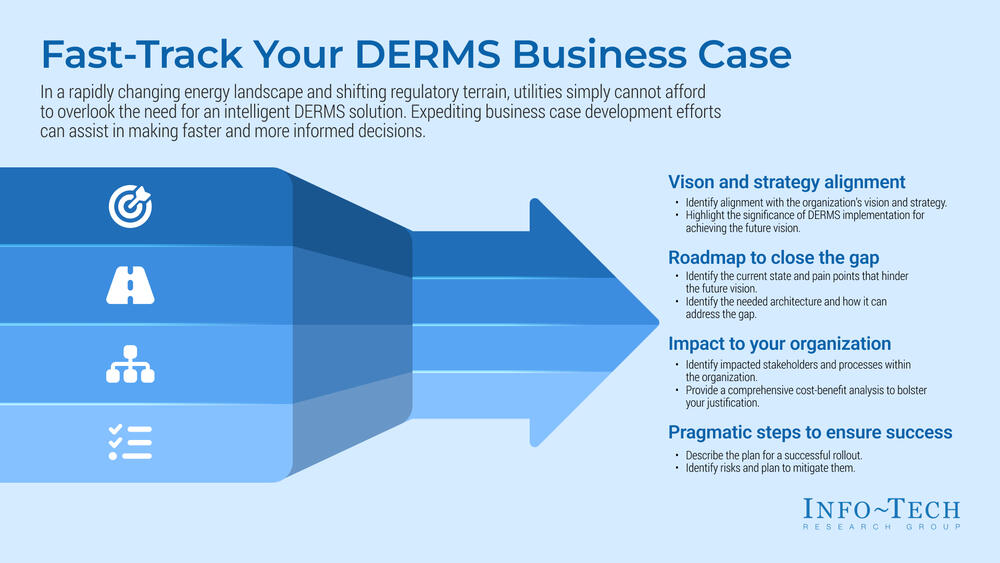
In a rapidly changing energy landscape and shifting regulatory terrain, utilities simply cannot afford to overlook the need for an intelligent DERMS solution. Expediting business case development efforts can assist in making faster and more informed decisions.
Impact and Result
A strategic presentation, accompanied by an exemplar of a business case, will help you get your ideas across faster throughout your grid-to-edge journey.
This report:
Research & Tools
1. Fast-Track Your DERMS Business Case – Speed up the process to justify the need for a distributed energy resources management system (DERMS) solution
Use this deck to build a strategic presentation, accompanied by an exemplar of a business case, to help you get your ideas across faster throughout your grid-to-edge journey.
Member Testimonials
After each Info-Tech experience, we ask our members to quantify the real-time savings, monetary impact, and project improvements our research helped them achieve. See our top member experiences for this blueprint and what our clients have to say.
10.0/10
Overall Impact
$8,820
Average $ Saved
20
Average Days Saved
Fast-Track Your DERMS Business Case
Speed up the process to justify the need for a distributed energy resources management system solution.
Analyst perspective
Assessing your readiness for DERMS in the evolving energy landscape.
The world has embraced a shift from a centralized energy supply toward distributed energy resources (DER). It is a vital response to the rising consumer demand for energy. It has also become an integral component of nations' net-zero pathways. The diverse nature of DERs, with their unique characteristics and impact to the grid, presents a set of challenges for utilities to manage.
As the penetration of DER reaches certain critical levels, existing systems and processes become insufficient for handling the growing number of interconnection requests. This fundamental paradigm shift highlights the complexity of gird management to ensure reliability and stability. Distributed energy resources management systems (DERMS) provide intelligence, flexibility, and processing power, empowering system operators and engineers to enhance decision-making.
The capabilities of DERMS need to evolve along with the distribution system market structure. Currently, there is no consistency among software vendors attempting to capitalize on growing opportunities. The common need is the imperative to modernize grid infrastructure and implement intelligent platforms for the energy transition. It is important to identify the required functionalities to align with your objectives.
This report aims to offer a practical business case framework, enabling utilities to examine their DERMS requirements and proactively assess their readiness for DERMS adoption.

Jing Wu
Principal Research Director
Utilities, Industry Practice
Info-Tech Research Group
Executive summary
Your Challenge
To support grid modernization, utility leaders are facing challenges in:
Determining the necessity of DERMS; recognizing the growth of DERs in your service territory.
Evaluating the benefits of DERMS for your organization to align with the evolving energy landscape.
Understanding how DERMS can integrate with your existing grid infrastructure due to limited familiarity with its technical intricacies.
Common Obstacles
Lack of a holistic and efficient approach to formulate all aspects required of a DERMS business case.
Lack of expertise and experience in overcoming organizational silos to develop cross-functional domain business case.
Limited visibility into regulatory considerations to ensure viability of obtaining approval for the business case.
Info-Tech's Approach
Offer an overview of the value proposition and impact of DERMS solutions on utilities and their broader ecosystem.
Explore DERMS case studies and business scenarios to emphasize key factors in shaping an effective business strategy.
Present an exemplar executive summary presentation of a DERMS business case to expedite planning effort.
Info-Tech Insight
In a rapidly changing energy landscape and shifting regulatory terrain, utilities simply cannot afford to overlook the need for an intelligent DERMS solution. Expediting business case development efforts can assist in making faster and more informed decisions.
Global adoption of DER is on the rise
Types of DERS
Distributed energy resources (DER) – "a source of electric power that is not directly connected to a bulk power system (BPS). DER includes both generators and energy storage technologies capable of exporting active power to an electric power."
– IEEE Std. 1547-2018
The majority of these resources locate on the distribution system with varying system sizes and capabilities such as rooftop solar photovoltaic (PV), utility-scale solar PV power plants, wind-powered generators, biomass generators, natural gas generators, combined heat and power (CHP) systems, battery storage, as well as electric vehicles.
x2 |
The US DER market is estimated to grow in double from 2022 to 2027 with the capability closely matching the utility-scale resource installation. |
|---|---|
x156 |
The total number of battery electric and plug-in-hybrid electric vehicles sold in Australia has grown almost 156 times from 2012 to 2022. |
x12 |
Annual solar PV capacity installation in the US residential sector has grown almost 12 times from 2005 to 2022. |
x38 |
The worldwide cumulative amount of installed wind power capacity has grown almost 38 times from 2001 to 2022. |
Energy transition fuels the DER growth
|
Renewable Energy Adoption |
The increased emphasis on sustainability and the need to meet grid operators' clean energy goals drive the incorporation of distributed sources such as solar and wind into the energy mix. Globally, there were 243 gigawatts of solar PV and 77 gigawatts of wind energy added to the renewable energy capacity. |
|---|---|
|
Regulation Support and Market Design |
The pursuit of net-zero goals and growing emphasis on energy efficiency have urged policy makers and regulators to introduce incentives and create a favorable market structure to stimulate widespread adoption. FERC Order 2222 allows DERs to participate in the US's wholesale electricity markets. Source: FERC, 2020. |
|
Energy Resilience and Affordability |
The increasing demand for energy underscores the necessity for utilities to improve grid resilience and stability. Meanwhile, many customers aspire to become less dependent on centralized utilities by establishing their own resilient backup power. The installation of rooftop PV systems can offset electricity costs, reducing customers' reliance on the grid. |
|
Technology Advancement |
The advancement of technologies such as energy storage, grid integration, and control systems contribute to the growth, along with falling total cost of ownership increasing the economic appeal. For instance, the average installation cost for solar photovoltaics worldwide in US dollars has dropped from $5,124 in 2010 to $876 in 2022. |
This content is exclusive to members.
Sign up to continue reading the full blueprint, or sign in if you already have an account.
Our systems detected an issue with your IP. If you think this is an error please submit your concerns via our contact form.