
Establish OT Boundary Governance Across Multi-Operator Transportation Networks
Govern the boundary nobody owns.
- Transportation operations rely on OT integrations across carriers, ports, rail operators, logistics providers, regulators, and technology vendors, creating dependencies that extend beyond any single organization’s control.
- Most operators have strengthened security within their own OT environments, but accountability for the connections between operators remains unclear.
- As OT grows more interconnected, organizations must show a defensible security posture across a supply chain where cyber risk can originate outside their perimeter.
Our Advice
Critical Insight
OT security risks in transportation often exist between organizations rather than within them. Organizations that identify, govern, and defend their operational boundaries can transform unowned integration points from a source of systemic risk into a managed and defensible component of their security posture.
Impact and Result
- Identify and classify OT integration points across the transportation ecosystem to establish visibility into operational dependencies and unmanaged security boundaries.
- Define ownership, accountability, and cross-operator governance structures that clarify responsibility for securing and managing critical integration points.
- Operationalize monitoring, incident response, and governance processes that enable organizations to defend shared operational environments and demonstrate regulatory defensibility.
Establish OT Boundary Governance Across Multi-Operator Transportation Networks
Govern the boundary nobody owns.
Analyst perspective
Your security stops at your boundary. The risk does not.
Transportation organizations have spent years strengthening OT security within their own environments. Yet freight movement depends on a network of ports, rail operators, carriers, terminals, technology providers and regulators that exchange operational data across organizational boundaries every day. As transportation becomes increasingly connected, risk is no longer confined to a single operator's infrastructure.
Most OT security frameworks were designed around the assumption of a clearly defined enterprise perimeter. They help organizations secure the assets they own but provide little guidance for governing the operational and digital handoffs that exist between organizations. As a result, many critical integration points remain operationally important but organizationally unowned.
This has created a new class of risk within transportation ecosystems. Attackers increasingly exploit shared platforms, third-party providers, and inter-organizational connections to create disruptions that cascade across multiple operators. While organizations may have visibility into their own environments, they often lack accountability, monitoring and response processes for the boundaries they depend upon.
The most significant unmanaged OT security risk in transportation exists at the seams between organizations. The next evolution of OT security is not simply strengthening internal defenses; it is identifying critical boundaries, assigning ownership, and establishing governance for the shared connections that underpin modern transportation operations.

Michael Adams
Senior Research Analyst, Transportation and Logistics Industry
Info-Tech Research Group
Executive summary
Your Challenge
- Transportation operations rely on OT integrations across carriers, ports, rail operators, logistics providers, regulators, and technology vendors, creating dependencies that extend beyond any single organization's control.
- Most operators have strengthened security within their own OT environments, but accountability for the connections between operators remains unclear.
- As OT grows more interconnected, organizations must show a defensible security posture across a supply chain where cyber risk can originate outside their perimeter.
Common Obstacles
- Existing OT security frameworks and regulatory requirements focus on assets within organizational boundaries, offering limited guidance for governing shared operational interfaces.
- Organizations often lack visibility into their full inventory of external OT integration points, making it hard to identify critical dependencies and prioritize risk.
- Cross-operator accountability is difficult to establish given fragmented ownership, inconsistent governance practices and the need to coordinate across multiple organizations.
Info-Tech's Approach
- Identify and classify OT integration points across the transportation ecosystem to establish visibility into operational dependencies and unmanaged security boundaries.
- Define ownership, accountability, and cross-operator governance structures that clarify responsibility for securing and managing critical integration points.
- Operationalize monitoring, incident response, and governance processes that enable organizations to defend shared operational environments and demonstrate regulatory defensibility.
Info-Tech Insight
OT security risks in transportation often exist between organizations rather than within them. Organizations that identify, govern and defend their operational boundaries can transform unowned integration points from a source of systemic risk into a managed and defensible component of their security posture.
Your challenge
Unowned boundaries create unmanaged cyber risk
- OT integrations span carriers, ports, rail, logistics, regulators, and vendors.
- Security ownership stops at the perimeter and rarely covers operator-to-operator interfaces.
- Attackers target these unowned seams, where risk goes unmanaged.
Limited visibility prevents effective governance
- External OT connections are often undocumented or inconsistently classified.
- No full inventory exists of dependencies or their criticality.
- Internal-focused monitoring leaves blind spots at the seams between operators.
Traditional security models fail to address shared risk
- OT frameworks and regulations assume a single organizational boundary.
- Cross-operator governance and incident response stall without aligned priorities and ownership.
- As ecosystems interconnect, perimeter-focused security is no longer sufficient.
Common obstacles
Governance accountability is difficult to establish
- No framework defines OT security ownership at the boundaries between operators.
- Coordination spans organizations with different priorities and risk tolerances.
- Accountability and escalation paths often go undefined until an incident occurs.
Operational dependencies are poorly understood
- Most organizations lack a full inventory of external OT integration points and their risks.
- Connections vary widely in operational importance, making prioritization difficult.
- Limited visibility creates blind spots in governance, monitoring, and risk management.
Existing security programs are perimeter-focused
- Tools, investments, and compliance programs are built to protect internal environments.
- Regulations offer little guidance for risks that span organizational boundaries.
- Monitoring and control rarely extend to assets the organization does not directly own.
Info-Tech's approach
Identify and prioritize critical OT boundaries
- Map OT integration points across operators, vendors, and regulators.
- Classify each by operational criticality, governance status, and business impact.
- Focus on the highest-risk points where ownership gaps create exposure.
Establish accountability across organizational boundaries
- Assign ownership, monitoring duties, and escalation authority for each critical connection.
- Build governance structures that clarify accountability internally and with external operators.
- Formalize cross-operator coordination through agreements and review cadences.
Operationalize governance and continuous oversight
- Align monitoring, incident response, and reporting to governed OT boundaries.
- Extend visibility beyond the perimeter to detect cross-operator threats.
- Produce board-ready documentation to demonstrate governance maturity and defensibility.
Define the transportation OT environment
Transportation Operator
YOUR ORGANIZATION
Integration Points
Real-Time OT Connections
- GPS/fleet tracking
- Vehicle telemetry
- Dispatch data exchange
- Cargo status updates
Industrial Control Connections
- Port gate access
- Rail signaling coordination
- Terminal equipment interfaces
- Intermodal handoff systems
Operational Data Exchanges
- EDI transactions
- Shipment status messages
- Scheduling systems
- Asset availability data
Regulatory Interfaces
- Customs reporting
- Security reporting
- Incident reporting
- Compliance monitoring
Internal OT Environment
Fleet Operations
- Dispatch systems
- Fleet management systems
- Vehicle telematics
- Driver communication systems
- Fuel monitoring
Transportation Control Systems
- Yard management systems
- Terminal operating systems
- Rail signaling systems
- Traffic management systems
- Cargo handling equipment
Physical Assets
- Vehicles
- Cameras
- Gate systems
- Sensors
- Conveyors
- Cranes
OT Network Infrastructure
- PLCs
- RTUs
- SCADA
- Industrial IoT sensors
- Edge devices
External Connections
Transportation Partners
- Rail operators
- Port operators
- Trucking carriers
- Intermodal terminals
- Warehousing partners
Technology Vendors
- Fleet tracking providers
- Telematics providers
- ELD vendors
- Maintenance vendors
- Managed OT service providers
Supply Chain Partners
- Customers
- Suppliers
- Freight brokers
- 3PLs
- 4PLs
Regulatory Agencies
- TSA
- Customs agencies
- Border services
- Transportation regulators
The transportation OT environment is not the fleet, terminal, or rail network itself. It is the ecosystem of operational systems and the integration points that connect them to external operators, vendors and regulators. Those integration points are where accountability becomes unclear and risk accumulates.
The seam between operators: Where transportation OT risk lives
Transportation organizations rarely operate in isolation. Every movement of freight requires operational coordination across external organizations, technologies, and regulatory bodies. These connections create OT integration points where accountability, visibility, and security ownership are often unclear.
| Integration Point Types | Real-Time OT Connections | Industrial Control Connections | Operational Data Exchanges | Regulatory Interfaces |
| What Is Being Shared? | Operational control, telemetry, dispatch, vehicle status | Equipment control, terminal, operations, signaling coordination | Shipment status, schedules, asset availability, EDI transactions | Compliance data, customs filings, security reporting |
| Why Security Ownership Becomes Unclear | Multiple organizations depend on the connection, but no single organization owns its end-to-end security | Operational responsibility crosses organizational boundaries during freight handoffs | Business systems are connected, but monitoring and incident response responsibilities are rarely defined | Regulatory obligations exist, but accountability for protecting the exchange is often fragmented |
Where Ownership Breaks Down
Inside the Organization
- Systems have owners
- Assets have owners
- Security controls have owners
- Incident response has owners
At the Integration Point
- Shared infrastructure
- Shared operational dependency
- Shared risk
Result
- No clearly assigned owner
- Limited monitoring
- Undefined escalation path
- Increased operational exposure
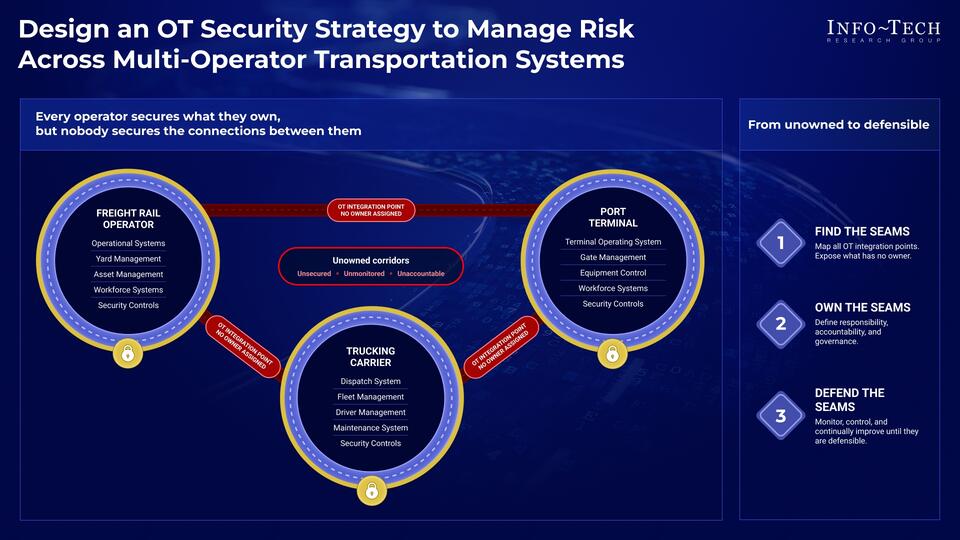
Design an OT security strategy to manage risk across multi-operator transportation systems
FROM UNOWNED TO DEFENSIBLE
1 FIND THE SEAMS
Discover the red corridors.
Map all OT integration points.
Expose what has no owner.
2 OWN THE SEAMS
Assign an owner to each seam.
Define responsibility, accountability, and governance.
3 DEFEND THE SEAMS
Instrument and document the seams.
Monitor, control, and continually improve until they are defensible.
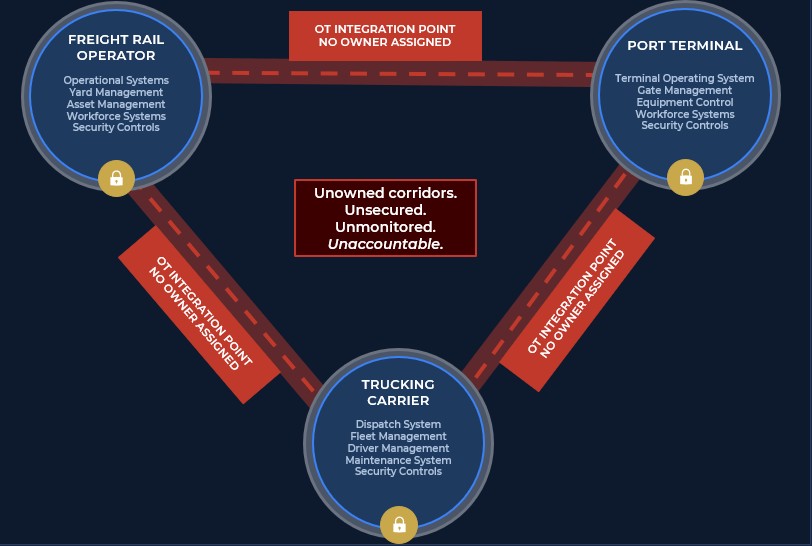
Every operator secures what they own, but nobody secures the connections between them
Info-Tech Insight
A transportation operator can lose visibility, operational continuity, or safety-critical functions through a connection owned by a partner. Organizations routinely depend on systems they cannot secure directly, making governance as important as technology.
Info-Tech's methodology for Establish OT Boundary Governance Across Multi-Operator Transportation Networks
| 1. Find the Seam | 2. Own the Seam | 3. Defend the Seam | |
|---|---|---|---|
| Phase Steps | 1.1 Map integration points 1.2 Tier integration points by risk 1.3 Identify the priority gaps |
2.1 Assign internal accountability 2.2 Establish cross-operator agreements 2.3 Document the governance zone map |
3.1 Assess monitoring coverage 3.2 Build the incident response pathway 3.3 Produce the OT Boundary Governance Plan Communication Deck |
| Phase Outcomes | Complete visibility into OT integration points
|
Accountability assigned to critical boundaries
|
Governed boundaries become monitored and defensible
|
About Info-Tech
Info-Tech Research Group is the world’s fastest-growing information technology research and advisory company, proudly serving over 30,000 IT professionals.
We produce unbiased and highly relevant research to help CIOs and IT leaders make strategic, timely, and well-informed decisions. We partner closely with IT teams to provide everything they need, from actionable tools to analyst guidance, ensuring they deliver measurable results for their organizations.
What Is a Blueprint?
A blueprint is designed to be a roadmap, containing a methodology and the tools and templates you need to solve your IT problems.
Each blueprint can be accompanied by a Guided Implementation that provides you access to our world-class analysts to help you get through the project.
Need Extra Help?
Speak With An Analyst
Get the help you need in this 3-phase advisory process. You'll receive multiple touchpoints with our researchers, all included in your membership.
Guided Implementation 1:
- Call 1: Establish scope and define the OT ecosystem.
- Call 2: Map OT integration points.
- Call 3: Tier integration points by risk.
- Call 4: Identify priority gaps.
Guided Implementation 2:
- Call 1: Assign internal accountability.
- Call 2: Establish cross-operator governance.
- Call 3: Build the governance zone map.
Guided Implementation 3:
- Call 1: Define monitoring and incident response requirements.
- Call 2: Finalize the OT Boundary Governance Plan Communication Deck.
Contributors
- Ann Heathcott, CISO, Atlas Van Lines
- Anonymous Contributor, IT Leader, Public Transportation Authority
