
Design a Service Catalog That Drives Insight and Innovation
Cut the complexity and transform your service catalog from a static list into a strategic hub.
Most organizations still treat the service catalog as a static menu of IT offerings – hard to navigate, disconnected from the organization, and incapable of surfacing meaningful insights. The result is low adoption, fragmented experiences, and missed opportunities for improvement. This blueprint offers a step-by-step approach to a purpose-built catalog that improves clarity, accelerates AI and automation readiness, and enables better decision-making.
Whether it’s improving service request experience, surfacing quality metrics, or enabling AI-based fulfillment, designing your catalog around a clear purpose is essential. But IT leaders often don’t know where to start or lack the time for a complete overhaul. By starting with a prebuilt, customizable catalog, you can skip time-consuming foundational work and focus on high-value tasks like tailoring audience-specific menus and extracting actionable insights.
1. Start with a purpose – and a prebuilt catalog.
Building a service catalog from scratch is time-consuming. A ready-made, customizable catalog helps you skip the heavy lifting so you can focus on what drives value: defining the purpose, standardizing what “service” means in your environment, and tailoring menus to different audiences. In just one day, you can have a functioning catalog customized to your organization, plus the tools to keep it relevant and impactful.
2. Provide great UX and get actionable insights.
You don’t need a complex catalog or advanced data mining techniques to deliver an excellent user experience while surfacing actionable insights. Even a simple well-structured service catalog can present customers with what matters most to them and equip decision-makers with meaningful insights, including trends, costs, and strategic opportunities.
3. Move your service catalog to the center of IT.
Start with your prebuilt catalog, customize it, use the insights – and then elevate it from a checklist at the front door of IT to the center of operations and decision-making, powering how services are designed, delivered, and improved. Rather than a static menu, your catalog becomes a dynamic, strategic hub that drives real value for your organization and the people it serves.
Use this step-by-step blueprint to build a dynamic service catalog
Our research offers a comprehensive framework, supported by robust tools, including a ready-made service catalog to use as your foundation. Use our step-by-step approach to rapidly build a service catalog that sits at the core of IT and drives better service experience, data, and decisions.
- Customize Info-Tech’s prebuilt catalog for your organization by clarifying your service catalog’s purpose and presenting a functioning catalog ready for creating menus and deriving insights.
- Use this foundational service catalog to present your services and derive insights by tailoring menus to different customer types and offering visibility into service quality, gaps, and support readiness for informed decision-making.
- Enhance your service catalog with portfolio-level insights including prioritization and rationalization of services based on real usage, satisfaction, and cost.
- Prepare to sustain, govern, and evolve your service catalog by establishing metrics, a governance structure, and a culture of continuous improvement, aided by marketing and communication supports.
Member Testimonials
After each Info-Tech experience, we ask our members to quantify the real-time savings, monetary impact, and project improvements our research helped them achieve. See our top member experiences for this blueprint and what our clients have to say.
9.8/10
Overall Impact
$35,769
Average $ Saved
27
Average Days Saved
Client
Experience
Impact
$ Saved
Days Saved
Institute of Nuclear Power Operations
Guided Implementation
10/10
N/A
5
Kansas Department of Labor
Workshop
10/10
$34,499
32
It was really nice pulling all the information together and the detail at which we dug. Great team building exercise.
City Of North Port
Guided Implementation
10/10
$6,800
5
West Virginia Lottery
Guided Implementation
10/10
$34,000
50
Best: Greg's deep knowledge and experience with IT service management. There are not worst parts, the entire experience was outstanding.
West Virginia Lottery
Guided Implementation
10/10
$34,000
60
Best parts were Greg's comprehensive knowledge and the quality of the blueprint. The example services spreadsheet is comprehensive and easy to und... Read More
Butler Community College
Workshop
10/10
N/A
N/A
Dennis did an excellent job leading my team in the Service catalog workshop. The approach to the workshop was valuable and made us take a look at o... Read More
HR Green, Inc.
Workshop
9/10
N/A
N/A
This workshop, presented by Sumit, was verity valuable to myself and HR Green. I found Sumit's experience, knowledge, and suggestions to be top not... Read More
Social Sciences and Humanities Research Council
Guided Implementation
9/10
$47,500
20
Mount Saint Mary College
Guided Implementation
9/10
$8,160
4
Sandi was great to work with and saved me a lot of time getting up and running with this! Very helpful.
Children's Aid Society - Ottawa
Guided Implementation
9/10
N/A
5
Not only were the templates very helpful but also the explainations given by greg helped me save a lot of time and effort.
Planned Parenthood Federation of America
Workshop
10/10
$136K
110
The best part of the workshop is that it brought folks together from across the org and got them on the same page with what we are doing. There ... Read More
Oregon Department of Employment
Workshop
10/10
N/A
10
Overall, this engagement was outstanding.
British Columbia Lottery Corporation
Guided Implementation
10/10
$4,000
10
Seasoned expertise and professional mature behaviors and relaxed demeanor.
Community Health Choice, Inc.
Workshop
10/10
N/A
N/A
The team appreciated Into Tech modifying our workshop as we already had a service catalog in place. The recommendation provided by Sumit will allo... Read More
Sanmar Corp
Guided Implementation
10/10
$2,740
2
Great insight into the topic and provided customer experiences on pricing with this vendor. Also, John outlined several alternatives we could purs... Read More
Ontario Power Generation
Workshop
10/10
$50,000
32
Sumit was a great facilitator and demonstrated facilitative leadership during the workshops.
Queen's University
Guided Implementation
10/10
N/A
2
PGG Wrightson
Guided Implementation
8/10
N/A
N/A
very good initial discussion. It's too early estimating any savings.
Department of National Defence
Guided Implementation
8/10
N/A
20
Best part: Follow-up sessions and Getting feedbacks on our progress Worst part: NA
Hernando County Clerk of Circuit Court and Comptroller
Guided Implementation
10/10
$12,999
10
Ibrahim was very knowledge and took the time to explain the slides and powerpoint. He was able to break down the topics and make them easier to und... Read More
Mexichem Servicios Administrativos S.A. de C.V.
Workshop
9/10
$32,499
20
The best was the management of the meetings to get the result and achieve the goal. The worst, is the initial lack of alignment between the expecte... Read More
Waterloo Region District School Board
Workshop
10/10
N/A
20
Appreciated the time to be able to work in collaboration with other staff to get this completed.
State of Hawaii – ETS
Workshop
9/10
$649K
120
The collaboration exchange with the different department stakeholders was a huge plus. On the flip side many departments felt the expectations were... Read More
Health Canada
Guided Implementation
10/10
$2,000
50
The best part was the reassurance that I have an SME at Infotech to assist and the worst part is getting the basic info from my colleague due to th... Read More
Kroenke Sports & Entertainment
Guided Implementation
9/10
$3,779
20
Great set of guidelines and templates for us to work with.
Construction Resources Management
Guided Implementation
10/10
$12,599
50
Oregon Enterprise Information Services
Guided Implementation
10/10
$2,519
2
Valence was able to traverse both a narrow and wide scope of topics within the service management domain, that was a big help because that's what I... Read More
Vancouver Police Department
Workshop
9/10
$19,000
35
Goodwill of Central and Northern Arizona
Guided Implementation
10/10
$2,519
20
Best parts are being able to ask question and get guidance and clarification specific to our organization.
Sun River Health
Guided Implementation
9/10
$2,479
20

Manage Service Catalogs
Improve user satisfaction with IT by letting business users know exactly what is available to them in a convenient menu-like catalog.
This course makes up part of the Service Planning & Architecture Certificate.
Please note that Academy course and certificate tracks will be updated on June 1, 2025. Please complete any current course you are enrolled in before this date or your progress will be lost.
- Course Modules: 5
- Estimated Completion Time: 2-2.5 hours
Workshop: Design a Service Catalog That Drives Insight and Innovation
Workshops offer an easy way to accelerate your project. If you are unable to do the project yourself, and a Guided Implementation isn't enough, we offer low-cost delivery of our project workshops. We take you through every phase of your project and ensure that you have a roadmap in place to complete your project successfully.
Module 1: Design Your Basic Service Catalog
The Purpose
Clarify your service catalog’s purpose and complete your customize service catalog.
Key Benefits Achieved
After the first day you will have a fully functioning service catalog design ready to create customized menu views for your customers and derive actionable insights from.
Activities
Outputs
Clarify your service catalog’s purpose.
- Service catalog purpose and context map.
Design your basic service catalog.
- Service catalog customized to your organization, built to your purpose and ready for menus and insights.
Add finishing touches to your service catalog.
Module 2: Create Menus and Derive Insights
The Purpose
Key Benefits Achieved
Activities
Outputs
Review and validate menus views.
- Menus tailored to customers.
Derive insights from your basic service catalog.
- Insights about service experience, service quality, support readiness, and service rationalization derived from the service catalog using the Service Catalog Design Tool.
Module 3: Derive Deeper Insights With Advanced Catalog Design
The Purpose
Prepare the service catalog to derive deeper insights using portfolio-level fields.
Key Benefits Achieved
Advanced actionable insights.
Activities
Outputs
Prepare your service catalog for portfolio level insights (validate new fields).
- Advanced catalog with actionable insights around cost, demand, usage, criticality, service health, and rationalization
Derive portfolio level insights using guidance and examples to correlate data.
Module 4: Identify Catalog Supports and Prepare to Market the Catalog
The Purpose
Ensure the service catalog is embedded into the organization, integrated into ITSM processes, and has a supportive ecosystem to ensure its long-term viability.
Key Benefits Achieved
Activities
Outputs
Strengthen your service catalog through integration and support (identify other ITSM connections, capabilities, governance), commit to a continuous improvement mindset, and build a roadmap.
Prepare to market the catalog with your message and a strategy document.
- Service Catalog Roadmap.
- Service Catalog Strategy Document with communications plan.
Design a Service Catalog That Drives Insight and Innovation
Cut the complexity and transform your service catalog from a static list into a strategic hub.
Analyst perspective
Unlock the potential of your service catalog!
Too often, organizations treat the service catalog as just a compliance checkbox or a basic inventory of offerings, something you pass through, like a front door, rather than a space where real value is created. The result? Low adoption, fragmented experiences, and missed opportunities for improvement.
A well-designed catalog does more than list services. With a clear purpose, it moves from the front door to the core of IT, becoming a dynamic hub that orchestrates services, enables automation, and delivers actionable insights. Integrated with ITSM processes and business functions, the catalog provides essential data on service cost and health, empowering decision-makers and demonstrating IT's value.
Moving the catalog from the front to the center of IT is a major shift, and building it from scratch can be a long, exhausting process. Instead, shave weeks or even months off your effort by leveraging Info-Tech's ready-made catalog. This lets you focus on high-value work like creating tailored, customer-driven menus and generating high-quality insights, so you can accelerate implementation without sacrificing quality.

Diana MacPherson
Research Director, CIO
Info-Tech Research Group
Executive summary
Your Challenge
Most service catalogs are outdated, hard to navigate, and built from an IT-centric perspective. They lack user-focused design, integration with other ITSM and business functions, automation readiness, and sustainable governance.
The result? Low adoption, rising ticket volumes, and a poor digital experience.
Common Obstacles
Organizations face these challenges because they:
- Hold on to the outdated view that a service catalog is just a static list of IT offerings, forcing customers to sift through technical components instead of a clear, entitlement-based list of services that can be easily presented and fulfilled through AI and automation.
- Don't know where to start or lack the time for a lengthy redesign process.
- Fail to realize the potential for the catalog to become a dynamic hub, integrating with ITSM processes and business areas (like cost and customer satisfaction) to deliver actionable insights.
Info-Tech's Approach
Start with Info-Tech's ready-to-use, comprehensive service catalog, complete with standard IT service examples for all industries. This fully developed catalog gives you an immediate foundation to design or redesign your own by:
- Presenting tailored views for different customer groups in clear business language.
- Delivering actionable insights for decision-makers and service owners to improve service outcomes.
- Providing proven methods to ensure your catalog remains coherent, widely adopted, and actively supported.
Info-Tech Insight
Your service catalog is so much more than an entry into IT services. Reposition it from a static list to a strategic hub that delivers tailored experiences, integrates with ITSM and business processes, and prepares your organization for AI and automation through a purpose-driven, well-organized foundation.
The service catalog is an untapped resource of strategic power
A well-structured service catalog enables you to:
- Gain actionable insights for better decisions: Help service owners improve offerings, enable leaders to prioritize funding, compare costs for critical vs. non-critical services, predict new service costs based on historical data and component roll-ups, and more!
- Demonstrate IT's business acumen: Show CIOs as strategic partners by listening to customers, presenting services in clear business language, and delivering seamless, entitlement-based access.
- Integrate and optimize ITSM processes: Feed data to and from incident, problem, and knowledge management to rationalize services, improve support, and create an ecosystem that continuously enhances service delivery.
- Build a foundation for future innovation: Position IT to leverage automation and AI by creating a well-organized, purpose-driven catalog that connects services to outcomes.
Bottom Line: IT already has the data and capabilities to achieve this, but it can't do it with an outdated mindset. Reimagine the service catalog and turn untapped potential into tangible business outcomes.
CIOs face mounting pressure to integrate AI agents and chat interfaces, making it critical to ensure that the underlying service catalog is accurately defined and maintained.
51% of organizations see predictive AI as a priority for the next 12-24 months.
Source: InformationWeek and TeamDynamix, 2023
80% of IT leaders say they are tasked with researching and evaluating possible AI additions to the tech stack.
Source: State of the CIO, 2025
Info-Tech's approach
Start with Info-Tech's tailored service catalog: ready in a day, built to last
Transform your service catalog into a strategic hub
1. Customize with purpose
Leverage Info-Tech's Prepopulated Service Catalog and customize based on the outcomes you want to achieve.
2. Tailor for customers
Present services in business language tailored to user needs.
3. Extract insights
Leverage pre-built analysis to uncover trends, costs, and strategic opportunities while preparing for automation and AI-driven service delivery.
4. Sustain and evolve
Establish governance, roles, and continuous improvement to keep your service catalog relevant and future-ready.
The Info-Tech difference:
Skip the heavy lifting and start with a ready-made service catalog tailored for IT leaders. In just one day, you'll have a functioning catalog customized to your organization, plus the tools to keep it relevant and impactful.
Our approach helps you:
- Focus on outcomes, not busywork: Design your catalog around what you want it to achieve, not just what it lists.
- Unlock strategic insights: Use our analysis to turn your catalog into a decision-making engine.
- Keep it coherent and adopted: Apply proven governance, management practices, and communication strategies to ensure buy-in and long-term success.
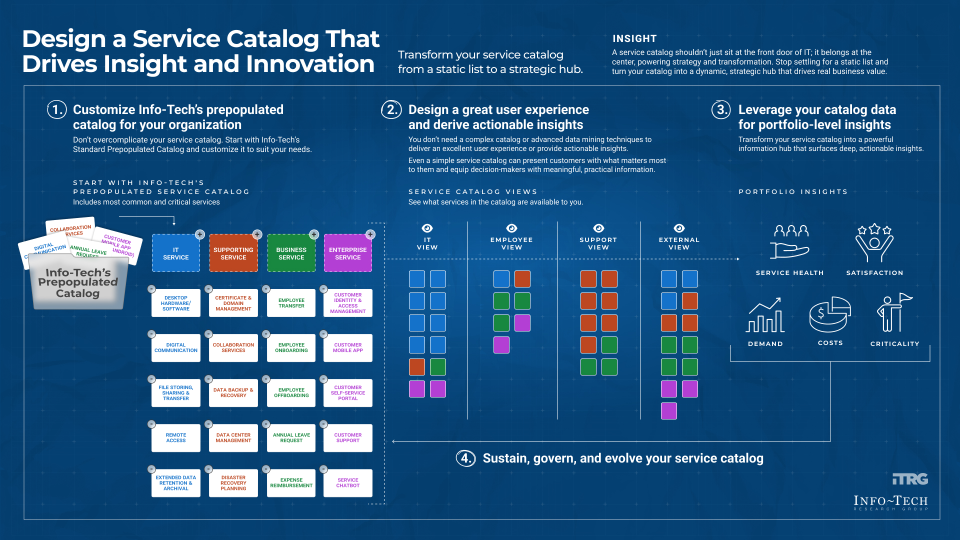
Info-Tech's methodology for designing a service catalog that drives insight and innovation
| 1. Customize Info-Tech's Prepopulated Catalog for Your Organization | 2. Use Your Service Catalog to Present Your Services and Derive Insights | 3. Enhance Your Service Catalog With Portfolio-Level Insights | 4. Prepare to Sustain, Govern, and Evolve Your Service Catalog | |
|---|---|---|---|---|
| Phase Steps |
|
|
|
|
| Phase Outcomes |
|
|
|
|
Insight Summary
Building from scratch is slow and drains resources. Simplify your approach with Info-Tech's pre-built service catalog and focus on what truly matters: the actionable insights it provides.
Overarching insight
A service catalog shouldn't just sit at the front door of IT; it belongs at the center, powering strategy and transformation. Stop settling for a static list and turn your catalog into a dynamic, strategic hub that drives real business value.
Simplify and design around purpose
Many service catalogs fail because organizations overthink them. Don't overcomplicate things. Start with a limited set of services and design your catalog around what you would like to do with it.
Provide a great UX and derive actionable insights
You don't need a complex catalog or advanced data mining techniques to deliver an excellent user experience or provide actionable insights. Even a simple service catalog can present customers with what matters most to them and equip decision-makers with meaningful, practical information.
Connect to IT and enterprise services
Your service catalog is the connective tissue between IT, business, and enterprise services. This transforms your service catalog into a powerful information hub that surfaces deep, actionable insights.
Manage your service catalog as a service
Your service catalog, as critical as it is, cannot stand on its own. It is essential to manage it as a service itself complete with specialized capabilities, enabling governance, and a commitment to continuously improve it.
Blueprint deliverables
Each step of this blueprint is accompanied by supporting deliverables to help you accomplish your goals:
Service Catalog Strategy Document
Use the strategy document to communicate about and market your service catalog.
Service Catalog Roadmap Tool
Use this tool to create a visual roadmap that supports your catalog in becoming a reality.
Key deliverable:
Service Catalog Design Tool
A ready-made service catalog complete with typical IT services so you don't have to start from scratch and can instead concentrate on deriving meaningful insights from the catalog data.
Blueprint benefits
| IT Benefits | Business Benefits |
|---|---|
|
|
Measure the value of this blueprint
| Measurable Benefit | Metrics | Impact |
| Catalog is used | Percentage of total service requests coming through the service catalog vs. other channels. | IT can determine if the catalog is meeting user needs and can adjust as required. |
| People find what they are looking for | Percentage of people who use the catalog and go on to request service | IT improves customer service and satisfaction. |
| Support costs decrease | Support costs before and after catalog | IT can demonstrate that they spend efficiently through effective management. |
| Service design becomes more efficient | Speed to automate/digitize using catalog vs. not | IT demonstrates that they can efficiently pivot and support business needs. |
| Meaningful insights can be derived using the catalog | Percentage of new insights derived as a result of the catalog | IT seen as a trusted business partner with quick service insights. |
| Accurate insights are derived quickly | Speed of meaningful insights derived improved by x% | IT can be confident that the decisions they make are based on accurate data. |
Case study
A purpose-built catalog reveals savings, guides decisions, and creates a coherent user experience.
INDUSTRY
Government
SOURCE
Anonymous
Challenge
The organization managed 80-90 fragmented, technology-centric services, creating confusion for non-technical customers, slowing procurement, and driving up costs through redundant offerings and inconsistent pricing. Multiple contracts and policy gaps stretched timelines from weeks to months, while overlapping services made decisions difficult and inflated risk.
Solution
The organization redesigned its service catalog with a clear purpose: to present services in business terms for easier purchasing and cost transparency.
In doing so, they uncovered insights about service overlap, pricing, and policy gaps that informed smarter decisions. Key actions included:
- Consolidating 80+ listings into 8-10 purpose-built, outcome-based services.
- Cutting procurement from weeks/months to days with one master agreement.
- Enabling cost savings and better decisions through clear options and standard pricing.
- Improving operational efficiency with reusable builds and consistent delivery.
Results
- Customers gained clarity and confidence: easy-to-understand catalog, faster ordering.
- Procurement accelerated: requests moved to 24-hour response and immediate solutioning.
- Costs reduced and decisions improved: insights eliminated redundancy and simplified pricing.
- IT achieved scalability: standardization enabled faster delivery and measurable performance improvements.
Info-Tech offers various levels of support to best suit your needs
| DIY Toolkit | Guided Implementation | Workshop | Executive & Technical Counseling | Consulting |
|---|---|---|---|---|
| "Our team has already made this critical project a priority, and we have the time and capability, but some guidance along the way would be helpful." | "Our team knows that we need to fix a process, but we need assistance to determine where to focus. Some check-ins along the way would help keep us on track." | "We need to hit the ground running and get this project kicked off immediately. Our team has the ability to take this over once we get a framework and strategy in place." | "Our team and processes are maturing; however, to expedite the journey we'll need a seasoned practitioner to coach and validate approaches, deliverables, and opportunities." | "Our team does not have the time or the knowledge to take this project on. We need assistance through the entirety of this project." |
Diagnostics and consistent frameworks are used throughout all five options.
Guided Implementation
What does a typical GI on this topic look like?
| Scoping | Phase 1 | Phase 2 | Phase 3 | Phase 4 |
|---|---|---|---|---|
|
Call #1: Scope requirements, objectives, and your specific challenges. |
Call #2: Clarify your catalog's purpose. Call #3: Start designing your service catalog. Call #4: Complete your service catalog. |
Call #5: Set up menus. Call #6: Derive insights from catalog. |
Call #7: Prepare your catalog for advanced insights. Call #8: Derive advanced insights (portfolio level). |
Call #9: Identify connections to IT services and identify governance and capability supports. Call #10: Create a roadmap and prepare communications. |
A Guided Implementation (GI) is a series of calls with an Info-Tech analyst to help implement our best practices in your organization.
A typical GI is 8 to 12 calls over the course of 4 to 6 months.
Workshop overview
Contact your account representative for more information.
workshops@infotech.com 1-888-670-8889
| Day 1 | Day 2 | Day 3 | Day 4 | Day 5 | |
|---|---|---|---|---|---|
| Activities | Design Your Service Catalog | Create Menus and Derive Insights | Derive Deeper Insights With Advanced Catalog Design | Identify Catalog Supports and Prepare to Market the Catalog | Next Steps and Wrap-Up (offsite) |
| 1.1 Clarify your service catalog's purpose 1.2 Design your service catalog 1.3 Add finishing touches to the catalog |
2.1 Review and validate menus views 2.2 Derive insights from your service catalog |
3.1 Prepare your service catalog for portfolio-level insights (validate new fields) 3.2 Derive portfolio-level insights using guidance and examples to correlate data |
4.1 Strengthen your service catalog through integration and support (identify other ITSM connections, capabilities, governance), commit to a continuous improvement mindset, and build a roadmap 4.2 Prepare to market the catalog with your message and a strategy document |
Completed deliverables | |
| Deliverables |
|
|
|
|
|
About Info-Tech
Info-Tech Research Group is the world’s fastest-growing information technology research and advisory company, proudly serving over 30,000 IT professionals.
We produce unbiased and highly relevant research to help CIOs and IT leaders make strategic, timely, and well-informed decisions. We partner closely with IT teams to provide everything they need, from actionable tools to analyst guidance, ensuring they deliver measurable results for their organizations.
What Is a Blueprint?
A blueprint is designed to be a roadmap, containing a methodology and the tools and templates you need to solve your IT problems.
Each blueprint can be accompanied by a Guided Implementation that provides you access to our world-class analysts to help you get through the project.
Need Extra Help?
Speak With An Analyst
Get the help you need in this 5-phase advisory process. You'll receive multiple touchpoints with our researchers, all included in your membership.
Guided Implementation 1: Scoping
- Call 1: Scope requirements, objectives, and your specific challenges.
Guided Implementation 2: Customize Info-Tech’s Prepopulated Service Catalog for Your Organization
- Call 1: Clarify your catalog’s purpose.
- Call 2: Start designing your service catalog.
- Call 3: Complete your service catalog
Guided Implementation 3: Use Your Service Catalog to Present Your Services and Derive Insights
- Call 1: Set up menus.
- Call 2: Derive insights from catalog.
Guided Implementation 4: Enhance Your Service Catalog with Portfolio-Level Insights
- Call 1: Prepare your catalog for advanced insights.
- Call 2: Derive advanced insights (portfolio-level).
Guided Implementation 5: Prepare to Sustain, Govern, and Evolve Your Service Catalog
- Call 1: Identify connections to IT services and identify governance and capability supports.
- Call 2: Create a roadmap and prepare communications.
Contributors
- Roy Atkinson, CEO and Principal Advisor, Clifton Butterfield, LLC
- Matt Beran, Senior Marketing Specialist, InvGate
- Rae Ann Bruno, President, Business Solutions Training Inc.
- Phyllis Drucker, Industry Thought Leader and President, EZ2BGR8 Service Management
- Ric Mims, Director of Operations, Simple ITSM
- Doug Tedder, Owner and Principal Consultant, Tedder Consulting LLC
 Design a Service Catalog That Drives Insight and Innovation
 Create a Service Management and IT Operations Strategy
 Develop a Plan to Pilot Enterprise Service Management
 Create a Service Management Roadmap
 Elevate Your Service Capabilities to Drive Enterprise Value
 Create an IT View of the Service Catalog
 Initiate Your Service Management Program
 Develop Meaningful Service Metrics
 IT Service Management Selection Guide
 Service Management Integration With Agile Practices
 Define Your Enterprise IT and Digital Services
 Fast-Track Your Enterprise Service Design
