
Design a Unified Guest Experience Strategy
Maximize the guest experience and topline business value through an omnichannel strategy.
Hospitality systems were built around individual transactions, not persistent guest identity. As a result, core systems are optimized to process isolated interactions rather than continuous ones.
The guest relationship is distributed across OTAs, brand systems, and franchise operators, meaning no single entity owns the full guest lifecycle, making it hard to establish a unified, end-to-end view of the guest.
A single guest exists across multiple contexts, creating fragmented and inconsistent representations of the same individual, resulting in duplicated guest profiles.
Our Advice
Critical Insight
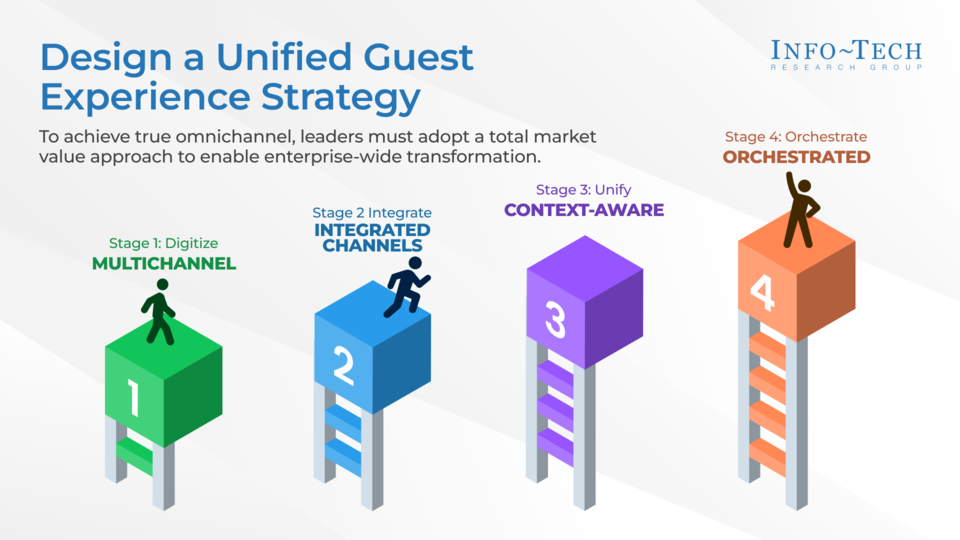
To achieve true omnichannel, leaders must move beyond viewing it as a threat to operations and channel-level revenue, which leads to incremental improvements, and instead adopt a total market value approach to enable enterprise-wide transformation.
Impact and Result
Omnichannel transformation requires a clear strategic roadmap that meets the organization at their current omnichannel maturity:
- Assess your omnichannel maturity to understand what omnichannel stage your organization is currently at.
- Map target state guest journeys to understand your ideal omnichannel state and the key blockers in achieving it.
- Establish initiatives and prioritize them to establish a clear omnichannel strategy roadmap.
Design a Unified Guest Experience Strategy
Maximize the guest experience and topline business value through an omnichannel strategy.
Analyst perspective
Omnichannel drives total guest value.
Omnichannel has long been an aspiration in hospitality, but achieving it historically required changes many organizations were not ready to undertake. As guest expectations for seamless, cross-channel experiences rise, it is now a top strategic priority, yet the challenges of achieving true omnichannel persist. Most systems were built around individual transactions rather than persistent guest identity, resulting in fragmented interactions and limiting a continuous, end-to-end understanding of the guest. The guest relationship is further distributed across OTAs, brand systems, and franchise operators, leaving no single entity with full ownership of the lifecycle.
These architectural challenges drive duplicated guest profiles, siloed data, and limited cross-channel visibility while high modernization costs, reliance on external partners, and internal resistance slow progress and reinforce incremental improvements.
Successful omnichannel transformation requires a shift in mindset, from treating physical and digital touchpoints as separate revenue drivers to maximizing total guest value across the entire experience. Organizations must assess their current state, define target guest journeys, and prioritize initiatives that close continuity gaps, enabling coordinated, enterprise-wide execution.

August Hummelbrunner
Research Analyst, Gaming, Sports, & Hospitality
Info-Tech Research Group
Executive summary
Your Challenge
Hospitality systems were built around individual transactions, not persistent guest identity. As a result, core systems are optimized to process isolated interactions rather than continuous ones.
The guest relationship is distributed across OTAs, brand systems, and franchise operators, meaning no single entity owns the full guest lifecycle, making it hard to establish a unified, end-to-end view of the guest.
A single guest exists across multiple contexts, creating fragmented and inconsistent representations of the same individual, resulting in duplicated guest profiles.
Common Obstacles
Architectural changes required to become fully omnichannel are extremely costly and require lots of resources, which is often challenging for IT teams to attain.
Delivering a unified omnichannel experience often extends beyond the organization’s direct control, as guest interactions span multiple systems, vendors, and partners, making coordination complex, constrained, and dependent on external capabilities.
Strong emotional attachment to existing systems, processes, and initiatives makes it difficult to shift priorities, as change is often perceived as a loss of control or value.
Info-Tech’s Approach
Omnichannel transformation requires a clear strategic roadmap that meets the organization at its current omnichannel maturity:
- Assess your omnichannel maturity to understand what omnichannel stage your organization is currently at.
- Map target-state guest journeys to understand your ideal omnichannel state and the key blockers in achieving it.
- Establish initiatives and prioritize them to establish a clear omnichannel strategy roadmap.
Info-Tech Insight
To achieve true omnichannel, leaders must move beyond viewing it as a threat to operations and channel-level revenue, which leads to incremental improvements, and instead adopt a total market value approach to enable enterprise-wide transformation.
Omnichannel is a unified guest experience
Omnichannel and unified guest experience are interchangeable, as omnichannel is only achieved when the guest is consistently understood and served across all interactions.
What does it look like?
- The guest never restarts or restates, the guest context is always there.
- Interactions feel fluid, the guest flows through the physical and digital experience as one.
- Every interaction is personalized and relevant to the specific guest.
What it is not
- It is not a one-time technology or marketing initiative.
- It is not achieved through system integration alone.
- It is not simply having multiple channels in place.
What is omnichannel?
Delivering a seamless, continuous guest experience across all touchpoints, enabled by a shared understanding of the guest.
Omnichannel and unified guest experience
Omnichannel and unified guest experience represent the same idea: the guest feels recognized and valued no matter where they interact, with every interaction informed by a consistent understanding of who they are.
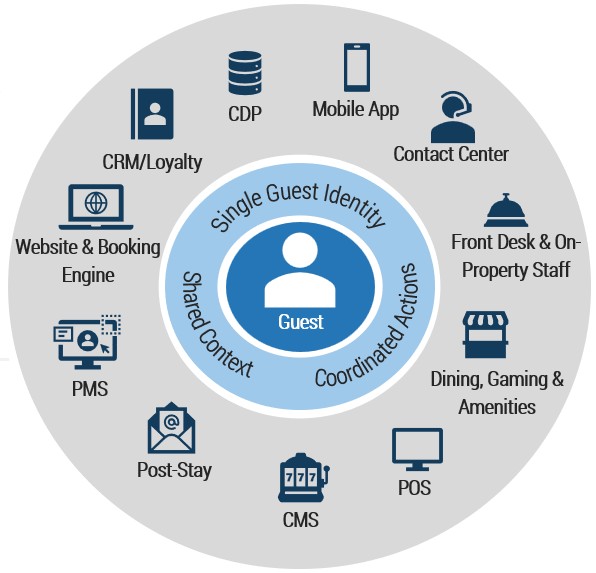
DXP is not a substitute for omnichannel
Omnichannel and DXP are not the same; a DXP is one component within an omnichannel strategy. Omnichannel defines how a unified guest experience is delivered across all touchpoints, while a DXP manages digital experiences.
DIGITAL CONTENT DELIVERY
Digital Experience Platform (DXP)
Manages and delivers content across digital channels. The DXP is a tool; it executes what guests see on screens.
- Website, mobile app, chatbot, e-commerce
- Content management, templates, and digital assets
- Session-level personalization within digital channels
- API-based delivery to digital touchpoints
- No visibility into physical guest interactions
END-TO-END GUEST JOURNEY
Omnichannel Experience
Connects every guest interaction, digital and physical, into one continuous, personalized journey. DXP is one input.
- Covers digital and physical touchpoints
- Casino floor, front desk, F&B, spa, and beyond
- Unified guest identity and personalization across every surface
GUEST ORCHESTRATION
Real-time decisioning and next-best-action across all channels; tells each system what to do for each guest, at each moment.
Info-Tech Insight
A DXP delivers digital content. Omnichannel experience connects that to physical interactions, unified guest data, and guest orchestration – the decisioning layer that determines what each guest receives, across every touchpoint, in real time.
Differentiate your brand by elevating the guest experience
Resorts World Sentosa
INDUSTRY
Hospitality
SOURCE
CIO.com, 2025
Resorts World Sentosa (RWS) is Asia’s premier integrated resort on Singapore’s Sentosa Island, spanning 49 hectares of luxury hotels, theme parks, and dining. It has hosted 200M+ guests since 2010.
As the portfolio grew, guest data and operations were spread across many independent systems including pre-arrival, on-property and post-stay touchpoints, making it hard to deliver a connected, personalized experience.
RWS’s focus on guest experience as a competitive differentiator made building a unified, data-driven guest platform a top priority, supported by an SGD 6.8B RWS 2.0 investment.
Results
RWS deployed a unified digital platform: AI and big data ingest data across the resort, a single mobile app delivers hyper-personalized journeys, and a Smart Operations Center integrates passenger flow, energy, security, and facility management in real time.
Core themes of the RWS unified guest experience strategy:
Bring guest data together across pre-arrival, on-property and post-stay systems to power a single, AI-driven view of every guest.
Deliver hyper-personalized journeys through a single mobile experience that handles itineraries, bookings, and tailored suggestions.
Run the resort from a Smart Operations Center that integrates passenger flow, energy, security, and facility management in real time.
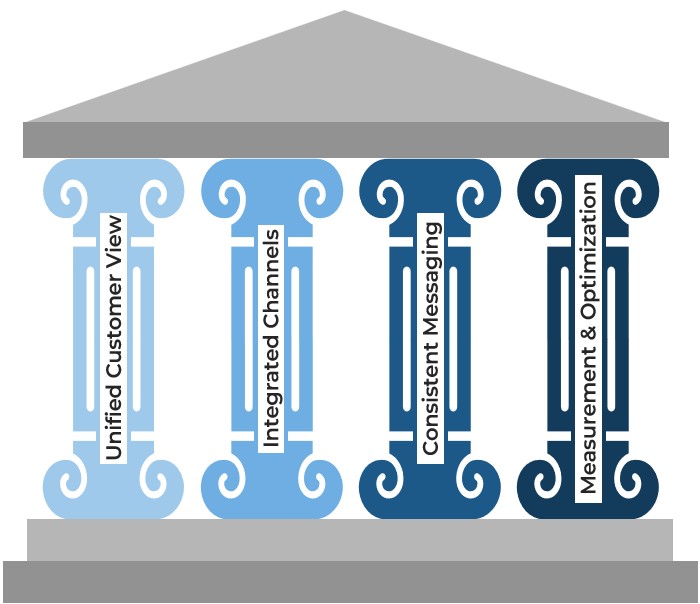
Understand the four pillars of omnichannel
A strong omnichannel strategy requires more than presence across channels. It demands a unified, customer-centric approach built on the following pillars:
Unified Customer View
Customers expect organizations to know who they are. Every interaction should reflect a complete picture of their journey, including what they’ve done, what they need, and what they care about.
Integrated Channels
Switching channels shouldn’t feel like starting over. Connected channels enable seamless movement, allowing organizations to respond in real time wherever customers engage.
Consistent Messaging
Departments should operate as one unified team, delivering consistent messaging that builds trust and reinforces the brand across every touchpoint.
Measurement & Optimization
A great customer experience isn’t one and done. Tracking what works and what doesn’t keeps teams aligned and focused on what matters most. It’s how you make every interaction better than the last.
Fragmented architecture breaks omnichannel
Hospitality organizations struggle to maintain a continuous, shared understanding of the guest across the journey, making omnichannel difficult to achieve.
Hospitality systems were built around individual transactions, not persistent guest identity. As a result, core systems are optimized to process isolated interactions rather than continuous ones.
The guest relationship is distributed across OTAs, brand systems, and franchise operators, meaning no single entity owns the full guest lifecycle, making it hard to establish a unified, end-to-end view of the guest.
A single guest exists across multiple contexts, >creating fragmented and inconsistent representations of the same individual, resulting in duplicated guest profiles.
40% of hoteliers cite disconnected systems as their biggest data obstacle, blocking unified guest profiles.
Source: Revinate, 2025
≈49% of hoteliers struggle to access the data they need for critical revenue and operational decisions.
Source: Revinate, 2025
15-20% Is the typical guest-record duplication rate at hotel groups before identity resolution is in place.
Source: Hotelinking
Info-Tech Insight
Establishing a single, unified guest identity that carries context across the property is foundational to omnichannel success. Without it, physical and digital touchpoints cannot coordinate to deliver a continuous guest experience.
Explore the benefits of omnichannel
Omnichannel enhances value for guests and staff across the entire resort ecosystem.
Total Guest Value
Connects hotel, gaming, dining, and entertainment to capture more spend per guest and reduce lost revenue between experiences.
Seamless Guest Experience
Eliminates friction across touchpoints, improving guest satisfaction and strengthening guest loyalty.
Real-Time Personalization
Tailors offers and interactions in the moment to increase conversion rates, upsell opportunities, and on-property engagement.
Operational Efficiency
Aligns systems and workflows to reduce manual coordination, lower operating costs, and improve service consistency.
Growth & Innovation
Modernizing architecture allows organizations to quickly launch new channels, integrate partners, and adopt AI without major rework.
Understand the common barriers to omnichannel
Omnichannel progress is constrained by cost, control, and culture:
Architectural changes required to become fully omnichannel are extremely costly and require lots of resources, which is often challenging for IT teams to attain.
Delivering a unified omnichannel experience often extends beyond the organization’s direct control, as guest interactions span multiple systems, vendors, and partners, making coordination complex, constrained, and dependent on external capabilities.
Strong emotional attachment to existing systems, processes, and initiatives makes it difficult to shift priorities, as change is often perceived as a loss of control or value.
Most operators lack the investment and integration needed to deliver omnichannel.
63% of hospitality operators say they haven’t invested enough in technology to make real progress.
Source: Whatfix, 2024
45% of hotels say fragmented technology and data prevent a unified view of customers and operations.
Source: Whatfix, 2024
About Info-Tech
Info-Tech Research Group is the world’s fastest-growing information technology research and advisory company, proudly serving over 30,000 IT professionals.
We produce unbiased and highly relevant research to help CIOs and IT leaders make strategic, timely, and well-informed decisions. We partner closely with IT teams to provide everything they need, from actionable tools to analyst guidance, ensuring they deliver measurable results for their organizations.
What Is a Blueprint?
A blueprint is designed to be a roadmap, containing a methodology and the tools and templates you need to solve your IT problems.
Each blueprint can be accompanied by a Guided Implementation that provides you access to our world-class analysts to help you get through the project.
Need Extra Help?
Speak With An Analyst
Get the help you need in this 2-phase advisory process. You'll receive multiple touchpoints with our researchers, all included in your membership.
Guided Implementation 1: Assess maturity and establish target state
- Call 1: Discuss what’s driving omnichannel transformation and establish understanding of maturity levels.
- Call 2: Assess current omnichannel maturity.
- Call 3: Determine omnichannel experience principles and target state.
Guided Implementation 2: Establish omnichannel strategy and roadmap
- Call 1: Identify critical touchpoints and map future-state guest journeys.
- Call 2: Establish pain points and opportunities, and define success metrics.
- Call 3: Translate guest journeys into requirements.
- Call 4: Translate requirements into initiatives.
- Call 5: Sequence the omnichannel roadmap.
- Call 6: Summarize results and plan next steps.
Contributors
- Larry Fretz, Senior Managing Partner II, Info-Tech
- Edison Bareto, Executive Counselor, Info-Tech
- David Farlin, Executive Counselor, Info-Tech
- Mark Rosa, CIO, Mohegan Gaming
