
Build a Technical Reference Architecture for Utilities
Build the utility technology landscape of the future.
Many utilities remain constrained by legacy systems, data silos, and fragmented IT/OT architectures. This complexity slows digital transformation, increases integration costs, and weakens reliability. Without a TRA, organizations struggle with:
- Misalignment between business and technology. Technical designs that are not traced back to business capabilities and outcomes become technology-centric exercises and face elevated risk of underutilization.
- Complexity from legacy technology. Utility companies still operate on legacy systems that are incompatible with modern IT.
- Disconnected IT/OT domains. IT and OT technology systems are deeply interwoven; however, the ways of working are disjointed.
Our Advice
Critical Insight
To achieve resilience and strategic innovation, a unifying technical architecture must be in place to support technology advancement. The pace of innovation within utilities is at an all-time high. Complex pressures from regulators, customers, government, and every changing demand landscape are forcing utilities to digitally transform. A TRA can help your organization invest in technology and skills strategically.
Impact and Result
- Align technology decisions with enterprise strategy and goals.
- Ensure interoperability across IT and OT teams.
- Standardize technical domains where appropriate, reducing duplication of work and increasing operational efficiency (e.g. limiting customized solutions).
- Evaluate the gaps across technical capabilities to assess the risk to the organization.
Member Testimonials
After each Info-Tech experience, we ask our members to quantify the real-time savings, monetary impact, and project improvements our research helped them achieve. See our top member experiences for this blueprint and what our clients have to say.
9.0/10
Overall Impact
$5,880
Average $ Saved
3
Average Days Saved
Client
Experience
Impact
$ Saved
Days Saved
Sydney Water
Guided Implementation
9/10
$5,880
3
Build a Technical Reference Architecture for Utilities
Build the utility technology landscape of the future.
Analyst Perspective
Accelerate digital transformation in utilities with a technical reference architecture.
The utility sector is under unprecedented pressure. Rapid demand growth from electrification, data centers’ demand for water and energy, combined with decarbonization targets, smart grid architecture, and tightening regulations, are reshaping how utilities must plan and operate. Customers now expect digital engagement and real-time visibility, while regulators demand resilience and cybersecurity.
Yet many utilities remain constrained by legacy systems, data silos, and fragmented IT/OT architectures. This complexity slows digital transformation, increases integration costs, and weakens reliability.
A technical reference architecture provides the essential blueprint for navigating this transformation. It defines the standards, interfaces, and governance that connect systems and data across the enterprise – ensuring interoperability, scalability, and security. Through alignment with the business reference architecture and the overarching enterprise architecture framework, the TRA links technology investment directly to business outcomes such as reliability, compliance, and customer experience, ensuring direct contributions to organizational value.
TRA transforms architecture from a technical exercise into a strategic enabler of the digital utility – one that supports secure, interoperable, and future-ready operations in an era of rising demand and complexity.

Bevin Chau
Research Director
Utilities, Industry Practice
Info-Tech Research Group
Executive Summary
|
Your Challenge |
Common Obstacles |
Info-Tech’s Approach |
|---|---|---|
|
|
|
Info-Tech Insight
A technical reference architecture acts as a strategic compass, design playbook, and governance framework, ensuring every technology decision contributes to the broader organizational capabilities and goals. Operationalizing the TRA is a critical step, turning it from a static document into strategic tool.
Your challenge
Utilities commonly face architectural fragmentation with legacy systems and duplicated data sources
|
Business & Technology Misalignment |
Complexity From Legacy Technology |
Disconnected IT and OT Domains |
|---|---|---|
|
|
|
“Electric utilities have the toughest challenge since grid control, protection, and communication systems are among the most complex legacy OT environments.”
Source: EPRI, 2018
50%-60%: Percentage of IT budgets consumed by legacy technology in utilities.
Source: Conduit Consulting, 2025
An application package submitted by Manitoba Hydro indicated the utility must spend $31 billion over 20 years to maintain and improve existing infrastructure and expand generating capacity (CBC, 2025).
Factors such as rising demands, new technology (e.g. AI, distributed energy resources [DERs]), and dynamic policies are driving a unified approach to technology transformation for utilities.
Common obstacles
The greatest obstacle will be operationalizing the TRA
|
Lack of Architectural Governance |
Architectural Resources & Skills Gap |
Resolving Technical Debt |
|---|---|---|
|
|
|
$53,429/worker/year
Energy and utility organizations lead all other industries in IT labor cost in maintaining legacy systems. (ServiceNow, 2025).
$3 million in legacy tech upgrades
Legacy tech upgrades costs businesses an average of $2.9 million in 2023, with three in five IT leaders saying their data stack is experiencing severe negative impact due to technical debt (CIO Dive, 2024).
38% of security roles have both IT and ICS (OT) responsibilities
There is an increase in demand for IT and OT skills – a shortage of skills and resources directly constrains operationalizing a TRA (SANS, 2023).
Info-Tech’s approach
Leverage the TRA to drive organizational value
|
Align to Organizational Value |
Map the Technical Capabilities |
Operationalize the TRA |
|---|---|---|
|
|
|
Info-Tech’s approach
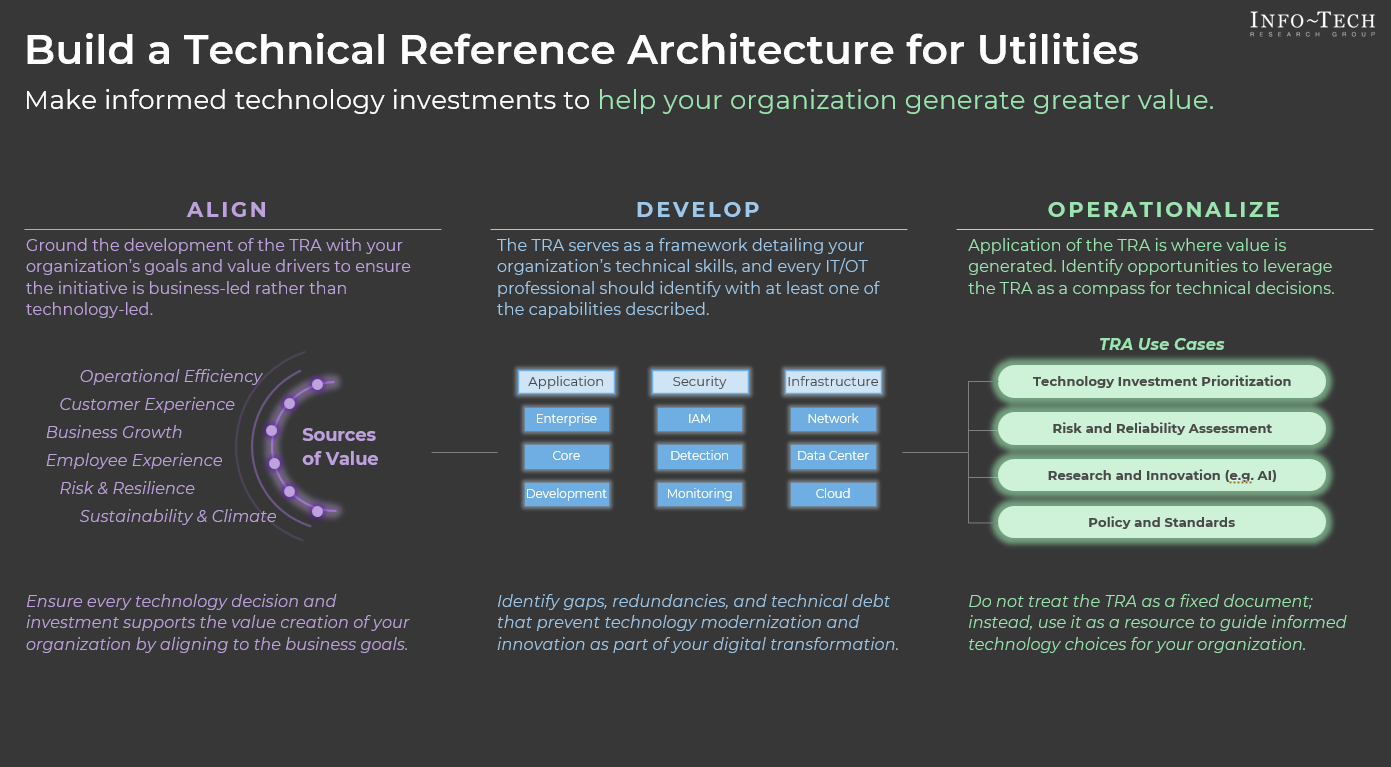
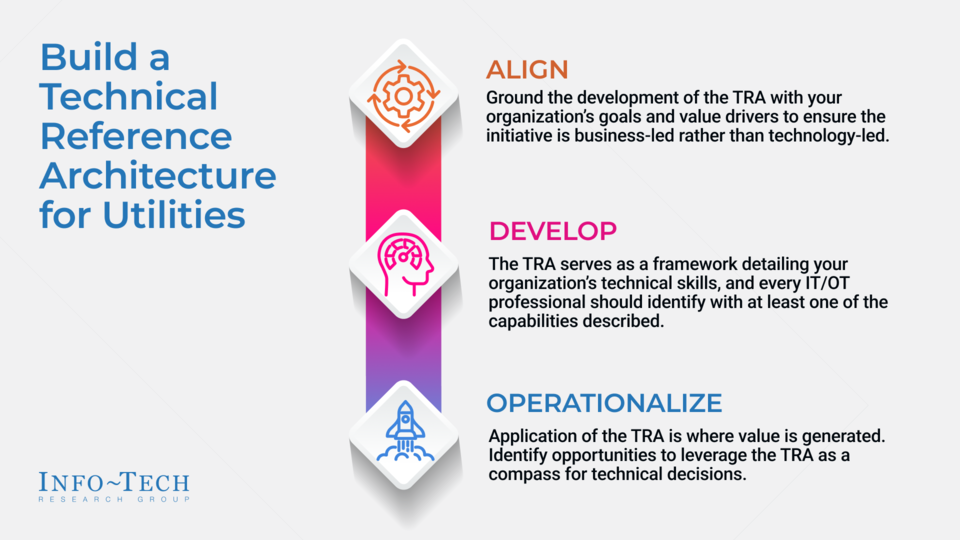
Align, develop, operationalize
|
Phase 1: |
Phase 2: |
Phase 3: |
|
|---|---|---|---|
|
Objectives |
Use the business reference architecture to define the organization’s value streams and supporting capabilities. This is a prerequisite to mapping the technical capabilities of your organization. |
Develop the technical reference architecture by mapping all technical capabilities, both existing and aspirational, supporting the applicable business capabilities outlined in Phase 1. |
Activate the TRA as a tool to make informed decisions across various areas of technology (e.g. risk and resilience, AI investments, standards and policies). |
|
Activities |
|
|
|
|
Outcomes |
Clear line of sight to the organization’s value stream, goals, and business capabilities. The BRA determines what capabilities the business needs, while the TRA provides how technology achieves those needs. |
Documented tool indicating current-state technical capabilities, existing gaps, and areas of redundancy to support the organization’s technological roadmap |
List of use cases that can be leveraged by the TRA to ensure it is not a static document but rather a tool embedded in the technology decision-making process. |
Before you proceed
Connect your business and technical reference architectures
Complete a BRA before the TRA. The BRA defines what a business does to enable value creation rather than how. The TRA, on the other hand, describes how the organization’s technology environment is structured to support those business capabilities. Without knowing what the organization does and why, you cannot answer the how.
|
Business Reference Architecture |
Technical Reference Architecture |
|
|---|---|---|
|
Primary Focus |
Describes what the organization does and why through business functions, capabilities, and value streams. |
Describes how the organization’s technology environment is structured to support those business capabilities. |
|
Goal |
Align business operations, capabilities, and strategy across the organization. |
Support the definition of consistent technology standards, integration patterns, and deployment models across IT/OT. |
|
Audience |
Executives, business architects, planners, operations leaders |
Solution architects, IT architects, infrastructure, security and data teams |
|
Scope |
Enterprise-wide business model |
Technology landscape |
|
Outputs Supported |
|
|
|
Example: Asset Management |
Defines how Planning & Engineering supports reliability and regulatory goals with capabilities like Asset and Work Management. |
Defines what systems (EAM, GIS) and integration patterns (APIs, ESBs) are required to enable those capabilities. |
Download Info-Tech’s Utilities Industry Business Reference Architecture.
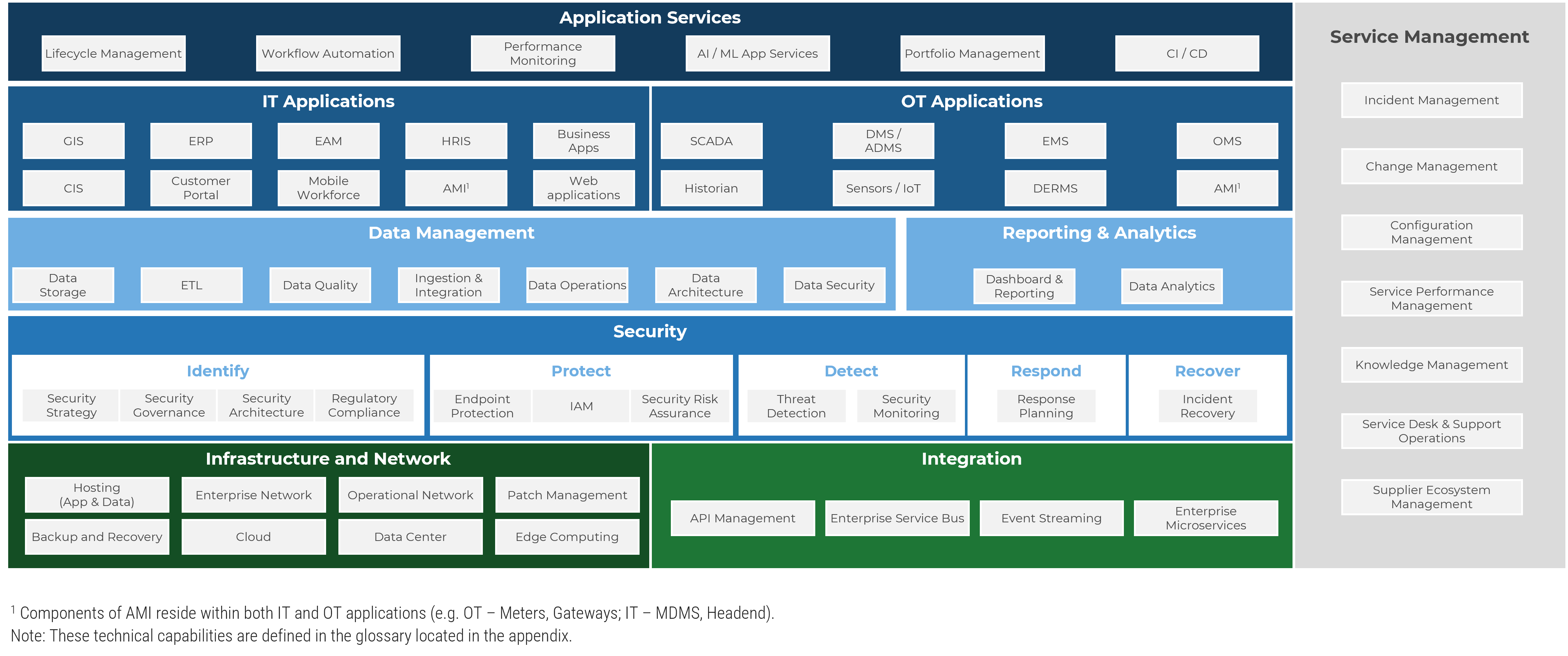
Technical Reference Architecture for Electricity and Natural Gas Utilities
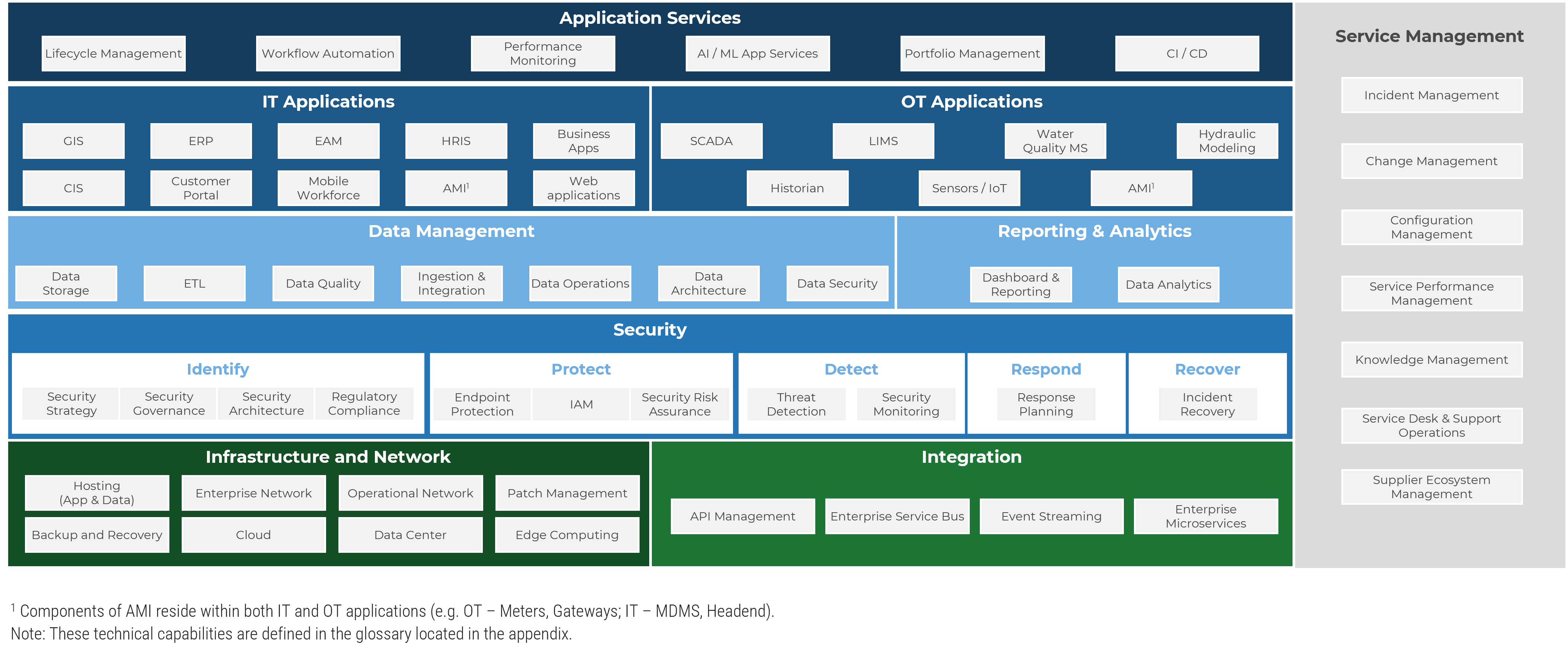
Technical Reference Architecture for Water and Wastewater Utilities
Insight summary
To achieve resilience and strategic innovation, a unifying TRA must be in place to support technology advancement.
The pace of innovation within utilities is at an all-time high. Complex pressures from regulators, customers, government, and the changing demand landscape are forcing utilities to digitally transform. A TRA can provide strategic support for your organization’s technology and skills investments.
Drive business value through technical capabilities.
Your organization’s technical capabilities need to align with business capabilities to drive value for your organization; otherwise the capabilities should not exist. Aligning your TRA to the BRA ensures capabilities are directly supporting value creation.
Map technical capabilities to the organization’s reality.
Efficiency is achieved when everything your organization does is intended to drive value – this is true for your technical capabilities as well. Every technical capability should be the remit of at least one individual in the organization.
The TRA should be a living document – use it to make decisions.
It is easy for organizations to fall into the trap of completing the TRA and then leaving it as a static document. The TRA is much more than that and can be leveraged to make informed decisions about investments, resource planning, and risk identification.
Blueprint deliverables
Each step of this blueprint is accompanied by supporting deliverables to help you accomplish your goals.
|
Baseline TRAs for Utilities* |
TRA Heat Maps* |
|---|---|
|
Provides a starting point for you to develop a unique TRA for your organization. Technical capabilities assigned to each layer are captured for a mature utility organization, allowing for customization. |
Prepopulated heat maps that operationalize the TRA to support technical decision-making. Heat maps for IT/OT ownership and market AI investment trends are provided as starting points. Develop other views unique to your organization. |
* Deliverables found within this storyboard
Key deliverable
Technical Capability Maturity Assessment
This Excel tool evaluates your organization’s technical capability maturity gap, redundancies, and technical debt. The outputted heat map is a view of your capabilities risk profile, supporting future initiatives and investments.
Blueprint benefits
|
IT Benefits |
Business Benefits |
|---|---|
|
A TRA benefits IT in the following areas:
|
Advantages created across the business include:
|
Info-Tech Insight
A TRA is not just an IT exercise – it is a business enabler that transforms technology from a cost center into a driver of reliability, innovation, customer value, and business growth.
Measure the value of this blueprint
This blueprint serves as a foundation to optimize your technical capabilities.
The average hourly rate of an enterprise architect in the United States is US$100 (Coursera, 2025). This blueprint is designed to help your organization develop a technical reference architecture in five days and could save your EA team US$28,000 worth of effort.
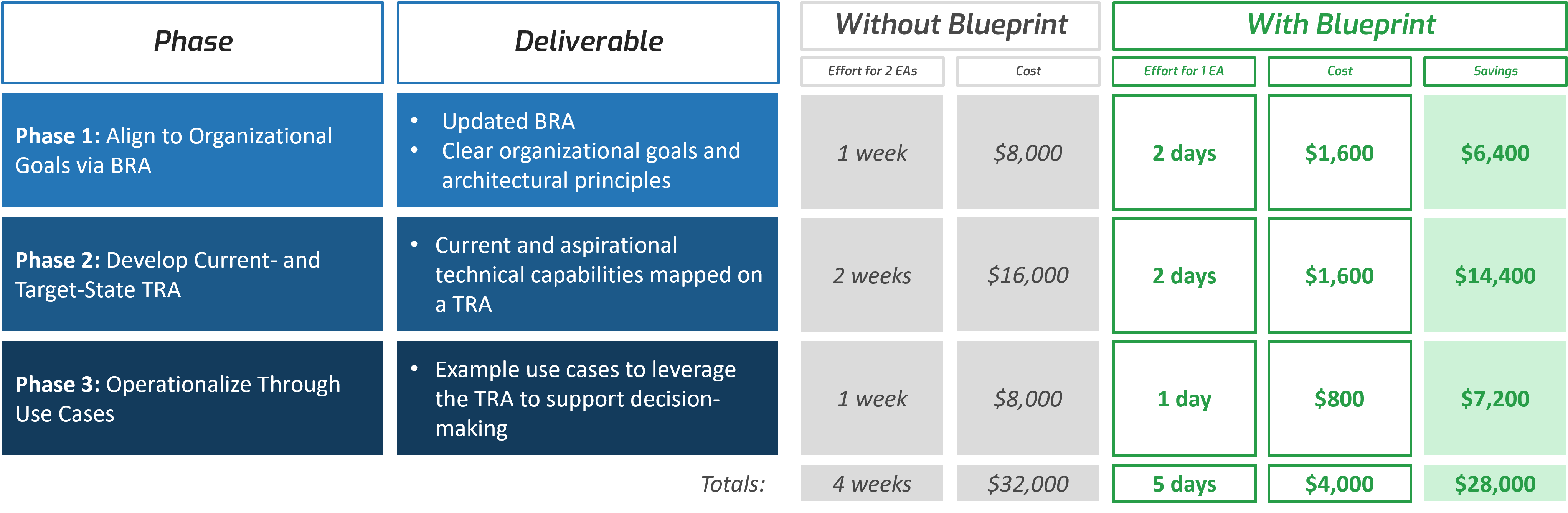
Info-Tech offers various levels of support to best suit your needs
| DIY Toolkit | Guided Implementation | Workshop | Executive & Technical Counseling | Consulting |
|---|---|---|---|---|
| "Our team has already made this critical project a priority, and we have the time and capability, but some guidance along the way would be helpful." | "Our team knows that we need to fix a process, but we need assistance to determine where to focus. Some check-ins along the way would help keep us on track." | "We need to hit the ground running and get this project kicked off immediately. Our team has the ability to take this over once we get a framework and strategy in place." | "Our team and processes are maturing; however, to expedite the journey we'll need a seasoned practitioner to coach and validate approaches, deliverables, and opportunities." | "Our team does not have the time or the knowledge to take this project on. We need assistance through the entirety of this project." |
Diagnostics and consistent frameworks are used throughout all five options.
Guided Implementation
What does a typical GI on this topic look like?
| Phase 1: Align to Organizational Goals via BRA | Phase 2: Develop Current- and Target-State Technical Capability Maps | Phase 3: Operationalize the TRA Through Use Cases |
|---|---|---|
|
Call #1: Call #2: |
Call #3: Call #4: |
Call #5: Call #6: |
A Guided Implementation (GI) is a series of calls with an Info-Tech analyst to help implement our best practices in your organization.
A typical GI is 4 to 6 calls over the course of 6 months.
Workshop overview
Contact your account representative for more information.
workshops@infotech.com 1-888-670-8889
|
Day 1 |
Day 2 |
Day 3 |
Day 4 |
|
|---|---|---|---|---|
|
Review Business Reference Architecture |
Design Technical Reference Architecture |
Assess Gaps, Redundancy, and Technical Debt |
Embed TRA Into Existing Workflows |
|
|
Activities |
1.1 Review organizational value streams, goals, and sources of value. 1.2 Assess BRA and the connection to technical capabilities. 1.3 Establish a set of architectural principles to guide the TRA development. |
2.1 Identify existing technical capabilities (Level 1 and Level 2). 2.2 Explore aspirational capabilities to enable in the future. |
3.1 Determine where there are capability gaps, highlighting at-risk capabilities. 3.2 Identify redundancies in business and technical capabilities, revising the TRA and BRA if necessary. 3.3 Chart initiatives to reduce technical debt in the future. |
4.1 Operationalize the TRA by embedding it in existing workflows and use cases (where applicable). 4.2 Integrate TRA in existing architectural governance processes. |
|
Deliverables |
|
|
|
|
Case Study
Implementing TRAs for electric grid cybersecurity
|
Challenge |
The electric energy sector faces a significant challenge in achieving consistent and robust cybersecurity across its operational technology (OT) and industrial control systems (ICSs). Even though there are over 60 cybersecurity standards applicable to the electrical grid, there are still gaps corresponding to various areas of the grid that may not be addressed. Key challenges include:
|
|---|---|
|
Solution |
The Department of Energy proposed a reference architecture for OT that would establish a common architecture communication platform to guide and constrain the customization of multiple architectures and solutions. The reference architecture:
|
|
Impact |
The reference architecture is used to:
|
Organization:
U.S. Department of Energy
Industry:
Electricity Utility
Sources:
U.S. Department of Energy, 2022
“Reference architectures are sets of documents that provide templates for the design or upgrade of systems in a variety of domains. If system designers work within a reference architecture, they are not starting from scratch.”
– U.S. Department of Energy, 2022
Case Study
TRA in Action: Duke Energy’s advanced distribution grid planning
Challenge | Duke Energy faced mounting operational and planning complexity due to:
|
|---|---|
Solution | Duke Energy implemented a layered TRA (built on AWS), connecting operational and enterprise systems through standardized data, integration, and analytic patterns. Key layers captured in the TRA included:
|
Impact | The reference architecture became a foundational document to support Duke Energy’s journey to grid distribution through:
|
Organization:
Duke Energy
Industry:
Electric & Gas Utility
Sources:
AWS, 2024; Duke Energy, 2022
“ [Grid forecasting] used to take ... Duke Energy around six weeks using traditional IT hardware. But just over a year into a partnership with ... AWS, the utility is running those same simulations in a matter of hours. In the next few years, it expects that timeline to narrow to around 15 minutes.”
– Latitude Media, 2024
About Info-Tech
Info-Tech Research Group is the world’s fastest-growing information technology research and advisory company, proudly serving over 30,000 IT professionals.
We produce unbiased and highly relevant research to help CIOs and IT leaders make strategic, timely, and well-informed decisions. We partner closely with IT teams to provide everything they need, from actionable tools to analyst guidance, ensuring they deliver measurable results for their organizations.
What Is a Blueprint?
A blueprint is designed to be a roadmap, containing a methodology and the tools and templates you need to solve your IT problems.
Each blueprint can be accompanied by a Guided Implementation that provides you access to our world-class analysts to help you get through the project.
Need Extra Help?
Speak With An Analyst
Get the help you need in this 3-phase advisory process. You'll receive multiple touchpoints with our researchers, all included in your membership.
Guided Implementation 1: Align to Organizational Goals via BRA
- Call 1: Review your organization’s goals and value stream.
- Call 2: Review the BRA and discuss where the technical and business capabilities align.
Guided Implementation 2: Develop Current- and Target-State Technical Capability Maps
- Call 1: Identify current and aspirational technical capabilities across each layer.
- Call 2: Assess any gaps, redundancies, and technical debts to consider for initiatives.
Guided Implementation 3: Operationalize the TRA Through Use Cases
- Call 1: Walk through key use cases for the TRA.
- Call 2: Embed architectural governance processes – leveraging the BRA processes.
Contributors
- Amy Meger, Platte River Power Authority, Sr. Information and Cyber Governance Manager
