
Assess and Prioritize Agentic AI Use Cases in Utilities
Turn AI agents from ideas to pilots by balancing risk, impact, and business realities.
Utility leaders struggle with determining where autonomy is appropriate given constraints in regulations, safety, and accountability. AI agents introduce new cyber, compliance, and governance risks that CIOs must proactively manage and extend beyond just the automation itself. Agents are treated as binary rather than a scale based on criteria such as risk, which limits opportunities.
Our Advice
Critical Insight
Utilities are implementing agents, starting with back-office functions where consequences of incorrect decisions are less severe, reversible, and can instill human-in-the-loop.
Impact and Result
- AI agents are designed to directly support business capabilities and drive organizational value.
- Defined processes compare agent value and implementation feasibility.
- Alignment of an organization’s risk appetite supports agentic automation.
Assess-and-Prioritize-Agentic-AI-Use-Cases-in-Utilities
Turn AI agents from ideas to pilots by balancing risk, impact, and business realities.
Analyst perspective
Stay ahead of the agentic AI curve in utilities.
Utility technology leaders have moved beyond debating whether agentic AI has value; the question now is where and how to deploy it responsibly. In the utilities sector, where operational constraints and regulatory constraints demand near-zero tolerance for error, this autonomy introduces both transformative opportunity and heightened risk.
Real-world agentic AI use cases in utilities are emerging fast. Globally, 82% of organizations plan to deploy autonomous AI agents within one to three years (World Economic Forum, 2025). However, adoption is cautious. 55% of energy executives cite ethical concerns as the top barrier to agentic AI implementation, and 60% worry about transparency and accountability when AI makes operational decisions (KPMG, 2025). The challenge is determining which AI use cases align with safety-critical operations and which expose the organization to unacceptable risk.
This research provides a structured methodology to help utility CIOs brainstorm and evaluate agentic AI use cases by considering business value, implementation feasibility, level of autonomy, and associated risks from a utility landscape. An agentic AI use case library for Electric, Natural Gas, and Water & Wastewater is also included to provide a view of the emerging agentic AI use cases. The goal of this research is to help utilities move confidently from hype to disciplined agentic AI adoption, ensuring autonomous systems enhance, not jeopardize, grid reliability, water safety, and public trust.

Bevin Chau
Research Director
Utilities, Industry Practice
Info-Tech Research Group
Executive summary
Your Challenge |
Common Obstacles |
Info-Tech’s Approach |
|---|---|---|
|
Many utilities face common obstacles when implementing agentic AI due to the novelty of the technology. Research has shown the most common obstacles revolve around:
|
|
Info-Tech Insight
Utility technology leaders are beyond speculating the value agentic AI can bring for their organization. The challenge now lies in execution; CIOs are seeking clear guidance on how to implement AI agents safely, at scale, and in alignment with regulatory and reliability mandates.
Your challenge
Regulatory and compliance requirements constrain agentic AI implementation:
47% of energy sector CEOs cited regulatory complexity as a key factor hindering AI adoption (KPMG, 2025). Utilities must ensure agentic AI processes conform with the stringent regulations from grid reliability to cybersecurity (e.g. NERC CIP, EU AI Act, or pending US Guidelines).
Integrate trust in agents poses a steep task for both operators and stakeholders:
74% of utility executives believe that agentic AI’s full potential can only be realized when it is built on a foundation of trust (Accenture, 2025). Unlike traditional software, AI agents can behave in nondeterministic ways and create risks in a culture of safe, critical operations.
Human-machine teaming is a critical requirement and a challenge for utility AI agents:
NERC guidelines highlight that operators should remain the ultimate decision authority and that AI systems must be designed to augment rather than replace human judgement. Achieving this balance is challenging in practice.
Source: NERC, 2024
47% of energy sector CEOs say regulatory complexity is slowing AI adoption.
74% of utility executives believe trust is foundational to the success of AI agents.
Common Obstacles
Research across consulting firms all point to the same obstacles when implementing agentic, and AI more broadly, for utility organizations. A 2025 survey for CEOs in Energy, Natural Resources, and Chemicals conducted by KPMG indicated the following as the top obstacles for AI adoption:
Ethical Challenges: Biases, transparency, and data privacy risks were cited as the number one obstacle (55% of respondents). For example, outage prioritization or rate design could unintentionally disadvantage certain communities or grid optimization models lacking transparency may not have justification for regulators and customers.
Data Readiness: Utilities often struggle with fragmented, poor quality, or siloed data across systems (e.g. SCADA, GIS, EAM) which limits agentic AI effectiveness and constrains use cases to single agentic processes (49% of respondents). Inconsistent data standards across the organization create an obstacle to train reliable AI models or scale use cases enterprise-wide.
Lack of Regulation: The absence of clear, consistent AI regulations creates uncertainty around compliance, accountability, and risk especially in utilities where decisions affect public safety and pricing (47% of respondents). For example, utilities may hesitate to deploy AI in grid control or customer billing because it is unclear how regulators will evaluate AI-driven decisions, audit algorithms, or assign liability.
Source: KPMG, 2025
Info-Tech’s Approach
Our approach helps your organization bridge the gap between agentic AI selection to implementation.
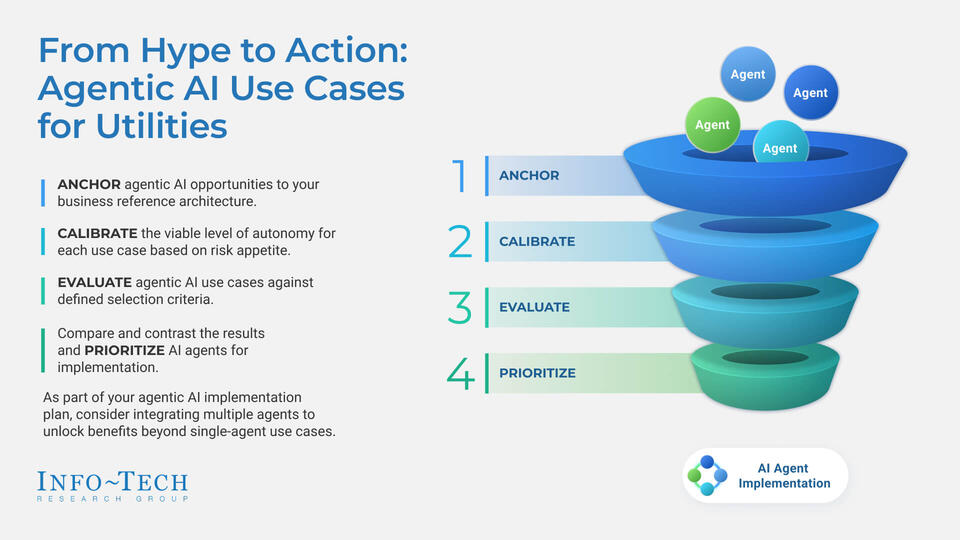
Anchor Agentic AI Opportunities to Utility Capabilities: Identify candidate agentic AI use cases by mapping them to the utility business reference architecture (e.g. grid operations, water network management, customer engagement). This ensures sector-specific opportunities and business context are considered.
Define the Autonomy vs. Risk Model: Instead of viewing AI agents as binary (manual vs. fully automation), the model helps determine the appropriate level of autonomy and the risk factors associated (e.g. operational, revisability, data sensitivity). The model can be leveraged to justify the acceptable level of autonomy for a given use case.
Apply Autonomy vs. Risk Model to Agentic AI Use Case Library: Determine the autonomy and risk appetite of your organization and apply them to the agentic AI use cases. Organizations should prioritize opportunities where decisions are easier to detect, isolate, and reverse.
Apply Use Case Selection Criteria for Prioritization: Compare and contrast identified agentic AI use cases to determine their business impact and implementation feasibility. Having a holistic view supports justifying your agentic AI implementation roadmap.
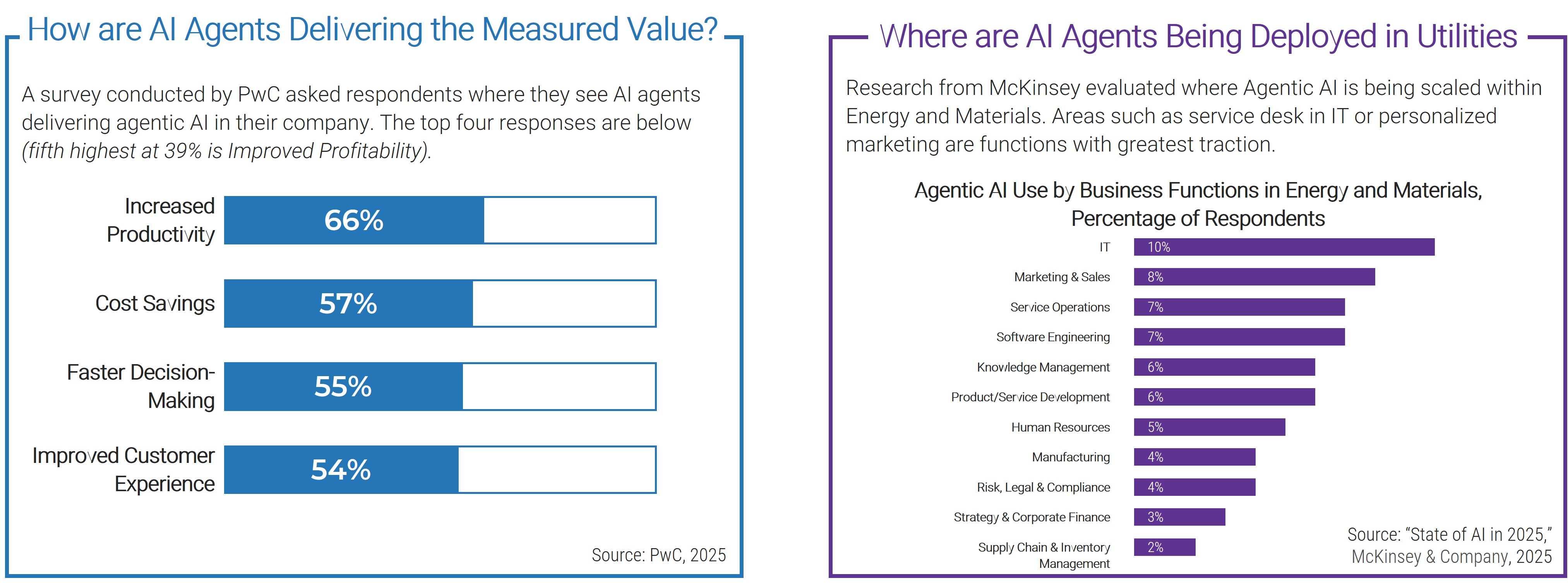
Select AI agents in proven areas
Consider prioritizing AI Agents proven to generate the most value for organizations.
Info-Tech Insight
Begin deploying agents in business functions where incorrect decisions are easier to detect, reverse, and carry lower risk (e.g. service desk, personalized marketing). Focus on internal value drivers, ensuring value can be tracked during implementation.
Assess the capability patterns for your AI agents
Agentic AI typically falls under four capability patterns. Clearly define the pattern for each use case or agent to help with the design and intended outcomes.
Data Processing Extract, classify, validate, and structure data from documents or other unstructured inputs.
|
Decision Support Gather information from multiple systems, perform analysis, and generate insights.
|
Monitoring & Alerting Continuously scan inputs and detect issues, trigger alerts, and follow-up tasks.
|
Triage & Orchestration Classify incoming requests, understand intent, and route work to the correct workflow or system.
|
Evaluate the agentic maturity fit for you
Breaking down the difference in agentic concepts.
Automation System |
Robotic Process Automation (RPA) |
Intelligent Automation (RPA + AI/ML) |
Single AI Agents |
Multi-Agent Systems |
Domain-Level Agentic Systems |
Cross-Functional Agentic Systems |
|---|---|---|---|---|---|---|
Definition |
Scripted bots that mimic human actions in structured, repetitive workflows, no learning, and relies on predefined rules. |
Adds AI to handle unstructured inputs and simple decisioning. Largely workflow-driven, but can classify, extract, and route. |
Interpret goals, reason within a bounded scope, and execute multi-step tasks via tools/APIs. |
Multiple Agents working together to solve more complex problems through coordination and task decomposition. Agents help do the work. |
AI systems that manage and optimize an entire process within a specific domain, integrating data, analytics, and execution. Agents own the work. |
Ecosystem of agents operating across business functions to autonomously execute and optimize processes. Agents run the business. |
Primary Benefits |
|
|
|
|
|
|
Key Constraints |
|
|
|
|
|
|
Utility Examples |
Automating billing data transfer between CIS and ERP systems |
Extracting customer email requests and routing to appropriate teams |
Customer agent resolving billing inquiries end-to-end (issue handling and correction) |
Outage response agents predict outage scope and triggers corrective response |
Predictive maintenance system monitors equipment health and schedules maintenance |
Storm response integrates weather data, grid ops, crew logistics to manage restoration efforts |
From Hype to Action: Agentic AI Use Cases for Utilities
Utilities are starting to implement AI agents with low-risk autonomy, focusing on integrating agents in a safe, reliable, and controllable manner.
Problem:
Utility technology leaders recognize the value of agentic AI but are limited by a structured approach for implementation.
Challenges:
- New challenges in governance, compliance, and cyber are introduced with AI agents
- Organizations need to shift the mindset by viewing agents as binary (manual vs. automation)
- Hesitation is created by the lack of regulatory guidance
Solution:
A structured approach to turn agentic AI ideas into actual implementation projects.
Benefits:
- AI agents support business capabilities driving organizational value
- Defined process to compare agent value and implementation feasibility
- Understand your organization’s appetite for automation vs. risk
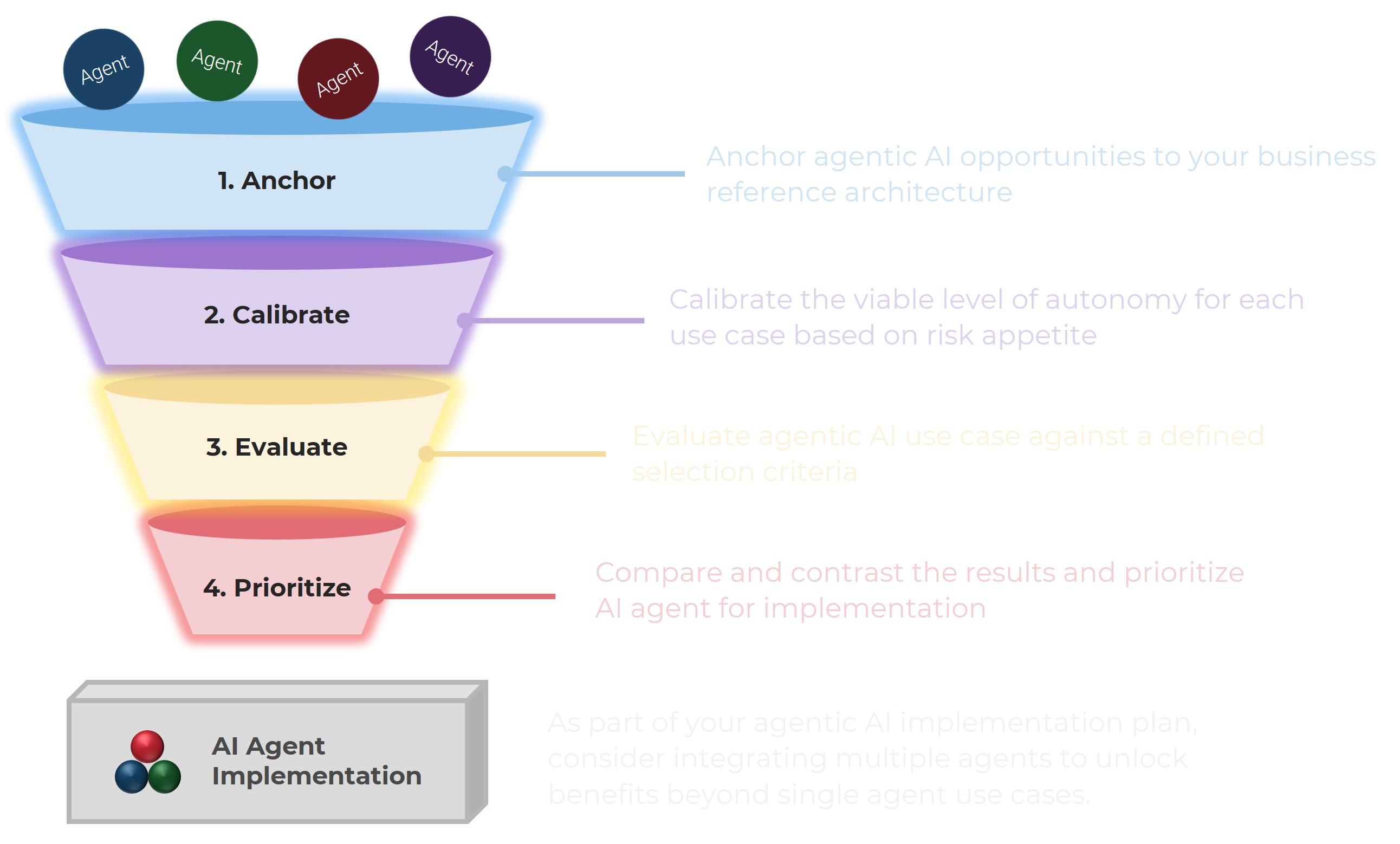
Info-Tech’s methodology to turn agentic AI from ideas to initiatives for utilities
1. Anchor |
2. Calibrate |
3. Evaluate |
4. Prioritize |
|
|---|---|---|---|---|
Phase Steps |
|
|
|
|
Phase Outcomes |
Gain a shared understanding of agentic AI and where it could create value in the organization. This ensures agentic AI are designed to drive business value and uncovers opportunities that matter most for the business. |
Autonomy of AI agents is right-sized based on their risk profiles to ensure they are designed safely. Guardrails are put in place to help justify the level of autonomy versus risk exposure. |
Quantify the business impact and feasibility of agentic AI use cases, allowing the organization to identify a curated list of agents that reflect real operational constraints. |
Agentic AI use cases are no longer ideas, but initiatives the organization can prioritize to start piloting and experimenting having completed the due diligence required. |
Blueprint Deliverables
Each step of this blueprint is accompanied by supporting deliverables/tools to help you accomplish your goals.
Agentic AI Use Case Tool for Utilities
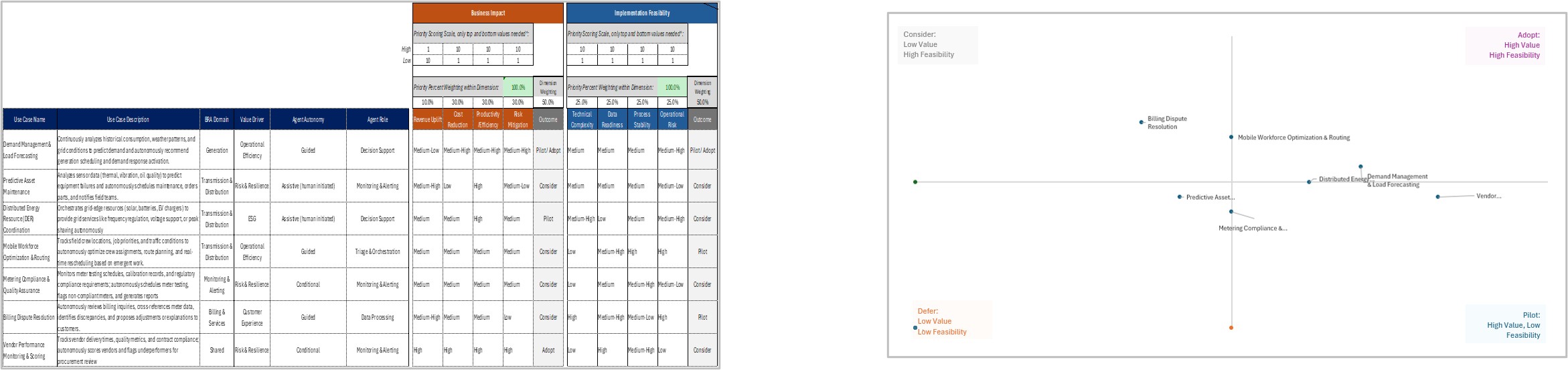
The use case evaluation tool will be used across each of the four phases of the research. Each phase is designed to help complete and set up the tool, leading up to the evaluation and prioritization of the use cases.
Before you proceed:
Download the Agentic AI Use Case Tool for Utilities to help facilitate the activities across the different phases:
- Phase 1: Document Use Cases
- Phase 2: Document Appropriate Autonomy Level
- Phase 3: Define Evaluation Criteria and Apply to Use Cases
- Phase 4: Review Results and Prioritize Use Cases
Blueprint Benefits
IT Benefits |
Business Benefits |
|---|---|
|
|
Insight summary
Agentic AI Success Depends on Incremental Development
Multi-agent, domain-level, and cross-functional agentic systems are built upon single agents developed through a strategic sequential manner. Start with single agents, expanding incrementally to carry out more complex tasks.
View Autonomy as a Spectrum
Autonomy is more than a binary choice, but rather a spectrum where level of automation and risk are directly proportional. Assess the desired level of automation and risk for each scenario to inform the end objective of the agent.
Start With Low-Risk Business Capabilities
Many utilities are implementing agents in back-office functions and rightfully so. The consequences of incorrect decisions are reversible, less severe, and can instill human-in-the-loop. This approach also builds a foundation of trust before agents are deployed in areas like operations.
Data, Governance & Security is Critical
Data readiness, governance controls, and cybersecurity controls are critical in the success of AI agents and should scale up in intensity with higher autonomy as higher risk agents are being deployed (e.g. grid operations, customer billing).
Track ROI & Value
Ensure value and ROI of agentic use cases are tracked. Boards and executives are demanding quantitative numbers to justify investments.
Implement Pilot Stage-Gates
A gating process determines whether a pilot should scale, constrain, or stop to ensure capital flows to agents that survive production realities.
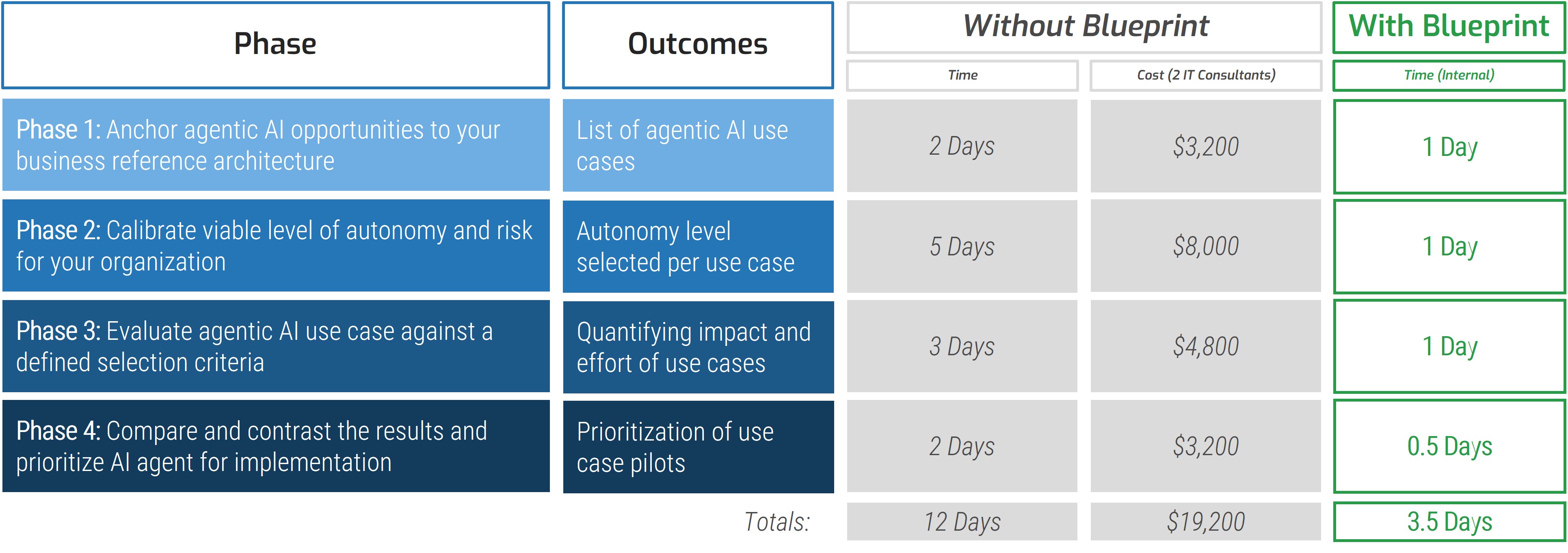
Measure the value of this blueprint
Turn your AI agents from ideas into pilots.
The average hourly rate of an IT consultant in the United States is US$100 to $250 per hour (MOR, 2025). This blueprint is designed to help your organization accelerate the selection of agentic AI use cases by providing a methodology and tools for use case evaluation. Assuming the scope of work outlined in this blueprint is conducted by a third-party consultant, it will conservatively save $19,200 in consulting fees and reduce the time needed by 8.5 days.
Guided Implementation
What does a typical GI on this topic look like?
| Phase 1: Anchor | Phase 2: Access Viability | Phase 3: Evaluate | Phase 4: Prioritize |
|---|---|---|---|
Call #1: Review the business capability map and value streams. Call #2: Identify domains where agentic AI may create value. |
Call #3: Determine your organization’s autonomy and risk tolerance. Call #4: Apply autonomy and risk model to identified use cases. |
Call #5: Define use case evaluation criteria. Call #6: Evaluate use case value and feasibility. |
Call #7: Prioritize use case based on risk, value, and readiness. Call #8: Develop a sequenced implementation roadmap. |
A Guided Implementation (GI) is a series of calls with an Info-Tech analyst to help implement our best practices in your organization.
A typical GI is 8 to 12 calls over the course of 4 to 6 months.
Info-Tech offers various levels of support to best suit your needs
| DIY Toolkit | Guided Implementation | Workshop | Executive & Technical Counseling | Consulting |
|---|---|---|---|---|
| "Our team has already made this critical project a priority, and we have the time and capability, but some guidance along the way would be helpful." | "Our team knows that we need to fix a process, but we need assistance to determine where to focus. Some check-ins along the way would help keep us on track." | "We need to hit the ground running and get this project kicked off immediately. Our team has the ability to take this over once we get a framework and strategy in place." | "Our team and processes are maturing; however, to expedite the journey we'll need a seasoned practitioner to coach and validate approaches, deliverables, and opportunities." | "Our team does not have the time or the knowledge to take this project on. We need assistance through the entirety of this project." |
Diagnostics and consistent frameworks are used throughout all five options.
Workshop Overview
Contact your account representative for more information.
workshops@infotech.com 1-888-670-8889
| Day 1 | Day 2 | Day 3 | Day 4 | |
|---|---|---|---|---|
Agentic AI Foundations and Business Alignment |
Calibrate Use Case Autonomy Level Depending on Risk |
Evaluate Use Case Value and Feasibility |
Prioritize Initiatives and Build Roadmap |
|
Activities |
1.1 Introduce research, framework, and purpose of workshop 1.2 Discuss business context and agentic AI strategy 1.3 Review the business reference architecture and identify agentic AI opportunities |
2.1 Brainstorm list of agentic AI use cases across business capabilities 2.2 Design the autonomy vs. risk model 2.3 Apply autonomy vs. risk model to use cases to select appropriate autonomy level |
3.1 Define the value and feasibility metric for use case evaluation 3.2 Evaluate the identified use cases 3.2 Determine high-level solutioning of each use case (e.g. level of autonomy, agent patterns) |
4.1 Plot use cases on 2x2 decision matrix 4.2 Define a phased implementation roadmap for selected use cases; identify ownership and next steps for pilots |
Outcomes |
|
|
|
|
Assess risk associated with agentic AI
Agentification of utility processes carries risks. CIOs must justify the level of autonomy and the risk exposure for each AI agent.
Operational Criticality |
Safety and Regulatory |
Data Privacy |
Reversibility of Action |
Financial Impact |
|---|---|---|---|---|
|
|
|
|
|
Info-Tech Insight
Autonomy of AI agents must be right-sized to minimize the risk exposure. High-impact use cases with high levels of automation do not justify high-risk exposure. Assessing the risks ensures operational realities, safety constraints, and data privacy are accounted for before prioritizing economic benefits.
CASE STUDY
Automating safety audits using AI agents
INDUSTRY: Electric Utility, Renewables
SOURCE: Anthropic/Claude
Global energy company that generates and distributes electricity across 15 countries and owns and operates power plants with a focus in renewables.
Challenge |
Solution |
Results |
|---|---|---|
With the expansion and growth of renewable power-generating assets, safety audits continue to grow as an insurmountable task. A single wind farm could have as many as 75 separate turbines, a dramatic increase compared to a traditional single-turbine power plant. This led to a significant increase in the volume of internal safety audits, which were time-consuming, taking up to two weeks to complete. This process was a major drain on company resources and was performed by employees who were not dedicated auditors, making it inefficient. |
AES partnered with Anthropic and Google Cloud to develop a multi-agent system to dissect the audit process into simpler tasks. The three agents created were:
The system automated the entire safety audit process, leveraging Anthropic and Google’s enterprise grade security, speed, and accuracy for handling sensitive audit data. |
|
About Info-Tech
Info-Tech Research Group is the world’s fastest-growing information technology research and advisory company, proudly serving over 30,000 IT professionals.
We produce unbiased and highly relevant research to help CIOs and IT leaders make strategic, timely, and well-informed decisions. We partner closely with IT teams to provide everything they need, from actionable tools to analyst guidance, ensuring they deliver measurable results for their organizations.
What Is a Blueprint?
A blueprint is designed to be a roadmap, containing a methodology and the tools and templates you need to solve your IT problems.
Each blueprint can be accompanied by a Guided Implementation that provides you access to our world-class analysts to help you get through the project.
Need Extra Help?
Speak With An Analyst
Get the help you need in this 4-phase advisory process. You'll receive multiple touchpoints with our researchers, all included in your membership.
Guided Implementation 1: Anchor Agentic AI Use Cases to Business Reference Architecture
- Call 1: Review the business capability map and value streams.
- Call 2: Identify domains where agentic AI may create value.
Guided Implementation 2: Calibrate Automation Level Aligned to Risk Model
- Call 1: Determine your organization’s autonomy and risk tolerance.
- Call 2: Apply autonomy and risk model to identified use cases.
Guided Implementation 3: Evaluate Agentic AI Use Cases Based on Impact and Feasibility
- Call 1: Define use case evaluation criteria.
- Call 2: Evaluate use case value and feasibility.
Guided Implementation 4: Prioritize Use Cases, Turning Agentic AI From Use Cases to Pilots
- Call 1: Prioritize use case based on risk, value, and readiness.
- Call 2: Develop a sequenced implementation roadmap.
Contributors
Two anonymous external contributors.
