
Assess and Prioritize Agentic AI Use Cases in Insurance
Powered by AI, guided by people.
- P&C insurers need to improve speed and efficiency in underwriting and claims without weakening accountability or decision quality.
- Not every insurance decision is appropriate for autonomous execution, making it critical to define where AI can act, recommend, or require human control.
- Poorly governed autonomy can increase pricing, settlement, fairness, documentation, and adverse consumer outcome risk.
- As agentic AI interest grows, insurers face increasing pressure to make informed use case decisions that balance business value, risk exposure and appropriate autonomy across use cases.
Our Advice
Critical Insight
Agentic AI delivers value in P&C insurance only when insurers replace isolated pilots with cross-functional use case prioritization, turning experimentation into governed investment decisions that can scale across underwriting, claims, and other high-impact workflows.
Impact and Result
- Define where agentic AI can act, recommend, or remain human-led across underwriting and claims.
- Align IT, business, risk, and compliance to evaluate and prioritize defensible, high-value use cases.
- Establish governance, oversight, and escalation thresholds so selected use cases can scale responsibly.
Assess and Prioritize Agentic AI Use Cases in P&C Insurance
Powered by AI, guided by people.
Analyst perspective
From technical possibility to governed autonomy.

Property and casualty insurers are under pressure to improve underwriting speed, claims efficiency, and service responsiveness while maintaining strong control over decisions that affect coverage, pricing, fraud handling, and settlements. AI is now moving beyond copilots and narrow task automation toward agentic systems that can coordinate and execute parts of end-to-end workflows.
In P&C insurance, that shift creates a different challenge than in less regulated industries. The question is not simply whether autonomous AI can improve productivity. The question is where autonomous behavior is appropriate inside workflows that carry financial, operational, and consumer consequences. Insurance regulators are increasingly focused on governance, documentation, oversight, and the risk of adverse consumer outcomes from AI-supported decisions.
This research helps insurers define where agentic AI belongs across underwriting and claims, where autonomy should remain constrained, and where human decision authority must stay in place. The objective is to move from experimentation to defensible prioritization grounded in business value, accountability, and insurance-specific governance expectations.
Vidhi Trivedi
Senior Research Analyst, Insurance Industry
Info-Tech Research Group
Executive summary
|
Your Challenge |
Common Obstacles |
Info-Tech’s Approach |
|---|---|---|
|
P&C insurers see real potential in agentic AI, but they need a defensible way to determine where autonomous behavior can operate inside underwriting and claims without increasing consumer, conduct, or regulatory risk.
|
Several structural realities make agentic AI difficult to scale in P&C insurance.
|
When P&C insurers align teams to define practical agentic AI use cases, they reduce decision risk, strengthen accountability, and avoid stalled adoption. Info-Tech helps by aligning teams around practical agentic AI use cases by:
|
Info-Tech Insight
Agentic AI delivers value in P&C insurance only when insurers replace isolated pilots with cross-functional use case prioritization, turning experimentation into governed investment decisions that can scale across underwriting, claims, and other high-impact workflows.
Your challenge
P&C insurers need faster decisions without weakening accountability.
This research is designed to help organizations facing these challenges:
- Underwriting and claims depend on fast, accurate action, but not all decisions are safe to delegate to autonomous systems.
- In P&C insurance, the core challenge is not automation alone. It is deciding where AI can act, where it can recommend, and where humans must retain full authority.
- Poorly governed autonomy can create pricing, settlement, fairness, documentation, and adverse consumer outcome risk.
- Without a practical framework for autonomy boundaries, insurers struggle to move beyond pilots in a way that is scalable and defensible.
Common obstacles
P&C insurers experience fragmentation across implementing agentic AI.
These barriers make agentic AI harder to scale across underwriting and claims:
- Most insurers do not yet have a structured method for separating acceptable autonomy from nondelegable decision authority.
- Core workflow data is fragmented across policy, claims, notes, documents, vendor systems, and human handoffs, which limits reliable orchestration.
- Scaling stalls when AI ambition outpaces governance, business-line ownership, and data readiness.
- In P&C insurance, even technically effective AI can fail if it cannot be explained, monitored, documented, and governed appropriately.
Info-Tech’s approach
A structured agentic AI use case tool helps P&C insurers identify where agentic AI can deliver value, where human oversight is required, and where autonomy introduces unacceptable risk.
How Info-Tech helps insurers make progress:
- Assess where agentic AI belongs in core insurance workflows. A P&C-specific review identifies where autonomous capabilities can improve underwriting and claims processes, and where traditional automation or human-led execution remains more appropriate.
- Apply a defensible evaluation framework to each use case. Info-Tech helps insurers assess use cases against key criteria such as business value, autonomy boundaries, regulatory exposure, consumer risk, and operational feasibility.
- Prioritize high-value use cases with responsible guardrails. A practical prioritization model helps leaders focus investment on use cases that are scalable, governable, and aligned to enterprise risk appetite.
- Support adoption through accountability and oversight. Clear ownership, human-in-the-loop expectations, and governance checkpoints help insurers operationalize agentic AI without weakening control over sensitive decisions.
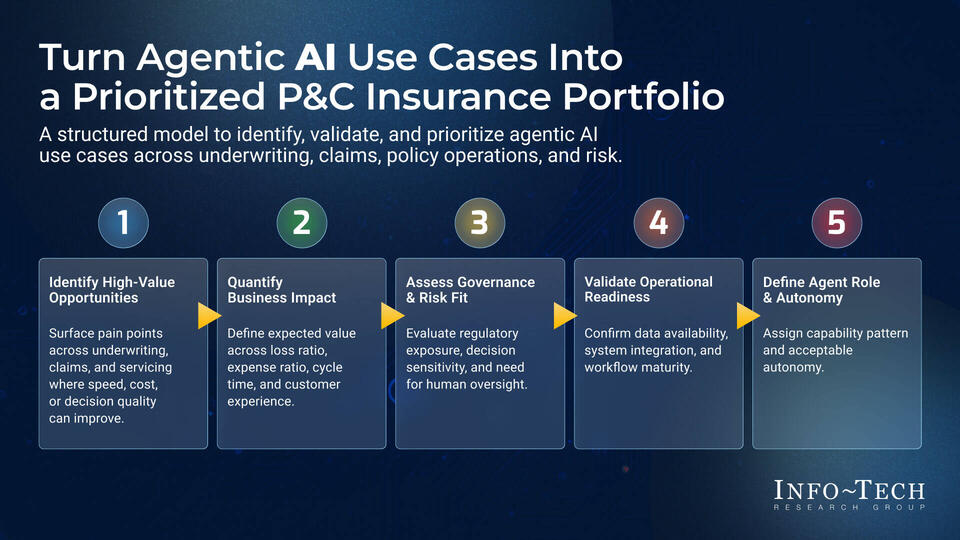
Turn agentic AI use cases into a prioritized P&C insurance portfolio
A structured model to identify, validate, and prioritize agentic AI use cases across underwriting, claims, policy operations, and risk.
Agentic AI Use Case Development
|
1. Identify High-Value Opportunities |
| ↓ |
|
2. Quantify Business Impact |
| ↓ |
|
3. Assess Governance & Risk Fit |
| ↓ |
|
4. Validate Operational Readiness |
| ↓ |
|
5. Define Agent Role & Autonomy |
Challenge
P&C insurers struggle to translate AI potential into measurable business value across underwriting, claims, and servicing.
Fragmented workflows, regulatory constraints, and high-volume operations create risk in adopting autonomous decisioning without a structured evaluation model.
Insight
P&C insurers unlock the most value from agentic AI when use cases are prioritized based on business impact, governance fit, and workflow readiness, not just technical feasibility or automation potential.
Decision Lens for P&C Insurance IT Leaders
- Business value (loss ratio, cost, CX)
- Implementation feasibility (data, systems, integration)
- Governance & risk fit (regulatory, decision sensitivity)
- Operational readiness (workflow maturity)
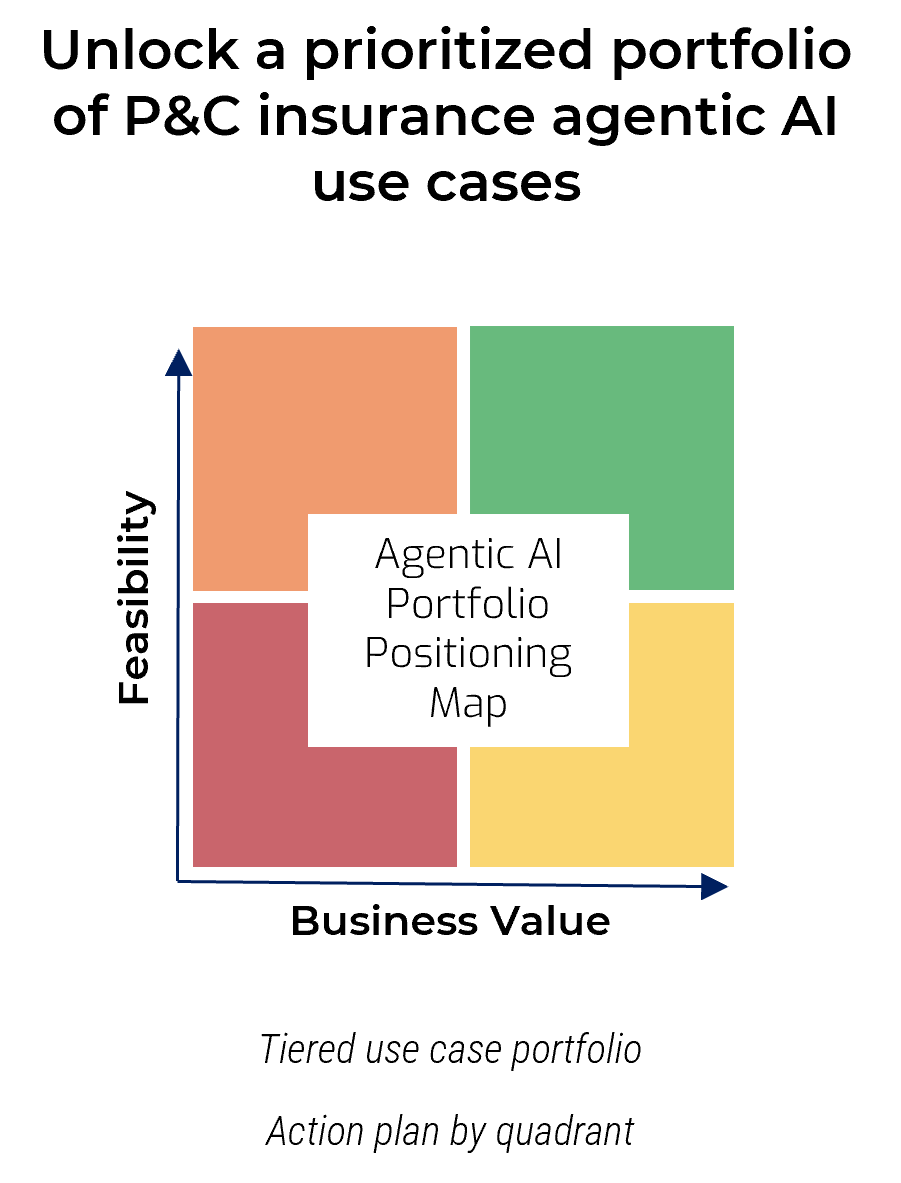
Drive faster, smarter decisions across insurance workflows
Agentic AI enables P&C insurers to shift from manual, fragmented workflows to coordinated, intelligent decisioning, improving speed, consistency, and customer outcomes while maintaining governance and control.
Info-Tech’s Methodology for Assessing Agentic AI Use Cases in P&C Insurance
|
1. Establish Context |
2. Shape the Use Cases |
3. Prioritize Opportunities | |
|---|---|---|---|
|
Phase Steps |
1.1 Establish agentic AI capability patterns 1.2 Explore agentic AI in practice |
2.1 Align AI capability to business context 2.2 Generate agentic AI use cases |
3.1 Score use cases for prioritization 3.2 Validate and confirm the use case portfolio |
|
Phase Outcomes |
A shared understanding of agentic AI concepts, capability patterns, and how they apply to core P&C workflows such as underwriting, claims, fraud, and servicing. |
A structured set of business-aligned agentic AI use cases tied to underwriting and claims priorities, operational needs, and target value areas. |
A prioritized and validated use case portfolio with consensus on the highest-value, most governable opportunities to pursue in P&C insurance. |
Insight summary
Agentic AI Value in P&C Depends on Governance-Led Prioritization
P&C insurers create value when they define where agentic AI can support underwriting and claims, assign clear ownership, and sequence use cases based on business value, risk, and readiness rather than chasing isolated pilots.
Match Autonomy to Decision Risk
Context should determine the right agent design. In P&C insurance, use cases should be classified by the role the agent plays, the decision sensitivity involved, and the level of human accountability required across underwriting, claims, fraud, and servicing.
Pressure-Test Use Cases Early
The best use case is one the business can operationalize. CIOs should assess each idea against business impact, regulatory sensitivity, data readiness, and workflow feasibility to separate viable P&C use cases from experimental concept.
Start Where Trust Can Be Built
Confidence grows through deliberate sequencing. Early wins should come from lower-risk, measurable workflows before expanding into more sensitive decision support. This mirrors how leading insurers are scaling AI from practical use into broader transformation.
Prioritize Fast, Governable Wins
Prioritize use cases where value can be demonstrated quickly, consumer impact is limited, and cross-functional friction is manageable, such as claims FNOL support, document summarization, workflow coordination, and adjuster assist. These use cases are easier to govern than fully autonomous pricing or settlement decisions.
Gate Use Cases by Readiness
Prevent wasted effort by validating each use case against readiness criteria before it enters the portfolio, including data quality, workflow clarity, ownership, escalation design, and governance controls for consumer-impacting outcomes.
Research deliverable
Each step of this research is supported by practical P&C insurance deliverables to help you identify, evaluate, and prioritize agentic AI use cases across underwriting and claims.
Agentic AI Use Case Tool for P&C Insurance
Provides a structured environment to identify and prioritize agentic AI use cases, capture value drivers, assess autonomy boundaries, and build an initial roadmap aligned to underwriting, claims, fraud, and servicing priorities.
Measure the value of this research
Leverage this research’s approach to ensure your AI use cases align with and support your key business drivers and speed time to value
|
With Info-Tech Resources |
Without Info-Tech Resources |
|||
|
Project Steps |
Time |
Average Cost (USD) |
Time |
Rationale |
|
Capability and Strategy Mapping |
0.5–1 day |
$7,500–$10,000 |
3–5 days |
Creation of a reference architecture & facilitation |
|
Use Case Generation |
0.5–1 day |
$5,000–$7,500 |
2–3 days |
Consultant facilitation |
|
Maturity Assessment |
1–2 days |
$5,000–$7,500 |
3–4 days |
Assessment development & facilitation |
|
Use Case Prioritization |
1 day |
$5,000–$7,500 |
2–3 days |
Scoring matrix & facilitation |
|
Effort |
3–5 days |
$22,500–$32,500 |
10–15 days |
|
|
Business Goals |
Key Success Metrics |
|
Operational Efficiency |
Reduce manual effort and cycle times across underwriting, claims intake, policy servicing, billing, renewals, and agent/broker support workflows. |
|
Business Growth |
Increase profitable premium growth, quote-to-bind conversion, retention, cross-sell opportunities, and expansion into target customer segments or distribution channels. |
|
Customer Experience |
Improve policyholder, claimant, agent, and broker experiences through faster quotes, simpler policy servicing, transparent claims updates, and personalized communications. |
|
Employee Experience |
Improve productivity for underwriters, claims adjusters, service representatives, actuaries, and operations teams through automation, decision support, and better access to trusted data. |
|
Risk & Resilience |
Strengthen underwriting discipline, claims accuracy, fraud detection, catastrophe response, regulatory compliance, data privacy, and operational continuity. |
|
ESG |
Support responsible insurance practices by improving climate risk insight, fair and transparent underwriting, ethical AI use, accessibility, and responsible claims and vendor management. |
Project benefits
|
IT Benefits |
Business Benefits |
|---|---|
|
|
Measure the value of this project
Consider tracking the following measures to demonstrate the value of a more structured approach to assessing and prioritizing agentic AI use cases in P&C insurance.
|
Metric |
Expected Improvement |
|
Priority use cases with approved owners |
Greater clarity on which underwriting and claims use cases are sponsored, who owns them, and how they will be governed. |
|
Time spent evaluating new AI use case ideas |
Reduced effort required to assess opportunities because teams use a common framework for value, risk, readiness, and autonomy boundaries. |
|
Use cases progressed from pilot to approved roadmap |
Higher conversion of promising use cases into governed roadmap items rather than stalled experiments. |
|
Documented governance coverage for prioritized use cases |
Fewer control gaps because priority use cases are evaluated for oversight, escalation, auditability, and consumer-impacting risk before implementation. |
|
Confidence in AI prioritization decisions |
Stronger alignment across underwriting, claims, risk, compliance, and IT regarding where agentic AI should be advanced first. |
|
Time to define an initial agentic AI portfolio |
Faster creation of a practical, validated shortlist of use cases tied to measurable value and operational feasibility. |
Build a governed agentic AI portfolio that helps your organization move from experimentation to responsible execution.
Phase 1
Establish Context
Phase 1 | Phase 2 | Phase 3 |
|---|---|---|
1.1 Establish agentic AI capability patterns 1.2 Explore agentic AI in practice | 2.1 Align AI capability to business context 2.2 Generate agentic AI use cases | 3.1 Score use cases for prioritization 3.2 Validate and confirm the use case portfolio |
This phase will walk you through the following activities:
You’ll review your organization’s business goals, key initiatives, and capability maps to anchor AI planning in real supply chain priorities. You’ll explore the purpose and structure of AI use cases to build a common understanding of how they support core processes and systems. Finally, you’ll assess your supply chain value chain and previously identified value drivers to confirm which business needs should guide AI use case development.
This phase involves the following participants:
- AI initiative lead
- CIO
- Other IT leadership
- Senior business executives and managers accountable for AI initiatives
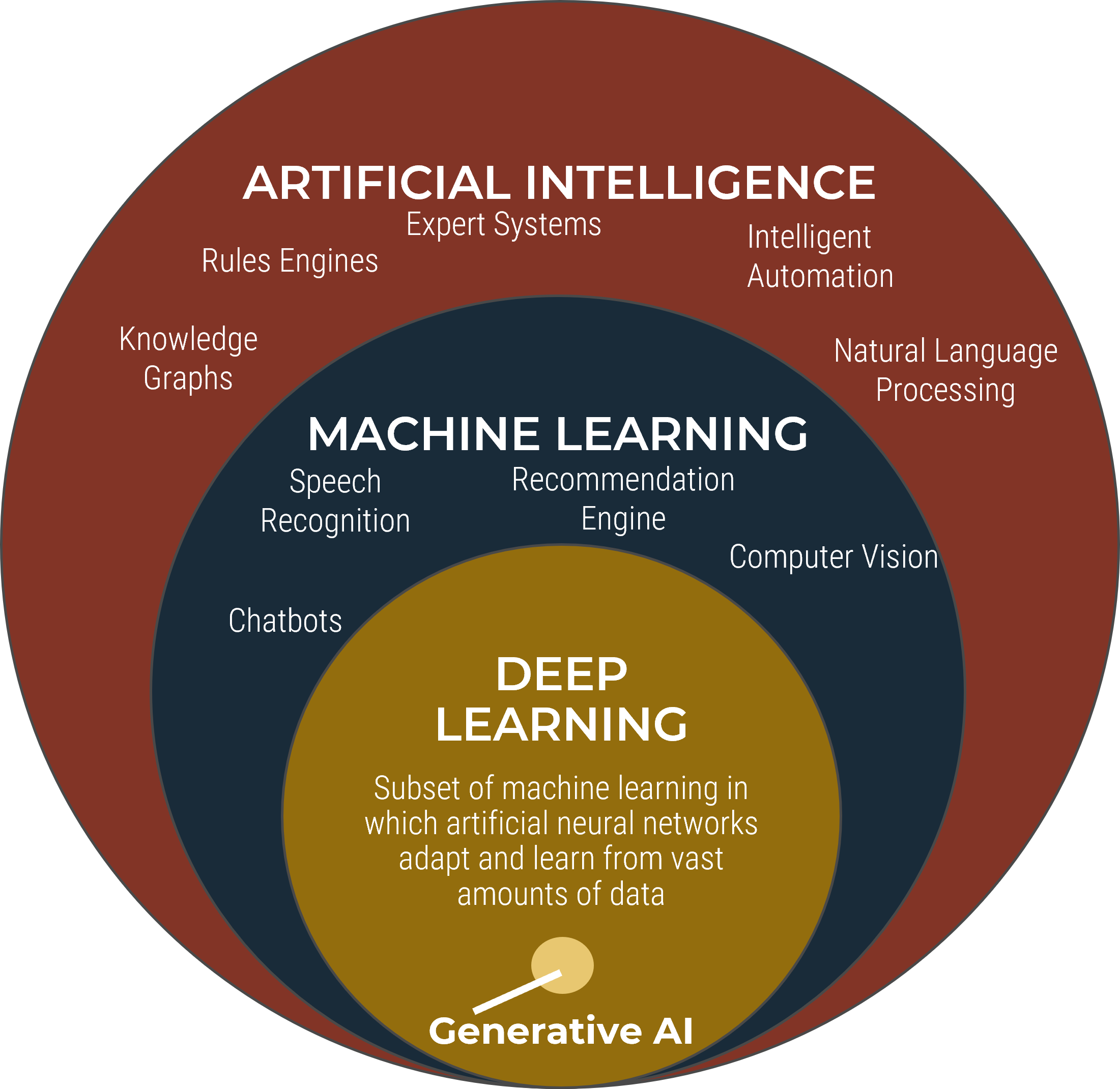
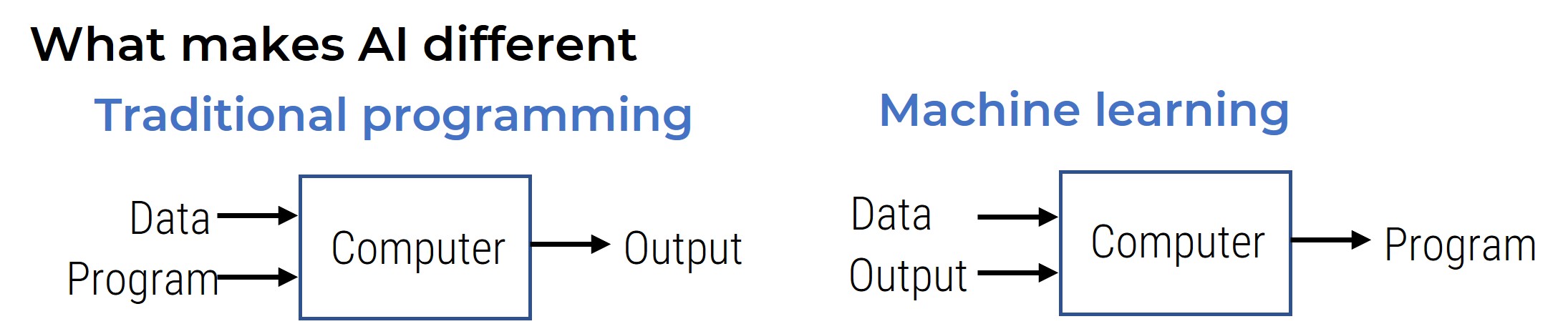
AI is an innovation in machine learning
Artificial Intelligence (AI)
A system that can make predictions, recommendations, or decisions influencing real or virtual environments.
Machine Learning (ML)
Machine learning (ML) is a subset of AI algorithms that parse data, learn from data, and then decide or make predictions.
Generative AI (Gen AI)
A subset of artificial intelligence systems that generate new outputs based on the data the system has been trained on using modalities such as text, audio, visual, and code.
About Info-Tech
Info-Tech Research Group is the world’s fastest-growing information technology research and advisory company, proudly serving over 30,000 IT professionals.
We produce unbiased and highly relevant research to help CIOs and IT leaders make strategic, timely, and well-informed decisions. We partner closely with IT teams to provide everything they need, from actionable tools to analyst guidance, ensuring they deliver measurable results for their organizations.
What Is a Blueprint?
A blueprint is designed to be a roadmap, containing a methodology and the tools and templates you need to solve your IT problems.
Each blueprint can be accompanied by a Guided Implementation that provides you access to our world-class analysts to help you get through the project.
Need Extra Help?
Speak With An Analyst
Get the help you need in this 3-phase advisory process. You'll receive multiple touchpoints with our researchers, all included in your membership.
Guided Implementation 1: Establish Context
- Call 1: Scope objectives, use case priorities, and your specific underwriting and claims challenges.
- Call 2: Align on foundational agentic AI concepts and what makes them different in regulated P&C environments.
- Call 3: Explore agentic AI in practice.
Guided Implementation 2: Shape the Use Cases
- Call 1: Anchor AI capability to business context and capabilities.
- Call 2: Develop and refine agentic AI use cases.
Guided Implementation 3: Prioritize Opportunities
- Call 1: Score use cases for prioritization.
- Call 2: Review and validate the prioritized P&C use case portfolio.
