
Assess and Prioritize Agentic AI Use Cases in Government
Build shared stakeholder understanding of AI autonomy, capabilities, and risk to accelerate use case selection and implementation.
- Government leaders struggle to identify, evaluate, and scale agentic AI applications.
- Stakeholders have uneven AI understanding and competing priorities.
- Accountability and risk constraints slow adoption of autonomous systems.
- Limited resources require prioritization of high-impact AI investments.
Our Advice
Critical Insight
- Stakeholder alignment is the prerequisite for scaling AI initiatives.
- The AI knowledge gap inhibits adoption and cross-agency coordination.
- Understanding autonomy is key to balancing AI value and risk.
Impact and Result
- Establish shared understanding of AI across stakeholders.
- Enable structured, defensible evaluation of AI use cases.
- Deliver a prioritized roadmap for AI implementation and scaling.
Assess and Prioritize Agentic AI Use Cases in Government
Build shared stakeholder understanding of AI autonomy, capabilities, and risk to accelerate use case selection and implementation.
Analyst perspective
Create a shared knowledge base to truly harness AI

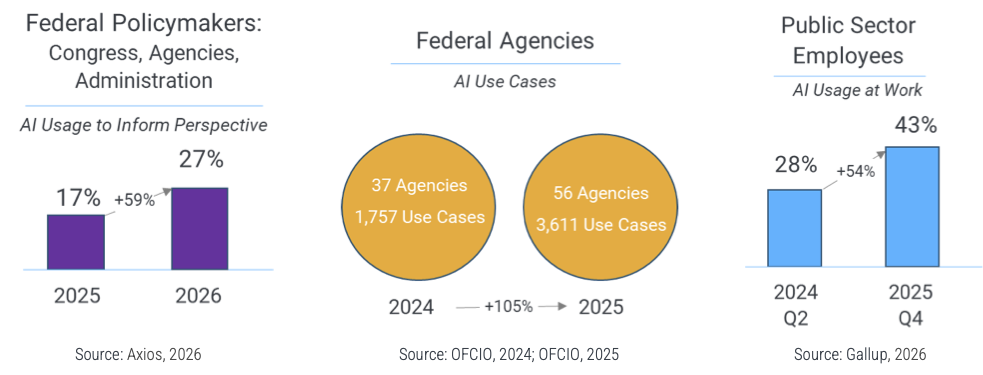
Agentic AI is at the top of every government leader’s agenda because of the tremendous potential it holds to improve efficiency, cut costs, and expand access to information and services. Agentic AI can transform how work gets done. In the few short years that generative AI has been widely available, the tools have been eagerly embraced by government workers. Daily usage is increasing across the public sector1, and AI use has expanded into informing federal policy for 27% of lawmakers and staffers2. AI use is here to stay and expanding in both adoption and application.
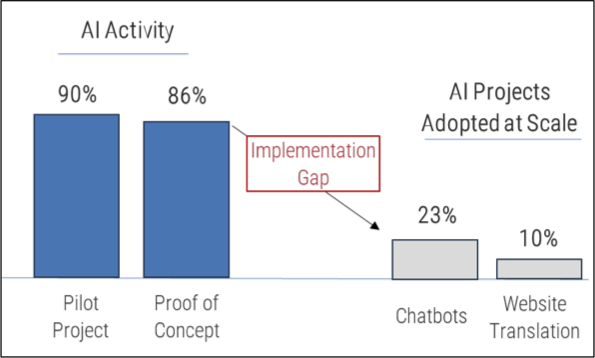
However, for all the attention and activity in the AI space, government leaders are falling short in reaching full-scale implementation. States face an AI implementation gap, with 86% of states having launched proof of concept projects3 but only 23% having deployed an AI agent (chatbot) at scale.4 Why are AI projects failing to take hold? And more importantly, what can be done about it?
Stakeholders have a poor and incomplete understanding about AI’s fundamental nature – its capabilities, risks, and impact in different applications. That AI knowledge gap is undermining and limiting the implementation and adoption of AI tools and services.
The most direct path for success lies in closing the AI knowledge gap by clarifying AI’s capabilities, flaws, and real-world application to governmental activities while developing a structured approach to evaluating, adopting, and managing the AI tools and systems already under consideration by teams across the government.
Scott Winslow
Principal Research Director, Industry
Info-Tech Research Group
- 1. Gallup, 2026
- 2. Axios, 2026
- “CIO Survey,” NASCIO, 2025
- “Beyond Generation,” NASCIO, 2026
Executive summary
Your Challenge
Government leaders are struggling to identify, evaluate, and scale agentic AI applications in their organizations.
- Government entities must provide full transparency and accountability in AI decision-making, which reinforces a natural conservatism toward autonomous systems.
- Stakeholders across agencies hold divergent goals and uneven understanding of AI, including legitimate concerns about what AI autonomy means in practice.
- Resources are constrained and timelines are real; leaders need the biggest, fastest wins from their AI investments.
Common Obstacles
A knowledge gap across government stakeholders regarding AI’s capabilities and risks is limiting alignment, impeding usage, and slowing adoption at scale.
- Competing narratives about AI's value and risk have created cross-agency friction that makes coordinated implementation difficult.
- The absence of clear regulations and policies governing AI usage, training data, and system access is creating hesitation and inconsistency across initiatives.
- Government leaders lack effective tools to assess the cost, benefit, and feasibility of specific AI projects before committing resources.
Info-Tech’s Approach
Anchor AI projects and use cases to a government business reference architecture, creating an explicit and defensible link between AI tools and business value creation.
- Build an understanding of agentic AI, its use cases in government, and the centrality of autonomy to AI's risk and value.
- Develop a shared evaluation methodology that ensures every AI project's risks and specific benefits are known and addressed before resources are committed.
- Create an AI project prioritization roadmap that sets implementation cadence and ensures oversight for each rollout.
Info-Tech Insight
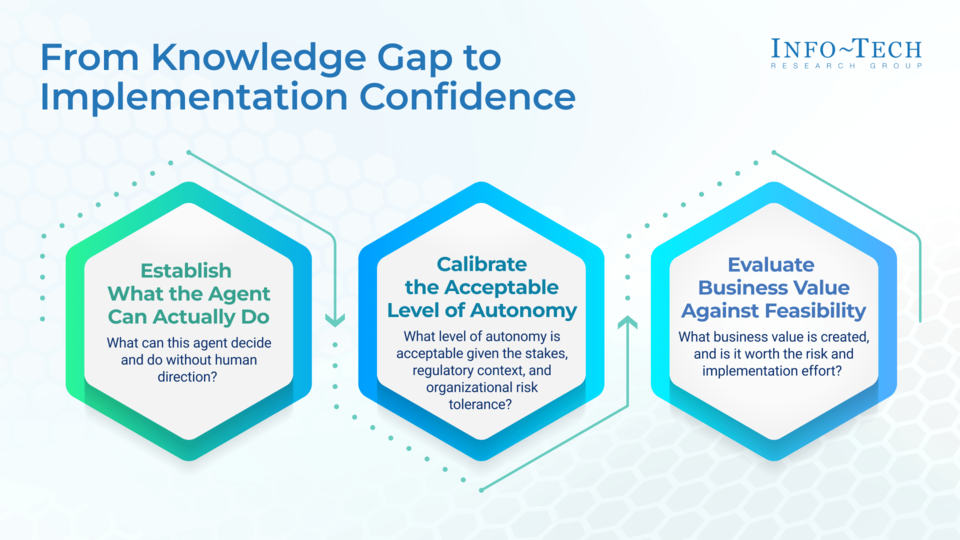
Stakeholder alignment is the critical prerequisite for AI project implementation and scaling. It is frustratingly difficult to achieve when stakeholders hold an incomplete and uneven understanding of AI's fundamental capabilities and risks. Government leaders must close the AI knowledge gap by ensuring that all stakeholders share a foundational understanding of AI autonomy: the ability of agentic AI to make decisions and take actions without direct human direction.
Decision Context
AI interest, usage, and activity are accelerating
AI adoption among government leaders, agencies, and employees is outpacing PC and internet adoption at the same point in their lifecycles.
Top of the To-Do List
- Government Industry Trends for 2026, Info-Tech LIVE, 2026
- Top Government Technology trends 2026
- Agentic AI and Intelligent Automation
2026 State CIO Priorities
Strategies, Policy Issues & Management Processes
Artificial intelligence/ GENA / Agentic AI / Machine learning
Source: “Priorities,” NASCIO, 2025
Your challenge
For all of the attention that AI has garnered across the past year, there is a yawning gap between AI pilot project activity (where 90% of states report having launched a pilot1) and project adoption at scale (where only 23% of states claim to have scaled chatbots, the most ubiquitous application2).
Leaders must close this gap and begin adopting AI projects at scale for these transformative AI technologies to deliver their promised benefits.
- “CIO Survey,” NASCIO, 2025
- “Beyond Generation,” NASCIO, 2026
Closing the Implementation Gap
Bringing AI’s promise to reality has been challenging, as government AI activity levels are not matched by government deployment of AI projects at scale.
Identifying and remediating the root causes of the implementation gap is at the top of government leaders’ to-do list.
US States – 2025
Source: “CIO Survey,” NASCIO, 2025
Source: “Beyond Generation,” NASCIO, 2026
Info-Tech’s approach
Our approach helps your organization close the AI knowledge gap by ensuring that all stakeholders have a deeper understanding of how agentic AI works and the benefits and risks to government services. This foundational knowledge will improve AI use case evaluation, facilitate adoption, and drive scaling of AI tools across agencies.
- Establish Agentic AI Capability, Risk, and Value Fundamentals – Create a common understanding across all stakeholders of AI fundamentals and explore the unique characteristics of agentic AI autonomy.
- Align AI Capabilities and Government Value Drivers – Develop a deep understanding of government business capabilities and brainstorm AI use cases that overlap with the refreshed understanding of AI capabilities.
- Evaluate Use Case Value and Feasibility – Review the brainstormed list of potential AI use cases to determine the value created versus the difficulty of implementing each use case.
- Prioritize Initiatives and Build Roadmap – Compare and contrast the identified AI use cases to determine their relative value to the organization. Create a project plan and roadmap to guide next steps.
What is agentic AI?
Agentic AI’s autonomy generates excitement (and fear)
Agentic AI is a digital system that is autonomous. Agentic AI has the capacity to perceive, reason, act, and learn and can independently orchestrate different AI agents and their capabilities to create a unified system that can execute the following tasks and activities:
- Access tools and data – roam digital space and investigate; access and use tools and data freely.
- Optimize workflows – determine the “preferred” process order, project management flows, and steps/activities required to complete a task.
- Create subtasks – Break down tasks as needed to distribute work to respond to changing dynamics.
- Achieve complex goals – independently complete all of the tasks, from information gathering to task execution, to achieve an end goal.
Agentic AI’s autonomy drastically multiplies what can be achieved and what can go wrong
Autonomy
(Acts Without Real-Time Review)
“The agent runs the workflow without waiting for me, but under predefined guardrails…”
Autonomy
Agentic AI stands in for the user, orchestrating and directing the work of individual AI agents, making the decisions, and executing the tasks to achieve an end goal.
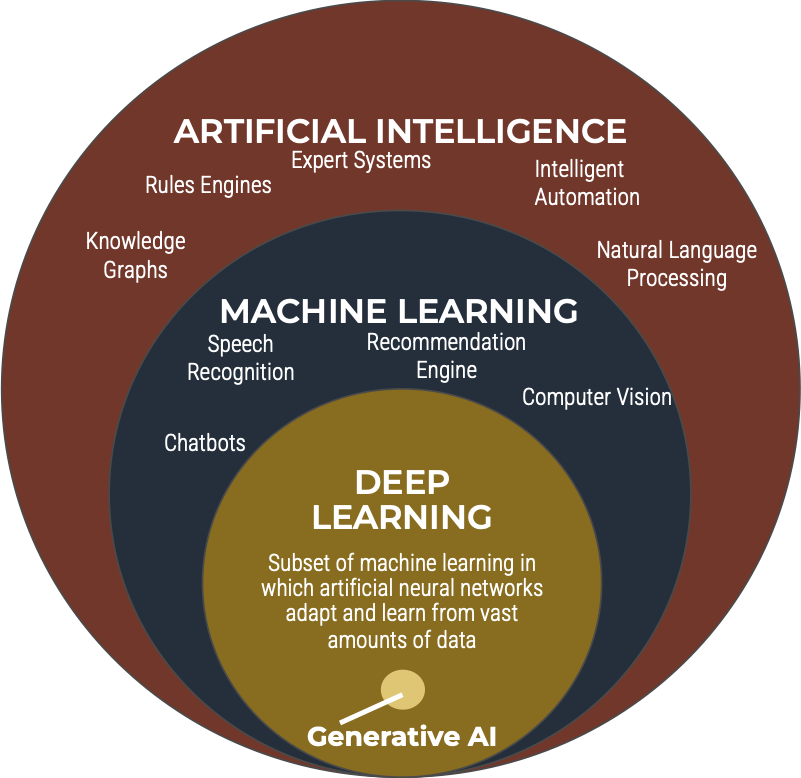
Generative AI is the engine powering agents
Artificial Intelligence (AI)
Artificial intelligence is human intelligence mimicked by machine algorithms and can take a variety of forms.
Machine Learning (ML)
Machine learning is a subset of AI algorithms that can parse data, learn from data, and then decide or make predictions.
Generative AI (Gen AI)
A subset of artificial intelligence systems that generate new outputs based on the data the system has been trained on, using modalities such as text, audio, visual, and code.
Core AI enablers
- Algorithms
- Accelerators
- Big Data
Your challenge
Government leaders are struggling to identify, evaluate, and scale agentic AI applications. Three structural challenges explain why:
- Accountability requirements reinforce a natural conservatism toward autonomous systems.
- Divergent stakeholder goals and uneven AI literacy create friction across agencies.
- Constrained resources and real timelines demand the biggest, fastest wins from every AI investment.
90%
of states launched AI pilots
Source: “CIO Survey,” NASCIO, 2025
23%
have scaled an application (chatbots)
Source: “Beyond Generation,” NASCIO, 2026
Closing the Implementation Gap
Agencies that remain in pilot mode absorb the cost and risk of AI adoption without capturing its value. Workforce expectations rise, public scrutiny increases, and the window for establishing governance ahead of scale narrows.
Closing the implementation gap is a leadership problem — and it requires a structured response.
US States – 2025
Source: “CIO Survey,” NASCIO, 2025
Source: “Beyond Generation,” NASCIO, 2026
Common obstacles
Mitigate AI project failures
Structural System Issues
Root Causes of AI Project Failures |
| Misunderstanding of how AI will solve the problem |
| Data issues — poor quality, access, governance |
| Focus on AI tech, not the problem to be solved |
| Inadequate infrastructure for AI workloads |
| Problem scope exceeds AI's capabilities |
Knowledge & Alignment Gaps
Info-Tech's Approach
Most failures are predictable and preventable.
-
Define the problem
before selecting a solution or vendor. -
Audit data readiness
including quality, access, and governance before build. -
Match scope to capability
to map problems to what AI can do. -
Assess infrastructure gaps
including compute, integration, and security posture.
Source: RAND, 2024
About Info-Tech
Info-Tech Research Group is the world’s fastest-growing information technology research and advisory company, proudly serving over 30,000 IT professionals.
We produce unbiased and highly relevant research to help CIOs and IT leaders make strategic, timely, and well-informed decisions. We partner closely with IT teams to provide everything they need, from actionable tools to analyst guidance, ensuring they deliver measurable results for their organizations.
What Is a Blueprint?
A blueprint is designed to be a roadmap, containing a methodology and the tools and templates you need to solve your IT problems.
Each blueprint can be accompanied by a Guided Implementation that provides you access to our world-class analysts to help you get through the project.
Need Extra Help?
Speak With An Analyst
Get the help you need in this 4-phase advisory process. You'll receive multiple touchpoints with our researchers, all included in your membership.
Guided Implementation 1: Establish agentic AI fundamentals
- Call 1: Align on fundamental agentic AI concepts.
- Call 2: Explore agentic AI in practice, focusing on government examples.
Guided Implementation 2: Align AI capabilities and government value drivers
- Call 1: Review government business reference architecture
- Call 2: Identify alignment between AI capabilities, government value drivers.
Guided Implementation 3: Assess the value and feasibility of AI use cases
- Call 1: Identify candidate use cases.
- Call 2: Evaluate use case value and feasibility.
Guided Implementation 4: Prioritize AI initiatives and build implementation roadmap
- Call 1: Prioritize use cases based on risk, value, and readiness.
- Call 2: Develop a sequenced implementation roadmap.
Contributors
- Joe Forte, Senior Vice President, NiCE
- Jacques Vest, Senior Consultant, Clarivate Analytics
