US retail M&A shifted toward larger deals in 2025, with deal count down 12.3% but deal value up 34.6%, and by Q2 2026 buyers increasingly targeted capabilities such as advertising, fulfillment, and customer engagement rather than footprint (KPMG, 2026). Different deal strategies place different demands on IT, and the CIO's role is to protect the existing business while enabling the value the acquisition is meant to deliver. IT is strongly linked to synergy capture, yet business-IT misalignment is a common barrier to full deal value, and every month that cost savings are pulled forward can be worth up to 8% of the full year's savings (BCG, 2016). Speed and caution both carry a cost: Defaulting every domain to the parent platform can destroy the differentiated customer experiences, data assets, and talent that made the target valuable.
The right stance is selective integration, with a rationale for every decision. Start from the value the acquisition must create, then use a business capability map to locate what matters, assess it across eight areas (culture, people, process, technology, data, vendor agreements, reporting, and transition services), and decide what to connect, consolidate, preserve, replace, or retire. A capability map organizes the investigation; it does not make the decision. For each decision, CIOs should record the target state, dependencies, accountable owner, readiness criteria, success measures, cost and risk, and timing, and measure success by business continuity, cost reductions, and realized deal benefits rather than the number of systems consolidated.
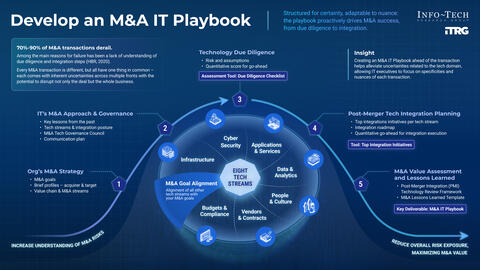
CIOs should apply this discipline across the deal lifecycle: Before signing, test technology assumptions and estimate integration costs; from signing to close, establish decision rights, secure critical skills, and define Day 1 and transition-service requirements; in the first 100 days, validate architecture, data quality, and dependencies and set readiness baselines before major cutovers; and through integration, require end-to-end testing, recovery plans, and go/no-go authority, retiring systems only after dependencies, records, controls, and contracts are resolved.