
Assess and Prioritize Agentic AI Use Cases in the Nonprofit Sector
Powered by AI, guided by people.
- Nonprofits need to improve capacity, coordination, and responsiveness while maintaining trust and human-centered service.
- Leaders need clarity on where agentic AI can assist and act and where human judgment must remain central.
- Without a structured approach, organizations risk pursuing AI use cases that are not ready, scalable, or aligned to mission needs.
- Responsible adoption requires clear governance, oversight, and stakeholder alignment.
Our Advice
Critical Insight
The greatest value from agentic AI to nonprofit organizations comes from prioritizing use cases that relieve capacity constraints and improve responsiveness without compromising mission accountability, donor trust, or community trust.
Impact and Result
- Identify practical agentic AI opportunities across nonprofit workflows.
- Prioritize use cases based on value, feasibility, and risk.
- Align key stakeholders around where AI can responsibly support the organization.
- Establish clear oversight and governance expectations for scalable adoption.
Member Testimonials
After each Info-Tech experience, we ask our members to quantify the real-time savings, monetary impact, and project improvements our research helped them achieve. See our top member experiences for this blueprint and what our clients have to say.
9.0/10
Overall Impact
$68,999
Average $ Saved
10
Average Days Saved
Client
Experience
Impact
$ Saved
Days Saved
MasterCard Foundation
Guided Implementation
9/10
N/A
10
Insights were very useful. We got guidance on governance for AI, potential pitfalls and additional resources touch on cost, capability mapping and ... Read More
American Foundation for Suicide Prevention
Guided Implementation
9/10
$68,999
10
The content was organized into clear, well-defined phases, which made it easy to understand and follow. The information provided a strong, practica... Read More
INFO~TECH RESEARCH GROUP
Assess and Prioritize Agentic AI Use Cases in the Nonprofit Sector
Powered by AI, guided by people.
Analyst perspective
From technical possibility to mission-safe autonomy.
Nonprofit organizations are under pressure to improve staff capacity, responsiveness, and operational efficiency while protecting donor trust, constituent experience, and mission integrity.
As AI evolves beyond copilots into more agentic systems that can coordinate and execute multistep workflows, nonprofit leaders are being asked a more difficult question than whether AI can save time. The question is where autonomy is appropriate inside workflows tied to service delivery, donor stewardship, volunteer coordination, reporting, and internal support.
In nonprofits, technical capability does not automatically translate into mission-safe use. Sensitive constituent data, fragmented systems, lean teams, and high-trust stakeholder relationships mean some use cases can strengthen capacity while others introduce unacceptable privacy, equity, accountability, or reputational risk.
This research helps nonprofit leaders define where agentic AI belongs, where autonomy must remain constrained, and where human judgment must stay central. The goal is to move from broad experimentation to defensible prioritization grounded in mission value, trust, feasibility, and oversight.

Vidhi Trivedi
Senior Research Analyst, Nonprofit Industry
Info-Tech Research Group
Executive summary
Your Challenge
Nonprofits see real potential in agentic AI, but they need a mission-centered way to determine where autonomous behavior can operate without weakening trust, service quality, privacy, or accountability.
- AI use in nonprofits must support mission delivery, not efficiency alone.
- Leaders must distinguish between lower-risk coordination use cases and higher-accountability interactions involving donors, constituents, or program decisions.
- Organizations risk advancing technically feasible use cases that are not equitable or operationally ready.
Common Obstacles
Several structural realities make agentic AI harder to scale across nonprofit organizations.
- Lean teams and rising service demand increase pressure to automate but also reduce capacity for governance and oversight.
- Fragmented systems and uneven data maturity weaken end-to-end orchestration and readiness for more autonomous workflows.
- Most nonprofits still need clearer frameworks to evaluate acceptable autonomy, human oversight needs, and mission-specific risk.
Info-Tech’s Approach
When nonprofit leaders align around practical agentic AI use cases, they reduce low-fit experimentation and focus investment on mission-enhancing opportunities. We do this by:
- Establishing where agentic AI can support or act across nonprofit workflows.
- Aligning IT, program, fundraising, operations, and leadership teams around defensible use cases.
- Prioritizing governed, value-driven investments with clear ownership, oversight, and escalation thresholds.
Info-Tech Insight
The greatest value from agentic AI to nonprofit organizations comes from prioritizing use cases that relieve capacity constraints and improve responsiveness without compromising mission accountability, donor trust, or community trust.
Your challenge
Nonprofits need greater capacity without weakening trust or human-centered service.
This research is designed to help organizations that are facing these challenges:
- Nonprofits are under pressure to improve responsiveness, staff capacity, and coordination, but not every workflow is appropriate for autonomous execution.
- The challenge is not automation alone. It is deciding where agentic AI can assist, where it can act with bounded autonomy, and where human judgment must remain central.
- Poorly governed autonomy can create risks to privacy, equity, reputation, donor trust, and service quality.
- Without a practical framework for autonomy boundaries, nonprofits struggle to move beyond experimentation in a way that is scalable, mission-aligned, and defensible.
Common obstacles
Nonprofits face fragmentation, capacity constraints, and trust barriers when scaling agentic AI.
These barriers make agentic AI harder to operationalize across nonprofit functions:
- Many nonprofits do not yet have a structured way to separate acceptable autonomy from workflows that require stronger human control.
- Core work is often fragmented across fundraising systems, spreadsheets, email, case notes, reporting tools, and manual handoffs, which limits reliable orchestration.
- Adoption stalls when AI ambition outpaces governance, business ownership, data readiness, and policy clarity.
- In nonprofit environments, even technically-effective AI can fail if it cannot be explained, monitored, governed, and aligned to community trust and mission accountability.
Info-Tech’s approach
A structured agentic AI use case tool helps nonprofits identify where AI creates value, where human oversight is needed, and where autonomy introduces mission or trust risk.
How Info-Tech helps nonprofit organizations make progress:
- Assess where agentic AI belongs in nonprofit workflows. A nonprofit-specific review identifies where autonomous capabilities can improve coordination, responsiveness, and internal capacity across fundraising, program support, volunteer operations, reporting, and shared services.
- Apply a defensible evaluation framework to each use case. Info-Tech helps organizations assess use cases against criteria such as mission value, privacy sensitivity, trust exposure, equity implications, operational feasibility, and oversight requirements.
- Prioritize high-value use cases with responsible guardrails. A practical prioritization model helps leaders focus on use cases that are scalable, governable, and aligned to organizational capacity and risk tolerance.
- Support adoption through accountability and oversight. Clear ownership, human-in-the-loop expectations, escalation points, and governance checkpoints help nonprofits operationalize agentic AI without weakening trust or mission integrity.
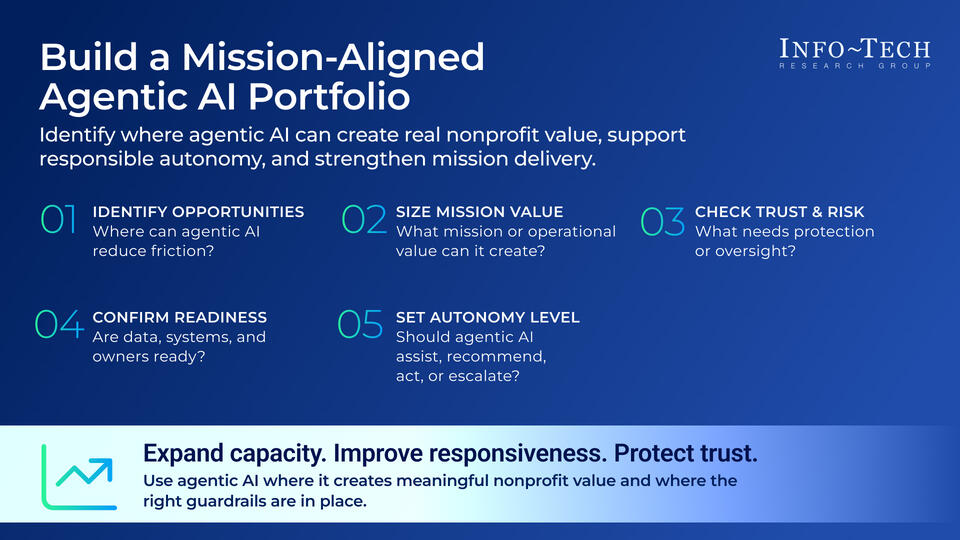
Build a Mission-Aligned Agentic AI Portfolio
Identify where agentic AI can create real nonprofit value, support responsible autonomy, and strengthen mission delivery.
THE PRIORITIZATION CHALLENGE
Not every AI opportunity should become an agentic AI use case.
Nonprofit organizations need a disciplined way to prioritize high-value opportunities, manage risk, and define where humans stay in control.
A practical model for prioritizing agentic AI use cases
Identify Opportunities
Where can agentic AI reduce friction?Size Mission Value
What mission or operational value can it create?Check Trust & Risk
What needs protection or oversight?Confirm Readiness
Are data, systems, and owners ready?Set Autonomy Level
Should agentic AI assist, recommend, act, or escalate?
Unlock a prioritized portfolio of nonprofit agentic AI use cases
Agentic AI Portfolio Positioning Map
Tiered use case portfolio
Action plan by quadrant
Expand capacity. Improve responsiveness. Protect trust.
Use agentic AI where it creates meaningful nonprofit value and where the right guardrails are in place.
Info-Tech’s methodology for assessing nonprofit agentic AI use cases
1. Frame the Nonprofit Context |
2. Shape the Use Cases |
3. Prioritize Opportunities |
|
Phase Steps |
1.1 Define agentic AI capability patterns
1.2 Explore agentic AI in practice |
2.1 Align AI capability to mission context
2.2 Generate agentic AI use cases |
3.1 Score use cases for prioritization
3.2 Validate the use case portfolio |
Phase Outcomes |
A shared understanding of agentic AI and how it applies across nonprofit workflows such as fundraising, program support, volunteer operations, reporting, and internal services. | A structured set of mission-aligned agentic AI use cases tied to nonprofit priorities, operational needs, and target value areas. | A prioritized and validated use case portfolio with consensus on the highest-value, most feasible, and most responsible opportunities to advance. |
Insight summary
Mission-aligned prioritization drives agentic AI value
Nonprofits create value when they define where agentic AI can support capacity, coordination, and service responsiveness, assign clear ownership, and sequence use cases based on mission value, trust fit, and readiness rather than chasing generic productivity gains.
Match autonomy to mission and trust risk
Not every nonprofit workflow needs the same degree of autonomy. Use cases should be classified by stakeholder sensitivity, decision impact, privacy exposure, and the level of human accountability required across fundraising, program support, volunteer coordination, and internal services.
Evaluate use cases before they scale
The best use case is one the organization can operationalize responsibly. Leaders should assess each idea against mission impact, trust sensitivity, data readiness, workflow stability, and oversight requirements to separate viable nonprofit use cases from experimental concepts.
Start with use cases that build trust
Confidence grows through deliberate sequencing. Early wins should come from lower-risk, measurable workflows such as internal coordination, routing, summarization, scheduling, and administrative support before expanding into more sensitive donor or constituent interactions.
Prioritize measurable value with responsible guardrails
Focus first on use cases where value can be demonstrated quickly, operational friction is high, and governance is manageable. These use cases are more likely to create momentum without compromising trust, transparency, or service quality.
Validate readiness before moving forward
Prevent wasted effort by validating each use case against readiness criteria before it enters the portfolio, including data quality, ownership, process maturity, policy fit, and human escalation design.
Research deliverable
Each step of this research is supported by a practical nonprofit deliverable to help you identify, evaluate, and prioritize agentic AI use cases across fundraising, program delivery support, volunteer operations, reporting, grant administration, and internal services.
Agentic AI Use Case Tool for the Nonprofit Sector
Provides a structured environment to identify and prioritize agentic AI use cases, capture mission and operational value drivers, assess autonomy boundaries, and build an initial roadmap aligned to nonprofit priorities, trust requirements, and human oversight expectations.
Measure the value of this research
Leverage this research’s approach to ensure your agentic AI use cases align with your mission priorities, strengthen operational capacity, and accelerate responsible time to value.
| With Info-Tech Resources | Without Info-Tech Resources | |||
Project Steps |
Time |
Average Cost (USD) |
Time |
Rationale |
| Capability and Strategy Mapping | 0.5-1 day | $7,500-$10,000 | 3-5 days | Creation of a reference architecture & facilitation |
| Use Case Generation | 0.5-1 day | $5,000-$7,500 | 2-3 days | Consultant facilitation |
| Maturity Assessment | 1-2 days | $5,000-$7,500 | 3-4 days | Assessment development & facilitation |
| Use Case Prioritization | 1 day | $5,000-$7,500 | 2-3 days | Scoring matrix & facilitation |
| Effort | 3-5 days | $22,500-$32,500 | 10-15 days | |
Business Goals |
Key Success Metrics |
Operational Efficiency |
Reduce manual effort, process delays, and administrative burden across fundraising, program delivery, volunteer coordination, reporting, and internal services through agentic AI-enabled workflows. |
Mission Growth |
Expand mission reach, donor engagement, grant capacity, and service scalability by identifying agentic AI use cases that support fundraising, outreach, programs, and community impact. |
Stakeholder Experience |
Improve experiences for donors, beneficiaries, members, volunteers, and community partners through faster responses, more personalized support, clearer information access, and more consistent service delivery. |
Staff & Volunteer Experience |
Improve staff and volunteer productivity by automating repetitive tasks, supporting knowledge retrieval, simplifying program administration, and freeing teams to focus on higher-value mission work. |
Risk & Resilience |
Strengthen responsible AI adoption by assessing use case risk, data sensitivity, privacy, compliance needs, human oversight, and service continuity impacts before advancing agentic AI opportunities. |
ESG |
Advance equity, accessibility, transparency, responsible resource use, and measurable community outcomes by prioritizing agentic AI use cases aligned to the nonprofit’s mission. |
Measure the value of this project
Consider tracking the following measures to demonstrate the value of a more structured approach to assessing and prioritizing agentic AI use cases in nonprofit organizations.
Metric |
Expected Improvement |
| Time to prioritize AI use cases | Reduced time from broad idea generation to a validated shortlist of high-potential use cases. |
| AI initiative fit | Fewer experiments pursued without clear mission fit, feasibility, or oversight readiness. |
| Cross-functional alignment on priorities | Stronger agreement across IT, fundraising, program, operations, and leadership teams on which use cases should advance. |
| Confidence in use case selection | Higher confidence that selected use cases are practical, responsible, and aligned to mission and trust expectations. |
| Number of use cases advanced per cycle | More focused investment into a smaller number of high-confidence use cases with clearer ownership and sequencing. |
Build an agentic AI portfolio that expands capacity without compromising mission or trust.
Project benefits
IT Benefits
- Clearer prioritization of agentic AI investments: Creates a structured method to evaluate where agentic AI belongs so technology teams can focus on the most viable nonprofit opportunities first.
- Stronger governance over AI-supported workflows: Helps IT define autonomy boundaries, ownership, escalation paths, and oversight expectations before deployment.
- Better alignment across business and technology leaders: Establishes a common language for assessing use cases across mission value, feasibility, privacy, trust, and readiness.
- Reduced pilot sprawl and duplicate experimentation: Replaces disconnected AI exploration with a governed portfolio and sequencing approach.
Business Benefits
- Faster progress on staff capacity and service responsiveness: Helps nonprofits identify where agentic AI can reduce administrative burden and improve coordination.
- Lower risk of misapplying autonomy in sensitive work: Distinguishes between supportable orchestration use cases and areas where human-led judgment must remain central.
- Greater confidence in responsible adoption: Supports explainability, accountability, and documentation expectations in workflows that affect donors, volunteers, staff, or constituents.
- More defensible business cases for AI investment: Prioritizes use cases based on measurable value, operational fit, and governance readiness instead of technical novelty alone.
Assess and Prioritize Agentic AI Use Cases in the Nonprofit Sector
Phase 1
Frame the Nonprofit Context
Phase 1 |
Phase 2 |
Phase 3 |
1.1 Define agentic AI capability patterns 1.2 Explore agentic AI in practice |
2.1 Align AI capability to mission context 2.2 Generate agentic AI use cases |
3.1 Score use cases for prioritization 3.2 Validate the use case portfolio |
This phase will walk you through the following activities:
Build a shared understanding of agentic AI by defining the core capability patterns, distinguishing agentic AI from automation and copilots, and creating a common vocabulary across the AI strategy team.
Explore nonprofit examples to identify where agentic AI may create value across donor engagement, program delivery, volunteer coordination, grant reporting, constituent support, and internal services.
Clarify where autonomy is appropriate, where human oversight is required, and where agentic AI should not be used due to privacy, equity, regulatory, financial, reputational, or mission-sensitivity concerns.
This phase involves the following participants:
- AI initiative lead
- CIO
- Other IT leadership
- Senior business executives and managers accountable for AI initiatives
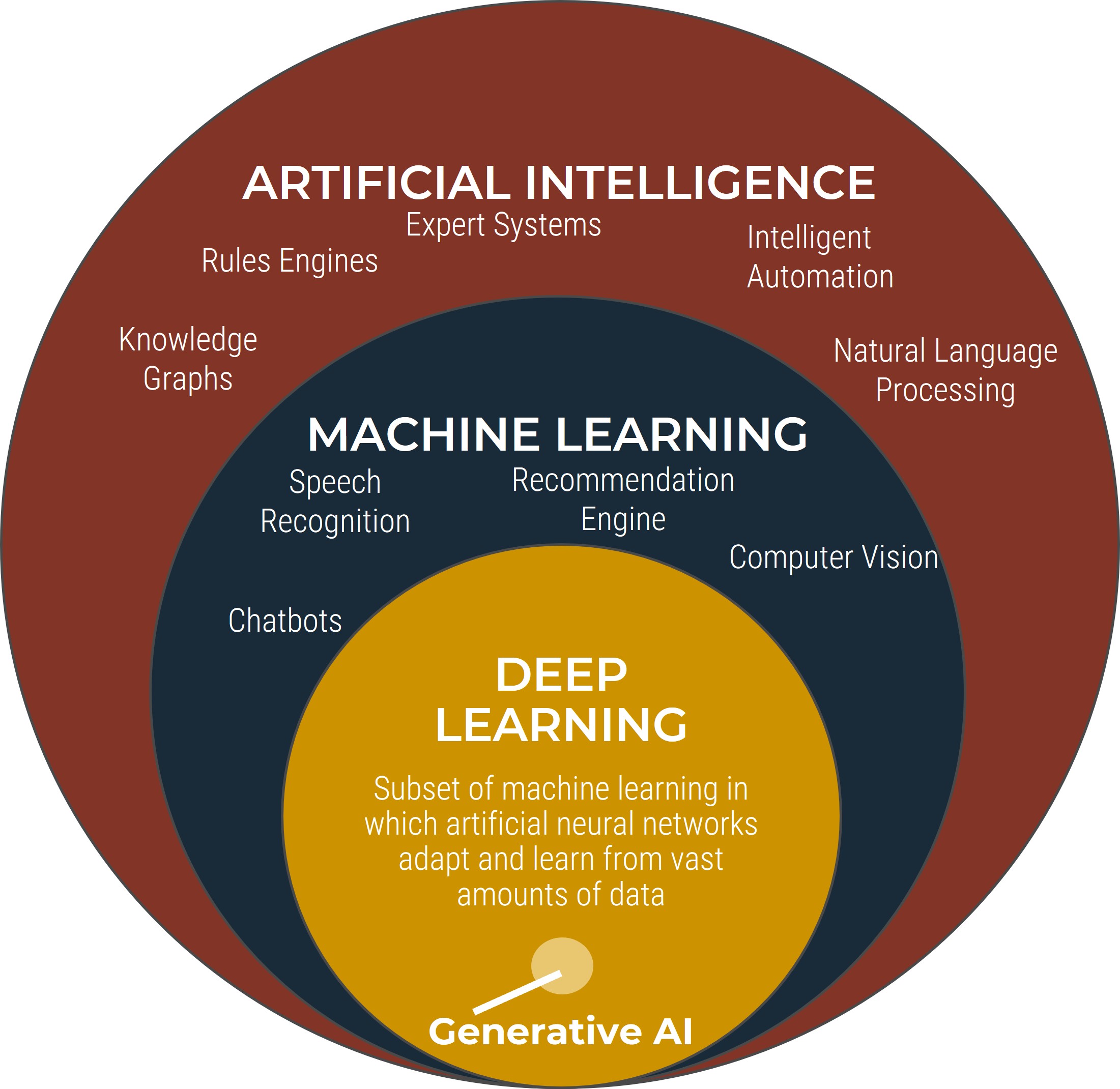
AI is an innovation in machine learning
Artificial Intelligence (AI)
An artificial intelligence (AI) system that can make predictions, recommendations, or decisions influencing real or virtual environments.
Machine Learning (ML)
Machine learning (ML) is a subset of AI algorithms that parse data, learn from data, and then decide or make predictions.
Generative AI (Gen AI)
A subset of artificial intelligence systems that generate new outputs based on the data the system has been trained on using modalities such as text, audio, visual, and code.
What makes AI different

Match nonprofit workflows to four high-value agentic AI capability patterns
Use agentic AI to process nonprofit operational data, support mission-aligned decisions, monitor program, donor, grant, and volunteer signals, and triage work across resource-constrained nonprofit workflows. Many high-value use cases combine multiple capability patterns.
Data Processing
Extract, classify, validate, and structure data from grant applications, donor records, program intake forms, volunteer submissions, case notes, emails, reports, and other unstructured nonprofit inputs.Decision Support
Bring together information from donor, program, grant, volunteer, finance, CRM, and third-party systems to generate insights, surface recommendations, and support human decision-making.Monitoring & Alerting
Continuously track workflow signals, detect exceptions, identify risk indicators, and trigger alerts or follow-up actions across fundraising, program delivery, grant management, volunteer operations, and internal services.Triage & Orchestration
Classify incoming requests, understand intent, route work to the right team, person, system, or service pathway, and coordinate next steps across nonprofit workflows.
1.1 Define agentic AI capability patterns
1-2 hours
Input: Mission and organizational goals, Strategic initiatives, Business capability map, AI use cases
Output: Shared agentic AI vocabulary, Understanding of the four agentic AI capabilities patterns, Alignment on how agentic AI applies in nonprofit environments
Materials: Collaboration/brainstorming tool (whiteboard, flip chart, digital equivalent), Four agentic AI capabilities, Agentic AI maturity framework (if available), Nonprofit capability map or workflow view
Participants: AI initiative lead, CIO, Other IT leadership, Senior nonprofit leaders, executives and managers accountable for AI initiatives
- Bring the AI strategy team together to build a shared understanding of agentic AI in a nonprofit context and how it differs from automation and copilots.
- Align on the core distinctions:
- Automation executes predefined, repeatable tasks
- Copilots assist users with content, summaries, and decision support
- Agentic AI uses context to make bounded decisions, take action, and coordinate multistep work across nonprofit systems and workflows
- Review the four agentic AI capability patterns most relevant to nonprofit operations:
- Data Processing – extract, classify, validate, and structure nonprofit data
- Monitoring and Alerting – track signals, exceptions, and indicators that require follow-up
- Decision Support – synthesize context to recommend actions or rank options
- Triage and Orchestration – route tasks, prioritize work, and coordinate workflows
- Align on how these patterns apply in nonprofit environments, where mission sensitivity, donor and constituent trust, privacy, equity, human accountability, and governance matter.
- Establish a shared vocabulary for where agentic AI can assist, where it can act with bounded autonomy, and where human-led authority must remain in place.
Explore the four agentic AI capabilities in action
Agentic AI Capability Pattern |
Example Use Case |
Problem |
Agent Solution/Action |
| Data Processing: Agents that extract, classify, validate, and structure data from documents and other unstructured inputs. | Grant Application Intake Agent | Nonprofit teams receive high volumes of grant applications, supporting documents, budgets, program descriptions, and compliance information in inconsistent formats. Manual intake slows review, creates inconsistent data capture, and delays routing to the right program, finance, or grant review team. | Ingest grant applications and attachments › extract and normalize applicant, funding, budget, eligibility, and program data › validate required fields and supporting documents › route complete files to the appropriate review queue. |
| Donor Record Intake Agent | Fundraising teams must manually review donor forms, emails, event sign-ups, pledge notes, and CRM updates before donor records can move forward. This delays stewardship, creates duplicate records, and increases administrative workload. | Ingest donor forms, emails, event lists, and CRM inputs › classify donor type and engagement history › extract key contact, giving, preference, and consent details › flag missing or conflicting information for staff review. | |
| Decision Support
Agents that gather information across systems, perform analysis, and generate insights. |
Program Eligibility Review Agent | Program staff often need to synthesize information from intake forms, eligibility criteria, case notes, service history, and referral data under time pressure. Important eligibility or risk indicators can be missed or reviewed inconsistently. | Pull data from intake forms, case management systems, program criteria, and referral sources › summarize applicant needs and eligibility factors › highlight exceptions, risks, and follow-up items › generate an eligibility briefing for staff review. |
| Grant Reporting Assist Agent | Teams must quickly determine reporting requirements, outcome indicators, budget updates, and narrative evidence, but grant information is often spread across award letters, program notes, financial records, and impact reports. | Gather grant requirements, program activity data, budget details, prior reports, and supporting documents › summarize reporting obligations and progress indicators › recommend next steps such as missing evidence collection, finance review, or program owner follow-up. |
Explore the four agentic AI capabilities in action
Agentic AI Capability Pattern | Example Use Case | Problem | Agent Solution/Action |
| Monitoring & Alerting | Donor Engagement and Stewardship Alert Agent | High donor volumes make it difficult to consistently detect important engagement signals, missed follow-ups, lapsed giving patterns, or high-value stewardship opportunities early enough to intervene. | Continuously monitor donor interactions, giving history, event attendance, email engagement, and CRM notes › detect lapsed giving, major gift signals, or missed follow-up indicators › alert fundraising staff › recommend next-best stewardship actions. |
| Program Capacity and Service Demand Monitoring Agent | During periods of increased community need, nonprofits face sudden spikes in intake volume, service requests, volunteer demand, and resource constraints. Without active monitoring, backlogs and service gaps can grow quickly. | Monitor intake volumes, waitlists, service requests, volunteer availability, inventory/resources, and service-level thresholds › identify surge conditions › alert operations or program leaders › trigger workload balancing, volunteer outreach, or resource coordination actions. | |
| Triage & Orchestration | Constituent Intake Triage Agent | At first contact, nonprofit teams must quickly determine urgency, eligibility, service need, and the right support pathway. Manual triage creates delays, inconsistent intake, and poor constituent experience. | Capture constituent inquiries through digital or assisted channels › classify service need, urgency, and eligibility › verify basic intake details › route standard requests to the right service pathway and complex or sensitive cases to the appropriate staff member. |
| Volunteer Request Routing Agent | Volunteer coordination teams often struggle to assign requests to the right opportunity, team, or location because skills, availability, role requirements, and onboarding status arrive inconsistently. Misrouting slows placement and frustrates volunteers. | Read volunteer applications, emails, forms, and availability details › identify skills, interests, location, availability, and onboarding status › determine routing based on role fit and urgency › assign to the correct volunteer coordinator, opportunity queue, or onboarding workflow. |
AI is not the silver bullet for all nonprofit use cases
While agentic AI can help nonprofits extend capacity and coordinate work, it is not a universal solution. Consider these scenarios where agents may not be the optimal approach:
Simple Tasks
Agents are overkill for simple, efficient tasks with existing manual or software solutions. Example: Sending standard donor thank-you emails, basic event reminders, or simple form confirmations.Deep Domain Expertise
Tasks requiring nuanced human judgment or specialized knowledge (e.g. medical diagnoses) are safer and higher quality with human experts. Example: Determining eligibility for sensitive services, making safeguarding decisions, or interpreting complex grant compliance requirements.Tight Budgets
High development and operational costs of robust agents may outweigh benefits for projects with severe resource constraints. Example: One-time reporting tasks, small internal pilots, or low-volume workflows where a template, dashboard, or simple automation would be sufficient.Human Emotion & Creativity
Agents cannot replicate human emotion, intuition, or creativity, essential for fields like psychotherapy or creative writing. Example: Crisis conversations, trauma-informed support, major donor relationship-building, community engagement, or deeply personal storytelling.
About Info-Tech
Info-Tech Research Group is the world’s fastest-growing information technology research and advisory company, proudly serving over 30,000 IT professionals.
We produce unbiased and highly relevant research to help CIOs and IT leaders make strategic, timely, and well-informed decisions. We partner closely with IT teams to provide everything they need, from actionable tools to analyst guidance, ensuring they deliver measurable results for their organizations.
What Is a Blueprint?
A blueprint is designed to be a roadmap, containing a methodology and the tools and templates you need to solve your IT problems.
Each blueprint can be accompanied by a Guided Implementation that provides you access to our world-class analysts to help you get through the project.
Need Extra Help?
Speak With An Analyst
Get the help you need in this 4-phase advisory process. You'll receive multiple touchpoints with our researchers, all included in your membership.
Guided Implementation 1: Pre-Work
- Call 1: Scope objectives, use case priorities, and your specific nonprofit challenges.
Guided Implementation 2: Frame the Nonprofit Context
- Call 1: Align on foundational agentic AI concepts and what makes them different in nonprofit environments.
- Call 2: Explore agentic AI in nonprofit practice.
Guided Implementation 3: Shape the Use Cases
- Call 1: Anchor AI capability to mission context and capabilities.
- Call 2: Develop and refine agentic AI use cases.
Guided Implementation 4: Prioritize Opportunities
- Call 1: Score nonprofit use cases for prioritization.
- Call 2: Review and validate prioritized nonprofit use case portfolio.
Contributors
- Rodrigue Odom, Acting Chief Information & Technology Officer, Conservation International
- William Skelly, Vice President, Information Technology, United Service Organizations (USO)
- Luigi Di Sessa, Director, Information Technology, Vancouver Foundation