Canadian Prime Minister Mark Carney delivered a landmark speech at Davos 2026, framing the current geopolitical moment not as a transition, but as a fundamental “rupture.” He painted a stark picture of a new economic order where hegemonic powers coerce trading partners and hyperscalers dominate, severely limiting choices in AI infrastructure. However, he also offered a offered a compelling third alternative with respect to AI, focused on building a sovereign AI strategy and collaborating with like-minded nations and partners to build out the sovereign AI ecosystem.
Sovereign AI refers to a nation’s capacity to develop, control, and govern its own artificial intelligence capabilities independently, rather than relying solely on foreign-owned infrastructure, models, or platforms. At its core, this concept encompasses the entire AI value chain from domestic computing power and foundational models to the data and talent required to sustain them. It is not merely an exercise in technological protectionism; rather, it is a strategic assertion of AI self-determination. By investing in sovereign AI, countries seek to ensure that their economic competitiveness, cultural expression, and national security interests are not dictated by the priorities of a handful of hyperscalers or hegemons.
Sovereign AI is a complex ecosystem
Developing a sovereign AI strategy is not easy, and executing on the strategy requires careful orchestration across a complex ecosystem, where dependencies, risks, and governance requirements spin an intricate web. It will require an unprecedented combination of consensus, collaboration, and cooperation at a national level that is rarely seen in modern democracies.
The key sovereign AI capabilities nations need to consider developing include the following:
- Data Sovereignty: Data is the core of every AI model, and sovereign AI begins with sovereign data. This involves using high-quality, nationally representative data in local languages for training models, ensuring citizen data is anonymized throughout the process. All data must also be stored on sovereign-controlled compute infrastructure.
- Infrastructure Sovereignty: Sovereign AI requires access to computing infrastructure capable of supporting the enormous demands of AI training and inference. Many countries are investing in sovereign cloud platforms, hybrid environments, or fully on-premises high-performance supercomputers to deliver the necessary processing power. Given the high energy demands of these new data centers, securing a cost-effective, reliable, and sustainable energy supply is also required.
- AI Value Chain Sovereignty: When fine-tuning an existing foundation model for domestic use, it’s critical that the model reflects the country’s values. This requires establishing standardized procedures and best practices to guide AI development, deployment, and adoption that is also aligned with national priorities. A national procurement framework can further strengthen the local AI ecosystem by encouraging domestic participation and growth.
- Talent Sovereignty: Maintaining a national AI ecosystem depends on a local workforce with the skills to manage and grow it. This means investing in upgraded educational programs and funding research to develop and retain talent. A coordinated national effort should also support local organizations in deploying and integrating AI-based solutions.
- Regulatory and Governance Sovereignty: Oversight of sovereign AI must be grounded in legal and human-based principles that reflect national values. A clear AI governance framework should guide AI use in critical sectors such as finance, healthcare, law enforcement, and education, ensuring alignment with cultural and societal norms. Complementing this framework with robust policies and an AI risk management program will help operationalize these principles and mitigate the AI risks that may occur.
AI Sovereignty Capabilities
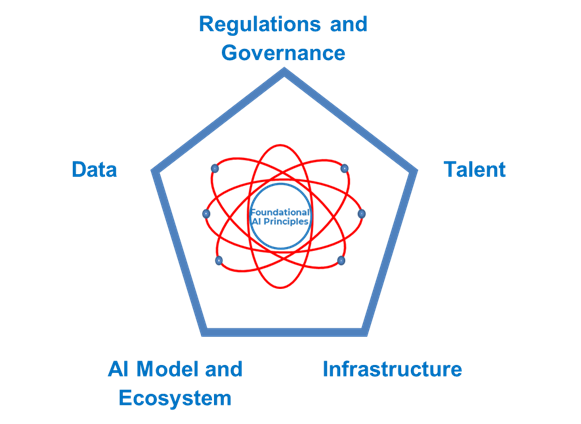
At the core of a nation’s sovereign AI capabilities are its foundational AI principles, which serve as a cornerstone for AI governance. They should guide decision-making at all levels of the government in ways that ensure the organization is leveraging the innovative potential of AI while at the same time protecting its citizens from risk and failures. Some countries have adopted responsible AI principles to provide this guidance; whatever their name, these principles should be customized to reflect national values. One example might be to include sustainability, a key strength in regions like Latin America and the Caribbean, where they can differentiate their services by offering clean energy alternatives for their AI platform needs.
There are currently dozens of sovereign AI initiatives across the globe today. Here are a few examples of some of the major AI initiatives by geography, key sovereign AI initiatives, government funding, and key sovereign AI goals.
Sovereign AI Initiatives Around the World
|
Geography |
Sovereign AI Initiative |
Direct Government Funding |
Sovereign AI Goals |
|---|---|---|---|
|
United States |
Stargate Project |
$10B to $20B |
10-gigawatt AI supercomputing network; 2 million chips across 20 state-linked “campuses” |
|
India |
IndiaAI Mission 2.0 |
$15B |
38,000+ GPU sovereign cloud; BharatGen AI model (22 languages); Reliance/Adani 120MW data center hubs |
|
China |
Next Gen AI Development Plan |
$140B+ |
National “Big Fund III” for chips; 6,000+ AI companies; total localized hardware supply chain |
|
EU |
AI Continent Action Plan |
$25B (€23B) |
JUPITER exascale supercomputer; 19 AI Factories; decentralized sovereign cloud for 27 nations. |
|
Saudi Arabia |
Project Transcendence |
$40B to $50B |
HUMAIN infrastructure (6.6GW); DataVolt partnerships; Vision 2030 AI-integrated cities |
|
UAE |
Stargate UAE |
$30B+ |
5GW Abu Dhabi AI campus; Falcon 180B+ AI model series |
|
UK |
Sovereign AI Unit |
$11B (£9B) |
Isambard-AI supercomputer; 4+ AI Growth Zones; national safety institute and medical AI models |
|
Japan |
Ministry of Economy, Trade and Industry AI Strategy |
$13B (¥1.9T) |
Rapidus 2nm chip fabs; “Physical AI” for robotics; SoftBank-led domestic LLM infrastructure |
|
Canada |
Canadian Sovereign AI Compute Strategy |
$10B to $12B |
100MW+ sovereign data centers; AI Compute Access Fund; Indigenous-owned data residency projects |
|
Singapore |
National AI Research and Development (NAIRD) Plan |
$740M (S$1B) over five years (2025-2030) |
Drive AI transformation in four key economic sectors: Advanced Manufacturing, Connectivity (logistics), Financial Services, and Healthcare. |
|
Latin America & Caribbean |
Latam-GPT, Stargate Argentina, Brazil PBIA |
$25B – Argentia, $4B – Brazil |
Data, Model, and Infrastructure Sovereignty |
|
Australia |
National AI Plan |
$3B to $5B |
GovAI platform for public services; renewable-powered Green AI Factories for mining and agriculture |
Recommendations
Achieving AI sovereignty is a complex national endeavor, but the challenges can be overcome with a phased and pragmatic approach. Recommended actions a nation can take to start developing their sovereign AI strategy include:
- Establish a clear and pragmatic foundation by defining what sovereignty means in their specific context and identifying where AI can deliver tangible value. Key tasks will include:
- Define national AI sovereignty: Identify what the target sovereign AI capabilities will be.
- Identify use cases: Select two to three high-impact sectors, such as healthcare, agriculture, or public services, where AI can drive measurable economic and social value.
- Adopt a hybrid or on-premises infrastructure platform: Choose one or a combination of sovereign cloud platforms with dedicated, high-performance compute infrastructures to balance control, costs, performance, and scalability.
- Strong leadership and stakeholder collaboration is critical: Consider this a resilience initiative, which requires leadership and a true champion at the top as well as alignment of every stakeholder. Every minister, department, and ultimately citizen must support a national initiative like this.
- Communication is essential: National and organizational initiatives of this magnitude and significance require constant communication and collaboration. This is not a top-down initiative in a democracy; it is a national imperative that requires national collaboration and buy-in.
Bottom Line
A sovereign AI strategy starts at a national level, but it does not end there. Organizations of all sizes from all industries have a vested interest, as does every citizen. The exponential advancement of AI capabilities, including generative AI and agentic AI, introduced a pace of change and revolution that has, unfortunately, caught virtually every government and citizen unawares. Adaptability and resilience are critical to move from a sluggish bureaucracy to adaptive and nimble governance.