
Digital Disruption
with Geoff Nielson


We Discuss
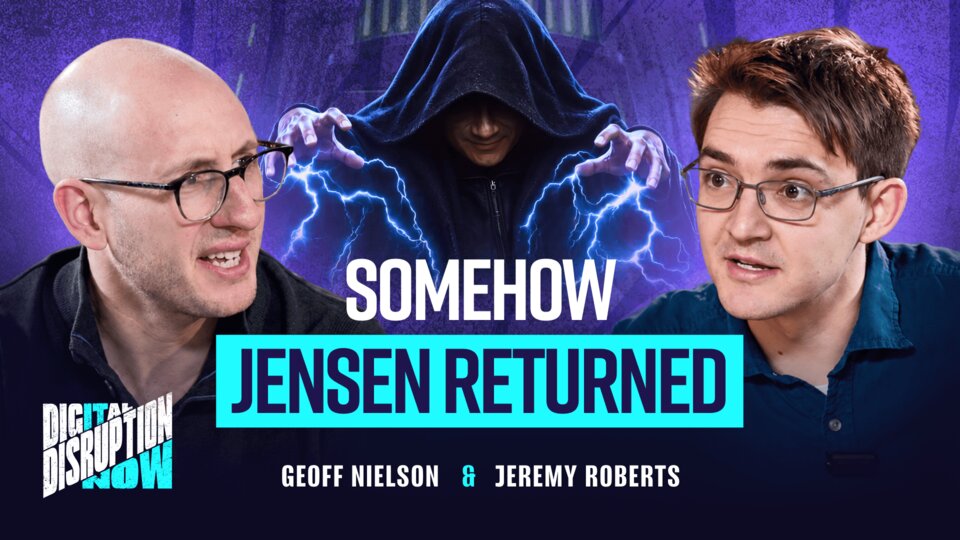
Jensen Huang is Back and We Hate It
Tech moves fast. So does work. Digital Disruption NOW helps you keep up and make sense of what matters.
Being a successful CEO shouldn’t make you untouchable. This week, we’re taking on the Jensen Huang controversy and asking whether NVIDIA’s board can hold its most powerful executive accountable. We also unpack major IT outages and business continuity, debate claims of a Claude-powered Riemann hypothesis breakthrough, and discuss what AI means for jobs.00;00;00;00 - 00;00;22;16
Speaker 1
I hate this story. I wish we didn't have to cover this story, frankly, but, like, it's just such a mess. It's a political mess. It's an economic mess. And I just think it was like, just like a terrible decision to bring them back. Setting aside the whole spy thing, which is a ludicrous statement, by the way, just setting aside the whole espionage thing, the affair should have been enough.
00;00;22;22 - 00;00;42;06
Speaker 1
And there were so many of them. And now he's back and the board is effectively toothless. We have decided that if you're Jensen Huang, you can do whatever you want. You can commit egregious corporate sins, and you are so valuable that you are untouchable.
00;00;42;08 - 00;01;00;05
Speaker 1
So Jeff, it is actually iPhone Duo Day. Isn't this the greatest thing you've ever seen? I'm actually like, it's smaller than I thought it would be. Like, I'm kind of underwhelmed, to be honest. Oh, but like, then you open it up. Look at that. You're going to tell me that that's not a prime reading experience? Well, you're the guy who has the tiniest e-reader in the world.
00;01;00;10 - 00;01;15;17
Speaker 1
I do. It's actually right here. Yeah. So. And it's it's very tiny, but like, this is for content. So I can actually have two tiny e-readers up at once. Have you ever wanted to read the New York Times and the Financial Times at once. And I've never wanted that. Like James Garfield, who could write in Greek and Latin, one with each hand.
00;01;15;24 - 00;01;32;04
Speaker 1
Is that decided? And James Garfield. That's a fun James Garfield fact. He also would have survived had the doctors not stuck their fingers in his wound and gotten it nice and infected, and they invented an early metal detector to find the bullet in him, but it was screwed up because he was on a metal bed and they didn't even think about that.
00;01;32;07 - 00;01;51;20
Speaker 1
Where you go? It's like all James Garfield facts all the time here on digital this show. I thought we were talking about iPhones and suddenly it's James Garfield. What would James Garfield have thought of the iPhone? I don't I know actually surprisingly little about James Garfield, to be honest. He was he's a didn't have a chance really to spread his wings in the way that other presidents did.
00;01;51;23 - 00;02;13;20
Speaker 1
But I'm assuming he would have said, wow, what a pinnacle of American innovation. The most successful consumer product in history. Yeah. Comes roaring back in 2026 with a redefining moment, building an underserved segment into the future of the phone. Well, we'll see what the sales have to say about that. They sell all the ones that they can make.
00;02;13;23 - 00;02;34;29
Speaker 1
There they are. They're doing a limited production run. I read of 6 million and they've sold out completely. And, you know, if you do an ASP of, what, $2,200 or whatever, you let, how many iPhones do they sell in a year? Hundreds of millions. Yeah. So it's a rounding error for the actual iPhones. Yes. But like in terms of, you know, the success of this individual product, it's a super premium product.
00;02;35;04 - 00;02;53;20
Speaker 1
And like, I don't know, Jeff, like, you can send me a message on teams and I've got YouTube right here. And I just watched the video and I can just swipe you away, but I can see what you said. It's super convenient. Wow. It's super. Well, you're going to you're going to be on this journey with me, my friend, because I'm going to be bringing this thing to the office every day.
00;02;53;22 - 00;03;13;15
Speaker 1
It's I can't wait. It's going to be your privilege. It's. And if you're lucky, I might let you send a message or watch a video on it. Perhaps we can choose one AirPod on the plane. I'm great. Aziz. Thanks. Well, Apple has had, we'll say, a good week, but maybe not every other company. Well, Apple. Apple had an outage in the past week too.
00;03;13;16 - 00;03;27;20
Speaker 1
Didn't they? They did. And I think we're going to be talking about that in today's episode of Digital Disruption now. Yeah, let's talk about it. So what are we talking about today? We're going to be talking about outages. We still can't figure agree on what story we want to tell. Second, maybe we'll talk about Waymo being banned on California freeways.
00;03;27;27 - 00;03;49;02
Speaker 1
Maybe we'll talk about anthropic, solving the Riemann hypothesis, one of the millennial millennium math challenges. I think I'm on team math for this one, Jeff, because while Waymo getting banned from freeways is actually a really good like, podcast story because there's footage of it. Yeah, it's pretty funny. You can see the car trying to get around like a rolling police roadblock of the cop.
00;03;49;05 - 00;04;08;26
Speaker 1
The fee, it's like, hey, no, don't go around me. And it's like, you can tell he really wants to arrest Waymo, but he just can't. So that's good. But at the same time, I think that maybe for our listeners and our viewers, the implications of the Ryman hypothesis, that's how you pronounce it, are probably more significant than one small setback.
00;04;08;26 - 00;04;26;13
Speaker 1
And what is otherwise been a pretty successful self-driving program. So I vote for the millennium. Okay. That's fine. We can we can talk about that one. And then I guess we should talk about Jensen Long as well. This is a story like I really don't want to talk about. It keeps on giving. Yes, it's going to be giving for a long time I think.
00;04;26;16 - 00;04;41;04
Speaker 1
But yeah. Should we talk about outages first? Yeah, sure. Let's get into it. So why don't I introduce this one? Because I made a little chart that our viewers at home can't see. So a little over a week and a half ago, we had a bunch of outages. And I wrapped up a list of the top five.
00;04;41;06 - 00;04;57;09
Speaker 1
So Microsoft is probably the most notable in terms of number of people impacted. And that was of course an outlook issue. And they've since published a full retrospective, you know, a root cause analysis on what went wrong. And it seems like they pushed a bad change a few months ago and only felt the implications of it today.
00;04;57;09 - 00;05;26;20
Speaker 1
So nobody had email and it was Microsoft. 364 3/8 of uptime Microsoft inspired long weekends. That was fun. The FAA nationwide ground stop due to a contractor swapping a router in Arkansas. Allegedly that one was pretty bad. JPMorgan had some issues processing transactions. There was an Apple outage that affected iCloud, Apple Pay. I didn't notice this, incidentally. And then NSA had an issue on its internal network that they alleged was due to maintenance, and it really felt like everything was sort of going to crop all at once.
00;05;26;21 - 00;05;42;05
Speaker 1
Jeff. So what are your thoughts on this? Well, there's been a lot of stories here about like, oh, was it some kind of cyber attack? Was it AI related? Was it just like a really boring IT story? And you know, the party line on all of this is like, no, it absolutely was not a cyber attack. In some cases.
00;05;42;05 - 00;06;03;20
Speaker 1
It's literally a party line to be clear. Right? Right. In terms of the NSA, is that the. Well, like just in terms of like it's a political issue, right? Talk a lot about AI. Yeah. Know for sure. And to me, like like we may never know the truth in terms of whether there was a cyber attack, but to me, like, there's, there's like a more important story here, which is like, could it have been a cyber attack?
00;06;03;22 - 00;06;30;12
Speaker 1
Of course it could have been, because so much of this infrastructure, almost everywhere is vulnerable to cyber attacks. Like this is just like an ongoing challenge. So could it be a cyber attack? Yes. Could it be something related to trying to implement AI? Yes, it could be in my books. Could it just have been like, these are really rickety old infrastructures and every time we push a deployment wrong or do a hot swap or something, if we don't do it right, it has catastrophic consequences.
00;06;30;14 - 00;06;58;13
Speaker 1
Yeah, all of the above are possible, and all of them to me, point back to the fact that we have really crappy business continuity planning, that we have really bad deployment hygiene, that we have issues around our cyber preparedness. And all of these in some ways are like super boring IT problems, but just like have worldwide consequences. And so I think like we just have to get really serious about getting these like basic bread and butter issues.
00;06;58;13 - 00;07;14;05
Speaker 1
Right. And I think technology leaders like, yeah, it's boring. It's way less sexy than like, oh yeah, look at what this cool thing AI is doing for us. But it has to be done. Like, you can't just be like, oh, sorry, I was so busy. Like planning the AI future of our company that like, I let the entire.
00;07;14;09 - 00;07;19;15
Speaker 1
We had to ground every flight in America, you know? Well. So. Okay, let's let's actually talk about the.
00;07;19;15 - 00;07;41;09
Speaker 2
Cause this year, right? Because there's a lot of speculation. But in each case, they've published, again, a root cause or a retrospective. So Microsoft says the defect was triggered by the combination of three operational conditions reduced production capacity due to planned maintenance. So they took some stuff offline a shift of teams traffic to the exchange online gateways. So reduced capacity, increased demand and then peak North American traffic.
00;07;41;09 - 00;07;55;17
Speaker 2
So everybody was on at the same time. And there was some latent defect that they pushed in July. Basically, their testing did not mimic the real world. And so when they hit this perfect storm, everything came down. That's extremely boring. Well, and by the way.
00;07;55;19 - 00;08;03;17
Speaker 1
He's traffic is like, that's such a bullshit answer. Like and if you've been like doing it deployments like, yeah, you should know that peak traffic is going to happen.
00;08;03;18 - 00;08;27;06
Speaker 2
Well, they say with the presence of the latent defect, their combined effect exposed the issue which caused servers to come unresponsive. So they're describing it as 3 or 4 things all going wrong at once, which is why they pushed this change that caused the problem so many months before it actually happened. The FAA said that their legacy equipment became unstable when data began that began flooding their network at a rate of 11 or 1000 connection attempts every 4 to 5 seconds, and this disrupted the communication system and created instability.
00;08;27;09 - 00;08;45;23
Speaker 2
JP Morgan Chase said that there was a software bug. Apple pushed a bad change. The NSA blamed their outage on internal maintenance. Basically, everyone has said it's not AI. It's not. It's not a cyberattack. And to me, this story is a story for like a handful of reasons. Right? So like there's a bit of bad luck these things happening one after the other.
00;08;46;00 - 00;09;04;02
Speaker 2
There's a tendency in media to clickbait a fair amount. So if you're like a freelance journalist and there's a couple of outages, you're going to be looking to mop on this because you can pitch it to an editor. Like if the NSA outage had just happened on its own, I don't think we'd be talking about it. The Apple Pay outage would have been a really minor story coming on the heels of everything else, it looked really bad.
00;09;04;09 - 00;09;08;10
Speaker 2
You're not getting around the ground. Stop though. That was that's only happened three times in history.
00;09;08;10 - 00;09;11;05
Speaker 1
Well it was yeah. It was the longest ground stop since nine over 11.
00;09;11;09 - 00;09;33;02
Speaker 2
Yeah. Which that's obviously a huge deal. And again, there is no there is no getting around that. That was that was massive. But like to me this is a story about, as you say, rickety infrastructure. It's a story about managing your technical debt. It's a story about and forgive the the metaphor here, but fixing the plane while you're flying it, it's a story about the increasing pace of change.
00;09;33;05 - 00;09;53;10
Speaker 2
Right. So fundamentally, it's these things are inevitably going to go wrong when you have a highly centralized IT service environment. So, you know, everybody gets their email directly through Microsoft who manages it. When they have an issue, everybody has an issue. Right. And so I think you hit the nail on the head. This is a story about business continuity.
00;09;53;10 - 00;10;02;00
Speaker 2
So we just have to accept that in the world that we built this is going to happen. So the real question is like what do we do about it. And that's that business continuity piece.
00;10;02;01 - 00;10;20;04
Speaker 1
Well, well, but there's like another piece too, which is you kind of alluded to it, but like all of these answers are like very technical and boring. And I feel like even if you're on the board or you're the CEO of these organizations, like you can't help but have your eyes glaze over when somebody like explaining to you like, oh, it was these three different things.
00;10;20;04 - 00;10;39;18
Speaker 1
And they were each, you know, there was a latent thing from like, it's just it's not that compelling. And so much of this comes down to and I think it was really, really important for technical leaders that this all comes down to trust and credibility. And like, there's just very little appetite at senior levels of the organization for the technical details.
00;10;39;18 - 00;10;59;16
Speaker 1
And so you have to be able to do your best to have proper hygiene and build credible processes here. But then you also have to be able to tell the story and be able to, like, bounce back quickly and just create credibility that you can prepare for these things and you can react to these things versus like, oh crap, what have we possibly done?
00;10;59;18 - 00;11;02;15
Speaker 1
You look very incredulous.
00;11;02;18 - 00;11;21;03
Speaker 2
It's not so much about incredulous. It's more like, okay, if you're a Microsoft. Like Satya Nadella was a technical executive who rose through the ranks and guarantee you he cares a great deal about the specifics. Now, if you're a Microsoft customer, you actually don't care about the specifics. And those are the eyes that are glazing over. And there's that famous serenity prayer, you know, except that which you cannot change, right?
00;11;21;04 - 00;11;35;08
Speaker 2
I think that there is an element of accepting that which you cannot change. But, you know, the corollary is you have to focus on the things that you can change. And so you can work on your preparedness, you can work on your business continuity. Right. People talk about disaster recovery. Disaster recovery is what Microsoft does to get their system back.
00;11;35;08 - 00;11;56;23
Speaker 2
Online business continuity is what you do to make sure that you're not sending all of your employees home. When such an outage occurs, and your business continuity planning could involve redundant systems. But like, who's going to build a parallel email system like I pay Microsoft for exchange online, but I'm also going to buy some some third party service, or I'm going to use exchange on prem or something like, no, you're obviously not going to do that.
00;11;56;23 - 00;12;12;06
Speaker 2
So you have to figure out what happens when email goes down. Incidentally, this was a very peaceful outage for me because I got no email updates saying that there was anything wrong. And we read a live event and I, I went like six hours before I realized that Microsoft was having a worldwide outage because email went down. It was so peaceful.
00;12;12;09 - 00;12;30;08
Speaker 2
It was like during Covid how like all the birds returned. It was, you know, it was maybe a little refreshing. But yeah, from a perspective, you know, make sure that you don't have anything integral built into this. Like I read a story about an alerting system that used email and went down and caused a real health and safety issue.
00;12;30;09 - 00;12;47;02
Speaker 2
Like, that's bad. You shouldn't be set up that way. In our case, I actually didn't know where to go for updates. It turns out it was a teams channel. Although teams is also sort of affected. Not to the same degree. So yeah, there's things that you can do, and I think it's incumbent on every technology leader to figure out what they are and execute against them.
00;12;47;03 - 00;13;06;16
Speaker 1
Right. And as you said, there's sort of two parts of this story. There's what does everybody do if Microsoft goes down. And I agree with you, I don't think the answer is, just build a backup Microsoft. But the idea that you can't communicate with your company anymore because you don't have email like and as you said, like teams worked perfectly well and well.
00;13;06;16 - 00;13;09;05
Speaker 2
Not perfectly well. Well, it was not.
00;13;09;08 - 00;13;47;13
Speaker 1
At all. It was functional. And people still really struggle with that. So I think being able to answer that question is super, super important. So because we're so reliant on on single vendors and single piece of technology, but for Microsoft or for anybody who has customer facing infrastructure, that is like mission critical to the global economy, like, yeah, like there's just a level of expectation around redundancies, around things going wrong, around rollbacks and just making sure that you're super, super crisp on what your plan is and that you've got really good visibility into this because it just things go wrong.
00;13;47;15 - 00;13;54;04
Speaker 1
And, you know, if you let them go to wrong, it's billions and billions of dollars and you know, your credibility on the line. Right?
00;13;54;05 - 00;14;10;03
Speaker 2
Well, I mean, on the plus side, if you were a Microsoft customer and let's say your relationship with your customers was impacted by the email outage, it's not like they're going to be like, how dare you not ensure that your email is up? Like everyone's kind of in the same boat. Like, I once work with one of our members on an island and they said, what if a ship's anchor drop and cuts off internet to the whole island?
00;14;10;03 - 00;14;24;17
Speaker 2
I'd be like, well, then your customer is probably a bigger problems. You know? They're not going to blame you for that. So there's a little bit of comfort in being just part of the herd in that respect. But I agree with you completely and instantly. This isn't the first time this has happened. We had a very notorious Cloudflare outage a couple of years back.
00;14;24;18 - 00;14;35;18
Speaker 2
Last year. We had, AWS goes down on occasion and brings, you know, the entire internet down with it. This isn't the first time Microsoft has had an outage. So it happens.
00;14;35;23 - 00;15;00;18
Speaker 1
Now do you by there's there's another narrative happening right now, which is that with AI, with infrastructure getting longer and longer in the tooth, with more sophisticated cyber attacks from AI, that we're just going to see more and more outages. Like I saw, I saw sort of a misleading chart the other day that was like it didn't show it as a projection, but it had 20, 27 as like almost asymptotic, like the the curve just goes way out of it.
00;15;00;20 - 00;15;02;25
Speaker 1
And I'm curious if you buy that narrative.
00;15;02;25 - 00;15;29;24
Speaker 2
I do. I think that the pace of everything is increasing dramatically, like we used to put out patches in bulk, you know, on a, on a several times a year sort of cadence. And now we use DevOps and we're pushing hundreds of changes a day. Right. And that inevitably increases your surface for things to go wrong. I also read a story, I think, that the Wall Street Journal, they reported that at least some experts believe that response to to zero days revealed by AI is part of what's driving this speed.
00;15;29;28 - 00;15;47;02
Speaker 2
So as organizations try to remediate things that they discover at an increasing pace, they are not deploying those patches. They're not making good changes. I mean, bad changes. And that's why we're experiencing this. It's all speculation. But yeah, 100% by it. Like we're in a world where everything is getting faster and faster and faster and faster and faster and faster and faster.
00;15;47;08 - 00;15;56;02
Speaker 2
And I think we'll just hit a point where we are, you know, deploying thousands of times a day, microscopic adjustments to, to to defend against the, the inevitable.
00;15;56;09 - 00;15;59;13
Speaker 1
In an automated way. Right. Like people aren't doing that. Well.
00;15;59;15 - 00;16;03;16
Speaker 2
Hopefully they'll be in the loop to some degree. But AI is certainly, I think, going to be the driver.
00;16;03;17 - 00;16;05;04
Speaker 1
Right? Right.
00;16;05;06 - 00;16;08;14
Speaker 2
And I mean, I think it's actually a good segue into our into our next.
00;16;08;14 - 00;16;25;29
Speaker 1
Story here. Well, do we want to do is it ad read time or should we go right into the next story? Okay. All right. Let's read the ad okay. Do you want to read the ads today okay I would love to. It's a it's that honor. Okay. So I talked to a lot of CIOs, although in a slightly different capacity than Jeff being the host of our main digital disruption show.
00;16;26;02 - 00;16;48;26
Speaker 1
And everybody knows that running a successful IT shop is extremely hard. And AI has only made it worse, going from dozens to hundreds to thousands of changes in a short period to, you know, the drill. Immature processes, a fragmented data ecosystem, and unlimited demand for it. It all makes for an impossible job. And yet nobody has invented a unified operating system for it.
00;16;48;27 - 00;17;15;17
Speaker 1
Can you believe that? We are literally the last function without one until now. That's why Infotech created CIO analytics, a single platform to run the IT department. We call it API driven advisory. It's powered by your data, our analyst insight, and it works with your existing tools right out of the box. Better context, better insight, better IT performance only with API driven advisory, only with Infotech.
00;17;15;19 - 00;17;36;27
Speaker 1
Check it out at the link below. What do you think Jeff? How do I do? Beautiful ad read I loved it. All right, now let's talk about anthropic. Yeah. So went public actually just last week to initial success and then somewhat less success. Yeah. Brought down by the broader retrenchment in the AI space. So I love this story.
00;17;36;29 - 00;17;59;09
Speaker 1
So a gentleman named Levent Al Paga, I believe that's how you pronounce it. Claims to have solved the Ryman hypothesis. And you know what? This is the hypothesis. I mean, I'll take a run at it in a way that I'm. You know, I'm not a PhD in math, but, I mean, do you want to try it or do you want me to to do you want to kind of pressure test the way I described?
00;17;59;13 - 00;18;23;15
Speaker 1
So my high level understanding is that it's essentially a hypothesis about how distribution is right. And something interesting is I was doing research for this show, is that we've always actually just assumed that the Ryman hypothesis was true. And like a lot of modern mathematics, are actually built on the assumption that it is true. So this guy coming along using Claude and actually producing a proof for the Riemann hypothesis is neat.
00;18;23;18 - 00;18;40;08
Speaker 1
But it's not like now we have to throw all of our assumptions out there. Right? But this is one of the millennium problems. So I think it's a Clay Institute offers $1 million for solving the millennium problems. One guy, Gregory Perlman, a solved 1 in 2002. They actually offered him the prize. You know what he said? Said no, he didn't want it.
00;18;40;09 - 00;19;01;03
Speaker 1
He didn't take the million dollar. He's damn mathematicians. He's he's he's very well known for turning down like, the Fields Medal. He turned down another award in the 90s. Super interesting guy. He was the only like human who has solved a millennium problem thus far. That's been confirmed. And then earlier this year, Navier-Stokes, which is another one that was solved allegedly by OpenAI, I think.
00;19;01;06 - 00;19;22;11
Speaker 1
And this is anthropic. So so this gentleman, he said he used an unreleased AI model that feels like cheating a little bit, you know, and he formalized the proof in this programing language or it's not a program in lean in lean. Yeah. It's a it's a tool that's used to, to basically if it compiles then the input is valid.
00;19;22;12 - 00;19;41;27
Speaker 1
Right. And I won't pretend to understand the specifics of that. But the people who do say, well, it did compile. So it seems like it's true, but a lot of mathematicians have come out and they said, well, it looks looks right, like it's incredibly dense and complicated, 250,000 pages. Right. He came out and he said that was a joke.
00;19;41;29 - 00;20;00;17
Speaker 1
Did he? Yeah. He apparently on social media, he said the 250,000 number was a joke. But it's very long and complicated and people don't understand this especially. Well, I do want to read a quote from him in his announcement that made me laugh really hard as I read it. And I thought, man, if you know, if math is ruined, at least he's got a career in literature.
00;20;00;19 - 00;20;27;21
Speaker 1
He said, Claude and I have had a great time together with such breadth in recent months, but this time Claude far outpaced me near the finish line. No. Claude flew and danced and sparkled near the finish line. I had a son. The line of combining two quite different ideas present in a toy setting, one of which was already new and shocking, making very simple one of the shadows of Raymond over which we mathematicians felt the most triumph.
00;20;27;23 - 00;20;43;11
Speaker 1
I guided us to the right situation, analogous to that toy setting. And then Claude began to leave me in awe. Wow. And that's for posterity, judge. And and a poet, a mathematician and a poet. Super interesting guy, by the way. He's quite young. He's. He's in his 30s, actually, born the same year as me. So there you go.
00;20;43;12 - 00;21;03;22
Speaker 1
I'm quite young. Take that. To take that. Folks who think I'm not quite young. He's got a PhD from Princeton. He works for anthropic. For anthropic. So, I mean, what do you make of this, Jeff? Is this, like, a fundamental blow to mathematics, to the broader world? I mean, like, I can take out the world's smallest violin for mathematicians themselves.
00;21;03;22 - 00;21;22;28
Speaker 1
Like, to me, like, it's not a glamorous job, really? No, but it's like it's so overwhelmingly theoretical, right? Like, this, to me, is just like, I don't know, puzzles for the sake of puzzles, you know, and people being clever and coming up with clever puzzles and being even more clever and coming up first. Jeff doesn't care about encryption.
00;21;23;01 - 00;21;55;05
Speaker 1
I don't care about about artisanal encryption. Let's put it that way. Right? Oh, and so, so so the math piece, like, yeah. Does it change mathematics? I'm sure it does. Does that change everything outside of mathematics? Not not explicitly, but but a couple of things have caught my attention. One of them is, you know, I was thinking about AlphaGo, and if you remember AlphaGo from a handful of years ago, you know, one of the last generation generation of A's that could actually be people at go this incredibly complicated, you know, thousands old game.
00;21;55;08 - 00;22;12;25
Speaker 1
And if you remember the story of when it when it beat the Grand master or whatever 2017 I think. Yeah. When a beat this guy like it just it made him move somewhere in the game where the guy was like, no human would ever have made that move. Like it just it came up with ways to play that no human had ever done before.
00;22;12;27 - 00;22;34;20
Speaker 1
Like, it was kind of like rewriting the rules of how to play go properly. And I've heard a little bit about like that, maybe what's happening here as well. Like, did it have to uncover new branches of mathematics to come up with this solution? Like, we don't we don't have all the answers there. But sometimes when you give it a prompt or you try and do something, you're not giving it all the intermediary steps.
00;22;34;22 - 00;22;55;18
Speaker 1
That's how AI works, right? Like it gets there on its own. And how it got there may actually be way more interesting than where it got. Well, that's that's true for all mathematics. So Terence Tao, who sort of become the spokesperson for math, I guess, and so far as math can have one, he I think was lamenting AI because of what it does to like the process.
00;22;55;18 - 00;23;12;21
Speaker 1
So like take chess computers, for example. I'm a little bit more familiar with that than I am with like AlphaGo. So in the 90s, right, you had Kasparov playing Deep Blue. He wins and he loses. And like now we have computers in our pockets. That can be Magnus Carlsen and Jesse. Like, you know, if you want to, like the technology has progressed really dramatically.
00;23;12;26 - 00;23;31;29
Speaker 1
We still play chess, though, because the intellectual, you know, joy of playing chess is quite valuable. And in a field like math, I mean, how you get there is just as important as you actually getting there. And understanding the proof matters a lot. And, you know, the intellectual curiosity that comes from pursuing branches of the process. Very important.
00;23;31;29 - 00;23;50;11
Speaker 1
And I think we just lose that if we skip right to the end. You know, it's like somebody handing you $10 million instead of you having to work and then wondering five years from now why you don't know anything about the world. Well, but I but but I think there's a slightly more positive angle, which is that so like human brains are only getting smarter at such an impressive rate.
00;23;50;12 - 00;24;11;13
Speaker 1
Right. Like there with, you know, standing on the shoulders of giants and all that. I don't know that we're actually getting smarter, but but that's it, that's it. But a guy is right. So if AI is getting exponentially smarter and we can look at the solution it found, and that increases human knowledge. Like that's exciting. That's still us learning at a pace that we may not be able to do without.
00;24;11;13 - 00;24;31;11
Speaker 1
AI like that is an exciting development. And I agree, like I don't think the answer is exciting. I think that understanding is more exciting, but these are just like these are math machines fundamentally right? And so it's not shocking to me that we've built something that's gotten better than the human frontier at math. And that's where we live now.
00;24;31;11 - 00;24;51;20
Speaker 1
And like, it's a little bit, you know, jarring and can give you, especially if you're a mathematician, like, you know, a sense of an identity crisis if you're not at that frontier anymore. But like, surprise, we're there and we're not going back. So I think, like, it's just going to force us to reckon with this new reality. I mean, I think it's a super compelling case.
00;24;51;20 - 00;25;07;25
Speaker 1
And as I was studying this, I thought, this reminds me a lot of genetic genealogy, like the DNA technique that they used to catch serial killers. It was like for a long time there were these, like great unsolved problems. We have the millennial millennium problems, excuse me in math. And we have, you know, the Golden State killer in California.
00;25;07;26 - 00;25;24;12
Speaker 1
And then eventually a technology comes along that allows us to just, like, solve it all these years later and, you know, it it involves a lot of effort and computing power in the case of AI. But like, they get there and they can do it. It doesn't mean we don't have serial killers anymore. Probably not. Does it fundamentally change the investigative landscape?
00;25;24;15 - 00;25;54;01
Speaker 1
Absolutely. Does it have problems? Do some people dislike it? Yes. Like the analog was pretty close. And so thinking that we went from one millennium problem solved to possibly three, with two of them happening in the last couple of months. I mean, let me put it this way. If I worked in any sort of job that required creative problem solving, math or not math, and I look over to my left, my right, and I see somebody over there using Claude to literally achieve the highest possible achievement in a discipline.
00;25;54;07 - 00;26;14;12
Speaker 1
And I realize that's sort of a general purpose thing. My job is to solve hard problems. Maybe they can take that thing that just solved that hard problem and pointed at my hard problem. I mean, I think that's where the the angst comes. Well, so I don't buy that. And I and I want to come back to the analogy of the like the, the DNA to solve murder cases.
00;26;14;15 - 00;26;39;05
Speaker 1
And by the way, like I love the analogy of like solving math problems to solving murder cases. Just the math problems. Take the murder cases and then take absolutely everything interesting practical about them and just strip them down to like a bunch of numbers and like, mathematicians can throw their tomatoes at me or whatever. But in the case of that, like, if you are a detective, you just you can't just solve murders artisanal anymore, right?
00;26;39;06 - 00;26;56;26
Speaker 1
Like this technology exists and it's functional. It's better at solving murders than your hunch. If it works, you have a responsibility. Have a responsibility to use it. And does it mean that we replace detectives? No. It means that detectives have a whole new toolkit that makes them substantially more effective at their job. And does that change in some ways?
00;26;56;26 - 00;27;22;00
Speaker 1
Kind of like the architectures or structures of like how policing and forensics works in a huge way, and we're going to see that again in a huge way with AI. But like we're here and it's better and it does these things. And like math is a frontier there. And we'll keep having more frontiers. And I don't know, like we seem to be talking about all these areas equally, like, oh, you solve math.
00;27;22;00 - 00;27;42;24
Speaker 1
Therefore you can completely understand like the human condition and organizational dynamics and actually make the right business decisions. And, you know, I think we're making some very large leaps there, but it's extremely effective at a large number of things. And yeah, as we were just saying, I think there's like a responsibility to use it. If you're going to get the best results, there's.
00;27;42;24 - 00;28;01;19
Speaker 3
Going to be more AI in math in the future, not less. And I've been seeing a ton of cope out there online. And now now the mathematicians, they can throw their tomatoes at me. People say, oh, it was a centaur who solved it, right? Like, you know, this mathematician, he used AI and without him, the AI wouldn't have known what to do.
00;28;01;19 - 00;28;34;28
Speaker 3
And that's probably true right now. But that's like saying, you know, cars and horses will work together because there are some roads that cars can't traverse. But like, eventually we kind of got rid of the horses. So I feel like there is a world where AI just becomes so effective that a lot of what we traditionally found value and meaning, and even in these highly in the fields like pure mathematics, just it becomes pointless, it becomes artisanal, it becomes a hobby in much the same way that if, like an alien came to Earth and said, we will destroy the Earth, unless you beat us at chess, we wouldn't say, well, it'd be unfair to use
00;28;34;28 - 00;28;50;17
Speaker 3
an AI. We would send our chess computer to play them. We wouldn't send the best human player in the world, because when it actually matters, you use the technology that's best for the job. So that's my controversial take for this episode. It is that anybody who says, oh, it's an augmentation, you know, it's not coming for your job.
00;28;50;17 - 00;29;02;08
Speaker 3
The future is people who use AI. I actually disagree, I think for a lot of jobs it is coming for your job and it will be better at it than you. And that may or may not be a good thing. Probably isn't for society, but that's the direction we're heading.
00;29;02;13 - 00;29;24;04
Speaker 1
I, I don't fully agree with you. I'm going to take a slightly more middle of the road approach. I do think it's going to take over a lot of work. I do think it's going to reshape a lot of jobs that exist right now. And I've had this argument before, like on the podcast. But first of all, the people who seem most worried about people about AI taking their job, they're not actually worried about AI taking their job.
00;29;24;05 - 00;29;28;06
Speaker 1
You know why? Because their job sucks. They're worried about AI taking their income. Yeah.
00;29;28;06 - 00;29;31;13
Speaker 3
And that's a whole that's a that's a political conversation for for sure.
00;29;31;14 - 00;29;55;15
Speaker 1
And it's a societal conversation. But I think that there's no shortage of things for people to do. And I'll come back to the analogy about policing and forensics and solving murders. Like, there will be things we talked about it earlier, like cyber defense and cyber security. There will be a lot where like, yeah, probably humans are not going to be doing the patching themselves in the next few years.
00;29;55;15 - 00;30;16;19
Speaker 1
It may get completely automated, but does that mean that there's nobody in kind of the technical organization of a company? I don't buy that. I believe that the shape is different. I believe that there's a lot more tools helping out. But the idea that like, oh, like, to me, it comes back to this like story you hear sometimes about like AI replacing all coders.
00;30;16;21 - 00;30;36;12
Speaker 1
And if you believe that coders just like type on keyboards and generate code and that's all they do, then yeah, of course it will. But like, coders have to think about what they want to solve and they like there's so much wrapped up into it, from understanding the requirements to the testing to the actual making sure that it can deploy properly to like all the governance around it.
00;30;36;12 - 00;30;48;14
Speaker 1
And like we've seen these outages though, and like, will we get to a level where AI replaces all of this stuff like maybe 60 years from now? But I don't see this as like a short term reality.
00;30;48;19 - 00;31;07;03
Speaker 3
Like it's ratcheting up faster than you can imagine. This is I think it's almost four years to the day that ChatGPT dropped. Its fundamentally changed the world, and it fundamentally changed the world almost the minute it dropped my analogy, because I'm full of analogies. This is like the Age of Sail, which ended in sort of the 1840s, 1850s.
00;31;07;04 - 00;31;23;28
Speaker 3
They started throwing steam engines on ships with sales for a hybrid approach. That sort of where we are now, right? Like, oh, you know, you're going to you're going to be augmented by AI. You know, the sales aren't going anywhere. I mean, you know, what if what if you run out of coal, you know, but now ships don't do that.
00;31;24;02 - 00;31;45;18
Speaker 3
Okay. And so I, I am increasingly skeptical of this. And I will just say I don't think that socially as like a species, we are ready for the idea that there are a bunch of people who will receive, but not contribute in the sense that the work that they would have done has now been taken up, and the economy can't move quickly enough to to to replace those people into, into better jobs more suited to their skill sets.
00;31;45;21 - 00;32;00;25
Speaker 3
We don't tend to like that. People don't tend to like handouts or the idea of handouts. And so we'll have to probably get pretty used to that idea if AI is going to eat everyone's lunch. But that is probably a conversation for a different, much more political podcast than this one. So maybe I'll leave it there.
00;32;00;28 - 00;32;26;14
Speaker 1
Yeah. As I said, I don't agree with you. I like first of all, I like. The handouts thing. We can talk about another time, but I don't think it's taking everybody's jobs. I think we're at least not anytime soon, like we're so many chess moves. To use an apropos analogy, from math to general understanding of how organizations work and what needs to be done that it's going to like, it's going to create so much more opportunity.
00;32;26;20 - 00;32;39;05
Speaker 1
And it's, as I said, there's a lot of jobs that are very kind of administrative and operational, that are at risk, and a lot of tasks and tons of jobs that are at risk. But I'm, I'm I'm not there with you, man.
00;32;39;07 - 00;32;58;08
Speaker 3
So you're not you're not going to write everyone off. Well, I will say that a lot of people do jobs that they don't like doing. And if AI happens to make that, you don't need to be an administrative assistant. What? Maybe an AI company owner founder would tell you is great. Now you get to go do something more valuable and more fulfilling.
00;32;58;11 - 00;33;09;16
Speaker 3
But history to me has not demonstrated that that is necessarily the trajectory that we will follow. So it's, I guess, my job on this episode of Digital Disruption now to be the show pessimist.
00;33;09;20 - 00;33;09;24
Speaker 1
Well.
00;33;09;24 - 00;33;21;06
Speaker 3
There you go. So please leave your comments down below. If you agree with me or you agree with Jeff. Anybody think AI is going to take everyone's jobs or do you agree with Jeff and are therefore incorrect? Those are your two options.
00;33;21;09 - 00;33;22;24
Speaker 1
I want to Europe. I want to hear a.
00;33;22;29 - 00;33;25;17
Speaker 3
Why don't we talk about our friend?
00;33;25;19 - 00;33;25;28
Speaker 1
I didn't.
00;33;26;02 - 00;33;32;14
Speaker 3
Hear somebody who didn't lose their job. That's exactly right. The Jensen Huang. So what happened there, Jeff?
00;33;32;17 - 00;33;36;09
Speaker 1
So, I mean, if you haven't been following along at home.
00;33;36;09 - 00;33;38;02
Speaker 3
So it probably got where.
00;33;38;02 - 00;33;38;21
Speaker 1
Where do we want.
00;33;38;21 - 00;33;39;15
Speaker 3
A smart speakers.
00;33;39;15 - 00;33;49;21
Speaker 1
And where do we want to start? So Jensen Wong has an affair with one of Nvidia's business partners, the CEO of Mega Speed, who is a suspected Chinese spy.
00;33;49;22 - 00;33;51;23
Speaker 3
We're pretty sure at this point we're.
00;33;51;26 - 00;34;14;20
Speaker 1
Yes, we're very we're quite sure. And he's suspected of what's the language we want to want to use here? It'll legally transferring chips to China in circumvention of export control. That would be the concern. So he's been lobbying publicly for Nvidia to be able to sell more chips. As far as I know, that's not illegal. I know there's been some deals that have been struck.
00;34;14;20 - 00;34;32;22
Speaker 1
He's struck up quite a close relationship with the administration in pursuit of this goal, which is interesting because like Nvidia doesn't have a demand problem, but I guess he's solving maybe a future demand problem. I don't know, I don't know. So so he's suspected of illegal behavior here, right. That's the concern. Although the government has said that they're not going to charge him with anything.
00;34;32;28 - 00;34;54;05
Speaker 1
Right. Which is a bit a bit challenging given that there's normally like a 20 year, you know, sentence for this and $1 million in fines. I mean, yeah, is a big deal. It's a big deal. And by the way, two more at least affairs with direct reports, he resigns. The board says there's no way he's coming back.
00;34;54;07 - 00;35;18;19
Speaker 1
The stock drops 30%. The US administration starts strong arming the board. Yes. And surprise, surprise, you know, he's back, and I like. I shouldn't say that to somehow Jensen Huang returned. Yeah. Yeah, exactly. And, like, unless you're buddies with Jensen Wong. You know, people are not happy about this. There's an abstract like the market so far.
00;35;18;20 - 00;35;36;07
Speaker 1
Like the the one day after he was back did. Well, it's down again. And like, depending on the day you're watching this episode, I'm sure it's going to yo yo now, because now the entire Nvidia stock has been politicized. Like it's just I don't think this is the end of the story. I hate this story. I wish we didn't have to cover this story, frankly.
00;35;36;07 - 00;35;57;28
Speaker 1
But like it's just such a mess. It's a political mess. It's an economic mess. And I just think it was like, just like a terrible decision to bring him back. Now. It was a good decision. I believe it was actually a really good decision for Donald Trump. It puts him in a position of extreme power, which is like, you know, good, good chess playing over there.
00;35;58;02 - 00;36;18;24
Speaker 1
But I think it's like quite bad for like the broader economy. Is it better chess playing than a computer? Jeff. Maybe we'll shelve that. What would the computer have done if what would the computer have done? I have no doubt that somebody went to grok and was like, Should Justin Wong be CEO? Still, to me, this is like a way more boring story than like salacious spy allegations would indicate.
00;36;18;24 - 00;36;36;17
Speaker 1
So basically, you know, invidious boards that we're going to appoint a chief compliance officer, we're still going to do the investigation. The fed said he's not under criminal suspicion. Didn't know she was a spy. But like, that's basically everyone who's commented on this has said, that's kind of the point of spying. Like, you feel like you don't show up and you're like, I'm a spy.
00;36;36;21 - 00;36;56;25
Speaker 1
Like, I think you're really attractive, but I'm a spy, just so you know. So if you want to pursue this, like, just be aware that you're anyway. So. So that happened. He resigned under, like, tremendous pressure. And then I guess he had, like, a marathon confession session with the board. And the Wall Street Journal was reporting that it was at least two more affairs.
00;36;56;25 - 00;37;13;14
Speaker 1
So if you do the math, we're up to, at least for now, quite possibly more than that. And they said, you know, they they appreciate that he's honest with them. But like, I guess he wasn't before or he certainly wasn't honest with, with everyone. So, at least of which his family. And so to me, this is like a much more boring story than that, though.
00;37;13;16 - 00;37;40;09
Speaker 1
This is this is corporate governance. The point of a board is to make sure that your management runs the company in the best interests of the company. They are the check and balance against a CEO. Having a fair is with direct reports or spies or, you know, any sort of corporate bad behavior. In 2019, the CEO of McDonald's guy named, I think, Steve Easterbrook, he got fired because he had a he had an affair with somebody in his brain.
00;37;40;10 - 00;38;05;18
Speaker 1
Yeah. And like, that's just the bare minimum of acceptable corporate behavior is like, do not have affairs with your direct reports and setting aside the whole spy thing, which is a ludicrous statement, by the way, just setting aside the whole espionage thing, the affair should have been enough. And there were so many of them. And now he's back and the board is effectively toothless.
00;38;05;18 - 00;38;25;23
Speaker 1
We have decided that if you're Jensen Huang, you can do whatever you want. You can commit egregious corporate sins, and you are so valuable that you are untouchable. Yeah, and that's terrible for invidious long term. And I do, because now you have this board of directors that can't do anything like, Jeff, I report to you, we are in a corporate structure.
00;38;25;25 - 00;38;44;14
Speaker 1
You are my boss. I have people who report to me. Imagine I fired one of them. And then you came in and said, actually, no, you're back. That was the wrong choice. What's my relationship with my reports like now? It's certainly not one of authority. And that's where we are with Jensen Huang. So to me this is an absolute disaster.
00;38;44;14 - 00;38;52;07
Speaker 1
And yeah, the stock popped a little bit. It's volatile. But like this is so dangerous for the long term I think it is too. And like I like I'm probably.
00;38;52;07 - 00;38;56;13
Speaker 4
Not going to make any friends like defending the board of Nvidia right now. And I don't love.
00;38;56;18 - 00;38;58;13
Speaker 1
Independent board. Yeah. And I don't love.
00;38;58;13 - 00;39;20;23
Speaker 4
Their decision. But look their stock is down you know 30%. Yeah. You've got the US administration putting its thumb on the scale being like bring this guy back. And it sounds like you know I wasn't on these phone calls, but it sounds like it was. There were a lot of phone calls. It was pretty aggressive. You know. And we know that the US administration like they will make your life miserable if you don't do what they want.
00;39;20;24 - 00;39;46;22
Speaker 4
And that to me sucks. Like it sucks that they're a powerful enough entity that their sway these markets. Right. Like like they're they're stepping on the independence of these boards and these markets like that's something that is like very rare typically in US politics, like we've talked about in the past, like the US government actually, you know, buying up a stake in companies to make sure that they don't go under.
00;39;46;22 - 00;40;08;02
Speaker 4
This happened. Yeah. Yeah. GM, AIG like it happened during the, you know, the Great Recession. But to actually say like, no, you have to have this leader because we like the guy, man. That's like that's a dark road to go down. And again, to defend the board like your stock prices down. You've got this insane pressure. I absolutely see why buckling and saying like, yeah, okay.
00;40;08;04 - 00;40;30;16
Speaker 4
We'll just bring them back is the easy solution. And by the way, the market in one day rewarded them for that. But I don't think that's the right way to look at it. I think what we've done is taken a stock price where it's like in some ways artificially deflated and doing the right thing creeps back up to where it should be is, you know, a lot better of a path than it being artificially inflated and then creeping down.
00;40;30;16 - 00;40;50;02
Speaker 4
Because where do you go from here? Like the whole organization is compromised now. And, you know, I don't know how you get out of this. And frankly, I think if the board had any teeth at all, they would be saying, okay, Jensen is part of this. We need to start putting together a succession plan for you, because they were totally caught flat footed when he left the first time.
00;40;50;06 - 00;40;57;10
Speaker 4
60 direct reports. You know, they bring in Colette Kress. I think her name was as the Fo. And I don't.
00;40;57;10 - 00;40;58;13
Speaker 1
Know, she was the interim CEO.
00;40;58;14 - 00;41;20;02
Speaker 4
Interim CEO. She's immediately catching flack and, you know, yada, yada yada. 11 days later he's back. Right. Like we need to have a better succession plan than this. Because if and when something like this happens again, it's in the best interest of the company to be protected and learn something from this. And like, if we can't learn something from this that is just deeply, deeply depressed.
00;41;20;03 - 00;41;43;12
Speaker 1
It's funny that they didn't have a chief compliance officer before, so, well, it's a bit of a bit of a blind spot there. The other thing that I'll say here is, look, this board has lost all credibility. I think they need a new board. I think that there's this idea, like criticism of sort of modern, I guess, corporate economics, the short termism.
00;41;43;15 - 00;42;08;17
Speaker 1
Right. I my bonus is quarterly. You know, I have to report quarterly earnings, come out, you know, on a regular cadence. And some of my, my horizon is roughly the length of, of that earnings reporting cadence. And that seems to me to be the issue here. Like yes, Nvidia took a beating after Jensen Huang left. Undeniably, investors were spooked.
00;42;08;21 - 00;42;23;05
Speaker 1
But like the fundamentals of the business didn't change. No, it wasn't like people were going to stop buying GPUs because Jensen Huang was gone. That's just that wasn't going to happen. And so I think they could have weathered the storm absolutely nicely and they'd.
00;42;23;06 - 00;42;23;18
Speaker 4
Be better.
00;42;23;18 - 00;42;37;11
Speaker 1
For it. They would in the long run because the board is actually exercising governance. They're actually exercising their function. So in a way you've got like the banana republic of corporations now and not literally the banana Republic, which is a subsidiary of gap.
00;42;37;15 - 00;42;37;22
Speaker 4
Their.
00;42;37;22 - 00;42;55;17
Speaker 1
Lowest performing subsidiary. And it goes Old Navy Gap, Banana Republic. I looked that up yesterday for some reason. Not not specifically because I was going to make that remark, but it's it's just governed totally chaotically. There is no governance. Jensen Huang can do whatever he wants. Like I think he actually has a get out of jail free card right now.
00;42;55;21 - 00;43;12;28
Speaker 1
Like I think he could say, okay, you know what? Like, I'm I'm going to engage in some really egregious behavior. And you think the board is going to fire him? No, because they've shown that they they defer to him. And there was another big story. I was reading the FTC this morning about space X and Tesla pursuing a potential merger.
00;43;13;00 - 00;43;24;08
Speaker 1
And I think it's a it's a committee of five disinterested, which is different from uninterested directors, three from one to from the other. I can't remember the mix. And they have to decide if this makes sense, like.
00;43;24;08 - 00;43;27;23
Speaker 4
Corporate governance matters. Yeah.
00;43;27;25 - 00;43;44;23
Speaker 1
Like if these people are under the thumb of someone like Elon Musk, are they going to make the right decision for shareholders or are they going to make the right decision for Elon Musk. So like again, this Nvidia situation different from the space and Tesla one. But corporate governance matters. Yeah. We can't just shove that under the rug.
00;43;44;23 - 00;44;04;25
Speaker 4
Well and I think you know it's depressing to say I think we're in a real dark age for corporate governance now in general. So many of the biggest tech stocks have their toothless when it comes to corporate governance. And again, we have an administration that I think in some ways prefers that. And so I don't know, it's going to be really interesting to see where we go here from the next couple of years.
00;44;04;26 - 00;44;19;05
Speaker 4
And like, look, I get why I get why powerful leaders of these organizations don't like corporate governance. They want to do what they want. They don't want checks and balances. I get that they want to move fast and break things.
00;44;19;06 - 00;44;26;23
Speaker 1
And that's a market Zuckerberg ism, who I believe has a special class of share that right gives him control, if I'm not mistaken.
00;44;26;24 - 00;44;34;19
Speaker 4
Yeah. And you know Elon is not too far off. You know he if Elon dies tomorrow what happens to the stock. You know like it's like that's not.
00;44;34;22 - 00;44;35;29
Speaker 1
Probably not a good thing. Yeah.
00;44;36;00 - 00;44;59;06
Speaker 4
Yeah. So so. It's extremely in vogue right now. And I think it's extremely dangerous. And I see like the seductive reasons why you would want lighter corporate governance. But it's just like you need grownups in the room. Like I don't know how else to say it. We've learned the hard lessons before, and I'm worried that we're going to do a lot of damage, and then we're going to learn the hard lessons again and be like, oh yeah, corporate governance.
00;44;59;06 - 00;45;10;14
Speaker 4
Like, I wonder why nobody thought of that. So yeah, I think we're just writing that wave right now, and I hope we can learn our lessons sooner and with less, you know, collateral damage to people's retirements funds than if we do it the hard way.
00;45;10;16 - 00;45;25;14
Speaker 1
I think everybody's learning their lesson right now. If you're like Nadella over a Microsoft, you're like, how many direct reports can I actually have? Let's do a hundred. Then if they fire me, you know, it'll be totally chaotic. Actually, I don't think Nadella would do that. I think Microsoft is actually quite, quite well governed by a lot of metrics.
00;45;25;21 - 00;45;42;27
Speaker 1
So yeah, I mean, I look, I agree with you. I'm sad that we had to talk about that. Like, this is, I think actually a very dark day for, for the governance of, of large organization that would comment about this to, to a journalist. And yeah, maybe my passion came through in the text. So this is terrible. Yeah.
00;45;42;29 - 00;45;48;13
Speaker 1
Can't can't let this happen. So yeah, hopefully the right people learn the right lessons is all I can say from this.
00;45;48;14 - 00;45;58;05
Speaker 4
Yeah. And I wish I wish I were optimistic about that but well you know we'll see what the future brings. You know hopefully there's some good that comes out of this at some point down the road.
00;45;58;08 - 00;45;58;20
Speaker 1
Yeah.
00;45;58;21 - 00;45;59;13
Speaker 4
Yeah, yeah.
00;45;59;14 - 00;46;04;24
Speaker 1
And maybe now Jensen Hong has a place to be other than at home, which I imagine is probably not.
00;46;04;26 - 00;46;05;07
Speaker 4
Yeah.
00;46;05;10 - 00;46;06;29
Speaker 1
Not the best place for him right now.
00;46;07;04 - 00;46;07;20
Speaker 4
Yeah. I can.
00;46;07;20 - 00;46;09;05
Speaker 1
Only spend some time at work.
00;46;09;08 - 00;46;11;24
Speaker 4
Well I think I think this is basically run its course.
00;46;11;25 - 00;46;12;27
Speaker 1
I'm certainly.
00;46;12;27 - 00;46;15;03
Speaker 4
Angrier than I was when I started the conversation.
00;46;15;03 - 00;46;31;23
Speaker 1
Than I hope you're not. Well, I, I want to know if you're angry or if you know. Are you Team Jensen? Is anyone Team Jensen just because he's good for portfolio. Round of applause I came back yeah, yeah. Gunpoint. No, no they they were. He walked into like the lobby and everyone was around and he was saying, you know, he was sorry for everything that he did.
00;46;31;24 - 00;46;48;28
Speaker 1
And they were clapping and hooting and chanting. They were very happy for him. Yeah, it's an interesting one. But let us know what you think. And hopefully you found this discussion insightful or at least interesting and amusing. And we'll catch up with more stories next week. Digital Disruption now is a production of Infotech, which employs both me and Geoff.
00;46;48;29 - 00;47;06;18
Speaker 1
My name is Jeremy Roberts, this is Geoff Nielson. You can check him out weekly on Digital Disruption, where he interviews luminaries in the fields of tech and business. I think my favorite interview of the past little while has been with Johan Stoica, who is one of the founders of Databricks. What's right in a billionaire tech founder? So definitely check that out.
00;47;06;25 - 00;47;25;22
Speaker 1
The show is produced by Koula Bouloukos. Our technical director is Tim Lai, our two camera ops here, one of whom will probably edit. This is Brian Moggach, our Brian Moggach and James Groome. Thanks, Brian and James. Special thanks to Maria Knight and Holly Calnan for all the work that they do holding down the fort. We will see you next week.



The Next Industrial Revolution Is Already Here
Digital Disruption is where leaders and experts share their insights on using technology to build the organizations of the future. As intelligent technologies reshape our lives and our livelihoods, we speak with the thinkers and the doers who will help us predict and harness this disruption.
Listen


We Discuss
Jensen Huang is Back and We Hate It
Being a successful CEO shouldn’t make you untouchable. This week, we’re taking on the Jensen Huang controversy and asking whether NVIDIA’s board can hold its most powerful executive accountable. We also unpack major IT outages and business continuity, debate claims of a Claude-powered Riemann hypothesis breakthrough, and discuss what AI means for jobs.

Listen
Our Guest Ion Stoica Discusses
AI Has Three Critical Problems | Tech Billionaire Explains How They Could Derail Everything
Ion Stoica, Databricks co-founder and UC Berkeley professor, sits down with us to explain three gaps holding back enterprise AI: defining what we want, modeling the real world, and verifying the results.
Listen
We Discuss
The AI Hype Is Out of Control. Or Is It? | LIVE DEBATE
Is AI living up to the hype, or are we betting too much on it?
Listen
Our Guest Chris Lattner Discusses
The AI Coding Revolution Has a Dirty Secret
Chris Lattner, creator of Swift and LLVM and co-founder of Modular, joins this week’s episode to talk about coding, vibe coding, and why more code doesn’t always mean better software.