
Digital Disruption
with Geoff Nielson


Our Guest Ion Stoica Discusses
AI Has Three Critical Problems | Tech Billionaire Explains How They Could Derail Everything
Why do AI breakthroughs struggle to deliver results in the real world?
Ion Stoica, Databricks co-founder and UC Berkeley professor, sits down with us to explain three gaps holding back enterprise AI: defining what we want, modeling the real world, and verifying the results.
We talk about AI agents, the risks of replacing enterprise software with AI-generated code, and why human expertise still matters. This conversation also emphasizes what AI means for jobs, leadership, and education, including why using AI to finish your homework doesn’t mean you’re learning.
Subscribe to Digital Disruption with Geoff Nielson for weekly conversations on AI, technology, and the future of work.
00;00;03;08 - 00;00;27;20
Ion Stoica
I heard so many cases in each, even at the top. I companies the top labs. You know, if people say I try to optimize it and building in my experiment is working. But when I deploy in production, the gains are very small. If any. And the likelihood that you are going to missing is very high, it will be a painful, iterative process.
00;00;27;24 - 00;00;37;22
Ion Stoica
New failures you never thought about are going to happen. The things you do not change or don't change fast are going to dictate the velocity of AI.
00;00;37;24 - 00;01;05;15
Geoff Nielson
None of these challenges or risks strike me as things that are going to be solved next year, because the technology just got more advanced. AI is being built as a solution to every problem in the world. Anthropic IPO filing claims it solves everything from drug development to guacamole placement in restaurant kitchens. But what happens to the revolution if A's advances in math, science, and coding don't actually translate to the real world or the enterprise?
00;01;05;17 - 00;01;30;09
Geoff Nielson
My guest is Yann Stoica, billionaire co-founder of Databricks and long time Comp Psi professor at UC Berkeley. He spent his career building the systems that make modern computing and AI possible, both in the lab and in wildly successful companies. So when John says that three unclosed gaps will limit AI's usefulness and where it will ever be successful, I'm inclined to listen.
00;01;30;11 - 00;01;36;26
Geoff Nielson
I'm Jeff Nielsen, and this is digital disruption.
00;01;36;28 - 00;01;56;13
Geoff Nielson
Well, young, thanks so much for joining today. Really excited to have you here and be speaking with you. I wanted to pick your brain a little bit. I mean, you've been in this space for so long software, AI, enterprise systems. And there's so much talk right now about, you know, AI and systems and how they're going to completely rewire everything we do.
00;01;56;15 - 00;02;14;19
Geoff Nielson
I'm curious from your perspective and what you've seen, how impactful you see this actually being. Is the hype validated? What sort of impact do you see them currently having and on the trajectory to have both in terms of how they rewire organizations and impacts on people's jobs?
00;02;14;22 - 00;02;48;18
Ion Stoica
Yeah, I think first of all, thanks for having me. It's my pleasure to and I think it's, it's a complex general question, which and the answer has many facets. So about talking about the agents and here we are talking about, just to be very clear, you are talking about some LLM doing something in a loop and, providing at the end of the day, some artifact which is going to be used, for solving a particular task.
00;02;48;23 - 00;03;14;29
Ion Stoica
Right. It can be programing and optimizing a system or filling in some forms or things like that. Right. That's kind of the task. Now, the first thing I would like to say is that, again, just to make sure that AI and at least agenda and also identity systems are kind of good at that. If you think about everything we do, almost everything we do has three parts.
00;03;14;29 - 00;03;37;28
Ion Stoica
First, it's about it's a we need to decide what we are going or what problems we are going to work on, or is that is given to us right by your supervisors or by your advisors or right. Then you are going to come with some solution. You try to solve that task or to solve the problem. And then this is finding the solution.
00;03;37;28 - 00;04;04;27
Ion Stoica
And the third part, it's about checking that the solution, the outcome generated by the solutions are what you want it right. Verifying the solution. So A is particularly good in the middle part finding the solution right. This is what happens. And its impact depends on the use case and on the task. You are you are a trying to accomplish.
00;04;05;00 - 00;04;39;05
Ion Stoica
And obviously we know every in some cases it's extremely effective, like mathematics. Like we've seen in some cases it's less so, especially when the human judgment, it's and the outcomes are hard to measure, right, are more subjective. So the way I see it, you know, to think about, about this, let's take, for instance, coding agents.
00;04;39;07 - 00;05;05;14
Ion Stoica
Right. In general, because this applies to many other things. So it's coding agents. What happens? You have this kind of like we discuss loop, which is very similar, is a loop with a development loop people used for decades, software engineering used for decades. So you have a human or an agent which iterate on a program until it passes some evaluation, after which is probably deployed to production.
00;05;05;14 - 00;05;26;08
Ion Stoica
And before then you just iterate, right? And when you develop, you develop based on kind of a formulation of the problem. The requirements right in software will be product requirements document. And then when you kind of test it and so forth, you you test it. You have a testing environment a simulator. It's an approximation of radial world. Right.
00;05;26;09 - 00;05;44;17
Ion Stoica
It's a it's a model of the real world. Right. By real world here I'm talking about deployment environment. Right. What is the things is going to actually to be deployed and used and fundamentally and this again this is, this is this are two gaps which are there for decades also in software engineering. Because again this slope is similar.
00;05;44;17 - 00;06;16;28
Ion Stoica
Right. You just instead of human you have an AI an agent. Right. It's a but you have these two gaps. So one gap is between the user intent and the requirements, what it conveys to the AI agent. Right. It's a gap. And one is because between this kind of model and environment in the real world. And I think this is where actually into these gaps, you have this kind of reward hacking.
00;06;16;28 - 00;06;51;11
Ion Stoica
You have these things like hallucinations, and these are kind of very consequentials. Let me give you some examples. Like for instance, say, you, you want to or I have this example is like, which is maybe simple. You want, you want to build to have a vacuum robot. Right. And, you would like to say, okay, you know, to what, what?
00;06;51;13 - 00;07;12;13
Ion Stoica
Think about what you want to optimize. Maybe you want to optimize some natural metric. It's how much dust or garbage it picks from the floor of the floor. Right. And the impact of that, you know that. You know, you you can you just what you are going to get at the end. Maybe you are going to get a robot.
00;07;12;14 - 00;07;43;28
Ion Stoica
What is picking the dust from the floor or garbage? Then he spill it over and pick is again. Why? Because this way is maximizing how much garbage epics from the floor right now you think about. Okay, I should have said that this is a gap, right? My intent, obviously, is never that robot to spill over the garbage on the floor or, you know, but I and I didn't convey that, you know, to the to the AI.
00;07;44;00 - 00;08;06;24
Ion Stoica
Right. And that's kind of a gap because the AI, you know, in this case is doing what it's supposed to do, maximizing a metric, which was how, you know, to how much garbage I'm picking on the floor. Right. And why didn't I say that? Well, I didn't say that because I don't even think about that. A vacuum robot should spill over garbage on the floor, right?
00;08;06;26 - 00;08;42;09
Ion Stoica
If this is my context, you know, it's like, that's kind of the definition of the vacuum, right? You know, pick the garbage of the floor. And but of course, this context may not be available to the agent. And these things over and over. This is kind of a requirement gap. Right. Or you know, like in some of the, some, you know, some of these kind of cases in which AI attacks various organizations, you have maybe a sandbox, which is supposed to be almost by definition, shouldn't be connected to the internet.
00;08;42;09 - 00;09;06;05
Ion Stoica
But somehow there is a way is still obsessive the internet. Right. That's kind of a model gap. So these are kind of where issue happens. You know, it's like between kind of the model you assume about the real world. And the real world is self. And between the user intent and what you convey to the AI agent. Okay.
00;09;06;08 - 00;09;23;29
Ion Stoica
The same is like with robotics, right? Is like robotics. If you think about one of the biggest problem, it's about modeling the real world. Right. And use maybe your simulators and things like that. It's always a problem. It's always a gap. Right. So so this is what and why I'm talking to you. I'm telling you about these gaps.
00;09;23;29 - 00;10;01;06
Ion Stoica
And this is an evaluation gap as well. I, I'm not going to talk about for now because where the domains where AI is very successful is when these gaps are very narrow or don't exist. Take the math for instance, in math, there is no this kind of model gap because between, you know, say, the testing environment and the real world, because the real world in mass is the axiomatic systems within, you are going to provide the proofs.
00;10;01;08 - 00;10;22;09
Ion Stoica
Right? So there is no gap. Right? And also on the requirement gap is not really a gap very there because these are the results of sorry, these are problems or conjectures. Conjectures which are there for years, for decades. Right. That's how you solve them is a big deal because they are there for decades. People did not solve them.
00;10;22;09 - 00;10;40;11
Ion Stoica
So now you've solved them. So this means that they are refined. They are very well specified. It's not like, oh, I'm thinking I want to prove the results. And I write the theorem. And maybe there is a gap between what I wanted to prove and the theorem is right. It's like maybe I didn't express it. So it's a perfect example.
00;10;40;13 - 00;11;12;13
Ion Stoica
But whenever you are going to have these gaps, you know, it's more challenging, right? Because and in general, for instance, the least for the requirement gap, as long as AI serves humans, the ultimate context, the intent lies with the humans. So only they are going to be able, at least as some level, to validate that the behavior of what you build, the systems, the robot or whatever satisfies their intent.
00;11;12;16 - 00;11;40;18
Ion Stoica
Right? So that's kind of I think one way to look at that, this I would say number one, the number two, we are talking, I think that when you, when you, when you have this kind of, look to develop the particular artifact and so forth. You need always to look at this about like, and in many cases, the bottleneck becomes the evaluation.
00;11;40;22 - 00;11;50;16
Ion Stoica
Right. How you make sure that what you develop satisfy the requirements and the user intent. And.
00;11;50;18 - 00;12;20;02
Ion Stoica
Especially when AI is applied to physical work, that evaluation becomes really the bottleneck. Right. And it's going to slow down. I think that that's why physically I will take more time than people believe. Right. Because, you know, you need to test it in the real world. You cannot accelerate. It's not everything digital, like robotics, like drug discovery and so forth.
00;12;20;02 - 00;12;44;05
Ion Stoica
You need still to, to, to go through, you know, to have clinical trials and so forth. It's going to take time. And it's not only about, oh, you need to do clinical trial because, you are required to do so. But it's fundamental because you need a new drug to test long enough. So you see there are no significant side effects.
00;12;44;10 - 00;13;10;14
Ion Stoica
Right. So the limit is kind of the human, body to respond to the drug and to see what happens in the longer term. I think that's kind of I would, I would, I would say, and the last thing I would say about the agents and this is maybe touches about the jobs and I'm happy to after this kind of a long answer to go into more details.
00;13;10;16 - 00;13;16;25
Ion Stoica
It's like I am on the camp that.
00;13;16;28 - 00;13;50;23
Ion Stoica
AI it's a, it's a tool. It's a and, yes, it's a very powerful tool, but it's still a tool. And, if you look back in history and so forth. It's like people who get most out of the tool, then most benefits from the tool are the people who are experts in the domain they are using. All right.
00;13;50;26 - 00;14;19;29
Ion Stoica
So if I am even if I want to do a mass, solve a mass problem, still, if I'm a mathematician, I'm going to get more benefits from the tool from AI than someone who doesn't know math. Right. And this was always true. Like if you have a hammer, a carpenter will get a lot of more kind of benefits and value from using that a hammer, then I can.
00;14;20;00 - 00;14;26;28
Ion Stoica
Right? So yeah, that's kind of, my bake.
00;14;27;00 - 00;14;51;26
Geoff Nielson
I talked to a lot of CIOs, and everybody knows that running a successful IT shop is extremely hard. And AI has only made it worse. You know the drill. Immature processes, a fragmented data ecosystem and an unlimited demand for it. It all makes for an impossible job. And yet nobody has invented a unified operating system for it. We're literally the last function without one until now.
00;14;51;28 - 00;15;13;19
Geoff Nielson
That's why Infotech created CIO analytics, a single platform to run the IT department. We call it API driven advisory. It's powered by your data, our analyst insight, and it works with your existing tools right out of the box. If you're interested, click on the link in the description to request access and check out CIO Analytics and Action for yourself.
00;15;13;21 - 00;15;34;00
Geoff Nielson
An Infotech team lead can get you started. Same day. Better context, better insight, better IT performance only with API driven advisory, only with Infotech. There's certainly a lot to digest in there and a lot of follow up questions I want to ask. So let me maybe attempt to digest some of it and ask you if you follow up questions.
00;15;34;00 - 00;15;55;08
Geoff Nielson
So first of all, I really like the the way you laid out some of the gaps, both the requirements gap and, you know, the model gap there. And they're very intuitive to me as well. And I've, you know, I've been someone who's been talking for a long time about the importance of clear requirements as it pertains to getting to an actual valuable solution.
00;15;55;10 - 00;16;20;20
Geoff Nielson
But, you know, to me, one of the implications of what you're saying is that we've found a lot of these use cases, like math already, where there's low, I guess, low enough ambiguity and low enough complexity in the requirements in the actual modeling environment, that this makes it a good fit and an environment where there's substantially more ambiguity, substantially more complexity.
00;16;20;22 - 00;16;55;12
Geoff Nielson
It will just be and remain very difficult to to leverage these tools in a very powerful way. And so if I yes, the implication there to me is that this, this set of tools, as you described it, is probably going to continue to remain a tool to augment what people and organizations are doing now versus a wholesale replacement of jobs, of functions because of the necessity of having humans have basically generating the requirements and testing the outcomes.
00;16;55;13 - 00;16;58;12
Geoff Nielson
Yes, yes. Is that fair? And is that changing in a big way?
00;16;58;19 - 00;17;21;25
Ion Stoica
That's fair, that's fair. And we are going to see a constant effort to narrow these gaps because these gaps are very hard to close. And again, they are there for a long time. The software engineers struggle with those for a long time. That's why you have, you know, product. You have all this discussion between the product management and the engineers right there.
00;17;21;27 - 00;17;38;27
Ion Stoica
Product manager say, you know, builds this router. And then the engineering started to code and say, or it used to say it's a, you know, like even before I oh, you know what I should hear. You know what? You know, if I get this package, should I prioritize it or go back and. Oh, I think you should. Right.
00;17;38;28 - 00;17;58;26
Ion Stoica
So it's all this kind of effort and we as a human to, to to kind of close the gap. But intuitively why is hard to close the gap is because how would you close them. Right. One way to close them and maybe to have a simulator of the for requirements gap of the human in all of the relevant aspects of that task.
00;17;58;29 - 00;18;21;29
Ion Stoica
Right. Or you have exhaustive and operation of what happens for this kind of case, what will happen, right. Or something like that, which is very hard and with with a word. It's again, it's like like you're trying robotics. You, you, you have a you are going to try to have a simulator of the real world. But that's kind of very hard.
00;18;22;01 - 00;18;51;05
Ion Stoica
And it's so it's another aspect. It makes it hard. We are living in an open, changing work. So assume that today you have everything nailed. But tomorrow the workload can change, the hardware can change. New failures you never thought about are going to happen. Right. So it's kind of always that's why it's so difficult. But you know, there will be constant efforts to close this gaps and is going to be better.
00;18;51;12 - 00;19;21;13
Ion Stoica
By the way, another area in which you've seen a lot quite a bit of success of AI. It's about chip design, right? But the chip design is also, easier for several reasons. One is because kind of the word is a kind of instruction set architecture. A register transfer level kind of these abstractions. And also they have a very good verification.
00;19;21;16 - 00;19;44;05
Ion Stoica
Right? And yeah, we've seen quite a bit successes. But again, the, the gaps are narrower. By the way, I said that there is another gap. It's a valuation gap. Let me talk a little bit about that one as well. The evaluation gap is the following is like I get the requirements and I do have this kind of model of the environment.
00;19;44;13 - 00;20;16;27
Ion Stoica
Let's say they are good perfect. Now the question is that my evaluator, if I if my program passes the evaluator, is it guaranteed that under all the execution in the given model is going to satisfy the requirements? Right. All possible execution. Now in general, the answer to that is now why? Because if you think what is the evaluator in a lot of windows software development today, mostly it's a test suite, right?
00;20;17;01 - 00;20;44;04
Ion Stoica
In the test suite it checks that for a branch of inputs, the outcomes, the results of the program are meeting, are passing the test. Which means that how you know a satisfying the requirements. But it doesn't say anything. You cannot prove that is also true for any kind of input, right. Or for some assumption or settings.
00;20;44;04 - 00;21;12;04
Ion Stoica
In the real world you didn't capturing the testing, right? Like for instance, I test for failures in which a machine just is fails or failures. The machine just stopped to work. But maybe in the real world I'm going to start seeing this intermittent failure like memory corruptions. It's a different kind of failures. I, I didn't test for that.
00;21;12;06 - 00;21;42;24
Ion Stoica
Now that gap is kind of we call the valuation gap. It can be closed when with this formal methods. Right. And people try more and more to do that. You have formal you are going to, you know, your if you have formal specifications which captures the property of the system, which are the requirements and assumptions about, you know, the, the real world.
00;21;42;24 - 00;22;14;12
Ion Stoica
So this is a model and a model environment model. Then is you can generate, code and proof that the code satisfy this kind of specification, in fact, for math. That's why it's it's a great example because the evaluation gap doesn't exist either because they use Lin. Right. There was formal methods to guarantee it. There is a proof actually is kind of, indeed proves the results.
00;22;14;17 - 00;22;53;27
Ion Stoica
Okay. So in general you have three gaps, right? You have the requirement gaps between the human intent and what you convey, the requirements to convey to the system, to the AI system you have the model gap is between the model. You are going to implicitly or explicitly assume when you develop the system and the real world where the system is going to be used, and then is the evaluation gap, assuming that these are the requirements and this is a kind of environment model, then the evaluator, if you pass the evaluator doesn't guarantee that in all situations, under all executions you are going to satisfy the requirements.
00;22;53;29 - 00;23;20;09
Geoff Nielson
Let's let's stay maybe on math for a minute because there's another, there's another lens here that's coming to my mind and it's coming up in math, but I think it's you can easily extrapolate it, which is explainability or lack of explainability, because this is one of the topics people are talking about in math, which is, you know, we can't necessarily explain the results, but we have some, evaluation that that demonstrates that it's correct.
00;23;20;16 - 00;23;33;05
Geoff Nielson
Is this is this just a reality that we're going to have to get used to living in? Is it a problem we're going to be able to solve? Well, what do we have to understand about explainability?
00;23;33;07 - 00;24;00;05
Ion Stoica
I've seen that. That's a very, very important aspect. I think this is has is critical with our ability to accumulate knowledge. And I mentioned earlier on there are these kind of three, stages for every task or problem you pick, the problem you want to solve, you get this, you find the solution and you verify that the solution, it's indeed solving the problem.
00;24;00;07 - 00;24;27;04
Ion Stoica
We talk a little bit about the middle one and the verification. But in general we didn't talk about the first talk, like for instance in math. And I'm not a mathematicians, but in math is like a huge value is to come with these kind of conjectures to the, to the, to the with, with the theorems. You have to prove right because that's map the directions of where the mass is going, right.
00;24;27;05 - 00;24;52;23
Ion Stoica
What the results you have to prove. And then, you know, if you prove them you say, okay, this is correct. So I have more information. I can go even more in that direction surviving at the action directions. Right. So you cannot get that without understanding. Right. That's kind of and that's why you want and I, I, I, I remember I read recently that they're kind of this kind of so to speak.
00;24;52;25 - 00;25;21;09
Ion Stoica
You know, maybe venues or conferences in which the value and how the papers are going to be evaluated. Math papers. It's about how easy is to understand the proof, right? Because if you understand the proof now, you have this kind of more knowledge and you can map the direction or the mass is going right, because that's still probably the human is the best position to do so.
00;25;21;11 - 00;25;50;01
Ion Stoica
So that's why it's very important, very critical. Let me give you an example. It's a it's more of a, you know, from our research, kind of like, so for the past few months, you know, well, we we are looking and looking. We're using agents to optimize systems or more recently to synthesize systems for, you know, since June last year, which is an eternity in the.
00;25;50;01 - 00;26;15;18
Ion Stoica
I worked and so when you jump in on this very, quite early and for, you know, past few months, one problem we wanted to synthesize, not optimized, not given the crowd of a system, hey, optimize it, make this load balancer faster or router faster or whatever. Faster. Right. But we want it to, synthesize from scratch a key value store, right?
00;26;15;18 - 00;26;44;06
Ion Stoica
Because, you know, it's if you can do that, it's going to be very cool because then for any workload, for any kind of deployments in terms of the target, you know, hardware, number of nodes, I can generate a system, right. And I have a few students working on it. And the students, again, they spent time also over the summer at various companies which are doing this kind of self-improvement or something like that.
00;26;44;08 - 00;27;13;16
Ion Stoica
And still, you know, it's it was difficult, although it was a very simple system or a relatively simple system. A key value store is still challenging because of these gaps and so forth. So at the end of the summer, I ask them, you know, like for people, for students. And my question was, if you were because, you know, you got some results, but the journey was not as smooth as we anticipated in terms AI solving everything.
00;27;13;18 - 00;27;47;25
Ion Stoica
So ask them, hey, if you were to go back, what you do to do it differently. So all of them, their question was so there was, well, I would have read more papers about this particular problem domain. So understand better so I can be more effective in guiding the agents to solve the problem. So it's the same thing about the understanding it's key right.
00;27;47;28 - 00;27;53;08
Geoff Nielson
No. Yeah. It comes back to the requirements gap piece. And just the better you understand the better you prompt the more.
00;27;53;12 - 00;28;14;15
Ion Stoica
What is the word. It's exactly. It's it's. Yeah, it's exactly that and also go back to the point is that if you, you know, if you, if you still think about AI as a tool, the experts in that domain gets the most benefits of the tool, right?
00;28;14;17 - 00;28;40;09
Geoff Nielson
Digital disruption has partnered with McLean and company to bring you the human centric AI program. If you're a knowledge worker, you've probably noticed that your colleagues are all using AI, and it's not always pretty, but it's a solvable problem. It's not a tools problem, it's a people problem. And yet we keep training on tools. McLennan companies human centric AI program is a judgment first learning experience built to drive AI impact at scale.
00;28;40;11 - 00;29;11;27
Geoff Nielson
Three self-paced learning paths, plus lid expert led sessions and content that evolves as AI does. Better judgment, better outputs, better outcomes. Check it out at the link below to learn more. I wanted to come back to that because I thought it was pretty interesting that you said you're using it to synthesize and not optimize, and definitely not. You didn't even put in the list, replace existing systems because that's something that I hear, you know, certainly in the media a lot about that.
00;29;12;03 - 00;29;28;24
Geoff Nielson
Well, suddenly now with agents and with, you know, AI coding, you can just replace enterprise systems with these kind of custom built AI systems. And I'll tell you, that makes me extremely nervous. But I wanted to get your perspective on what's what's realistic.
00;29;28;26 - 00;29;59;24
Ion Stoica
But I know it's much harder. And for the same reason I it's it goes back in some things to the gaps. It's much harder than anticipated. And here is one reason. If I give, if I am going to take a system and I'm using AI to optimize it, that system, the code embeds a lot of requirements edge cases, functionality is there, right?
00;29;59;27 - 00;30;08;01
Ion Stoica
So you get all that. Context is part of the requirement is part of the model. So.
00;30;08;04 - 00;30;35;17
Ion Stoica
If I start from scratch I need to specify everything. Right. There is no kind of that context. So it's much harder. So you really only if you can. It's a game. If you can specify everything it's okay. It's it's good right. It's going probably it's going to work. But at some point. But that is very, very hard right.
00;30;35;19 - 00;31;00;15
Ion Stoica
Because this is, this is the thing is that like, for instance, you know, there are you can specify, okay, there are, formal languages and like, clean for math and others or CoC or others, but if still need to write, the specification and specification is can be very long. So again how do you know this writing the specification.
00;31;00;17 - 00;31;28;19
Ion Stoica
There are no mistakes. How do you know that is indeed reflect the user you know intent. So so this has a kind of challenges you have to deal. You have you know, that's why some people are saying, you know, like it's harder to write a spec because than just write the program itself. Right? So these are kind of the challenges you have to deal with.
00;31;28;22 - 00;32;01;26
Ion Stoica
And at the end of the day, again, you have to close these gaps. And if in the domains you can close them or you can listen to them significantly, AI is going to do a pretty good job. But but again like in for very complex software we are not there yet. Right? I heard you know you can even optimization is hard because you can optimize in one place and it can have unfortunate, impact in other places.
00;32;01;26 - 00;32;29;10
Ion Stoica
So, so it's like I heard so many cases in each, even at the top. I companies the top labs. You know, if people say I try to optimize it and during in my experiment is working. But when I deploy in production the gains are very small, if any. Right? So it has to be for now, if there are constrained problems, is going to work like math.
00;32;29;13 - 00;32;51;17
Ion Stoica
Another one is kernel generation for GPUs and so forth. Right. That is going to work. For existing chips is still going to be a challenge for the new chips for which you have new instructions, and you don't have very, maybe accurate documentation. You don't have enough examples of this kind of new instruction. That's still going to take time.
00;32;51;18 - 00;33;04;10
Ion Stoica
But it's again, it's like everything is about how well you can specify the problem and how kind of constraint it is.
00;33;04;13 - 00;33;30;29
Geoff Nielson
Right. And I want to I want to try and wrap all of that into like sort of a pithy statement and tell me whether you agree with it or whether it's it's lost some of the detail. But what I think I heard you say is that if you're going to be implementing, you know, agents in a systems, the easiest and most valuable use case for that is synthesizing information and insight across systems.
00;33;31;01 - 00;33;36;13
Geoff Nielson
And even that is still very hard. Is that fair? Yeah.
00;33;36;15 - 00;34;12;15
Ion Stoica
Yeah. It's you need. Yeah. I said yeah I said to things one when you synthesize when you optimize a, an existing system in the existing systems, you have already embodied a lot of requirements, functionalities, edge cases when you want to synthesize a system to build by synthesizing I mean building from scratch a new system. Forget about the previous system.
00;34;12;17 - 00;34;49;14
Ion Stoica
It's very hard because you need to specify everything and the likelihood that you are going to missing. Right. It's is very high. It will be a painful iterative process. Why you are going to missing again we go to requirement gap because there are things you do not. You do not even think to specify like we our you know, when you discuss about the robotic examples, you don't think to specify that the robot should actually not spill the garbage on the floor, right?
00;34;49;15 - 00;35;21;05
Ion Stoica
The other thing is about you don't know what you don't know, okay. Like for instance, you build a file system, a build a file system works beautifully. Everything works. And at some point you delete an important part. Now what you are going to do? Well, one thing you can think about next time when you delete a before you delete a file, ask me to confirm.
00;35;21;08 - 00;35;40;25
Ion Stoica
But you see, my intent now has changed. I didn't have this intent on I started, but now I have it because I've seen a new situation, a new scenario I didn't consider before. Right? So that's why it's so hard. Well, if you start from an existing code, these things can also be there, right, for an existing file system.
00;35;40;28 - 00;36;06;06
Ion Stoica
So how you can get this kind of an and everything requirements for a new to if you want to synthesize a new system. Yeah. You can go and look at the existing systems. You can existing literatures try to gather all this information and things like that. But that will be the challenge, that will be the problem and not actually synthesizing the system itself.
00;36;06;08 - 00;36;21;28
Geoff Nielson
Right. And I'm just, you know, I'm absorbing all of that as just in the context that trying to do any of this, trying to deploy any of this in an enterprise environment at scale is going to be messy and risky because of all.
00;36;22;00 - 00;36;52;01
Ion Stoica
This messy and risky. And there is another thing. So also you mentioned about, who you know about at what level the I will replace, you know, people and so forth. There is another reason for which you have, because they are talking about enterprises for which you would need human in the loop, and that's liability. Yes. Right. Say I develop I use AI to, to, to develop this.
00;36;52;06 - 00;37;19;25
Ion Stoica
Maybe AI is doing everything and then you deploy the system and that kind of systems. It's easier vulnerable to an attack and allows credit cards numbers to be stolen or people identity to be stolen. Or maybe it's attacking something so you know, some other, you know, service on another for another company who is alive, who is liable. It's not anthropic or OpenAI or whatever.
00;37;19;27 - 00;37;28;29
Ion Stoica
A genetic code I used is me, right? Otherwise, it's very hard to work in the current world.
00;37;29;01 - 00;37;51;26
Geoff Nielson
It it makes sense. And I mean, sort of what I'm taking away from that as well is that none of this, none of these challenges or risks strike me as things that are going to be solved next year, because the technology just got more advanced. These are these are structural issues with it that need to be solved with governance and understanding and process governance.
00;37;51;26 - 00;38;00;20
Ion Stoica
Yes. And the processes it's exactly it needs to fit in the existing processes. Right. And the processes will take time to change.
00;38;00;22 - 00;38;25;25
Geoff Nielson
Right? Right. Which, you know, it makes sense to me and I think, yeah, I don't know, maybe that's a more depressing answer than a lot of the, you know, headlines stealing news. You hear about AI. But it feels right. And it's what I'm hearing based on talking to a lot of enterprise technology leaders. Right. Like it's just fundamentally hard and it needs to be governed.
00;38;25;27 - 00;38;53;21
Ion Stoica
Yeah. And you need you have a lot of responsibility, right? You you know, it's if something bad happened, it's not good. You are going to make the headlines, especially in this world. Right. So that one. But you know, the popping one level back when you are talking about the evolution of AI, you know, it's like if you think about what are things which do not change, right?
00;38;53;23 - 00;39;23;07
Ion Stoica
Because things do not change eventually are going a little bit or change don't change fast, are going to dictate the velocity, at least of AI in solving some task or some for some use cases. And in general the things do not change is humans. We don't change much, right? We are not going to become smarter overnight. We are going to have the same emotions and so forth.
00;39;23;08 - 00;39;46;19
Ion Stoica
You know, we haven't changed much in the last 10,000 years. And the other one is physical world, right? Probably there are other things, but these are the things. Right. And what I, I'm talking about humans, the humans put in place the processes. Right. It's not like you just rip out the processes. Right. And you know, next time you, you go to the office or don't go to the office and things will be different.
00;39;46;21 - 00;40;15;01
Ion Stoica
It takes so much from the humans to adapt and so forth. And it's then it's all the entire society, entire kind of industry relationships are based on the humans. Right. So it's even if you change your company. What about the rest? The entire economy, the fabric, right of the economy. So that's why it's yeah, these are the kind of fundamental limitations you are going to have to deal with.
00;40;15;03 - 00;40;37;04
Geoff Nielson
And, you know, it's interesting because there's a tension there in my mind between the fundamental limitations of people and processes and our and ability to digest, adopt governance. And, you know, when you look at some of these systems or some of these environments, it feels like there's more complexity than ever in what we're managing in an enterprise environment.
00;40;37;04 - 00;40;56;28
Geoff Nielson
And there's an expectation that will change or move faster than ever before, and that these tools will help us just do everything faster. And I don't know, to me, that feels like a bit of a trap because as you said, nothing here is easy despite what you know, your your CEO or what your board or what the headlines may tell you.
00;40;56;28 - 00;41;01;05
Geoff Nielson
So I mean, do you have any advice for navigating that?
00;41;01;08 - 00;41;27;08
Ion Stoica
So it's like with any new technologies you have to figure out you know, where to what what is the easiest to apply it. Right. It's like it's you need to identify the use case for which is working. I mean, look, coding agents are revolutionizing the coding, right? You know, but enable but again, with coding you see the same thing.
00;41;27;08 - 00;41;51;13
Ion Stoica
The experts get the most of the benefit, right? I talk with many people so they help them. They said I can't write or can't this system and so forth. You know, in ten times faster, which is great. But the reason they can do that, because they have all the kind of context and it's kind of localized, I still am going to write the system is going to be fast, faster, but the process will be the same.
00;41;51;14 - 00;42;15;04
Ion Stoica
It's going to still be testing. You just accelerate the timeline. Accelerate. Right? Right. So it's not fundamentally changing kind of, you know, different processes or, you know, how I sign the contract when I buy something or things like that. Right. And I think of that changes. Right. I think you hear a lot and repetitive tasks, things clear.
00;42;15;07 - 00;42;41;09
Ion Stoica
You are going, you know, forms, feeling forms and so forth. You should absolutely do it. But still in that thing you just improve productivity. It's a productivity booster coding productivity booster. If you feel is a kind of all this kind of forms, you still are going to have someone in charge, you know, in most of the cases responsible, you know, to verify, maybe verifies by sampling or something like that.
00;42;41;11 - 00;43;05;20
Ion Stoica
But again, if something is wrong, you have someone responsible for that. Right? So there are aspects, you know, and domains are going to have or you know, like or customer support. Right? We have that. And it's sometimes it's working, sometimes frustrates people. But even in that case you have a fallback. Vast majority of cases you have a fallback to a human right.
00;43;05;26 - 00;43;30;07
Ion Stoica
So this is what I'm trying to say. It's going to be this kind of different use cases, and it's going to improve productivity with like every tool is doing it right. And I don't want to minimize, you know, it's like it's a very powerful tool, you know, and at some point, you know, maybe, you know, this, that I've seen switch, maybe it will be different than every other tool in the past.
00;43;30;08 - 00;43;56;16
Ion Stoica
What you can do and what kind of change is going to trigger as a level of society, of humanity in general. I'm not discount that. But if you are going back to this, it's basically a tool which is going to improve the productivity, at least for now, and you should aggressively try to adopt it, but at the same time make the judgment towards the best is the best applied.
00;43;56;21 - 00;43;59;12
Ion Stoica
And yeah.
00;43;59;15 - 00;44;18;29
Geoff Nielson
It's a really interesting and I think in some ways controversial, you know, like debunking of a lot of the, you know, the hype. We're hearing about how this is a sea change and everything is going to completely different and it's going to rewire everything that we do. And so maybe, maybe I'll ask it to you this way. Yawn.
00;44;18;29 - 00;44;42;01
Geoff Nielson
But I mean, you've you're a serial entrepreneur. You've you've led organizations, you know, do you think that leadership and what it means to be a successful leader with these tools is fundamentally changing? Like is it is it a sea change or is it we it's everything that's mattered before just is a bit faster because productivity is higher to manage.
00;44;42;01 - 00;45;10;15
Ion Stoica
Well, I can I think it can be a lot faster. And I think that even as a leader you can get a lot of things done quicker, right? Like for instance, you know, if you have, if you have an agent has access to the data, you can ask all the kind of questions before you have to ask people, you know, your financials, your sales and so forth.
00;45;10;16 - 00;45;38;11
Ion Stoica
Right. Like we have one, a Databricks slide. So that's kind of you can do a lot of things yourself. Like probably you can do more because of AI agents yourself in the personal life. Then you could do before. Right? Or you have to ask people now you don't need to. So I think you should aggressively, you know, and every leader has to aggressively adopt us.
00;45;38;11 - 00;46;07;26
Ion Stoica
And because they need to understand the technology, if you cannot if you don't understand the technology, it's very hard to lead a company which is going to adopt the technology. Right? It's so I think you should absolutely. You know, as a leader, you should embrace it and you should push it. But always it's.
00;46;07;29 - 00;46;36;13
Ion Stoica
It's again. And people know about that. Leaders not the most obviously the processes, the relationship between the people and it's that will still remain. So it's again, it's like how you are going within this kind of framework, which of things which are hard to change, like human relationship, economic relationships and things like that. These are the constraints.
00;46;36;13 - 00;46;47;08
Ion Stoica
And within these constraints you are going to innovate. You are going to use AI to improve productivity, to improve your businesses, improving your products.
00;46;47;11 - 00;47;09;28
Geoff Nielson
It makes sense to me. And there's something you know in there. I wanted to tease out a little bit more, which comes back to what you were saying earlier about expert still win and you know the best people to make use of. You know, hammers are still carpenters because, you know, some some of the narrative that, you know, I do want to challenge is that actually AI and these tools replace experts.
00;47;09;28 - 00;47;30;21
Geoff Nielson
And, you know, there's you know, we've been in the business of helping data leaders for an awfully long time. And we've talked about sort of the the tyranny of self-serve tools that, you know, to come back to the requirements gap. You have to actually understand what you're asking for. And if you don't understand this, that this can actually be dangerous.
00;47;30;23 - 00;47;32;05
Geoff Nielson
Yes, yes.
00;47;32;07 - 00;47;55;20
Ion Stoica
No question about that. The experts, in fact, because of course, I'm also faculty at Berkeley in. So I'm teaching also I'm also teaching and thinking about the location a little bit as well or more than a little bit. But if you think about I think that.
00;47;55;23 - 00;48;27;29
Ion Stoica
The experts will matter for the reasons we discussed. And in the future, I think you are going to have even more kind of the field or all these kind of fields will get divided in more and more images, and you have these experts in these measures and it's again, it's nothing new here. Right? What we've seen over the history, you've seen people in, you know, just you know, it's like you have a more and more jobs kind of jobs, right?
00;48;28;00 - 00;48;42;25
Ion Stoica
Because you need to develop the expert. Why do you need to develop the expertise? Because at the end of the day, you need to provide a societal value right for you. Right to feel, you know, people feel.
00;48;42;27 - 00;49;10;09
Ion Stoica
Good about themselves when they contribute, when they deserve do something meaningful which is valued by their peers, right? Or by other kind of humans, right? We are social like social animals, right? So I think this is this is what will happen. And it's kind of and when I say that happens for a long time, it's like if you go back 500 years ago.
00;49;10;10 - 00;49;40;14
Ion Stoica
Think about how many kind of jobs you had. You have farmers, gardeners, maybe Shoemaker and a few of these other jobs. We have maybe war years. Right? He's like, but probably if you go now into a hospital, the number of jobs in a hospital can be probably is larger than the number of, you know, jobs in terms of type of jobs you had 500 years ago.
00;49;40;16 - 00;50;10;20
Ion Stoica
Right. And again, the technology raises, you know, it's a tight now. The tide is raised faster than ever. So the way you can provide meaningful value, marginal value. Right. It's just specializing. Right. So I think that actually you will have a lot of more experts in the future for narrower, you know, fields.
00;50;10;25 - 00;50;28;08
Geoff Nielson
I want to pick on that a bit. Specifically, I'm thinking of the hospital and healthcare example, because I think that this is just such like a fruitful example to pick, because I agree. I'm sure if you go back, you no 100 or 150 years as a hospital, as doctors, nurses and, you know, a few administrative staff, that's it.
00;50;28;10 - 00;50;31;16
Ion Stoica
Is everything is trying to sell and whatever.
00;50;31;18 - 00;51;02;06
Geoff Nielson
Right. And now we've ended up in this world, I think, largely through it, where there's all these different roles in a hospital. But with all those roles comes actually an increased cost of healthcare. Right. So which I see, I mean, there's better healthcare, right? We have more technology, we're delivering better healthcare, and it's more expensive. And so if you play the clock forward, it sounds like you're saying there's going to be even more roles in a hospital in ten years than there are now.
00;51;02;08 - 00;51;12;29
Geoff Nielson
Is it going to be more expensive, or is it a way to just, you know, we're able to increase productivity to a level where, you know, we can offset some of this sprawl? Yeah.
00;51;13;00 - 00;51;14;02
Ion Stoica
I think I think.
00;51;14;04 - 00;51;15;24
Geoff Nielson
00;51;15;26 - 00;51;39;17
Ion Stoica
Two things. So first of all, when I thought about more and more roles, I wasn't taking necessary on a hospital. I was just shooting hospital. Comparing how many roles you have in a hospital or today, or is that you had 100, 230 hundred years ago? It could be. Certainly you have new roles and some of the roles will no longer be relevant.
00;51;39;17 - 00;52;09;14
Ion Stoica
Again, this is always happen in the society, right? Like so. But your question about the efficiency of the systems, because if you are going to have maybe intuitively, if I were to maybe to just to take what you said, you have more roles, maybe it's harder to sync between them and more steps. And that might be the cost is going to increase.
00;52;09;15 - 00;52;36;08
Ion Stoica
Right? I think there are other reasons I didn't. I'm not an expert in healthcare, but certainly what from outside. You are completely right. It's more expensive and so forth. Right. I do think that again, there will be also repetitive tasks. There are a lot of tasks. I think that we can be automated and they are going to be automated as and that's fine.
00;52;36;09 - 00;53;03;13
Ion Stoica
It's a reducing in the early that'll reduce the cost, but I'm not sure as frankly because of you know what. Bye bye. How much. Because a lot of things are more regulations. Right. That's also which, you know, I'm not for, I'm sure for good reasons for and, of course there are all kind of liabilities are higher. Right.
00;53;03;16 - 00;53;31;25
Ion Stoica
So, you know, you need to be more careful, which makes you much more, conservative and doing things. And so I think there are these other aspects which you should consider. Right? Because in other things, you know, like, like maybe another 111, one. Look, one thing to to to watch for, it's about manufacturing, building cars and so forth and see what the progress will be there.
00;53;32;01 - 00;53;54;18
Ion Stoica
And clearly there, you know, you'll see more and more about robot, you know, being deployed and so forth. And it's it's the same story, right? It's like always, you know, if you go probably every decade or every so forth, the number of cars you can do, you can build in a day or something like that, it's probably increased substantially.
00;53;54;21 - 00;54;08;07
Ion Stoica
Of course, the price of the car didn't come down correspondingly. But I would I would say at the end of the day, I would say that.
00;54;08;09 - 00;54;10;27
Ion Stoica
00;54;10;29 - 00;54;32;25
Ion Stoica
Increasing productivity is not always and perfectly correlated with the cost and price. Of course, the other argument you can make is that if you wouldn't have this increase in productivity, the cost of a car would be, you know, five times higher now, right?
00;54;32;28 - 00;55;02;00
Geoff Nielson
No, it makes sense. I'm curious. And I want to ask you I mean, you're you're. Yeah. From what I understand, sitting, you know, in your office at Berkeley right now is a is about education and higher education. Because from my perspective, you know, one of the things I'm hearing and seeing is that there's this, you know, almost angst or pressure in higher education that that suddenly these technologies are making it creating a belief that these institutions are now suddenly antiquated.
00;55;02;00 - 00;55;22;17
Geoff Nielson
And we should be everything should be personalized education or something radical has to change, you know, in the next handful of years. Yeah. Do you subscribe to that or do you think that that's, you know, that there's a reason that these institutions have, you know, been able to persist like this, like how do you see it impacting education?
00;55;22;20 - 00;55;50;06
Ion Stoica
It's a great question, and unfortunately I do not have the answers. You are right. It's a lot of anxiety and at all levels. Right. And it's of course it's discourse coming from some of the big labs and like, well, you know, in two years AI will do everything. So you want to be able to do anything. So why don't you come now to join us?
00;55;50;07 - 00;56;22;24
Ion Stoica
Right. Because it's three years. It's what you have. Right? After that, your skills will be meaningless. I think, you know, instead of giving you an answer about how I think things should change, I'm going back to some of the same things that what I think do not change. And I think there are constraints. And we need to evolve the academia within these constraints.
00;56;22;25 - 00;56;40;11
Ion Stoica
Right. You cannot ignore them. So one thing I would say there are two things here and is going to I'm going to tie, with something I said before. The first thing you know, I was at
00;56;40;13 - 00;57;05;07
Ion Stoica
You know, I give some of the talks and answer questions from students, you know, have high you know, some of them have high level of anxiety. And we and I see also. You know, sometimes I ask them, okay, do you want still to be a software engineer. Right. Because you know a lot of focus the past years or so as coding agents.
00;57;05;07 - 00;57;46;17
Ion Stoica
And they made significant the improvements were really staggering. And they say yes. Right. And then what I asked them then is like, then is this kind of between people using AI? We don't force the students not to use AI, right? So they use AI for homeworks, project and so forth. And you get to this point at which the homers and projects are great, but the performance in the exams dropped significantly compared to the previous years.
00;57;46;19 - 00;58;12;28
Ion Stoica
Right. So I ask people and it's not like people cheat and so forth, right? It's like because ask people and say or they don't want to do that. I think, and how do they use AI? Right. And they say, well, you know, I'm using AI for homework and so forth, but I am reading the code and I make sure that I have to understand it.
00;58;12;28 - 00;58;40;23
Ion Stoica
So if I don't understand something, I'm asking a right. And until I understand still the exams are significantly worse than before. They do worse. And the reason they do are is the only. The main reason is that they don't have the same grasp of the concepts they used to have and why they, they don't don't have it is because again, here is one thing doesn't change.
00;58;41;01 - 00;59;13;04
Ion Stoica
Typically humans learn by doing it. So if you just read it, you may think that you understand. But as a human, your ability of most humans, I'm sure there are exceptions to understand is limited, right? It's like but when you are going to do it, when you are going to get, you know, to have challenges, you have to deal with, you have to spend time to really understand, you know, fix a bug and so forth.
00;59;13;06 - 00;59;37;22
Ion Stoica
You are going to understand much better. You are going to understand the concepts. Right. So this will not change. It's again, you have to do it right. And now going back to the what I said about the students and so forth. What does this means also is that this AI tools, you see this kind of funny thing. You have these AI tools which I is doing.
00;59;37;25 - 01;00;04;24
Ion Stoica
They are doing what, you know, what was hard before. And people say, oh, I'm using it. It's great. It's so much easier to take the class, you know, the parser class and so forth. I spent so much less time. But in fact, the main question here is again, is that what is going to be as a student, your marginal value, what you are going to bring to the table.
01;00;04;26 - 01;00;25;29
Ion Stoica
So now the agents do these things. What else. What you are going to be beyond that. Right. So in fact the students today and say, you know, in some sense you have to study even more than before, not less, because you have these tools, right? Because everything is what is the value? It's it's down to the expertise. Right?
01;00;26;02 - 01;00;53;05
Ion Stoica
Right. That's kind of because this is what from industry and this is very unfortunate, is people saying, well, you know, I'm not going to hire as many undergraduates because I have an expert programmer, which is doing, you know, is now is doing ten times more work. Of course, this is my in my mind, because if that person is doing ten times more than you should, you know, you do yourself to do ten times more things, right?
01;00;53;06 - 01;01;14;19
Ion Stoica
It's like or to go, you know, ten times faster is your product roadmap. Is everything right. And you have to still do get the the graduates because this will be your experts from tomorrow. Experts. Right. And train them. Right. But I think this is this is kind of I just want to to, to mention it's kind of the there is no way around it.
01;01;14;20 - 01;01;33;19
Ion Stoica
You have to provide to figure out what is the marginal value. And we need to adapt as a university to help people to, to get there. I will say another thing. So how do you get there? You have to get the you need to get the concepts. And people say, why do you need to get the concepts? It's I already I can use AI.
01;01;33;21 - 01;02;04;20
Ion Stoica
It's because you need to understand like we discussed. And there are examples, past examples. Take calculators. We have calculated from the end of 6070s right beginning of 70s. Now think about calculator is doing better than any human and correctly every time is correct. There is no reward hacking, no hallucination, nothing like that. Okay, so it's one thing that humans do, you know, or doing now.
01;02;04;20 - 01;02;27;21
Ion Stoica
They are done by calculators and better than any human can do, and more accurate and obviously faster and everything. So what happened didn't did we have say arithmetic is not taught in in in schools. No. You still teach you still you still learn it. You still do. Well you know, multiplication table and so forth. Why do you do that?
01;02;27;24 - 01;02;50;28
Ion Stoica
Right. Because again, you have to have this kind of concepts in order to build on them, your understanding, because that's kind of the value you provide, right. And understanding how to best use the tools to do a better job, right and to contribute to the society. So I think that with AI we should do the same thing. You need to learn the concepts.
01;02;50;28 - 01;03;13;27
Ion Stoica
You have to learn the concepts hands on, right. You are not allowed to use calculator and you do that when you learn the multiplication, right. You have to do that, right? Because why? Because that's the way the humans flood. Right. And then it's probably we need to figure out about we are going to have Howard is the best way to use this AI systems.
01;03;13;27 - 01;03;42;24
Ion Stoica
But that will come from the expertise. Right? It's like and I think that you are going to have to, if anything, probably, you know, people are going to study even more. It's again, this was through history, right? Because it's you need more to accumulate to get to a point in which you can contribute. Right. Think about what was the school in like 500 years ago, right.
01;03;42;26 - 01;04;09;10
Ion Stoica
And even 100 years ago. Right. This high school, most of the people are just high school graduates right now. Most most people are, you know, bachelor, right? Who knows tomorrow. Most people have something related, like PhD or at least Masters and so forth. So I think this is a this is an we need to figure out. But my point is that at the end of the day, the human still is a human.
01;04;09;12 - 01;04;36;19
Ion Stoica
We need to we need to understand deeply the concepts. There is a way we learn by doing things, and probably a human teacher is kind of more effective doing that, because a human relationship we had, just remember we had ten, 15 years ago, it was this kind of massive online courses. It was the same massive courses basically saying it's going to change everything.
01;04;36;22 - 01;05;05;21
Ion Stoica
Why do you need schools, universities, when you can get people from that you can follow, you know, the courses of the best teacher in the world, right? Stanford, MIT, Berkeley, whatever. You, you know, Cambridge, Harvard, right. Why? So what happens. Right. You know, are they useful? Absolutely. Did they play the universities now? Because it's it's a human need.
01;05;05;21 - 01;05;27;08
Ion Stoica
It's like, you know, social you know, interacting with a peer. This is how you motivated. This is how you understand. But sometimes you understand better if your peer explains to you because they have the same concept like you write this and sorry, the same context like you, like you. So I think that's kind of the things. But so that's kind of what I'm saying.
01;05;27;12 - 01;05;40;08
Ion Stoica
One thing. So we still have to understand a lot of the concepts. And, you know, it's going to take more to get to a point at which you are going to provide this kind of marginal value.
01;05;40;11 - 01;06;04;11
Geoff Nielson
I think I think that's well said. And it's very in some ways in line with the conversation we've been having all along around understanding, you know, requirements, avoiding shortcuts and trying to actually, you know, get, get to a level of expertise. And when you were talking, I, I found it hard to not extrapolate the education piece to, you know, the workforce as well, because it seems like it's all the same thing.
01;06;04;12 - 01;06;07;29
Ion Stoica
You have to learn all the time, because the things that are going to progress all the time.
01;06;08;05 - 01;06;08;22
Geoff Nielson
Yes.
01;06;08;26 - 01;06;36;28
Ion Stoica
You know, some people say, and this was for a long time what you have to do in school. You have to learn how to learn. Right. That's the most the biggest thing to do it. Of course, in order to learn how to learn, you need to learn to make sure that you can learn. You can you. You first learn how to gain and understand again, understanding for some particular, you know, for some particular, topics.
01;06;36;29 - 01;06;53;19
Ion Stoica
Right. And then you hopefully generalize this kind of process about learning. And this is but yeah, that's it's like they say if, if like they say, you know, the only constant is change. What does that mean that you have to constantly adapt to the change. Right.
01;06;53;21 - 01;07;15;14
Geoff Nielson
Yeah. So so I'm curious, you know, about you yawn because you, you in some ways are kind of, you have an odd profile in the sense that you're the odd academic and researcher who has actually bridged the gap to practitioner, organizational leader, and has been, you know, I think, wildly successful in a number of very different arenas.
01;07;15;14 - 01;07;27;24
Geoff Nielson
And so what I mean, what's your posture, what motivates you? And, you know, how how do you apply various interests to all these very different areas? Yeah.
01;07;27;25 - 01;07;59;26
Ion Stoica
So so I always try to start to start. From the problem I'm trying to solve. And, and you want to solve in general a problem we, you are passionate about. And you want also to ask yourself the problem. What is the impact. By impact I mean it does change the life of some people for better because they use what you've done.
01;07;59;29 - 01;08;26;26
Ion Stoica
Okay? It can be everything. You know, maybe for some people it's kind of demonstrating a proving a result, right? Which, you know, or building something. So anything can. Right. Almost anything. So so that's kind of what, what I always start and this is actually similar Boston Academy and industry of course in industry you have to solve a problem because you have to provide a solution for that problem because that's kind of otherwise.
01;08;26;29 - 01;08;52;16
Ion Stoica
And hopefully the solution will help some people. And that's why you'll pay your money for right. The same. But in, in university in the academic environment is kind of the same. Right. It's like you want to build something which is going to be used by other people at some level, maybe now or later. You know, there are things I've done which are used because I'm old enough after 29, 30 years.
01;08;52;18 - 01;09;14;29
Ion Stoica
Right. And it was very satisfying when they're used. And the things I've done, they were used like, like, for instance, I give you an example, the first thing I was referring, you know, I was, you know, PhD students are working on this kind of scheduling algorithms. And it was this kind of one scheduler which has we developed then very complicated name, very bad name even.
01;09;15;02 - 01;09;48;02
Ion Stoica
But you know, after 29, you know, I think 29 or 30 years since the was developed, it was now in Linux. Right. It was default scheduler last year or two years ago. So that's a long time or then we use we developed VLM. It's this kind of, you know, the inference engine for large language models that was used in 1 or 3 had impact, almost immediate impact one year or something like that.
01;09;48;02 - 01;10;10;22
Ion Stoica
Right. So but at the end of the day, what I'm trying to say, it's about impact, right? This is what we need to strive, right? This is in some sense how you contribute to the society. And yeah, so then you need to be passionate because you need to put time and work and you know, into that. And that's kind of as one theme which is across.
01;10;10;24 - 01;10;57;19
Ion Stoica
And then sometimes, you know, a lot of times this kind of a lot of companies I've been involved with, you know, I founded what based on the research you've done here. And the reason happens is that, you know, you build these systems, you know, like open source and so forth. And at some point you are getting to this threshold at which you have a bunch of users and companies using it, you know, and then as more companies use, use these kind of technologies, and some of them, they start to be, you know, pretty important technology, in their own.
01;10;57;21 - 01;11;18;27
Ion Stoica
Then the question is that always what happens with this technology when the students graduate? Right. So now you have this kind of what you are going to do. You know, there are not many choices you can choose. I say, well, you know, I'm an academic. It's fine. You know, someone else should take over. If someone else I should be fine.
01;11;18;27 - 01;11;42;10
Ion Stoica
The project eventually to die. Still, the idea behind the project will survive. You know the principle. So I still have a contribution. You can convince someone else to take over the project or start a company if just, you know, especially if the students are excited about it. So. So that's kind of what happens. So it's a very natural transition.
01;11;42;14 - 01;12;13;04
Ion Stoica
Right. And this is what we've done. Like you know I, I like to say this story when we started Databricks it was based on Apache Spark, which was big data processing engine, which growing very much in popularity. The first thing we try to do it is actually to convince one other company to take it over the development, but that company didn't take it over, although your collaborating with them because they have an internal projects, which was kind of competing.
01;12;13;06 - 01;12;26;17
Ion Stoica
So that's why we started. Right? But that's kind of the way I am thinking about. It's about solving the problems. Right. And which excites you and hopefully are going to have a positive impact.
01;12;26;20 - 01;12;49;05
Geoff Nielson
I, I love that framing. And, you know, I'm so curious to, you know, you're someone who, you know, as I've said, and I think most people know you've been you know, I think it's fair to say wildly successful a number of different times in different arenas in your career. And, you know, I hope this doesn't come across as to flippant, but you're someone who, you know, you're still building things.
01;12;49;05 - 01;13;03;19
Geoff Nielson
You could be on a yacht in the Mediterranean right now, you know, but you could be. But but you're not. You're still excited. You're still building new things, championing new things. So what I mean, what motivates you now and what are you excited about over the next ten full of years?
01;13;03;22 - 01;13;30;26
Ion Stoica
Actually, I do think that it's, it's nothing special. It's about it's human. So it's a human. I was asking always myself, like, everyone asks, what makes you happy and so forth. And I do think that in many cases, what ultimately makes human happy, it's the act of building, creating something, right? Of course you can. You can be a vacation, you know, can be happy.
01;13;30;29 - 01;13;53;15
Ion Stoica
You can be happy. You know, you know, buying something, you really want it and you dream about, but always found this kind of a short term happiness or this sort of to speak. And it's natural because as a human, you know, it's like if you think about how we are one dimension, we are different from all these kind of animals.
01;13;53;15 - 01;14;14;04
Ion Stoica
Of course, it's kind of building what we created. Right. And I think that's kind of the answer. This, this still makes me happy about creating building things. That's it's nothing in something special. It's and I think many people like that. Right.
01;14;14;07 - 01;14;36;02
Geoff Nielson
In some ways that's inspiring and on message with so much of what we've been talking about. Because what it sounds like when you think about AI and you know, these tools and I'll come back to the word you chose, which is tools that they enable more building and more doing. You don't see them as replacing your ability as a creator or builder to do things, but you see them as an accelerator.
01;14;36;04 - 01;15;02;07
Ion Stoica
Yes, it's accelerators. And look, I think you need to embrace them. So this is what I was telling you is like agent write a genetic the systems we we started to look at them in June last year once this paper from DeepMind came up alpha above. And then he saw the open source system open above. And Alpha Ball was this paper was showing that you can this kind of use AI agent loops solving.
01;15;02;08 - 01;15;29;21
Ion Stoica
You know, so you know, optimizing some and algorithmic algorithmic tasks and optimizing some systems aspects. And I thought, you know, then we did this kind of over summer just to the students and do a seminar, you know, weekly meetings and so forth. And I asked them to use these tools on their work, not benchmarks on their work.
01;15;29;23 - 01;15;49;15
Ion Stoica
You know, you have a paper, you publish it in a top conference, you have some or something you are working on, maybe some paper. You submit it. Just see whether you using this tool is going to improve your results. Right. And it improved. So that's why we started and I you know I thought to graduate courses without position papers.
01;15;49;15 - 01;16;19;10
Ion Stoica
You did a lot of work. But what are you trying to to. I am I am giving you this story is because in some sense this is it's uncomfortable. Right. You know, I think about one one things I was lucky to I was involved in many systems which are, you know, has some impact, you know, is like from Asos what that was you know, that was eventually Kubernetes was there who was gaining widespread adoption.
01;16;19;10 - 01;16;44;00
Ion Stoica
But it was spark and Ray and Bill Alam and AJ Lang, chatbot arena and so forth. And in some sense it's uncomfortable, right? Because if they build the system right now. So what your value of talking about is a marginal value, right? It's like we are talking about. Right. But you have to embrace them. Right. And if because and if they are going to commoditized something you are good at, it's okay.
01;16;44;00 - 01;17;10;16
Ion Stoica
You have to find the next thing. You cannot ignore them. Right? It's like it's like Steve Jobs said, one, this kind of great quote, you know, if you don't disrupt yourself, someone else will. So I think that's kind of I think that's one aspect, right? You, you you you go you need to go over your, you know, out of your comfort zone, right?
01;17;10;18 - 01;17;34;23
Ion Stoica
And try to embrace it and see and push them, push them right. It's like generally and this is what you see the gap you, you you you are going to improve your understanding, right. What are the limits. But some of you know little bit of what they discussed. So this is one thing. And the other thing is that like I mentioned least in my in my from my perspective, is this kind of following the problem, right.
01;17;34;25 - 01;18;12;16
Ion Stoica
Because in the past, like, you know, like you said, I moved between different areas, right? I did my networking idea. Sorry, I did my PhD in networking. Right? Was I graduate in 2000. It was internet. Everything was about internet then. I've done peer to peer, big data, kind of AI and AI systems. And in some sense at least, maybe this kind of training me to go, to be to go a little bit out of my comfort zones because the same thing, you know, when when you are an academic, the one thing which is makes it difficult is that you are going to get your reputation in a particular domain, like networking or whatever, whatever you
01;18;12;16 - 01;18;35;19
Ion Stoica
are. And then if you if you are going to stay because you are, you are going to be excited about problem in a different domain. It's hard because in academia is about reputation. It's about, you know, your little fame you build for, you know, years of work, and then you try to do to do something a little bit different, or more different.
01;18;35;20 - 01;18;58;04
Ion Stoica
So it's kind of hard, right. But I think that we should maybe this is one, one, one thing I should say. Maybe it's like if everything changes, any changing faster than ever, you need also to be more, more comfortable as humans to get constantly to be out of our comfort out.
01;18;58;06 - 01;19;17;04
Geoff Nielson
I think that's extremely well said. And it's it's so well said that I was going to ask you if you had any other concluding remarks you want to make, but I feel like you may have summed it up perfectly there. And anything else you wanted to leave in terms of final message, or should we leave it at the get comfort with uncomfortable?
01;19;17;06 - 01;19;27;00
Ion Stoica
Look? I mean, it's I don't the one thing I want to say is that,
01;19;27;02 - 01;20;03;06
Ion Stoica
We are living obviously very disruptive times. And it is true that, it's a lot of this AI, the AI creates and for a lot of people for good reasons. And I don't never want to minimize, I mean, minimize that aspect. I do think that it's also escalated because the way we are talking about AI, because it's like this kind of alien entity and so forth, which I don't think it's,
01;20;03;09 - 01;20;39;20
Ion Stoica
It's helpful in any particular way. And the one thing I will I want to say is that here is that as humans, we have emotions. And I think that when things are disruptive and since we feel threatening us, the emotions sometimes tend to take over. And then, yeah, a motion is in general, in my experience, do not lead to good decisions and so forth.
01;20;39;20 - 01;20;59;25
Ion Stoica
So to sound decisions, let's put it this way. And I just want to, you know, in general, I think that what we should do in this kind of times to take a step back and every the end of the day, look at the facts. Right. Don't look at what people say, about things. Right. Just look at the facts.
01;20;59;27 - 01;21;19;05
Ion Stoica
You know, it's like, what was that? Right? And try to understand it's understanding. Right. About this AI app and so forth. It's like try to understand. It's like like, for instance, can I and make it easier to attack, you know, to.
01;21;19;07 - 01;21;40;21
Ion Stoica
To device attacks and so forth? Yes. But what is a step change? This is this is this is important to say because, you know, I am also doing a little bit of research on the security side. But, you know, like when people talk about, well, I'm giving you an example about what what do I mean by facts. Look at the facts.
01;21;40;23 - 01;22;12;10
Ion Stoica
So people say about, you know, how bad and and what the security nightmare will be with AI and, you know, will everything will crash and burn. But, you know, you have to think about think about like ChatGPT came in November 2022, almost four years ago. Do you know about any?
01;22;12;12 - 01;22;54;10
Ion Stoica
Significant attack which cause significant losses driven by I. Right. What I mean, loss is hundreds of millions of dollars, billions of dollars. Why am asking this? Because when I did the internet, I told you I'm not working. I was not working. You had these kind of cases, right? Big services were like for hours for outages. Right. Because internet enables viruses right now, enables like to attack you, you know, power plants because now they are online before they are not online.
01;22;54;11 - 01;23;23;03
Ion Stoica
So I just, you know, just keeping keep the perspective. That's what I'm trying to say, right? I'm not claiming that it's not maybe the biggest change in the human civilization so far have the biggest impact, but still think about is like we are, you know, the emotion drives us and sometimes not for the better. And is this a great quote?
01;23;23;03 - 01;23;46;19
Ion Stoica
I, I remember I don't know who said that, but I think, it's like that since I've never as good as you think. And they are never as bad as you think. Right? So that's what I would say. I think just hopefully that will create a more normal or normalize a little bit.
01;23;46;21 - 01;24;01;25
Ion Stoica
The discussion and kind of environment, you know, hey, living all this polarized word on multiple levels, right? It's it's I'm not talking about politics here. I'm talking about even in our own field.
01;24;01;27 - 01;24;15;25
Geoff Nielson
I think that's very well said, very wise. And a wonderful concluding note for us. John, this has been really insightful. It's been a lot of fun for me. Hopefully you enjoyed it as well and I really appreciate you making the time today. Yeah.
01;24;15;25 - 01;24;20;21
Ion Stoica
Thank you. Thanks for having me. It has been my pleasure.
01;24;20;23 - 01;24;47;16
Geoff Nielson
If you don't work in enterprise technology, you can skip ahead or take a quick break. But if you do, Infotech is your secret weapon. Infotech helps it teams get projects done faster, better, and at a lower cost. Whether you're rolling out new tech, improving processes or just looking for cost savings, Infotech provides unlimited access to practical tools and expert guidance you need to execute at a fraction of the cost of traditional consulting.
01;24;47;19 - 01;24;57;28
Geoff Nielson
No matter the project, from AI strategy to cyber security to vendor negotiation, Infotech has you covered. Check it out at the link below and don't forget to like and subscribe!
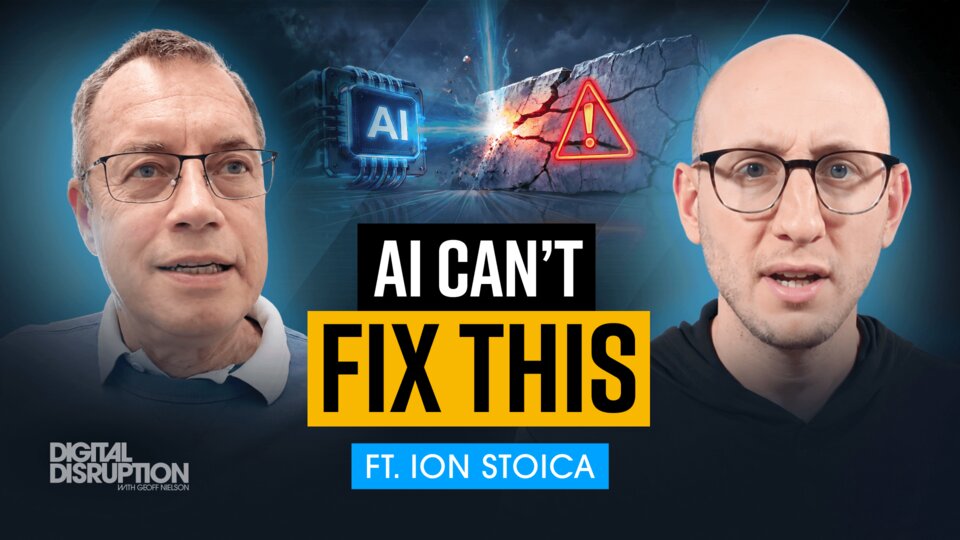



The Next Industrial Revolution Is Already Here
Digital Disruption is where leaders and experts share their insights on using technology to build the organizations of the future. As intelligent technologies reshape our lives and our livelihoods, we speak with the thinkers and the doers who will help us predict and harness this disruption.
Listen


Our Guest Ion Stoica Discusses
AI Has Three Critical Problems | Tech Billionaire Explains How They Could Derail Everything
Ion Stoica, Databricks co-founder and UC Berkeley professor, sits down with us to explain three gaps holding back enterprise AI: defining what we want, modeling the real world, and verifying the results.

Listen
We Discuss
The AI Hype Is Out of Control. Or Is It? | LIVE DEBATE
Is AI living up to the hype, or are we betting too much on it?
Listen
Our Guest Chris Lattner Discusses
The AI Coding Revolution Has a Dirty Secret
Chris Lattner, creator of Swift and LLVM and co-founder of Modular, joins this week’s episode to talk about coding, vibe coding, and why more code doesn’t always mean better software.
Listen
We Discuss
The Jensen Huang Scandal Is Bigger Than You Think
What happens when Big Tech depends too much on one person, and we depend too much on AI? This week we’re covering the Jensen Huang controversy, the backlash against AI data centers, and how AI coding tools could weaken critical thinking.