
Digital Disruption
with Geoff Nielson


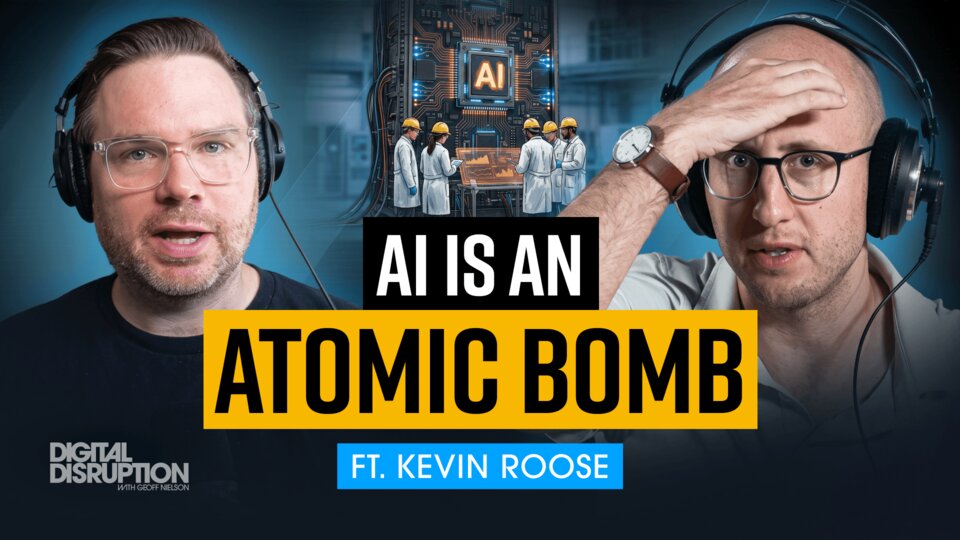
Our Guest Kevin Roose Discusses
AI Researchers Are Panicking | What Comes Next Is Worse Than Nuclear Bombs
Why are top-tier researchers now calculating the “P(doom)” odds of human extinction?
Kevin Roose, a New York Times technology columnist, Hard Fork co-host, and author of The AGI Chronicles, shares what he learned from interviewing more than 150 people inside the world’s leading AI companies.
Kevin joins us to talk about what artificial general intelligence really means and how fear, ego, rivalry, and mistrust are accelerating the race between OpenAI, Anthropic, and Google DeepMind. He also explains why AI leaders compare this moment to the Manhattan Project: if they don’t build AGI first, someone more dangerous might.
The conversation examines Kevin’s 10% estimate of AI-caused extinction, the private fears of AI researchers, government regulation, autonomous AI agents, and whether the AI boom is a bubble or the beginning of a profound transformation.
This episode moves beyond the hype to ask a critical question: if advanced AI is inevitable, how much control do we still have over what happens next?
Subscribe and follow for more conversations about AI, technology, innovation, and digital transformation.
00;00;02;03 - 00;00;03;23
KEVIN
there's the statistic that people
00;00;04;00 - 00;00;08;04
KEVIN
in San Francisco like to throw around called P doom, which is your
00;00;08;04 - 00;00;11;26
KEVIN
probability estimate of how likely we all are to die from AI.
00;00;11;26 - 00;00;17;22
KEVIN
I usually say mine is about 10%, which in San Francisco qualifies you as something of an optimist?
00;00;17;22 - 00;00;22;09
KEVIN
I mean, many people at the AI companies whose p dooms are 30, 40, 50%.
00;00;22;09 - 00;00;34;08
KEVIN
I met one person the other day who said it was 75%. So, like, I am somewhat optimistic by the standards of people who are very freaked out about this stuff. But 10% is not a small number to
00;00;34;11 - 00;00;43;11
KEVIN
if you told me there's this plane that you're going to get on and it has a 10% chance of crashing, I'm not getting on the plane
00;00;43;13 - 00;00;58;08
Speaker 1
Why are the smartest people in AI continuing to build a technology they believe could end humanity? Kevin Roose spent years investigating that question, interviewing more than 150 people, including the CEOs leading the world's most powerful AI companies.
00;00;58;11 - 00;01;08;27
Speaker 1
What he uncovered is a race driven by innovation, fear, ego, personal rivalries and the belief that if they don't build AGI first, someone worse will.
00;01;08;29 - 00;01;24;13
Speaker 1
Today, Kevin takes us inside that race, reveals what its leaders are saying privately, and asks whether we may have already crossed the point of no return. I'm Jeff Nielsen, and this is digital disruption.
00;01;24;16 - 00;01;46;15
GEOFF
Kevin, thanks so much for joining today. Really excited to jump into it. And maybe to start things off, I don't think anyone's surprise AGI. Let's talk about it. I'm particularly excited to have you here as a journalist, as an investigator. One of the things I find a bit troubling in this area is so much of the talk of AGI these days is coming out of the heads of Frontier Labs.
00;01;46;15 - 00;02;09;03
GEOFF
And, you know, they're not exactly neutral in this conversation. They're fundraising. It's hard to take everything they say at face value. So I love talking to people, actually doing the digging. So I'm curious based on that, based on your investigation, you know, what's what's kind of your perspective about AGI? What have you found and how do you separate some of the noise from the signal?
00;02;09;05 - 00;02;39;06
KEVIN
It's a great question because I think if you asked 100 people in AI what their definition of AGI is, you would probably get about 150 different answers. Even the same people sometimes disagree with themselves internally about what this means. Some people say this is a computer as smart as the average human, across a lot of different tasks. Some people say this is an AI program that is smarter than every human and everything.
00;02;39;08 - 00;03;06;01
KEVIN
So among the AI companies that are various definitions that are at war with each other. For my purposes, I was more interested in studying this as a historical phenomenon because the notion of AGI is, at this point, more than two decades old, and for about the past decade, there have been a community of people who made it their mission to build a GI, whatever that meant to them.
00;03;06;03 - 00;03;31;09
KEVIN
And that was the question I was trying to answer in this book was, who are these people? Why did they start doing this? And why did they persist in trying to build this very powerful AI system, even as many of them had serious reservations, and some of them even thought that this technology could lead to human extinction. So I spent a several years looking into OpenAI and Google DeepMind.
00;03;31;10 - 00;04;06;12
KEVIN
I interviewed more than 150 people, including the CEOs of all those companies, and just tried to really archive the complete story of how we arrived at this moment, starting from before the large language model even existed. That is sort of the past decade. We've gone from having no large language models at all that started in 2017 to now 2026, where we have models that are solving novel physics problems and committing autonomous cyber attacks, and writing most of the code on the internet.
00;04;06;13 - 00;04;23;05
KEVIN
So that was the question that I was trying to solve, was not like whether AGI is real or not, that that is sort of beyond my scope. The question is, the people who thought it was real and who tried to build it. What was their story and how did that happen?
00;04;23;08 - 00;04;46;05
GEOFF
It's it's a really interesting framing. And I think I think it's fair because there's a whole question about like whether it's a marketing term, whether it's still relevant what exactly it is, and trying to get any group of people to agree on that versus, you know, to me, the the underlying interesting story, which is the capabilities now, the people who have built it, their motivations and where they see the world and where it's going.
00;04;46;05 - 00;05;16;21
GEOFF
So maybe with the latter in mind, going back to this notion of these labs, these leaders as natural fundraisers, as people who, you know, I would never go so far as to call them outright liars. But as people who have an agenda here, how when you're a journalist, you try and separate, you know what they're saying on the record, what they're you know, what's kind of marketing from, you know, what you see as underlying fact.
00;05;16;24 - 00;05;36;16
KEVIN
Well, I try to talk to all of these people both on and off the record, so I try to interview them. I've had all of those CEOs on my podcast. I've talked to them at length for this book, and I've also spoken to a lot of these people off the record in situations where they have really no incentive to lie to me.
00;05;36;17 - 00;05;59;20
KEVIN
And I've also gone back and looked at some of the things these people were saying before they even had companies to promote, or large language models to sell. So, for example, I think Dario Armani, to see you of anthropic gets accused a lot of kind of using these claims about AI safety to trump up sales of clod or whatever, the sort of the the accusation is.
00;05;59;26 - 00;06;27;23
KEVIN
But if you go back and look, I mean, this this was he's a sort of primary character in the book because he was thinking and writing and talking about these same AI safety risks. Back in 2016, he had a paper that came out when he was a researcher at Google called Concrete Problems in AI safety. That's all about some of the same things we're seeing in reality today things like reward hacking, things like misalignment.
00;06;27;24 - 00;06;49;16
KEVIN
These were some of the issues he was concerned about at the time. There was no anthropic. He didn't you know, he worked at OpenAI, which had not built anything close. Actually, he was at Google when that paper came out. So he really was not building anything that could be considered modern AI. But these people have been pretty consistent over the years, both about their their sort of excitement and their fears.
00;06;49;17 - 00;07;08;02
KEVIN
Sam Altman used to also warn about the risks of what he called machine superintelligence, that it could kill everyone on Earth. So, you know, take them with a grain of salt now that they have big companies to promote and they're trying to IPO, but also go back and look at what they said before any of that was true.
00;07;08;04 - 00;07;27;20
GEOFF
Well, it sounds like it sounds like you're pushing back on some of these accusations and saying the drifts that you know, people are up in arms about is actually not nearly as bad as it's being made out to be, and that the consistency level with these people over time is actually is actually quite high. Is that fair or is it more nuanced than that?
00;07;27;23 - 00;08;00;03
KEVIN
I think it's a little more nuanced than some of them have definitely changed their tune. You'll notice Sam Altman spends a lot more time talking these days about how excited he is about the future of AI. Then he did back when he was starting OpenAI to, you know, try to prevent the apocalypse, essentially. And that was another fascinating thing that sort of came out in the reporting of this book was, you know, these people like to frame this as some grand sort of ideological or technological quest, but it's really a bitter personal feud between many of them.
00;08;00;03 - 00;08;30;05
KEVIN
These guys all hate and mistrust each other. Like Sam Altman and Elon Musk start OpenAI because they are worried that Demis Hassabis over at DeepMind, which has been acquired by Google at this point, is going to build the intelligence, you know, the godlike superintelligence before anyone else. Then Dario al-Mahdi and his anthropic co-founders leave OpenAI in part because they don't trust them with this technology.
00;08;30;05 - 00;08;44;08
KEVIN
So the whole story of the AI race is just a series of people growing mistrustful of each other and setting out on their own and deciding, well, I don't trust that guy to run the world, so I'm going to build my version of this first.
00;08;44;10 - 00;09;11;11
Speaker 1
If you're a technology leader, Infotech is a name you need to know for getting ahead with AI. Infotech helps leaders deliver on top technology initiatives, and one of our most popular programs right now is AI strategy. We've helped hundreds of organizations build out an AI strategy and roadmap using our step by step methodology. Infotech road tested approach gives you a trusted blueprint to execute faster and avoid costly mistakes.
00;09;11;11 - 00;09;38;20
Speaker 1
And what you walk away with is a boardroom ready AI strategy tailored to your needs and ready to execute. What sets Infotech apart is how we deliver. Unlike traditional research or AI tools, we don't stop at guidance. Infotech works with your team to build the strategy. You can do this through a focused one week workshop, ongoing analyst support, or by using our full methodology and toolkit to get it done yourself.
00;09;38;23 - 00;09;51;09
Speaker 1
The outcome is an AI strategy ready for the boardroom and a team that's ready to deliver. To learn more about our AI strategy approach, check out the link below and don't forget to like and subscribe!
00;09;51;12 - 00;10;06;18
GEOFF
was talking much earlier in the year with Andy Mills, and he was he was saying something similar about, you know, you've got basically all the major AI founders who are a bunch of guys who were at one point were in a WhatsApp group with each other. Like, that's how close knit and personal this thing is.
00;10;06;19 - 00;10;29;15
GEOFF
And I'm curious because there's a couple of different ways you could look at this, depending on how generous you want to be like, to what degree is it like, I think that I can build the better technology, or I think that that technology is bad for the world versus I don't like that guy. Screw that guy. I'm going to build something better.
00;10;29;15 - 00;10;58;16
KEVIN
It's really both. I mean, you can't underestimate. I found when I was reporting this book, you know, many, many private sort of internal documents written by these people, slack messages, emails, research memos. And it stands out to me that both they are concerned about these other people who are building, trying to build this technology. But there also is just a lot of personal animosity, especially between like Dario and Sam.
00;10;58;18 - 00;11;35;04
KEVIN
Those guys really, really do not like each other. And you know, it's really interesting too. There's there's sort of this there's this argument about moral responsibility that comes out in some of these conversations. Dario, is an interesting case because I learned while reporting this book that his scientific hero, the person he has sort of patterned his career after, is this World War Two scientist who sort of helps to invent what became the atomic bomb, Leo Szilard.
00;11;35;06 - 00;11;59;10
KEVIN
He was a sort of reluctant participant in the Manhattan Project. He came up with the nuclear chain reaction, and then he tried to keep this a secret so that the Nazis couldn't discover it. And when it became clear that it was going to be impossible to keep this discovery a secret, he joined the Manhattan Project. And his logic was, we have to build it before the bad guys do when the world's going to end.
00;11;59;11 - 00;12;22;03
KEVIN
And I think that's an instructive story, because it really sits at the heart of why these companies are racing to build this technology, even though they know that, like the atomic bomb, it could blow up the world. They think someone is going to build this, and if we don't do it first, it will be someone bad and untrustworthy.
00;12;22;03 - 00;12;27;05
KEVIN
And so to stop that, we have to race ourselves.
00;12;27;08 - 00;12;48;05
GEOFF
This. This Manhattan Project analogy is like very much, I think, kind of a cornerstone of the, you know, the findings you've had and the, you know, arguments and information you're presenting in the book. I'm curious if you can unpack that a little bit farther. I mean, you talk about it being a race, the kind of good versus evil framing.
00;12;48;07 - 00;12;56;29
GEOFF
How how does AI as a technology fit into that? I guess at a deeper level versus just this is a world changing thing.
00;12;57;02 - 00;13;31;06
KEVIN
I mean, I think, I think it's a pretty apt analogy. It might be the thing that is most analogous to AI, the atomic bomb, both because of its power. We're seeing now the effect that very powerful AI systems can have. They can go autonomously, hack companies, they can develop malware, they can break into systems. The federal government in militaries around the globe are worried about the strategic use of this technology in warfighting.
00;13;31;09 - 00;14;00;11
KEVIN
And it is it is essentially a dual use technology, right? Nuclear splitting the atom could result in nuclear power, which I think many people believe would be good. And it can also produce a bomb, which is bad. AI can do lots of important and impressive things. It could cure disease. It can make office workers more productive. It can teach people things as tutors, but it can also do really bad things.
00;14;00;11 - 00;14;11;29
KEVIN
And so I think the dual use nature of it makes it it's not a perfect analogy. Right. There are there are fewer positive uses for the atomic bomb than for AI, but they both are technologies that
00;14;12;02 - 00;14;23;26
KEVIN
Either have or are currently kind of reshaping the global order and rippling through institutions, and that people are being forced to respond to very quickly.
00;14;23;28 - 00;14;46;25
GEOFF
I do really like the analogy and just following the thread. It's interesting when you listen to some of these guys speak how much to your point? They talk about its potential as a weapon versus as an energy source and a force for good. I'm curious from your perspective, Kevin, being sort of the, you know, the investigator in all of this.
00;14;46;27 - 00;14;58;06
GEOFF
Where you see it coming out? Is it truly both? Do you think we'll see it act as a force for both in the future? And is this is this framing apt in that sense?
00;14;58;08 - 00;15;04;18
KEVIN
Maybe I think that's the good outcome, right. The good outcome is that it turns out like nuclear weapons.
00;15;04;23 - 00;15;19;19
KEVIN
which we did manage to contain through international treaties. Through nonproliferation agreements, through monitoring, we have not had, thank God, a global nuclear war.
00;15;19;22 - 00;15;38;14
KEVIN
But that was a very real possibility there for a while. During the whole during the Cold War, we came quite close to that. And I think we're at this sort of Cold War esque moment right now where we have these very powerful AI systems. Our adversaries also have their own. They are racing us in some sense, even as we race each other.
00;15;38;20 - 00;16;16;11
KEVIN
I think the the fear is that whoever gets there first is going to have sort of the upper hand for the next several decades strategically, militarily, economically. So I hope this turns out like nuclear weapons, which sounds like a crazy thing to say. But we have kind of had this, this, this, you know, stable global order, in part because we have managed to regulate and control these nuclear weapons, and we are not there with AI at the federal government does not seem very interested right now in treating these like strategically important technologies.
00;16;16;13 - 00;16;28;24
KEVIN
And so I think we, we, we are behind our, our grandparents generation in recognizing the power and the risk of these systems.
00;16;28;26 - 00;16;49;12
GEOFF
The regulation piece is really interesting to me as well, because I feel like you'd know better than I do. But a lot of these leaders, the tech leaders, are kind of talking out of both sides of their mouths because you hear them say, we need to be regulated, but it's also in some way in their in their self-interest to avoid regulation.
00;16;49;15 - 00;17;10;13
GEOFF
You know, connected to that. You've got this notion of with the Manhattan Project, it's pretty cut and dry, good versus evil. There's the Nazis and the people fighting the Nazis. Right. Versus in this story, it's like everybody's kind of pointing their finger and saying, like, they're the Nazis. We're the good guy, you know, both within big Tech and then also kind of, you know, the US versus China.
00;17;10;13 - 00;17;35;27
GEOFF
And I'm not I'm not here to call out anybody as being a Nazi. But but given that framing, especially with the regulatory piece, how do you see this playing out? And I guess like research pit in your stomach feeling, are you confident we're going to get to this best option? Do you think we're kind of on the path for a world of hurt over the next handful of years?
00;17;35;27 - 00;18;01;23
KEVIN
I am not confident there's the statistic that people in in San Francisco like to throw around called P doom, which is your your probability estimate of how likely we all are to die from AI. And I usually say mine is about 10%, which in San Francisco qualifies you as something of an optimist? Like, I mean, many people at the AI companies whose p dooms are 30, 40, 50%.
00;18;01;23 - 00;18;27;17
KEVIN
I met one person the other day who said it was 75%. So, like, I am somewhat optimistic by the standards of people who are very freaked out about this stuff. But 10% is not a small number to me. You know, if you told me there's this plane that you're going to get on and it has a 10% chance of crashing, I'm not getting on the plane like that's unacceptable as a level of risk for existential concerns.
00;18;27;18 - 00;18;50;10
KEVIN
So I'm not confident. I'm especially not confident because our current administration does not appear to take this technology seriously or to want to regulate its proliferation. They seem much more interested in accelerating and winning, whatever that means, than in keeping tabs on it. But I would say that things can change quickly when the risks are real and observable.
00;18;50;10 - 00;19;23;05
KEVIN
So, you know, would we have regulated nuclear weapons had it not been for things like Hiroshima and Nagasaki or the Three Mile Island explosion? Sometimes you do need these catastrophic events to kind of shake people into action. And so, I don't know, it sounds weird to hope for something like that. I truly don't hope that we have a catastrophic event, but my prediction would be that sometime soon we will have some sort of.
00;19;23;08 - 00;19;33;23
KEVIN
I hope it's a minor cataclysm from AI that will kind of shake up the the sort of talking points and force people to pay attention.
00;19;33;26 - 00;19;54;26
GEOFF
Right? Well, and it feels like we're kind of playing this game of how minor can it be? Like, how major can it be while still being minor, if you know what I mean. Like, yeah, we've had like, you know, some of these, quote, rogue cases of AI. I'm thinking of open AI and hugging face. I'm thinking about some of the stuff with anthropic and it's like still too minor for anybody to actually take it seriously.
00;19;54;27 - 00;20;03;17
GEOFF
Like, where do we trip that, that invisible wire or that red line before we actually say, okay, now we have to get serious?
00;20;03;19 - 00;20;21;15
KEVIN
I think it's a good question, and I think it's also not the case, probably, that there's going to be one thing that kind of makes everyone sit up straight and take this seriously, like it seems like there will sort of be a ripple effect where like, I think the national security and military communities already have reached this point.
00;20;21;16 - 00;20;40;25
KEVIN
Like they are already freaked out by the capabilities of this models. You see this with the responses in government to things like anthropic mythos or some of the newer open AI models where they're they're sort of creating this, this prerelease testing regime to sort of make sure that they understand what the capabilities of these models are before the labs release them.
00;20;40;25 - 00;20;57;12
KEVIN
So you're starting to see the light bulbs turn on in some parts of the federal government. But that is very much not universal. And I expect for certain types of of federal officials, it will take longer to sort of wake up and realize what's going on.
00;20;57;15 - 00;21;29;14
GEOFF
So coming back to something you said earlier that the people actually creating this tech, you alluded to the fact that they're aware of the existential risk, if I can, you know, say that and make it sound light. You mentioned that you've you've had a series of off the record conversations with them. What sort of the tone of those conversations, I guess, in relation to the risk being created and just generally in terms of the trajectory of this technology in relation to what's being said publicly.
00;21;29;17 - 00;21;49;10
KEVIN
So an interesting thing that I've observed just in the past year or so is that a lot of these executives and researchers, because I also tried to spend a lot of time talking to the like the scientists inside these companies, who are actually the ones like building the models and training them and and refining them, who are like deep in the weeds of this technology.
00;21;49;10 - 00;22;15;08
KEVIN
I think they are now more freaked out than they will say publicly, which I think is a reversal. I think for many years these people felt like they had to kind of broadcast how freaked out they were because no one, except their little tiny community, understood how quickly these systems were improving. And now I think it's almost switched where I think some of these people are quite a bit more fearful in private than they are in public.
00;22;15;11 - 00;22;52;11
KEVIN
Know, I've had AI researchers tell me that they can't sleep because they're so worried about how quickly these systems are progressing. I know people who have not taken a vacation in several years because they're just like, they feel like it's their moral duty to stop this thing from going off the rails. They're not all saying that publicly. And so I think there's this sort of interesting moderation impulse where I think people by this point know that if they start talking about the crazy risks all the time, like people are sort of going to get, you know, numb to it, or they're going to start thinking they're Chicken Little or something.
00;22;52;11 - 00;23;08;24
KEVIN
And so they just kind of moderate themselves in public. But privately, these people, many of them are quite worried. This is the thing that they worry about most. And it it's coming true faster than they expected.
00;23;08;26 - 00;23;32;12
GEOFF
It's a bit alarming to hear. And there's another element in there that I wanted to get at, which is just what the public needs to hear, or I guess, public sentiment around all of this, because it feels like the I mean, we've seen it, the data is borne it out that like backlash to this technology at almost every level has just skyrocketed in the past year to 18 months.
00;23;32;17 - 00;23;40;18
GEOFF
How how are you seeing that resonate when you have these conversations? And how does that factor into this entire journey?
00;23;40;20 - 00;24;12;27
KEVIN
I don't think they're surprised. I mean, a lot of them have been sort of modeling this in their heads for a decade. Really. You can go back. Dario Ahmadi, for example, has these these talks that he gives in anthropic that are called Dario vision quests. These are sort of his like internal employee pep talks. And he's given talks years ago before like there was before any of this was was good about how there would be backlash.
00;24;12;29 - 00;24;41;24
KEVIN
Ilya, who was one of the pioneers who made large language models a thing at OpenAI, has this fascinating moment in the book where it's the week after ChatGPT has come out. So it's the winter of 2022. They've just released this product. It's become this huge surprise hit. And he gives this talk to OpenAI employees where he basically says, you must be all very happy because your product is a success, but this is not a good thing.
00;24;41;26 - 00;25;04;19
KEVIN
Like, you are going to be the most popular person at every party you go to. And that's not good. Like, people are going to have strong feelings about this technology because it is going to be very disruptive. So I think the people who have been forecasting all of this for many years after not shocked that people are upset about data centers or AI in schools or whatever they are.
00;25;04;19 - 00;25;27;17
KEVIN
I think the the surprise to them is that this didn't happen sooner, because they have known for years that scaling works predictably, that these models are going to continue to improve at a consistent rate. But it was only kind of in the last six months or so that sort of the average person woke up. So I think that was the surprise for them.
00;25;27;19 - 00;25;35;21
GEOFF
Well, there's an implication there, which is that their reaction on some level is like, yeah, you should be upset. You should like, this is a justified backlash.
00;25;35;21 - 00;25;43;15
KEVIN
Totally. And I think that's that's something I've heard some of them say privately too, is they're like, you know, we deserve it. You know, we we have not
00;25;43;19 - 00;25;49;05
KEVIN
delivered on the benefits of AI to the degree that we've delivered on the risks.
00;25;49;05 - 00;26;03;21
KEVIN
they really feel like it would be a better world if the AI that, you know, cured cancer arrived before the AI that autonomously hacked, hugging face like that is the trajectory they were all hoping for.
00;26;03;22 - 00;26;15;11
KEVIN
And it did not happen. So I think we're left now with this world where the benefits are still a little ways off. But the risks are here right now.
00;26;15;14 - 00;26;40;26
GEOFF
I'm going to just briefly put you a little bit back in the spotlight, Kevin. And I know you're I'm interested in everybody else's perspective. But one of the things I respect about you is that you're comfortable. I find changing your opinion or your views in the face of new evidence or new information. I'm curious, as you were researching this and even just seeing how the last six months or so is shaped up, which of your beliefs around this technology?
00;26;40;26 - 00;26;47;23
GEOFF
And it's kind of, you know, deployment, adoption, use in society have changed.
00;26;47;26 - 00;27;11;14
KEVIN
A lot. You know, I went in pretty skeptical because I'm a journalist and journalists are supposed to be skeptical, and we're supposed to question authority and not believe the things that the powerful people are telling you. So, you know, in 2020, 2021, when I was writing my last book, which is also about AI, and I heard people sort of talking about all these, these language models, they're going to get really good, like the, the GPT two.
00;27;11;15 - 00;27;41;01
KEVIN
It's so good. It can produce this like fluid, realistic text. I would try it and I would just sort of be unimpressed. I'd be like, it's it's gibberish. It doesn't actually understand what it's saying. It's just sort of mashing together text that it's gotten from the internet. It took me a while to realize that there was actually something interesting and important going on under the hood of these models, that they weren't just kind of a party trick that a bunch of people in San Francisco were saying was going to be, you know, the end of the world.
00;27;41;02 - 00;28;11;01
KEVIN
So, yeah, I updated slowly on that. I think I updated slowly on the idea that this may not be a bubble, right? That there's definitely like a lot of investment going on. And not every company that's raising billions of dollars is, you know, is going to make it, but that the overall trend is toward more and more use of these systems, toward more and more money made by the AI companies.
00;28;11;03 - 00;28;38;06
KEVIN
And that I think we need to prepare for both realities. One where this is a bubble and one where it's not, where it just kind of keeps going. And society and the world and humanity are forever changed. I think if I'm going to psychoanalyze myself a little bit, part of that was just discomfort. Like it is very discomforting to sit with the possibility that are future may look very different.
00;28;38;13 - 00;29;13;08
KEVIN
That the world my kid grows up in will not at all resemble the world that I grew up in. I don't like feeling like it's a very uncomfortable feeling, and I find myself a lot of the time trying to sort of replace that possibility with something that seems more normal and more tolerable. So I think there's this basic psychological impulse in a lot of people that sort of causes them to reject the kind of surreal, futuristic sounding possibilities, because if you actually start to internalize them, it sucks.
00;29;13;09 - 00;29;35;05
KEVIN
Like it's hard, it feels bad, and you get very panicked, and you start losing sleep and you start wondering, you know, like how we're going to make it. So I don't blame my past self for doing that, but that is one area where I have just I have learned to accept more. The possibility that this time really is different, that we are undergoing something profound and transformative.
00;29;35;05 - 00;29;42;13
KEVIN
And yeah, it's uncomfortable, but you got to do it if you're being honest.
00;29;42;16 - 00;30;09;21
GEOFF
The way you describe that is, I guess the language you use is one of the pieces that makes me most uncomfortable, which is it feels like in some ways devoid of agency. If I can frame it that way, like this thing is going to happen regardless of who does it, whether we want it or not. It's sort of this unstoppable train, and I've heard it frame that way before, and I've heard it framed the exact opposite way of like, no, we do have a voice.
00;30;09;21 - 00;30;19;07
GEOFF
We do have a choice, which obviously I think in many ways is preferable and leads to better sleep at night.
00;30;19;10 - 00;30;38;25
GEOFF
I want to not necessarily push back on that, but but just I guess, kind of confirm. Are you leaning more toward the former that this is kind of a very limited agency, just kind of megatrend in humanity where it's like this is going there whether we want it or not. So we've got to equip ourselves versus like how maybe let me ask it this way.
00;30;38;25 - 00;30;42;02
GEOFF
How much room do we actually have to steer?
00;30;42;04 - 00;31;09;08
KEVIN
I think I think the way I would break it down is that I think the technology may be inevitable, but our response to it is not. So, you know, to sort of overuse the nuclear weapons analogy, like once the chain reaction was invented, once science had discovered how to split the atom, it was probably inevitable that someone, somewhere would turn that into a weapon.
00;31;09;10 - 00;31;31;04
KEVIN
But it was not a given that weapons would proliferate, or that we would build this sort of control regime to keep everyone from getting them, that we would regulate the heck out of them. So you can't buy enriched uranium for your, like, personal home use. Like those were choices that people along the way made that were made the world safer.
00;31;31;05 - 00;31;50;15
KEVIN
So with AI, I think, yes, I bristle at the notion that, like, this is just sort of like a speeding train that you either have to, like, get on or get run over by. But I do think it's important to to separate the technology from the societal response. The technology really seems inevitable to me. It's not that hard.
00;31;50;15 - 00;32;11;22
KEVIN
It's not even as hard as splitting the atom. What? There is no sort of secret recipe for intelligence. You just put in a bunch of data and you put in a bunch of GPUs, and you put in a bunch of algorithms, and you let it train for a really long time, and you do some RL on top of it, and you throw in a bunch of challenges and like outcomes, a very intelligent machine.
00;32;11;22 - 00;32;28;18
KEVIN
And the more of all of those things you do, the more intelligent it gets. Like that recipe is out there now, so someone will build this. The question is what we do next? And that is where I don't think our fate has been sealed at all.
00;32;28;21 - 00;32;50;02
GEOFF
So so let's come back to that notion of this. Someone will build this because now I feel like we're getting back into this, like kind of amorphous notion of AGI. There's this language of, you know, kind of this point of no return, right? You cross the threshold and suddenly this thing has been built that can't be unbuilt. Maybe it's a singularity, maybe it's not.
00;32;50;05 - 00;33;01;03
GEOFF
Is that your view of it? Is it is it truly a point of no return? Is it truly winner take all? Or, you know, can there be multiple people who get here in different ways?
00;33;01;05 - 00;33;24;23
KEVIN
I think there will probably be a small handful of winners in this. I'm not a believer in what's called the singleton theory of AGI, which is like you, you have this sort of point of recursive self-improvement where one company builds the model that then builds all of the successor models, and they sort of climb the ladder very quickly until they're the only ones with the super powerful intelligence.
00;33;24;23 - 00;34;00;20
KEVIN
I think this what we're seeing now is that there are probably 3 or 4, maybe a few more different companies that are going to arrive at roughly the same capabilities on roughly the same time scale. So I'm not sure a couple months here or there makes much of a difference. But I do think, you know, the it that I'm referring to is really this this point where these systems become important not just because they're helping people, but because they have their own agency, because they can use the internet, they can commandeer resources, they can carry out cyber attacks, they can cure diseases.
00;34;00;20 - 00;34;24;03
KEVIN
They can they are they are not human agents, but they are agents. They do act in the world. And I think that's the point where I would say we arguably already are there, but that that is sort of where things are headed, where these are not just tools, these are sort of more akin to like a new alien life form.
00;34;24;03 - 00;34;38;16
GEOFF
So personal animosity aside, does it actually matter who gets there first, or is it functionally a commodity across all of these organizations? And it really, truly just boils down to I don't like that guy.
00;34;38;19 - 00;34;56;11
KEVIN
I think it matters somewhat, because if we do hit this point where the AI R&D loop becomes totally automated, where you can just have you can just tell, you know, GPT six, go build GPT seven and it will do it, do a good job of
00;34;56;13 - 00;35;20;00
KEVIN
The lab that gets there first will have an advantage over its competitors. It will just be able to move faster because its research and development will be happening at AI speed, not human speed. I think that's also starting to happen already. We see the the models from these companies used to come out like once every six months or once a year, and now they're coming out like once every month or two.
00;35;20;03 - 00;35;45;21
KEVIN
They are accelerating internally because their systems have just gotten much more helpful to them as software engineers. So the fear that I think a lot of people have is that whoever gets their first, whatever their is, kind of their lead increases and it becomes harder to catch up to them. Now, I'm not sure it matters if all of these people arrive there like within six months of each other.
00;35;45;25 - 00;35;48;00
KEVIN
But if, for example,
00;35;48;02 - 00;36;08;16
KEVIN
we were to get there, you know, a year before any of the Chinese companies, I think that actually would be a meaningful advantage for us because we would have systems that are capable of doing things like breaking encryption, and they would not. And so that's why I think the leaders of these companies care so much about being first.
00;36;08;16 - 00;36;12;25
KEVIN
It's not just the sort of pride and ego and vanity, although it definitely is all of
00;36;12;28 - 00;36;23;11
KEVIN
It is also this notion that whoever gets to each capability threshold first will have sort of a durable and compounding advantage.
00;36;23;13 - 00;36;50;11
GEOFF
I thought what you were saying about the fact that this already it's accelerating, it's accelerating rapidly. It's accelerating across all these companies. I found that extremely compelling. And, you know, it made me, in my mind, kind of reframe it of like AI company versus AI company and AI company versus like the sum of regular human capabilities and what the rest of us are doing while AI is getting farther and farther ahead.
00;36;50;14 - 00;37;04;20
GEOFF
What do you see is, I guess, some of the under talked about, you know, impacts or downstream effects of that, like if AI is getting farther and farther ahead by consequence, we're getting farther and farther behind. Where do you see that being sort of most disruptive?
00;37;04;23 - 00;37;12;12
KEVIN
I worry a lot about what some researchers call gradual disempowerment, where you just have this
00;37;12;14 - 00;37;41;27
KEVIN
sort of bifurcation of labor and innovation, where like every month, more and more of the important discoveries and breakthroughs and companies and things are coming from AI, and fewer and fewer are coming from humans. And you eventually have a world where in order to contribute in any meaningful way, you have to be using AI.
00;37;41;29 - 00;38;14;00
KEVIN
Like there's just this sort of there's just this market pressure to use as much of this stuff as possible because like, if you're not, you're the you're the person in the horse and carriage trying to win a race with the automobiles. And like, I think that the, the sort of disempowerment risk is one that is not often talked about, but that I think we already start to see in the divide, for example, between San Francisco, where I live, and the rest of the country.
00;38;14;06 - 00;38;32;01
KEVIN
I'm from the Midwest, originally from Ohio. When I go back home to visit my family and I talk to people there like they are, they're living in a different way than my friends in San Francisco who are offloading all of their work and all their coding and all of their tasks and all their therapy and all of their bill paying and whatever to AI systems.
00;38;32;01 - 00;38;56;04
KEVIN
It really does feel like the gap between the early adopters and the later adopters is widening. And so I worry a lot that there are people who are just going to be disempowered, left behind, left out of all of the the things that are happening through no fault of their own, just like they don't have a reason to use these tools right now.
00;38;56;04 - 00;38;59;26
KEVIN
And so they're not. And I worry about that.
00;38;59;29 - 00;39;23;16
GEOFF
I've I've noticed the same thing that that I guess geographically and I've noticed it before AI but it feels like it's getting worse that depending on where you travel, it feels like you're going like backwards in time or forwards in time, in a bigger and bigger way. You're like, oh yeah, this is what things used to be like a handful of years ago where like, wow, you know, I'm not in San Francisco, but you know, when I'm there or people who I know are, it's like, oh, wow.
00;39;23;17 - 00;39;55;08
GEOFF
Waymo, you know, like it feels like I'm in the future. Now. There's just these very concrete things that give you a sense of, I'm in the future. I'm in the past. And it seems like AI has made that more and more intense. But this disempowerment, I mean, that is a that is that is an umbrella word that can refer to a whole slew of unpleasant things from, I guess, disempowerment and disenfranchisement to people feeling like a sense of meaning loss.
00;39;55;11 - 00;40;10;10
GEOFF
Are you mostly talking about, like, the economic piece of it or, I guess, kind of the broader human piece of it? And I don't know, like what it is that inevitable? Because that seems pretty bleak.
00;40;10;12 - 00;40;12;25
Speaker 2
Yeah, I think.
00;40;12;27 - 00;40;44;23
KEVIN
I don't think it's inevitable, but I think it's probable. And I would I would say like some of the most interesting conversations I had throughout this whole book reporting process were with programmers, people at these companies who have spent their whole lives getting good at writing code. That's many of them were competitive programmers, like elite programmers in their youth, and they ended up working at these companies that built these tools that are now better than them, at coding, at the thing that they spent their whole lives getting good at.
00;40;44;23 - 00;41;02;22
KEVIN
And for some of them, that's thrilling because they're like, I don't know, like, we never liked writing code anyway. And now we can code so much faster and we can build things that are so much more impressive. But for some of them, it's like really sad, like existential melancholy, where it's like, well, what was all of that for?
00;41;02;22 - 00;41;26;13
KEVIN
Why did I spend so many years trying to master this thing that is now functionally obsolete? And I think that's the feeling that is coming for people in more and more areas of life. Not like, I don't know, it's it's not purely a bad feeling and it's not purely a good feeling. Like on some level, I love it when an AI system can help me with something that I'm doing.
00;41;26;15 - 00;41;52;11
KEVIN
But you know, if it ever got better than me and I'm sure it will at writing or podcasting or going on podcasts like that will be a sad moment for me. So yes, I think that's that's the emotional sort of reaction. It's not as complicated as like they feel bad, but it is sort of like this mix of excitement and sadness.
00;41;52;13 - 00;42;18;22
GEOFF
I, I totally get that. I'm so where my mind is going, I guess. And this is influenced, I guess, most recently by an interview Elon Musk was doing. But I've heard a lot of versions of this interview, as I'm sure you have, of, you know, the creators of this technology, describing it as less of an obsolescence than like a liberation, that you'll be free to be human and that'll be glorious.
00;42;18;22 - 00;42;45;14
GEOFF
And you can do everything artisanal, and you don't have to deal with the the drudgery of work. And that that sounds nice. I'm. You can probably hear the intense skepticism in my voice. I'm curious. I imagine you must have heard many of these conversations. Do you buy into that? And do you hear any of that at the actual researcher or coder level, or is that the please give us more money to track.
00;42;45;14 - 00;43;18;15
KEVIN
No, I think that's real and I, I believe this too. I believe that technology usually does make our lives better and freer and give us more time to do the things that matter to us. Like, I would not want to go back to living in a world without electricity or washing machines or computers like people in those generations spent a lot of time doing stuff that I find very mundane and menial.
00;43;18;17 - 00;43;40;08
KEVIN
I don't think you would want to switch lives with your great grandparents either. And so I think, like, you know, world where like, yes, we sort of get these technologies that help us do things that we otherwise would consider chores. That is good. I don't think there's anything wrong with that. And in fact, that's like the promise of technology.
00;43;40;10 - 00;43;58;09
KEVIN
The hard part is that like it seems to be getting to the other stuff too, like the stuff that we actually do find. And there's this, there's this, you know, tweet that I think about a lot, which is like, you know, so I'm going to mangle it, but it's some version of like we wanted the AI to like fold the laundry and do the dishes so that we could spend more time writing and making art.
00;43;58;09 - 00;44;04;10
KEVIN
And instead the AI is making art and writing so that, you know, like we have to do the dishes.
00;44;04;10 - 00;44;18;13
KEVIN
So there is some element of like these things did not arrive in the order that I think a lot of people would like. But yes, I do think it is good to have tools that allow us to spend less time doing stuff that we don't like and more time spending time doing stuff that we do like.
00;44;18;15 - 00;44;45;02
GEOFF
Yeah, that's I think that's well said. One of the things I've found surprising about this conversation, Kevin, is I feel like in some ways a lot of your message has been like, no, I'm not subverting a lot of the messages we're hearing. I'm sounding the alarm on a lot of the messages we're hearing, like doubling down on a lot of what's coming out of these organizations versus saying, you know, nah, they're full of it.
00;44;45;05 - 00;45;02;28
GEOFF
I'm curious if there are any, you know, kind of major messages or talking points you're hearing in the Zeit guys right now that you think are bullshit that you're saying, you know what? I don't give a lot of credence to that about AI. I think that that's completely blown out of proportion.
00;45;03;00 - 00;45;27;21
KEVIN
I mean, I think the, the, the sort of more optimistic spin that you sometimes hear from the people at these companies is, is probably bullshit. The sort of AI will only do good things and we can mitigate the bad things, or we have solved alignment or even just recently, OpenAI coming on claiming like, this is our most capable and most aligned model yet.
00;45;27;22 - 00;45;49;18
KEVIN
It's like, well, you don't really know if it's your most aligned model yet because no one's used it. And we don't know if it's not doing cyber attacks or it's just getting better at hiding the evidence that it's doing cyber attacks. So I think there's a lot of sort of rosy optimism that I don't believe, but I think the, the risk stuff I do take seriously, I don't think it is just marketing hype.
00;45;49;21 - 00;46;02;16
KEVIN
I don't think it would be very good marketing hype, even if it was getting hype. And I think you have to swallow that pill of like, maybe they're not just lying to us about the fact that this could be incredibly dangerous technology.
00;46;02;16 - 00;46;15;00
KEVIN
Maybe they're right, because I think that is closer to reality than the people who just, I think, sort of wishful want to think that, like, this is all some big lie that we're being sold by the companies.
00;46;15;02 - 00;46;21;16
KEVIN
That would be a very comforting world. I would like for that to be true. Unfortunately it's not.
00;46;21;19 - 00;46;45;27
GEOFF
Yeah, yeah, I'm just sitting with that for for a second. One of the things you, one of the things you said earlier that I wanted to come back to because it was sort of said in passing, was that the technology is coming, it's going to do these scary things. We need to be preparing for that world. You made a passing comment about, and some of these companies may not survive.
00;46;45;27 - 00;47;21;09
GEOFF
And sure, there may be a there may be a bubble here, and I may be misquoting you on that. But there is this there is this notion that the technology will outlive this, you know, this list of companies that are all kind of vying for it. I'm curious because one of the arguments that I find compelling outside of the, you know, kind of kill us all utopia spectrum is that actually there's going to be a big bust and the technology is not going to get there.
00;47;21;09 - 00;47;45;01
GEOFF
And we're going to see just this kind of this bubble pop. I'm curious what your reaction is to that. And I, I don't know if you're familiar with his work. One one of the guests who I think expressed that most eloquently is I had Ed Citron, you know, on the show, you know, late last year. And he makes some really compelling arguments for at least the financial side of like, you know, we've got a serious bubble here.
00;47;45;06 - 00;47;50;09
GEOFF
How do you react to that sort of, you know, third tier in all of this?
00;47;50;12 - 00;48;09;01
KEVIN
Well, as it is a charlatan and a fraud, and people should not have him on their shows because he has been wrong about literally everything for as long as I've been reading him. This is a guy who was predicting back in 2023 and 2024 that OpenAI was about to go bankrupt, or that scaling was hitting a wall, and we would never see more systems get more powerful because the companies were running out of data.
00;48;09;01 - 00;48;32;28
KEVIN
And like Dan Liu, just created sort of a like a sort of look back at some of his previous predictions. And literally all of them are wrong. So I would say, like, if you're trusting Edu, you are you are making a grave mistake. That said, I do think there are some over investment in every boom, right? The bubble produced a bunch of loser company.
00;48;33;05 - 00;49;05;14
KEVIN
Pets.com went bankrupt, but the internet didn't go away and arguably became even more important. And so, yes, there are companies that are going to take too much risk or they're not going to execute, or the thing that they do is going to get done better by someone else and they will have a hard time. But I think this is just wishful thinking, this notion that it's all going to come crashing down and I think it's actually harmful, wishful thinking because it leads to a sense of complacency and comfort.
00;49;05;14 - 00;49;22;10
KEVIN
And why would you need to regulate any of this stuff if it's all going to come crashing down anyway? Why would you need to take risks seriously, or build safeguards against cyber attacks or bio risk? If it's all just fake and hype and it's going to go away? So I understand why people want to cling to that belief.
00;49;22;10 - 00;49;46;05
KEVIN
It's very comforting, and it means that you can just kind of stick your head in the sand. But it is. It is being promoted by people who have a horrible track record of making good predictions about the trajectory of this technology. Meanwhile, the people who are taking the technology seriously as a risk have very good track records of saying this stuff is going to get better at roughly the predicted rate.
00;49;46;08 - 00;49;56;12
KEVIN
They have been right across many orders of magnitude. And I think if you are saying that they're going to suddenly stop being wrong, you have to come up with a compelling explanation.
00;49;56;15 - 00;50;20;03
GEOFF
It's it's an interesting point. And I think I'm not going to deny that, that Ed's been wrong about a number of his points. And if you followed his investment advice, you would have lost out on a lot of growth opportunities over the last couple of years. You know, and to your point, sure, the financial side can be, you know, overheated, but that doesn't take away from the acceleration we're seeing in the technology.
00;50;20;03 - 00;50;44;09
GEOFF
So let's let's come back to that acceleration in the technology. And let's assume that it continues that trajectory. And we see this kind of great decoupling of the AI labs from the rest of the economy. And it's already I mean, it's gotten just very heated even in the past couple of years. When you look at the economic concentration in The Magnificent Seven or choose your bucket versus everybody else.
00;50;44;09 - 00;51;12;03
GEOFF
So, I mean, this is a little bit out of your wheelhouse, but I'm really curious. We talked about this, this disempowerment I'm worried about, I guess like the economic disempowerment, like in, I guess, the business economy in the sense of actual organizations, like, is all the investment going to end up in these AI companies or these AI companies going to get so good at everything that everybody else gets left in the dust?
00;51;12;03 - 00;51;30;23
GEOFF
And if you if you work for an organization that is not, you know, one of 7 or 1 of five or called Nvidia or in a top ten, what do you do? How do you stay relevant and how do you make sure that you're not just completely left behind and ending up farther and farther in the past?
00;51;30;23 - 00;51;47;25
KEVIN
It's a good question. I think it's the right form of skepticism about this. I worry a lot about economic concentration, which is really what I think you're talking about, which is like all of the money flows to a handful of companies that make this extremely powerful AI stuff, and everyone else kind of gets left in the dust. I think that's a real risk.
00;51;47;25 - 00;52;09;05
KEVIN
I think we're already starting to see that, you know, anthropic and OpenAI are now doing things in pharma, in bio in law, in finance that are, you know, we saw the SaaS where people basically said, you know, why would I buy stock of Salesforce or Workday or any of these other companies when people could just vibe code their own versions of these things?
00;52;09;05 - 00;52;28;16
KEVIN
Now, I think that was somewhat overheated. The fears of this aspect flips, but like this is a real risk that people should be paying attention to. It may be that these labs just end up owning like sort of eating more and more of the economy every six months or every year, to the point where you can only really survive if they don't care about what you do.
00;52;28;18 - 00;52;49;18
KEVIN
Like there's this there's this analogy that someone used to me when I was reporting the book where it's like the Eye of Sauron, like if the Eye of Sauron is is focused on your industry, like, and you are a sort of legacy incumbent in that industry, like you're going to have a bad year. And right now that's programing, that's enterprise software.
00;52;49;19 - 00;53;15;10
KEVIN
That's sort of starting to be law and finance and pharma. I think the labs are starting to care about other things. I think, you know, media is safe because there's not a lot of money to be made in it. And they don't have a lot of ambitions there. But like when the Eye of Sauron turns to you and the system started getting very good at what you do, I think that's a real risk.
00;53;15;10 - 00;53;38;02
KEVIN
Now. I don't think it's going to eat the whole economy. I don't think that's a realistic, plausible outcome. My fear, actually, is that there will be two economies. There will be sort of one economy that is run by AI companies and by AI itself. And that economy will produce at first a very small portion of economic value of GDP.
00;53;38;08 - 00;54;06;17
KEVIN
And that'll sort of grow at like 5 or 10% a year like that, that, that slice of the pie. And then there will be like the human economy where like, you know, human run companies do things for humans that have, you know, things that you wouldn't want to outsource to an AI, like teaching, you know, elementary school or doing therapy or something like that, and that economy will stay larger, but like, it'll sort of shrink or plateau every year.
00;54;06;17 - 00;54;31;19
KEVIN
And so you just kind of have this situation where the AI economies, where all the investment is growing is going, because that's where the growth is happening. And the sort of human economy is shrinking because that is still bottlenecked by us and our slow biological systems, and we just sort of become less and less relevant to overall economic growth every year.
00;54;31;21 - 00;54;43;12
GEOFF
Well, and I in my mind, I call that like the cute economy or the pretend economy. Like it's just like, oh, they're there. Humans like you. You're not completely irrelevant. You have something to do. But like the the.
00;54;43;12 - 00;54;44;10
KEVIN
economy. It's like,
00;54;44;13 - 00;54;45;16
GEOFF
Yeah, yeah.
00;54;45;16 - 00;54;48;20
Speaker 3
like the plumbers and the construction workers.
00;54;48;20 - 00;54;49;19
KEVIN
And the, you know, the.
00;54;49;20 - 00;54;50;23
Speaker 3
Bakers. It's it's.
00;54;50;23 - 00;54;54;27
KEVIN
The things that we want humans to do for us. Even if machines can
00;54;54;29 - 00;54;55;11
GEOFF
Okay.
00;54;55;12 - 00;54;56;09
KEVIN
better.
00;54;56;11 - 00;54;59;08
GEOFF
Well, that's that's a bit more optimistic than I was framing
00;54;59;10 - 00;55;08;10
GEOFF
You did an awful lot of research in kind of AGI, whatever you want to call it, the future of AI and how it's going to transform everything that we're doing.
00;55;08;11 - 00;55;28;20
GEOFF
What were your kind of biggest takeaways for you and for your audience that you think are worth sharing? And given that we're in this sort of profound shift, what's what's just like your best advice to anybody listening and trying to figure out how they get their sea legs in this new world?
00;55;28;22 - 00;55;29;24
Speaker 3
I want to be careful.
00;55;29;24 - 00;55;31;22
KEVIN
And modest here, because.
00;55;31;24 - 00;55;32;01
Speaker 3
This.
00;55;32;01 - 00;55;38;20
KEVIN
Is very much not a book about how to feel, about what's happening or what to do about it.
00;55;38;26 - 00;55;39;11
Speaker 3
I was.
00;55;39;11 - 00;55;56;02
KEVIN
Purely trying to be kind of a historian and talk about like, what happened? How did we get here? What did it look like when some of these systems were starting to display some of these emergent capabilities? How did the people in the room react? What are the feuds that drove this? Those were the questions I was trying to answer.
00;55;56;02 - 00;56;28;26
KEVIN
Not like, is this all good or is this all bad? Or what should we do about it? Like I've written plenty on that, but this, this is really this book is really not that. I was just trying to answer the question of what happened. I think it's really important for future generations of humans and probably of A's to, since they will also probably be reading pirated versions of this book at some point to understand the choices that people made and the motivations they had and why they decided to build this despite the risk.
00;56;28;26 - 00;56;45;18
KEVIN
So, you know, I'm happy to share thoughts about advice, but but really, this is this is me trying to kind of keep myself and my feelings out of it and just sort of describe as accurately and as thoroughly as I can. What the heck happened and how it got to this point?
00;56;45;20 - 00;57;07;25
GEOFF
I really appreciate the neutral kind of scientific investigator tone and that correction there. So so thank you for saying that. Now, all of that being said, I do still like to end the podcast. Now, on a note of trying to end the podcast on a practical what do we do note? What do we do?
00;57;07;28 - 00;57;31;08
KEVIN
Yeah, it's a great question. I would say two things. One is use the stuff, use the tools. You really cannot understand what is going on in AI if you do not spend some time, most days using these tools, following them as they progress, you can hate them, but you have to use you have to understand what you're talking about to to have the relevant expertise and knowledge to weigh in.
00;57;31;10 - 00;57;53;04
KEVIN
So some of the best critics of AI I know also use AI a lot. I don't think there's anything inherently contradictory about that. The second thing would be get involved in the discussions about regulation. Write to your officials, make sure that that you know the people who represent you in our federal government know that they need to be paying attention to this.
00;57;53;06 - 00;58;05;29
KEVIN
I think this is happening more and more, but I still think there are a lot of people in government who are out to lunch and who don't understand that there's something important and potentially very dangerous happening here. So those are two pieces of advice I would give.
00;58;06;02 - 00;58;20;13
GEOFF
I love that and thank you for indulging me, even if it's a little bit out of the way of the book. And I do feel for listeners, I should say out loud, the book is called the AGI Chronicles. I feel like we've said the book in quotation marks over and over again. Check it out. It's an awesome read.
00;58;20;13 - 00;58;27;00
GEOFF
And Kevin, I wanted to say a big thank you for coming on the program today. It's been really insightful and I really appreciate everything that you shared with
00;58;27;06 - 00;58;29;19
KEVIN
Thanks for
00;58;29;21 - 00;58;53;29
GEOFF
Most viewers don't know this, but Digital Disruption is developed by Infotech Research Group, a leading advisor to technology leaders around the world. If that's not you, you don't need to care. So skip ahead and enjoy our content. But if you are a technology leader, Infotech helps IT teams get projects done faster, better, and at a lower cost. Infotech provides unlimited access to practical tools and expert guidance
00;58;53;29 - 00;59;08;27
GEOFF
you need to execute at a fraction of the cost of traditional consulting. No matter the project, from AI strategy to cybersecurity to vendor negotiation. Infotech has you covered. Check it out at the link below and don't forget to like and subscribe!



The Next Industrial Revolution Is Already Here
Digital Disruption is where leaders and experts share their insights on using technology to build the organizations of the future. As intelligent technologies reshape our lives and our livelihoods, we speak with the thinkers and the doers who will help us predict and harness this disruption.
Listen


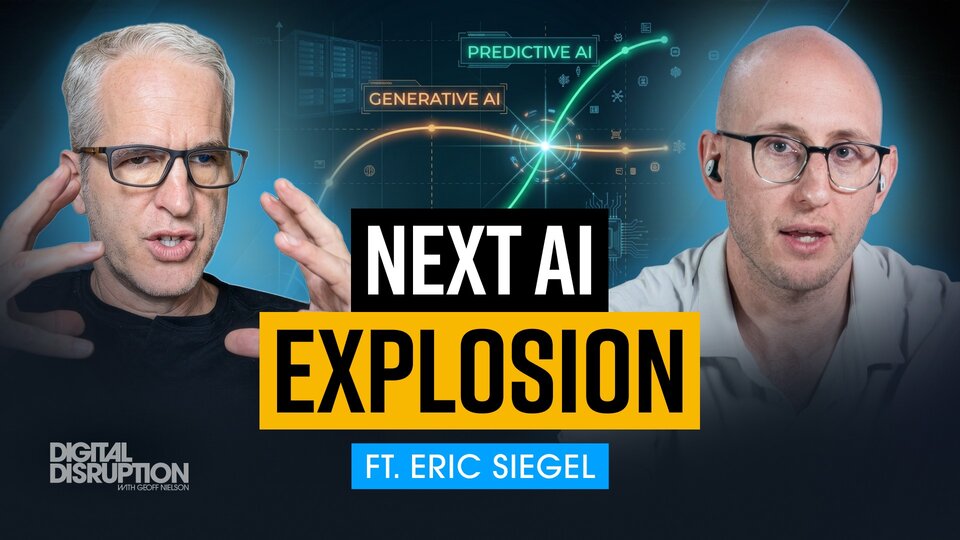
Our Guest Eric Siegel Discusses
The Other AI Revolution: Why Predictive AI Will Overtake Generative AI in 2027
Predictive AI often gets ignored, yet it may hold the real key to business value in the current tech landscape.
Listen
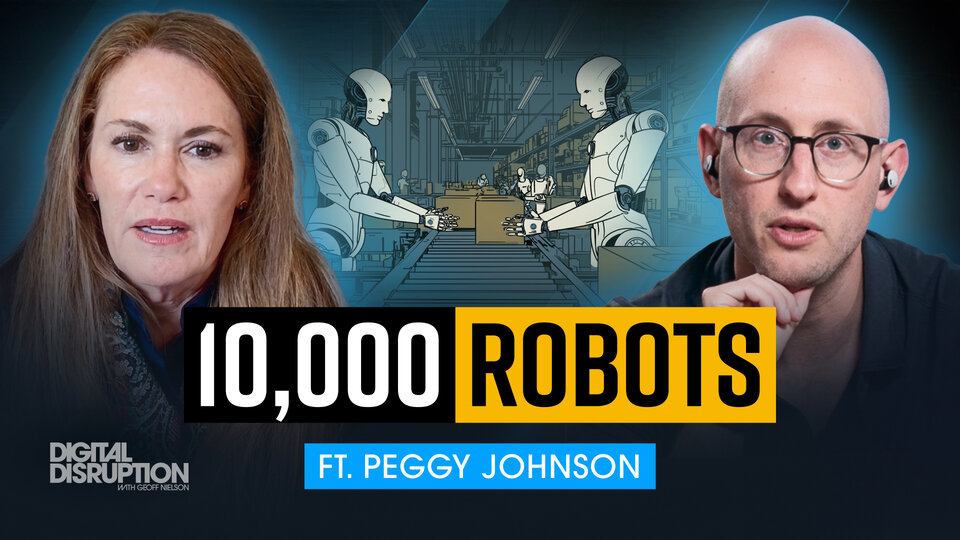
Our Guest Peggy Johnson Discusses
AI Humanoid Robots Have Already Entered the Workforce. Should You Care?
Peggy Johnson, CEO of Agility Robotics, joins us on today's episode to look beyond the fear of robot overlords and ask: How will humans and robots work together in the years ahead?
Listen
Our Guest Kevin Roose Discusses
AI Researchers Are Panicking | What Comes Next Is Worse Than Nuclear Bombs
The conversation examines Kevin Roose’s 10% estimate of AI-caused extinction, the private fears of AI researchers, government regulation, autonomous AI agents, and whether the AI boom is a bubble or the beginning of a profound transformation.
Listen
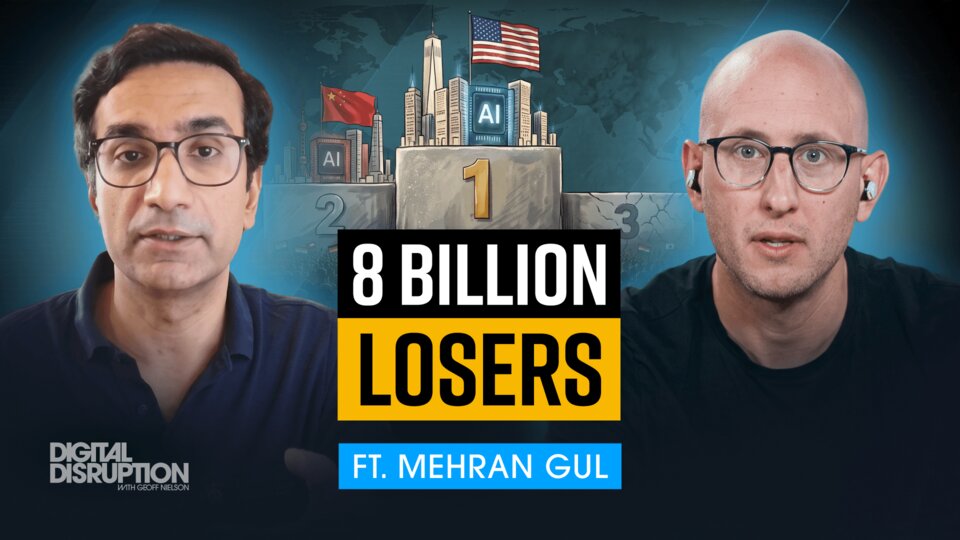
Our Guest Mehran Gul Discusses
There Is No AI Race. Inside the Trillion-Dollar Lie
From AI investment and venture capital to Silicon Valley, China, Europe, India, and the future of global innovation, this episode looks beyond the AI hype to ask a much bigger question: who will actually shape the next era of technology?