
Digital Disruption
with Geoff Nielson


Our Guest Jeremy Roberts Discusses
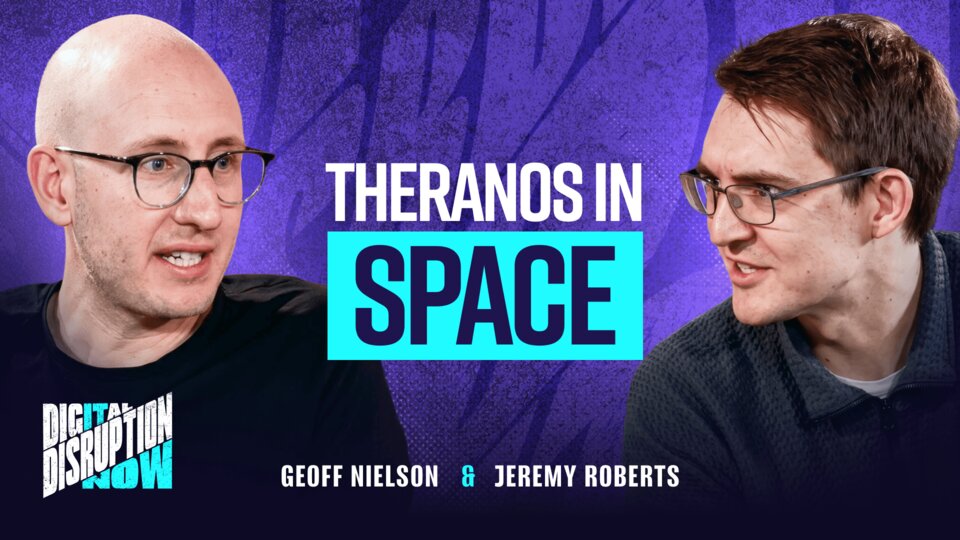
AI Data Centers in Space: Stupid or Genius
Tech moves fast. So does work. Digital Disruption NOW helps you keep up and make sense of what matters.
All signal. No static. An Infotech production.
Are AI data centers in space a practical solution for the future or just an expensive fantasy? We analyze the technical reality. This week we’re covering the AI market rout, datacenters in space, and the Binance hack.
00;00;00;00 - 00;00;13;27
Speaker 1
When I first started hearing about this, I thought it was like the stupidest thing in the world. The guy who owns a rocket company and owns an AI company, but he's like, hey, what if the AI was, like, sent up on rockets? I'm like, wow. Like, what a shock, that idea. What a shocker that you would come up with that idea.
00;00;13;28 - 00;00;22;19
Speaker 1
But I actually think it has more merit than you're giving it credit for.
00;00;22;21 - 00;00;29;24
Speaker 2
Liana said that The Force Awakens is actually better than the original 1977 Star Wars. She said that one was campy. She didn't get it.
00;00;29;29 - 00;00;39;10
Speaker 1
I I'm okay. That's a lot to process. I mean, I mean, she's right that it is campy, like I can. I can see why someone would say that, but like, she's still wrong.
00;00;39;10 - 00;00;51;03
Speaker 2
No, she's not wrong. Think about it like this, Jeff. They had one shot at the story, and then they fixed all of the beasts right in the second iteration. Yeah. If anything, this is an improvement. This is Star Wars V2. Why wouldn't you like it more?
00;00;51;05 - 00;00;59;18
Speaker 1
Yeah. I mean, I actually do really like Force Awakens. Probably more than I should, but, like, let's not talk about Last Jedi or what's even the third one called.
00;00;59;20 - 00;01;01;05
Speaker 2
Oh, I can't remember.
00;01;01;07 - 00;01;02;11
Speaker 1
Skywalker rising.
00;01;02;12 - 00;01;06;17
Speaker 2
Rise of Skywalker. That's it. Yeah, yeah. The return of the Jedi. Yeah.
00;01;06;19 - 00;01;07;04
Speaker 1
Should we jump.
00;01;07;04 - 00;01;08;11
Speaker 2
Into it? Yes. Let's do it.
00;01;08;12 - 00;01;22;20
Speaker 1
So we've got three stories to talk about today. The first one is that the markets have been punishing big tech firms for just, like, spending basically a crapload of money on AI. The second one we'll talk about is the first data center in space.
00;01;22;21 - 00;01;24;10
Speaker 2
Here we go.
00;01;24;13 - 00;01;36;16
Speaker 1
Results. We'll get there. We'll get there. And then third, and finally we're going to talk about the North Koreans that hacked the Binance, crypto exchange. So we should jump right into it. What do you want to tell us about the first one?
00;01;36;17 - 00;01;56;24
Speaker 2
Oh, yeah. Let's talk about this. So of course there is a massive selloff last week big enough to warrant news on digital disruption. Now Google and Amazon reported earnings. Apple actually reported earnings yesterday. Were filming this on a Tuesday and Microsoft reported earnings two. And the big headline, of course, is that they just got absolutely pummeled by the market.
00;01;56;24 - 00;02;19;16
Speaker 2
Google lost $500 billion in market cap. You know, $500 billion buys. You do a Costco, not like one Costco store. The entire Costco company buys you Coca Cola. Advise you Cisco. Just absolutely massive figures we're talking about here. And of course you know why the market punished Google, don't you, Jeff? It's because they're negative cash flow like right.
00;02;19;19 - 00;02;27;12
Speaker 2
They can't sustain this AI build out with their operations. And we were talking about this before the show. Do you remember how much they committed to spend.
00;02;27;14 - 00;02;30;09
Speaker 1
What was what was the number you said. You said close to a trillion.
00;02;30;10 - 00;02;43;23
Speaker 2
I think they committed over a trillion. That's crazy. Over the next few years like that. Those are anthropic levels of spending. Now Google is actually profitable. Yeah. So they can do that. But like if you're an investor my goodness $1 trillion in forward looking spend.
00;02;43;24 - 00;03;03;21
Speaker 1
Well in anthropic also updated their S-1. And they're also committing like close to $900 billion or something. Like they're just they're just crazy numbers. And my my concern about all of this is that we're just kind of reaching this diminishing returns point of AI where to make it incrementally more capable, you just have to invest more and more.
00;03;03;23 - 00;03;27;14
Speaker 1
And so we've got this like really messy tension where these companies like they want to, quote, win the race. And like we can talk about if that's nonsensical or rational and investors being like, holy crap. Like you're going to spend how much $1 trillion on this to get ahead to be incrementally better. And it's just like, I don't know from my perspective, like something's got to give.
00;03;27;14 - 00;03;29;15
Speaker 1
And I think we're starting to see that happen now.
00;03;29;15 - 00;03;48;15
Speaker 2
Well, the thing about Google is that historically, it actually has always made money. Ever since they went public, they've always been profitable. They basically always been cash flow positive, except for one recent earnings report. And now it looks like that's going to change. And that's kind of a big deal. And so just some other numbers here 50 billion is what they spent this previous quarter on capital expenditures.
00;03;48;15 - 00;04;06;00
Speaker 2
Yikes 205 billion was the projection for the year. And then the trillion that we just talked about. So I mean, okay, cool. Why does this matter? Why should you not as an investor, but as somebody who actually like, uses AI, engages with the enterprise tax base? Why should you care about this? Isn't this just noise? So I think.
00;04;06;02 - 00;04;25;29
Speaker 1
I mean, if you look at what's going on here, this can go a few different ways, right? To me, the most obvious way is that these companies sort of panic and say that, I mean, we already know this, but there's subsidizing the cost of AI in a pretty big way as a way to gain more adoption. And this is like a classic, like up and coming, like tech play.
00;04;25;29 - 00;04;44;16
Speaker 1
This is what Uber did you know before and around the time of their IPO. They want to like corner the market now I think there's more competition here. But I think we're going to see costs come up and some of these subsidies go away because it's just completely unsustainable, right. Like investors just don't have the stomach for this.
00;04;44;18 - 00;05;05;23
Speaker 1
And this is coming at a time where companies and people, users in general of AI are already starting to get this sort of sticker shock of like, holy crap. Like we're spending how much on AI? Yeah, like we talked about token maxing and we high fived each other, and we wanted everybody to be using this technology as much as possible, and it's costing us how much.
00;05;06;00 - 00;05;40;08
Speaker 1
And so taking a situation where there's already that sort of angst around that and then saying, oh, by the way, it has to be more expensive for these companies to not collapse. I think there's going to be a real reckoning. And if we want to make sure that it's not just like this chaotic and, you know, really, really red spending for all these companies and people out there, I think we just need to literally spin up a function that's like, hey, can we just start like, planning and strategizing around these costs?
00;05;40;08 - 00;05;55;29
Speaker 1
Can we get ahead of them so that we're not like, surprise? We spent another few million dollars on AI this month, right? How do you actually budget it? How do you put, you know, checks and balances in place? And you were doing like a presentation on token omics actually a few weeks ago. Did that, did that come up there?
00;05;56;02 - 00;06;00;18
Speaker 2
Oh, 100%. So yeah, the token omics is basically the economics of managing your tokens.
00;06;00;23 - 00;06;01;26
Speaker 1
I figured that out. Yeah, yeah.
00;06;01;28 - 00;06;16;28
Speaker 2
You you understood the portmanteau. It didn't get past you. Well, you completely threw me off there. No, the token omics basically is this idea that you want to manage your token spend. And there's a bunch of techniques you can use to do it. And so some of them are pretty minimal, like, you know, keep your prompts short, you know, make sure that you're being effective.
00;06;17;00 - 00;06;31;29
Speaker 2
Use the use the right model for the right task. That's a really big one. But I think this is bigger than that. Like you're going to use a frontier model. They're going to be bidding up the price of hardware to power it. Oh, it's going to be absurdly expensive. And so you're probably just going to end up using one of these open late models.
00;06;31;29 - 00;06;50;08
Speaker 2
This 90% is good. And that's I think part of the reason that Google is feeling that pressure, it's because being at the very leading edge for a massive premium on your capital spend might not be the economic play that we thought it was. And there's some signs that there fortress is weakening a little bit. So like search obviously running ads against searches.
00;06;50;08 - 00;07;03;10
Speaker 2
They're big business. But when you put an AI summary at the top, you're not selling any ads. And that's part of what spooked investors here. So they're going to have to figure out ways to monetize this beyond just advertisement.
00;07;03;12 - 00;07;15;23
Speaker 1
They're diversified already right. Like I saw I saw a chart that said, like for the first time, search is now less than 50% of their revenue. Yeah. And it was kind of divided into like search cloud and then quote everything else, which is, you know.
00;07;15;26 - 00;07;33;04
Speaker 2
Yeah, Google Cloud is a big business. But at the same time, if this whole bottom falls out of this AI bubble, their pipeline for their cloud customers disappears too. So it feels like diversification, but it's really just two doors that open into the same room, I think.
00;07;33;07 - 00;07;49;16
Speaker 1
I don't know that I follow that like their cloud business, I think is is fairly diversified. Like it's not this isn't just like an anthropic problem or like an invidious problem where you just have like the same for, you know, hyperscalers spending all of it. Right? Isn't it coming from a much larger consumer base?
00;07;49;18 - 00;08;09;18
Speaker 2
It is so like running traditional virtual machines and stuff. But that's not a growth business in the same way that AI is. And the data center build out the massive additional gigawatts and megawatts of capacity that all the hyperscalers are building out is to serve the AI market primarily. So if that falls out, they're going to have their trillion dollars in commit, right?
00;08;09;18 - 00;08;26;09
Speaker 2
They're not going to be able to to pay for it with cash flows, which is what I think is really scaring investors here and really what it comes down to from a why does this matter perspective is Google will never pay for that. You as the customer are always going to end up paying for that in much the same way that venture capital is subsidized.
00;08;26;09 - 00;08;32;26
Speaker 2
Uber, which you alluded to earlier for a really long time, Google is subsidizing the cost of AI so that the ventral.
00;08;33;00 - 00;08;48;25
Speaker 1
The venture capital piece is really interesting because we've also seen that like, you know, we talked about this last week, I think. But the when you look at like quote, venture capital backed firms, they seem to be where all the growth in spending is an AI right now because they're just pouring money into this saying like, this is the way to do it.
00;08;48;25 - 00;08;57;20
Speaker 1
And so yeah, yeah, I worry too that like if that appetite starts to shift, like it creates like this really systemic risk there.
00;08;57;22 - 00;09;17;22
Speaker 2
And that's exactly it. I mean, you see this in basically all the financial media. It's the the economy is being held up by AI. Yeah. And it's not just me spending money on tokens. It's all of the ancillary spend around that. The data center build outs, the cloud compute, you know, the frothy ness in the startup ecosystem. And so I think that I don't think the bubbles popped.
00;09;17;22 - 00;09;25;07
Speaker 2
I will just say that. But I think directionally this is very scary. If you were concerned about the overall health of the economy as you should be.
00;09;25;08 - 00;09;43;01
Speaker 1
There's something you said earlier, though, that I'm still trying to wrap my head around, which is that, you know, you're kind of alluding to the fact that for a lot of companies, maybe like a model that's 90% as good as the frontier is good enough and probably like, you know, dramatically cheaper, is that going to be the right play for a lot of people?
00;09;43;01 - 00;09;53;00
Speaker 1
And like, if that is is is that sort of like an existential threat to the, the financing and the funding model of the frontier?
00;09;53;03 - 00;10;16;01
Speaker 2
Absolutely. I mean, so so let me put it like this. You don't need a Nobel Prize winner in physics to teach a high school physics class. That's the frontier model, right? Right. Most most customers aren't actually trying to get a millennium prize with their eyes. They want to solve basic problems and an open weight model. And I think I saw some stats that suggest there are only a few months behind the frontier models.
00;10;16;03 - 00;10;34;18
Speaker 2
I mean, they're dramatically cheaper. You can run them yourselves, you can run them locally, you could run them in Google's cloud if you wanted to write like they changed the economics pretty dramatically. And these companies that are building these open weight models, they aren't valued nearly with the same premium or to the same degree that the anthropic and the open A's and the Googles are.
00;10;34;18 - 00;10;50;14
Speaker 2
So like, I think that Google, actually, unlike OpenAI or anthropic, does have a bit of a moat in that they'll still sell some infrastructure. They've got their search business, you know, they make phones, they do all sorts of things. So I think it's a real challenge, and they're going to spend a lot of time working on regulation to try and keep these out.
00;10;50;17 - 00;11;09;16
Speaker 2
And they're going to spend a lot of time propounding the benefits of being truly at the frontier and pitching these wild economy changing predictions, because that's the only way that they can stay feasible. And I think maybe one of the lessons for the people watching is, have you looked into an open weight model that you can run locally?
00;11;09;16 - 00;11;12;00
Speaker 2
Maybe, maybe that's sufficient for your needs.
00;11;12;01 - 00;11;36;08
Speaker 1
Right. So, so when the message you're kind of getting, you know, literally or subliminally is there is no competition. There's just, you know, anthropic and open AI. It's probably worth looking farther than that. But there's there's another element to it that, that you probably know more about, which is that, you know, one of the, like, dirty little secrets of all of this is that if you're not using either of those two models directly, you may be using them indirectly, right?
00;11;36;09 - 00;11;56;18
Speaker 1
Like you've got Copilot, like you've got Microsoft sometimes Google actually pulling from these models to power, you know, the AI interfaces that you're already using right now, like is it just Microsoft eating the cost of that and this is bad for their business? Or is there an implication in terms of what you're going to see in your Microsoft bill.
00;11;56;18 - 00;12;16;14
Speaker 2
Well, you can bring your own model, right? You can you can integrate Claude into office if you want to. And presumably you pay tokens for that. I think a lot of the hyperscalers, what they're doing is they're actually building their own AI solutions. Right. So Microsoft has a model called Maya, for example. They're building their own chips. Microsoft is also a building chips in this.
00;12;16;17 - 00;12;38;29
Speaker 2
In this case, OpenAI is building their own chips are trying to sort of vertically integrate to to protect their margin a little bit here. Microsoft, incidentally, is one of the few hyperscalers that didn't get rocked in the AI sell off precisely because they protected their margins a fair amount. So I don't know. I'm not sure if they're necessarily eating costs to the same degree that others are.
00;12;38;29 - 00;12;51;04
Speaker 2
I think that they're passing them along. And I think that if you're using just generic copilot built on the open AI service, they're likely just routing you to a pretty cheap model, because these things have moved pretty significantly in the past couple of years.
00;12;51;05 - 00;13;12;04
Speaker 1
Well, and I guess, I mean, there's two more angles that are probably worth exploring. I mean, we're talking about, you know, open weight models and some of this long tail of other vendors that are going to be substantially cheaper. But I guess if you are an anthropic or an open AI, you can just by default set your customers to a lower model so that you know they're not paying as much for this and hopefully happier and more likely to renew.
00;13;12;10 - 00;13;35;24
Speaker 1
I guess that, you know that that could hurt your your revenue if everybody's paying you less. But but the other piece that I expect that they're going to tell you is on the horizon. And, you know, it's not really a guess because it was literally in the amended S-1 anthropic, you know, shared earlier this week. But, oh, the the efficiency gains were getting now are like four x if you squint just hard enough.
00;13;35;26 - 00;13;36;27
Speaker 1
Do you buy that?
00;13;37;01 - 00;13;57;24
Speaker 2
Absolutely. I mean, as with all things, over time the technology is going to be refined and get better. And what seemed like a total frontier discovery 3 or 4 years ago is so mundane as to not even be newsworthy. Today, they're building their own chips. They're working on building their own power plants. Microsoft is restarting one of the reactors at Three Mile Island, not the one that melted down a different one to power it.
00;13;57;25 - 00;14;12;11
Speaker 2
Right. So they're gaining this. They're talking about putting data centers in space, which would give them more access to solar energy. But it's got a bunch of other problems, which we'll discuss in a few minutes. So I mean, yeah, I buy that it'll get more efficient sort of Moore's law, you know, we probably have to update it for somebody other than Gordon Moore.
00;14;12;13 - 00;14;26;27
Speaker 2
But yeah, it's this idea that it's going to get cheaper over time. Absolutely. I think what happens though is when stuff gets cheaper, we don't use less of it and pocket the gains. We use more of it and go, wow, this is still really expensive. So I don't think we've solved the cash problem yet.
00;14;26;28 - 00;14;45;23
Speaker 1
No, I don't think so either. Like I like I guess I agree with you that it will get cheaper, but I don't. I like I don't see it actually getting cheaper for people. Right. Like I feel like the, the efficiencies just are nowhere near enough to offset like the additional compute costs that are, that are, you know, creeping up here from more advanced models.
00;14;45;24 - 00;14;49;13
Speaker 1
So like, I don't know, I see the problem with continuing to get worse, not better, frankly.
00;14;49;14 - 00;14;58;09
Speaker 2
Well, I think that's a good way to put it. Maybe now is a good time to advise people on how they can make the problem go away in their own organizations.
00;14;58;09 - 00;14;59;27
Speaker 1
Oh, is it is it added time already?
00;14;59;28 - 00;15;00;17
Speaker 2
It is added.
00;15;00;22 - 00;15;05;07
Speaker 1
Thank you. Thank you for reminding me. Let's do that.
00;15;05;09 - 00;15;21;02
Speaker 1
Well, everybody knows that running a successful IT shop is extremely hard and AI has only made it worse. Immature processes, a fragmented data ecosystem and unlimited demand for it. It all makes for an impossible job. It's true. And yet nobody has invented a unified operating system for it.
00;15;21;04 - 00;15;21;21
Speaker 2
Nobody.
00;15;21;22 - 00;15;44;14
Speaker 1
We're literally the last function without one. Oh. Until now. Until now. That's why Infotech created CIO analytics, a single platform to run the IT department. We call it API driven advisory. It's powered by your data, our analyst insight, and it works with your existing tools right out of the box. If you're interested, check out the link in the description to request access and see CIO Analytics in action for yourself.
00;15;44;17 - 00;15;54;07
Speaker 1
An Infotech team lead can get you started. Same day. Better context, better insight, better IT performance. Only with API driven advisory. Only with Infotech.
00;15;54;11 - 00;15;58;29
Speaker 2
Is there a Webby Award for best? Maybe. Maybe be an honorary. Like maybe.
00;15;59;01 - 00;16;02;05
Speaker 1
Maybe that's something we can work on by the end of the first season of this.
00;16;02;06 - 00;16;08;25
Speaker 2
Yes. Figuring out how to how to win an award for your ad read. No. It's good. You should go to infotech. Com check it out. I actually have it open on my laptop in front of me here.
00;16;08;26 - 00;16;13;29
Speaker 1
Should we move into story number two? AI in space? I feel like you're, like, chomping at the bit to talk about that one.
00;16;14;00 - 00;16;15;24
Speaker 2
I am, and I it's champing at the bit.
00;16;15;24 - 00;16;18;19
Speaker 1
Jeff champ. It's not. There's no way it's champing at.
00;16;18;19 - 00;16;20;01
Speaker 2
The bit. It's champing at the bit.
00;16;20;02 - 00;16;21;25
Speaker 1
I don't believe you. We'll we'll have to.
00;16;21;26 - 00;16;23;26
Speaker 2
The YouTube commenters are to are going to correct you.
00;16;23;27 - 00;16;39;22
Speaker 1
Yeah. Good. So so Google received its first response from Project Sun Catcher. Love that name. The prototype AI data center in space that it launched earlier in October on a Space Falcon nine rocket. It wrote a haiku about being in space. And I'd like to read you the haiku.
00;16;39;29 - 00;16;41;02
Speaker 2
Okay. All right.
00;16;41;05 - 00;16;49;18
Speaker 1
Blue marble below. Data streams and silent grace. Starlight feeds my core sparkle emoji, sparkle.
00;16;49;20 - 00;16;50;13
Speaker 2
Sparkle emoji.
00;16;50;18 - 00;16;52;27
Speaker 1
You know, like the AI emoji. Like it's just the.
00;16;52;29 - 00;16;55;19
Speaker 2
Stuff you say. Sparkle emoji. Doesn't that throw off the syllable count?
00;16;55;20 - 00;17;05;19
Speaker 1
Well, I'm saying it because I'm I'm not putting it up on the screen. That's true. Okay. It's not part of the haiku. So. So what do you make of this story? Is, is is AI and space as stupid as it sounds, or is there actually something here?
00;17;05;19 - 00;17;10;00
Speaker 2
So first of all, data centers in space is the world's largest.
00;17;10;05 - 00;17;10;14
Speaker 1
Data.
00;17;10;16 - 00;17;32;17
Speaker 2
Center misnomer. It's for us, Jeff, and they can't even power all of them at once. So it's one at a time. The power production on this thing is about the size of a fridge is one kilowatt. That's like small appliance level powering, like you can power a microwave or a hairdryer or something. Like you could do a couple of loads of laundry.
00;17;32;17 - 00;17;55;15
Speaker 2
This isn't data center scale operations. It's running a relatively lightweight model with these four TPUs. The main purpose of this, near as I can gather, is to figure out what radiation does to the chips, how vibration from takeoff actually impacts the chips, and, you know, the whole chassis and the housing when they send it up to space and probably just to draw some attention.
00;17;55;15 - 00;17;58;17
Speaker 2
So like you probably seen a few stories about this, right.
00;17;58;19 - 00;17;59;19
Speaker 1
At least. Yeah.
00;17;59;24 - 00;18;02;23
Speaker 2
Well it went up in I think September, if I'm not mistaken.
00;18;02;26 - 00;18;04;12
Speaker 1
It was beginning of October by the year points down.
00;18;04;14 - 00;18;24;21
Speaker 2
Yeah, a few months ago. And people have been talking a ton about it. And the story that we pulled this from is TechCrunch. Obviously very exciting, and I feel like it just hasn't gotten the right amount of skepticism. So like let's talk about the obvious. Like getting to space is really hard and expensive. Just before the show, I looked up how much it cost to launch a Falcon nine.
00;18;24;21 - 00;18;52;23
Speaker 2
It's $74 million, and obviously it's got a payload. Google wasn't the only customer there, and Google can afford it. $200 billion in CapEx. What's 70 million here and there? You know, between friends pocket change. Right? I think we've got it in the in the chair here. But like if you wanted to launch an actual full scale data center that could do real compute equivalent to these multi acre terrestrial data centers, this would be like the most expensive thing humanity has ever done.
00;18;52;25 - 00;18;54;00
Speaker 2
That seems reasonable to you.
00;18;54;05 - 00;19;12;15
Speaker 1
So I like I have to admit I.
00;19;12;17 - 00;19;13;15
Speaker 2
See company now.
00;19;13;15 - 00;19;35;25
Speaker 1
Jeff don't don't when when he's like hey, what if the AI was like send up on rockets? I'm like, wow, like, what a shock. That idea. What a shocker that you would come up with that idea. But I actually think it has more merit than you're giving it credit for. And like, I don't know, part of me wants to just file this under, like a journey of a thousand miles starts with a single step, you know, like, yeah, of course it is.
00;19;35;25 - 00;19;54;29
Speaker 1
It like a frigid space right now? Yes, because they're testing it out. But do you have to test it out before you scale it? Yes. And so we can sit here and throw stones, or we can be like, oh, this is really cool. And it solves a bunch of, like, deep seated problems with data centers. I mean, first of all, everybody hates data centers.
00;19;54;29 - 00;20;16;06
Speaker 1
Like, it's like it's like a hilariously bipartisan issue. Like, literally the world is coming together to say, like, not in my backyard. Yeah. So you've got, like, the backlash against data centers, tightly coupled with that. You've got like the power needs of data centers, you've got the water needs of data centers. Like they're just like, really, I want to say hilariously unpopular people might be like, it's not funny.
00;20;16;06 - 00;20;34;28
Speaker 1
There's nothing funny about how much we hate data centers and, you know, the environmental destruction that they're doing, which is like a bit overblown, but that's that's a different story. But you put them in space and suddenly it solves a bunch of these problems. And I'm not look, I'm not saying data centers in space 2026. I'm not saying data centers in space 2027.
00;20;35;00 - 00;20;41;22
Speaker 1
But if you read, you know, the Google kind of mission statement about this, they're looking at kind of 2030 and beyond.
00;20;41;23 - 00;20;42;07
Speaker 2
Yes, in the.
00;20;42;07 - 00;20;43;16
Speaker 1
2030s.
00;20;43;18 - 00;20;59;02
Speaker 2
Oh, no. No. So, Jeff, I have a mouse problem in my house. So I burn my house down, I solve the mouse problem, but in the process I created a whole bunch of other problems. So you said we have issues with water use in data centers. What do we use water in data centers for? For cooling. How do you cool them in space?
00;20;59;03 - 00;21;18;13
Speaker 2
Space is cold, but it's not a great heat sink. You need these massive radiator booms like the the the amount of physical stuff you would have to send up to cool a data center of any scale is a problem that I frankly haven't seen tackled in any of the reports here. So yeah, we solved water use on Earth by just not cooling stuff in space.
00;21;18;15 - 00;21;40;04
Speaker 2
What about actually repairing it when something goes wrong? What are you do send Bruce Willis up like Armageddon to fixing the data center? Like, no, that would be absurdly expensive. And, frankly, probably pretty dangerous. Like, it doesn't make any sense. So to me, this is like Theranos crypto level of just unfeasible. Like anybody who's like, really expert in the space, which I'm not saying I am.
00;21;40;08 - 00;22;02;03
Speaker 2
But like anybody who knew anything about blood testing knew that Theranos wouldn't work. Right. Anybody who knows anything about the financial system, and this is probably the most thing I'll say I'll show, is skeptical somewhat of the value of many of these cryptocurrencies that are out there. And I think that anybody who has spent any time working on computing in space travel will tell you that, like, there are a lot of challenges that you need to overcome before this becomes feasible.
00;22;02;03 - 00;22;10;04
Speaker 2
And I agree, journey of 1000 miles begins with a single step. But not every moonshot succeeds. That's why their moonshots, if every moonshot succeeded, they wouldn't be moonshots.
00;22;10;06 - 00;22;31;03
Speaker 1
So I mean, let's talk about that. I mean, first of all, this is like maybe the most literal moonshot because it's like actually shooting something into space. But it in your mind, like, are you saying like, shut her down? This is not a moonshot worth doing. Like, to me, it's so obvious that there's value here and it solves so many problems that, look, I'm not like, this is a solved problem.
00;22;31;03 - 00;22;54;22
Speaker 1
I'm not saying this is a sure bet, but what I've become increasingly convinced of over the past few weeks is this is probably worth investing in, as you said, like pocket change for Google compared to what it's spending in compute. Like, would you just say shut it down, go, you know, look at pouring that into a frontier model like this to me actually has problem has promised right are the problems.
00;22;54;22 - 00;23;15;29
Speaker 1
Of course there's problems. Right. Like and you know Elon Musk like nobody has gotten rich yet at least betting against Elon Musk. Like. And look I have no shortage of of, you know, concerns with the guy. But he has a reputation for fixing things that people said were impossible. Right. So so I'm just I'm not willing to write it off wholesale.
00;23;15;29 - 00;23;20;23
Speaker 2
There's a reason I'm sitting here on a podcast and he's CEO of a bunch of companies I fully understand.
00;23;20;25 - 00;23;21;06
Speaker 1
Okay.
00;23;21;07 - 00;23;37;02
Speaker 2
Yeah. No kidding. That said that said, if you want to spend money on a crazy place to put a data center, like we have a lot of crazy places at home, you know, you can you can put it out on a prairie somewhere. You can put it under water, which Microsoft did with Project Nemo and is actually quite successful.
00;23;37;02 - 00;23;50;12
Speaker 2
But there was a bunch of issues around like shocker, repairing the thing, you know, keeping it up to date. Nobody's talked about that, by the way, like, oh, a new GPU comes out. What do you do, send Bruce Willis up again to swap it out? Like, how does this work? What's the life cycle like? We talk about pollution.
00;23;50;12 - 00;24;10;02
Speaker 2
I haven't done the math on this, but I have to imagine that the amount of carbon generated by launching a literal rocket into space to bring four TPUs up is probably greater than the lifetime carbon consumption of the equivalent TPUs on Earth. Because rockets, it turns out, use a lot of energy to get into low Earth orbit. That's just a thing.
00;24;10;03 - 00;24;23;24
Speaker 2
The satellite is going to break up after a while. What about space junk? It's only going to operate, I think, for one year, but they're going to keep it orbiting the Earth for many years. You know that that's not free real estate in the same way that I think maybe people think about space, like the low Earth orbit is getting quite crowded.
00;24;23;24 - 00;24;44;14
Speaker 2
It's kind of a problem. Is there a future for computing in space? Absolutely. As long as we're in space, we're going to need computing up there. This is good. We're going to learn a lot about radiation and bit flipping and all that good stuff. But like, is this a serious alternative? No, this is like the Hyperloop, which my conspiracy brain mind says they pitch the Hyperloop to avoid jurisdictions building railways.
00;24;44;16 - 00;24;58;18
Speaker 2
And the reason they did that is because the people who were into Hyperloop like Elon Musk, sell cars. And so if I say no, don't build a railway, we'll build a Hyperloop. And then I don't build the Hyperloop. It looks like you got to buy a car, right? That's my conspiracy minded thing. So it's not to build data centers in the short term.
00;24;58;18 - 00;25;05;05
Speaker 2
My question is, what is it for? And maybe I'll leave that for the audience because I don't know, I don't know, I'm just speculating here being a little conspiracy brain.
00;25;05;08 - 00;25;18;08
Speaker 1
Well, so like let's just follow that a little bit farther down the road. Like, where does this go from here? Like, you've kind of conceded that this is probably worth investing in on some scale. There's some value here.
00;25;18;09 - 00;25;27;26
Speaker 2
Computers in space are as old as space travel itself, basically. You know, Sputnik was beeping. I don't know if it had a computer in it in the technical sense, but yeah, we've been taking computers up for a long time.
00;25;28;02 - 00;25;47;00
Speaker 1
So. So at what point do you get like a Jeremy was right moment here. Like because we're going to keep shooting these into orbit. We're maybe not going to scale them to the degree where it's actually like, you know, this is the next big thing. What do you need to see happen in the next five years to be like, like I told you so.
00;25;47;02 - 00;26;06;12
Speaker 2
Oh, I think if they close the project Sun Catcher and say, yeah, we're not going to pursue further development on the actual data center in space concept, I would consider it a air quotes failure, although failure isn't always a bad thing. Just like with Microsoft and Project Nemo, the underwater data centers, they did the project, they experimented, they came back and they said, for reasons we're not going to do this.
00;26;06;18 - 00;26;21;23
Speaker 2
So if the equivalent happens with Project Sun, at a certain point you pull the plug on this stuff, then I'll claim victory. That said, I can't say what's going to happen in the indefinite far future. And if we spend way more time out in space, you know, maybe we'll be having this conversation. People say data centers on the moon are ridiculous.
00;26;21;23 - 00;26;29;12
Speaker 2
350,000 miles away, at least lower orbit. It's easy to get to. You know, maybe I'll be on that side of the argument then. But yeah, that's that's my answer.
00;26;29;14 - 00;26;41;12
Speaker 1
That's that's that's reasonable. And I'm curious to see, you know, how it goes from here. I also just like when I, when I was doing a bit of research on this, I made a note to myself that just said data residency question mark.
00;26;41;16 - 00;26;43;18
Speaker 2
Yes. Who owns it in space? That's a good point.
00;26;43;19 - 00;27;04;27
Speaker 1
And I mean, I don't know if that's a good thing or a bad thing, but like, yeah, what happens to your data when it's suddenly underwater or in space? And I don't know, is that a good thing or a bad thing? And is this worth contending with? Like, I don't know. Is this on your roadmap of concerns? If you're, you know, thinking about your data or is this like a huff, like, you know, across that road when we get.
00;27;04;27 - 00;27;29;19
Speaker 2
There, it's like somebody pitching like a formal dinner on the moon and me being like, oh no, my biggest problem is, what do I wear? Yeah, I suppose I'll have to cross that bridge when I get to it, Jeff. But I don't think I'm gonna have to cross it anytime soon. Speaking of unreasonable things, our third story, I think anybody who's followed me, which is honestly probably not a lot of people here, I'm an analyst at an IT firm and and I have covered in the past.
00;27;29;20 - 00;27;51;05
Speaker 2
Crypto knows probably what my opinion on this is. So I'm going to ask for yours. Binance was hacked for $6.3 billion worth of a variety of different cryptocurrencies. I think there's some Bitcoin in there, some USD t. They were actually able to freeze about 3 billion of that, which calls into question the premise of crypto a little bit, doesn't it?
00;27;51;05 - 00;28;10;10
Speaker 2
Isn't it all about decentralization and not being able to do that? But anyway, the FBI says it was a group called trader. Trader. Like get it? Like that's a kind of a pun. They're homophones. They sound the same working out of North Korea. Right. And North Korea has done this. They actually I read that they hacked the Bangladeshi central bank.
00;28;10;11 - 00;28;28;19
Speaker 2
At one point, they got access to their swift credentials and started transferring money like hard dollars. And one of their transactions failed because they spelled the word foundation wrong. So I was just a little bit of law there. So this isn't the first time they've done it, but that was only in the tens of millions. This is 3.3 billion outstanding.
00;28;28;21 - 00;28;31;04
Speaker 2
Binance has said they're covering all losses.
00;28;31;06 - 00;28;32;15
Speaker 1
90%. I thought.
00;28;32;18 - 00;28;52;13
Speaker 2
Well, 90% so far. Right. I think they said they're covering all in there at 90% now. And they said that the funds were Sappho, which is say foo, which is crypto slang for money is safe, just like Hodl. You know, they love a good typo in crypto world. I don't know, Jeff. I read this story and I thought, okay, so some DevOps engineers laptop was compromised.
00;28;52;13 - 00;29;07;02
Speaker 2
Now they're saying it's a deeper infrastructural issue. We're not 100% sure what happened. We're recording this on Tuesday the third. So we don't know specifically what the cause was. But I'm sure there's a lesson to take away here. What's your lesson from the Binance hack.
00;29;07;02 - 00;29;19;07
Speaker 1
So so there's like there's tiers of lessons here. This whole thing is just like so stupid tears Jeff. So, so I mean, first of all, if you listen to Binance, they're like, guys, everything is fine.
00;29;19;09 - 00;29;20;19
Speaker 2
Don't worry. Your funds are.
00;29;20;22 - 00;29;41;10
Speaker 1
Yeah, but like I have a problem with this problem. Number one, you just gave North Korea like an extra $3 billion. And by the way, like their apparent like GDP last year was only $30 billion. And that's GDP. And like I get it. We're not doing 1 to 1 here. But like $3 billion for North Korea is like just a shit ton of money.
00;29;41;12 - 00;30;03;04
Speaker 1
Like why do we have this system where suddenly North Korea is able to steal $3 billion? I, like I am a very big crypto skeptic. Like, let me just put a fine point on it. I think there is no legitimate purpose for crypto, period. I think if you're a criminal, it's useful. I think the whole thing is a pyramid scheme.
00;30;03;05 - 00;30;10;26
Speaker 1
And like if you're still investing in this, shame on you. You should not be in crypto. You know, you got talked into it by a crypto bro.
00;30;10;27 - 00;30;12;26
Speaker 2
Not financial advice.
00;30;12;29 - 00;30;47;25
Speaker 1
Fine. So so yeah, I'm, I'm just like and by the way, it's not even performing. Well. It's down 30% this year. In the past five years it's lagged. The S&P, like everything you've read about crypto is by just like multi-level marketers being like you got to get it on crypto bro. So like all of that is thing one thing two is, you know, to your point, like there's just such an obvious cybersecurity lesson here, which is, as you said, like they got into this on like a single laptop and.
00;30;47;25 - 00;31;02;01
Speaker 2
They're they're walking that back a little bit. That was their initial pronouncement. And they've come out and said, oh, it wasn't one person's permissions. I don't know how true that is. I feel like if it was one person's permissions, that would be like a disastrous thing to announce. So.
00;31;02;04 - 00;31;09;01
Speaker 1
Well, so I want I want your take on it because you, I mean, I, I like dabble in cyber but you, you go a bit deeper in it.
00;31;09;06 - 00;31;10;11
Speaker 2
Like infrastructure.
00;31;10;13 - 00;31;12;29
Speaker 1
What's your take as someone with an infrastructure background?
00;31;13;00 - 00;31;34;15
Speaker 2
I mean so I don't know what happened here. So I'm just speculating entirely. But I will say that most hacks are not super sophisticated exploits. Yeah. Usually it's they compromise someone's credentials and things aren't configured properly internally. And then the hackers able to get access to a whole bunch of systems that they shouldn't. In this case, I think they were able to make some transactions.
00;31;34;15 - 00;31;57;00
Speaker 2
They had permission to make unauthorized transactions essentially on the Binance platform. And so this strikes me as a big issue with how they manage internal permissions. Like, obviously, a financial institution like Binance does have to have the ability to make those transactions. Or maybe somebody who's more expert in crypto can chime in and explain specifically how this works, but it strikes me as a failure of zero trust.
00;31;57;02 - 00;32;19;14
Speaker 2
It strikes me as a failure of like general risk mitigation. How can that much money be moved that quickly without alarm bells going off? And I guess maybe the alarm bells did go off after 20 minutes, but it was all done. Maybe some of the things that make crypto so appealing, like it's irreversibility, you know, the the anonymity, the relative anonymity.
00;32;19;14 - 00;32;42;28
Speaker 2
Anyway, although Binance does have a know your customer policy, as far as I understand it. Maybe those things made this much more appealing. So I will say that, you know, my takeaway here is without the full picture, my bet is that somebody clicked the bad link or followed the wrong file path, or authorized something that they shouldn't have or believed something was true when it wasn't.
00;32;43;00 - 00;32;59;14
Speaker 2
And so that was a failure point. And then how did we get to a point where once somebody had that access, they could I think this is the largest heist in history. I don't think there have been any bigger ones, like every other one would also be a crypto right issue. There's the whole razzle con.
00;32;59;14 - 00;33;03;29
Speaker 1
But but it's just like like this is like, oh, it's the safest thing. Like it's got, like.
00;33;04;01 - 00;33;04;28
Speaker 2
The funds are safe.
00;33;04;29 - 00;33;23;26
Speaker 1
Yeah. It's just like, it's so much better than regular money. It's like, okay then like how come it keeps getting stolen and how come it can get frozen? And how come people are, like, forgetting their key? Like there's just there's so many things that can go wrong here. But the I mean, the other thing that's on my mind is like, what does this mean for Binance as a trusted platform?
00;33;24;00 - 00;33;44;14
Speaker 1
And like where I'm yeah, heavy quotation marks, like where I'm coming from is I was actually talking to the chief security officer at visa last week in an interview. It hasn't aired yet. But, you know, visa is visa like like they're investing literally billions of dollars in cybersecurity and they're doing these, like, you know, pretty impressive things.
00;33;44;14 - 00;34;17;23
Speaker 1
And they're actually sharing it with the like, financial and insurance community because, you know, you're only as strong as your weakest link. And they want to strengthen the chain. But like, you're not reading stories about visa getting hacked because they, they, they like their whole business is being like kind of hack proof, right? Being secure to use a very simple word and like, isn't that Binance whole thing like this just seems like like calling it a 101 error is probably not correct.
00;34;17;23 - 00;34;26;07
Speaker 1
But like the to go back to the start of our conversation, I'm picturing like the Death Star trench run and that one stupid, you know, exhausted.
00;34;26;10 - 00;34;28;12
Speaker 2
Why don't you put the exhaust port in there? That makes no sense.
00;34;28;13 - 00;34;28;22
Speaker 1
Yeah.
00;34;28;23 - 00;34;29;16
Speaker 2
Just literally cover.
00;34;29;16 - 00;34;29;26
Speaker 1
That up.
00;34;29;28 - 00;34;40;02
Speaker 2
Yeah. I'm like, why did they have all the guns there? They clearly knew that it was a problem. Right. And they didn't fix that one little problem. I guess you need to have exhaust because it's important to radiate heat in space.
00;34;40;05 - 00;34;42;15
Speaker 1
Okay. Now we're like now. Now it's all coming in.
00;34;42;15 - 00;34;49;13
Speaker 2
Comedy callback those full sphere in the third movie, the sphere wasn't full yet. It was still under construction. But they they built.
00;34;49;13 - 00;34;50;25
Speaker 1
The website. But that thing's operational.
00;34;50;26 - 00;35;08;05
Speaker 2
So she talked about Starkiller Base to. While we're at it. Look, Binance, the head of Binance, he's not actually formally the CEO. There are two CEOs. Neither of them are the guy that everybody associates with. Binance name is Changpeng Zhao. He actually served a short prison term for violating money laundering rules.
00;35;08;06 - 00;35;13;00
Speaker 1
That's what I like to hear from the person running the exchange that my money is in.
00;35;13;02 - 00;35;19;20
Speaker 2
Binance isn't allowed to operate in the United States as far as I know. At least they weren't until fairly recently. If that's changed, they.
00;35;19;22 - 00;35;21;04
Speaker 1
Space it is that.
00;35;21;07 - 00;35;43;02
Speaker 2
There you go. Put them up on the data centers. Beam your money back down at you. Ironically, I think that a lot of other financial institutions, if they were executing this type of a transaction, there would be multiple parties involved. I think Binance, despite being the largest player in this DeFi space, actually had the centralized ability to move stuff around based on my limited understanding, which is kind of an ironic issue.
00;35;43;05 - 00;36;00;21
Speaker 2
So yeah, I mean, should people trust Binance? I mean, look, my full disclosure is I own no crypto, I never have. I've been pretty skeptical of it. This, to me is an indication of immaturity in the space. And I would argue in agreement with you that the space doesn't really need to exist like we do enterprise IT advisory.
00;36;00;21 - 00;36;07;04
Speaker 2
And 4 or 5 years ago, crypto got really big. People were really excited about it. I kept hearing about business, NFT.
00;36;07;06 - 00;36;08;04
Speaker 1
Blockchain in general.
00;36;08;05 - 00;36;24;27
Speaker 2
Blockchain in general. That's exactly right. The distributed ledger is going to change insurance. The Australian Stock Exchange is going to switch its settlement system to something that was blockchain based. And that was all BS. Yeah. And you could tell while you were sitting there you're like, this is a digital receipt for a JPEG. Why would anyone pay real money for this?
00;36;24;28 - 00;36;42;20
Speaker 2
And then of course, the bottom fell out. The Australian Stock Exchange was never going to move to a blockchain based solution because it didn't solve a problem that they actually had. There wasn't like a trust issue on the Australian Stock Exchange. And so they ended up moving away from it and writing down the cost of their attempt to make that transition.
00;36;42;22 - 00;37;07;11
Speaker 2
So currency is really the last remit of crypto. And I think if you lost money in the Binance hack and then they paused your ability to withdraw, you would think, wait a minute. I thought the whole point of this was to remove institutional power over my currency, but it turns out that that institutional power remains. And also I'm not insured by like a deposit insurance corporation.
00;37;07;13 - 00;37;26;02
Speaker 2
Yeah, getting a real insurance company to pay for my Dogecoin's or whatever strikes me as quite problematic. You know, I'm trading USD. Why don't I just hold dollars? You know, like the whole thing that's lagging the S&P 500 and it tracks the regular markets more broadly, like, I don't know, I'm very skeptical of it.
00;37;26;03 - 00;37;44;10
Speaker 1
So so just like trying to land on like a what do we learn from all this? I mean, one of the things we haven't talked about yet is to me, like at this point in general, as a company like cyber insurance has just become a no brainer. Like it's just you are almost certainly going to get hacked, it's going to do damage.
00;37;44;10 - 00;38;15;12
Speaker 1
Having some sort of insurance just feels like it's something you must do. And you talk briefly about zero trust, right? Like the idea that one, you know, whether or not this is true. Like if one laptop or one employee gets hacked. We've talked for so long about employees being your weakest link, and it just seems like, like just untold dollars spent trying to do cybersecurity training and people just like being like, oh, this doesn't look like phishing to me.
00;38;15;13 - 00;38;34;16
Speaker 1
And like, clicking the wrong thing or writing their password at their desk or whatever. Like, you just need to secure the environment enough that even if an endpoint is compromised, only so much damage can get done. Is there any more kind of color you'd add there, or anything else to kind of tag on to that thought?
00;38;34;18 - 00;38;56;07
Speaker 2
I think the broader parable is, I think a lot of crypto people looked at the existing financial system and said, wow, it takes days for this to settle. What a disaster. Not realizing that it's not a technical limitation of the financial institutions that makes it so that these, you know, different payments or whatever take time to settle their transfers.
00;38;56;13 - 00;39;28;22
Speaker 2
It's regulatory, it's process based, there's multiple actors involved, it's risk mitigation. And so they take that out of the system. And then this happens and they're sort of learning the lessons that I think banks I guess spent centuries learning right over time. And I think that there is a lesson in that for anybody who's building anything, which is if somebody does something a particular way, instead of saying, that's stupid and just building your own thing, you should probably understand why they do it that way, why the global economy is based on fiat currency.
00;39;28;23 - 00;39;57;25
Speaker 2
You know why we depend from gold or whatever. And this is not a 1970s Nixon shocks comment. Or podcast, I should say that's not the purpose of this show. But like, I think that's the fatal mistake of crypto as a, as an industry is, they're attempting to innovate and they're doing things differently. And sometimes the things they do differently probably shouldn't be done differently based on lessons that we learned, but they haven't, right.
00;39;57;25 - 00;40;01;17
Speaker 1
If you're going to move fast and break things, you can't get upset when things break.
00;40;01;22 - 00;40;03;13
Speaker 2
Yeah, I think that's a good way to put it.
00;40;03;14 - 00;40;06;12
Speaker 1
Yeah. Well is that enough for one week?
00;40;06;13 - 00;40;23;19
Speaker 2
I think so. And so for those of you watching Digital Disruption now is our weekly news show comes out every Wednesday. Make sure you subscribe to Digital Disruption for all the latest and Jeff's great interviews, including with the Google engineer who is actually at least partially responsible for data centers in space. So you can check that out. What was his name?
00;40;23;19 - 00;40;23;28
Speaker 2
Blaze.
00;40;23;28 - 00;40;26;02
Speaker 1
Blaze. Agora e Arcus. Yeah.
00;40;26;03 - 00;40;42;12
Speaker 2
Oh, there you go. So check that out. You can you can see Blaze's opinion on stuff and maybe understand how he arrived at data centers in space being a good idea. Now, digital disruption now is a production of Infotech, which is an IT research and advisory firm. You can check us out at Infotech. Jeff and I are both analysts at Infotech.
00;40;42;13 - 00;41;07;06
Speaker 2
That is our day job. The show is hosted by Geoff Nielson, a senior vice president, and me, Jeremy Roberts, a senior director. Tim Lai is our technical director and our editor. Thank you, Tim. Koula Bouloukos is our producer. Maria Knight also produces the show. Brian Moggach, Tim Champion and James Groome, our camera operators and general studio techs. Thank you so much, guys, for getting a really good shot of me right now.
00;41;07;13 - 00;41;16;07
Speaker 2
Special thanks to Holly Calnan who is holding down the fort while we present this. So join us next week for more news in tech and work.
00;41;16;09 - 00;41;17;24
Speaker 1
Thanks, Jer. We'll do it again next week.
00;41;17;25 - 00;41;18;11
Speaker 2
Looking forward.
00;41;18;11 - 00;41;18;21
Speaker 1
To it.



The Next Industrial Revolution Is Already Here
Digital Disruption is where leaders and experts share their insights on using technology to build the organizations of the future. As intelligent technologies reshape our lives and our livelihoods, we speak with the thinkers and the doers who will help us predict and harness this disruption.
Listen


Our Guest Jeremy Roberts Discusses
AI Data Centers in Space: Stupid or Genius
Are AI data centers in space a practical solution for the future or just an expensive fantasy?

Listen
Our Guest Stephen Wolfram Discusses
AI’s Biggest Problem May Be Mathematically Impossible to Solve | Stephen Wolfram
Stephen Wolfram, creator of Mathematica and Wolfram|Alpha, explains why artificial intelligence remains fundamentally unpredictable and how we can make it useful despite those limits.

Listen
Our Guest Jeremy Roberts Discusses
Anthropic’s IPO Filing Reveals $80 Billion Loss. It Doesn’t Matter.
Digital Disruption NOW is the latest podcast in the Digital Disruption network, bringing you a weekly take on tech, work, and what it all means.

Listen
Our Guest Marina Mogilko Discusses
AI’s Promised to Transform the Economy. Where Are the Results?
From organizing company data to building targeted AI agents, the conversation explores what it takes to turn AI adoption into business value. Marina shares why experience, strategic thinking, and accountability remain essential, and how leaders can prepare their teams for sustainable growth.