
Digital Disruption
with Geoff Nielson


Our Guest Ravin Jesuthasan Discusses
AI Is Breaking the Economics of Work. No One Is Ready
If AI can free up half a company’s labor capacity, what happens to the people doing the work?
Ravin Jesuthasan describes AI transformations that have freed up 40%-50% of labor capacity. Is your organization ready for what that means for its workforce?
The futurist and bestselling author explains how AI is reshaping the future of work and why its productivity gains don’t have to translate into layoffs.
Ravin joins Geoff on this episode of Digital Disruption to discuss generative AI, AI agents, and the impact of automation on jobs. He explains why entry-level roles are under pressure, how traditional career paths are changing, and why judgment, empathy, and curiosity are becoming increasingly valuable.
Drawing on examples from Standard Chartered and Unilever, he explores how organizations can prepare employees for new opportunities through upskilling and reskilling and breaks down what it means to build a skills-powered organization where learning becomes part of everyday work.
Ravin also shares how leaders can reinvest AI productivity gains in employee wellbeing, better customer experiences, and continued innovation.
00;00;01;25 - 00;00;03;03
These AI
00;00;03;03 - 00;00;06;02
powered transformations
don't yield 3 or 4%.
00;00;06;02 - 00;00;09;22
They get you 40 to 50% capacity release.
00;00;09;25 - 00;00;14;12
As I said to one of my clients, you know,
we freed up 50% of your labor capacity.
00;00;14;21 - 00;00;18;03
You've got three non
mutually exclusive choices.
00;00;18;06 - 00;00;21;09
You could take it
as an opportunity to reset
00;00;21;13 - 00;00;24;11
what is a pretty dire work environment.
00;00;24;11 - 00;00;27;01
With a 40% turnover rate for.
00;00;27;01 - 00;00;31;02
We could redeploy some of the games
so that we are improving
00;00;31;02 - 00;00;34;15
what is almost an equally dire
customer experience.
00;00;34;24 - 00;00;38;22
And the CEO, to his credit, said, I think
I'll have a little bit of all three.
00;00;38;23 - 00;00;40;29
Please.
00;00;40;29 - 00;00;43;29
This is the show about the future of work
and the future of tech.
00;00;44;07 - 00;00;47;10
AI is radically reinventing
how work gets done.
00;00;47;11 - 00;00;50;09
But when a company can free up
half its labor capacity,
00;00;50;09 - 00;00;52;03
what happens to its people?
00;00;52;03 - 00;00;56;07
Today, futurist and bestselling
author Robin Jesu Thorson explains
00;00;56;07 - 00;00;57;27
which jobs are most vulnerable,
00;00;57;27 - 00;01;01;21
why judgment may become
our most valuable skill, and how leaders
00;01;01;21 - 00;01;06;05
can use AI's enormous productivity gains
without simply turning them into layoffs.
00;01;06;10 - 00;01;09;27
I'm Jeff Nielsen,
and this is digital disruption.
00;01;12;29 - 00;01;14;20
Well, Robin,
thank you so much for being here today.
00;01;14;20 - 00;01;16;24
Really excited to have you on the program.
00;01;16;24 - 00;01;21;14
You know, I want to talk a little bit
about AI in the context of the future
00;01;21;14 - 00;01;26;03
of work automation, the impact that it's
going to have on all of our jobs.
00;01;26;03 - 00;01;29;20
And so, you know, maybe to kick us off,
I'd like to ask you more broadly,
00;01;29;24 - 00;01;34;10
when you think about the future of work,
how do you really conceptualize it?
00;01;34;10 - 00;01;37;00
How do you conceive of it?
What do you see?
00;01;37;00 - 00;01;37;14
Yeah.
00;01;37;14 - 00;01;39;20
So firstly, Jeff, it's it's
truly a pleasure to.
00;01;39;20 - 00;01;41;17
Be here with you.
00;01;41;17 - 00;01;45;00
You know, it's it's interesting
because I was recently
00;01;45;01 - 00;01;49;12
asked for a retrospective
on, on on my last six books
00;01;49;12 - 00;01;53;08
that I've written, and all of them
are focused on the future of work in AI.
00;01;53;23 - 00;01;57;23
And what started off back in the early 20
00;01;57;24 - 00;02;01;09
tens as being this movement
towards work being done
00;02;01;09 - 00;02;05;02
outside of the traditional confines
of what a job was, right?
00;02;05;04 - 00;02;07;17
If you think of a job in an organization,
00;02;07;17 - 00;02;08;20
the value exchange
00;02;08;20 - 00;02;13;04
between company and person,
and then how that job is designed, etc.,
00;02;13;12 - 00;02;17;07
that that liberation,
if you will, for a better phrase
00;02;17;10 - 00;02;22;17
of the job into non-empty type,
non-empty type work relationships.
00;02;22;23 - 00;02;26;11
And then in 20, you know, 2016,
00;02;26;12 - 00;02;30;01
we published a book, John Boudreaux
and I Reinventing Jobs,
00;02;30;01 - 00;02;33;01
that looked at the impact of machine
learning and deep learning,
00;02;33;01 - 00;02;36;26
and this increasing human machine
collaboration that was kicking in.
00;02;37;02 - 00;02;39;28
And then you fast forward, Jeff,
to where we are today.
00;02;39;28 - 00;02;43;20
Where. AI has reached a different level
00;02;43;20 - 00;02;46;22
of capability with generative
AI and AI agents.
00;02;47;03 - 00;02;49;27
So, you know,
when I think of the future of work,
00;02;49;27 - 00;02;55;19
I think it's it's it's a it's
the bending of the demand curve of work
00;02;55;19 - 00;02;59;13
in a fundamentally different way,
different ways of getting work done
00;02;59;13 - 00;03;02;28
that are exponentially more efficient,
effective and impactful
00;03;03;06 - 00;03;05;29
than anything
we've contemplated in the past,
00;03;05;29 - 00;03;09;17
but also the opportunity
to bend the supply curve of work
00;03;09;22 - 00;03;13;24
in a different way,
making work increasingly more inclusive
00;03;13;27 - 00;03;18;22
and adaptable for human needs
than we've ever contemplated in the past.
00;03;18;23 - 00;03;23;18
So I don't know if that's true ethereal,
but I think of it as as, you know,
00;03;23;19 - 00;03;26;23
in fairly positive terms, if
00;03;26;23 - 00;03;29;24
if we choose to capture the opportunity
before us.
00;03;30;14 - 00;03;32;02
No, I, I appreciate that answer.
00;03;32;02 - 00;03;34;29
And I think there was a lot wrapped up.
00;03;34;29 - 00;03;40;04
You you very quickly covered a lot of,
I think, different and important concepts.
00;03;40;04 - 00;03;44;11
So maybe just on what you call
the demand curve of work
00;03;44;11 - 00;03;46;23
and the supply curve of work,
can you unpack those a little bit,
00;03;46;23 - 00;03;48;16
like what do those actually mean
00;03;48;16 - 00;03;52;04
and what what's encompassed in those
and what's actually changing?
00;03;52;10 - 00;03;54;10
Yeah, absolutely.
00;03;54;10 - 00;03;57;28
So when I think of the demand
curve of work, think of it as the mapping
00;03;57;28 - 00;04;02;07
of the volume of work
against the total cost of work,
00;04;02;07 - 00;04;05;06
whether that cost is from a human versus
a machine.
00;04;05;06 - 00;04;06;09
ET cetera.
00;04;06;09 - 00;04;07;26
And as you think about, you know,
00;04;07;26 - 00;04;10;26
my little retrospective,
they of these different options
00;04;10;26 - 00;04;14;17
for getting work done
as those options have increased
00;04;14;19 - 00;04;18;23
from the use of gig workers
to not other types of non employed
00;04;18;24 - 00;04;22;11
labor, to alliance partners, to AI and,
00;04;23;03 - 00;04;25;21
you know, agents, etc.
00;04;25;21 - 00;04;28;21
the cost of work, which is the y axis
00;04;28;22 - 00;04;31;22
is now expanded
to include all these options.
00;04;31;24 - 00;04;33;17
And what that's done is change.
00;04;33;17 - 00;04;35;14
What was that traditional calculus of.
00;04;35;14 - 00;04;39;26
Whereas the volume of work went up,
the cost would linearly go up
00;04;40;01 - 00;04;45;06
to actually now where there is now
the separation, where as the volume goes
00;04;45;06 - 00;04;50;22
up, the cost actually starts to decline
as we add to those options,
00;04;50;27 - 00;04;54;29
as we substitute,
for example, in the example,
00;04;54;29 - 00;04;58;16
the work of employees with a genetic AI,
00;04;59;00 - 00;05;03;22
the cost of the token cost,
the compute cost is often a fraction
00;05;03;28 - 00;05;06;27
of the cost of the human labor
that might be substituted.
00;05;07;21 - 00;05;11;07
So that would be one example
of that demand curve bending,
00;05;11;07 - 00;05;14;27
if you will, from its traditional
relationship.
00;05;15;02 - 00;05;19;09
What we've had in place for,
you know, several hundred years, right.
00;05;19;11 - 00;05;24;05
Of as work increases, the cost of work
increases equally.
00;05;24;16 - 00;05;27;06
I think with AI,
if we think of the supply curve
00;05;27;06 - 00;05;30;28
and you think of that
inverse relationship, right, of where,
00;05;32;06 - 00;05;32;13
you know,
00;05;32;13 - 00;05;36;28
when you think particularly of what
it takes to attract people to do work,
00;05;37;25 - 00;05;40;05
you know, the use of AI
00;05;40;05 - 00;05;44;24
allows us to bring a lot
of nontraditional talent into the mix,
00;05;45;02 - 00;05;48;00
you know,
reducing that total cost of acquisition
00;05;48;00 - 00;05;53;18
because we're now, catering to a more
diverse and broader pool of talent, talent
00;05;53;18 - 00;05;56;18
we might traditionally have closed off
from opportunities.
00;05;56;19 - 00;06;00;17
Now we're in the mix
because we can see their skills
00;06;00;17 - 00;06;05;00
and capabilities, and we can see
how their adjacent skills and capabilities
00;06;05;04 - 00;06;09;10
might allow them to take on new bodies
of work that perhaps they haven't done,
00;06;09;16 - 00;06;13;06
but might be uniquely qualified for,
where perhaps they might not have
00;06;13;06 - 00;06;14;09
the right degree,
00;06;14;09 - 00;06;18;09
but they actually have the right skills
and capabilities to do that work.
00;06;18;28 - 00;06;23;07
Is that helpful at all in terms
of the double click on both those curves?
00;06;23;10 - 00;06;23;28
It is.
00;06;23;28 - 00;06;28;11
And there's a word
you said that really is, you know,
00;06;28;11 - 00;06;30;20
I think encompassing of your answer,
which is options.
00;06;30;20 - 00;06;35;08
That feels like in the last ten years,
a lot of options have opened up around
00;06;35;08 - 00;06;38;16
what work could be in terms
of how it's actually fulfilled.
00;06;38;16 - 00;06;43;10
It's not just, hey, you have people
working, you know, 40 hour a week jobs.
00;06;43;11 - 00;06;46;11
It's,
you know, as you said, it's, you know,
00;06;46;12 - 00;06;49;14
non-labor work, it's AI, it's gig work.
00;06;50;19 - 00;06;51;12
There
00;06;51;12 - 00;06;54;06
there is a narrative out there
that in the next
00;06;54;06 - 00;06;58;07
handful of years, all of those options
are going to collapse.
00;06;58;07 - 00;07;01;12
And it's just going to be,
you know, just hand it all over to AI.
00;07;01;15 - 00;07;05;10
And the future is, you know,
all I know people functionally
00;07;05;10 - 00;07;07;15
and I'm deliberately
painting this in extreme.
00;07;07;15 - 00;07;11;02
But I'm curious,
do you subscribe to some version of that
00;07;11;02 - 00;07;15;12
or do you continue to see it be,
a future full of options?
00;07;15;24 - 00;07;19;29
I think the future is incredibly nuanced,
and I know the word
00;07;19;29 - 00;07;24;15
nuance is not good for that, for,
you know, the popular press, right?
00;07;24;18 - 00;07;29;08
Who it's where it's beneficial
to paint things and start contrast.
00;07;29;13 - 00;07;33;13
I actually think, Jeff,
the future is incredibly nuanced.
00;07;33;22 - 00;07;36;21
I think for the foreseeable. Future.
00;07;36;21 - 00;07;40;20
Certainly at a minimum,
the work requiring judgment,
00;07;41;06 - 00;07;46;07
empathy and presence,
human presence is going to be with us,
00;07;46;07 - 00;07;49;23
I believe, you know,
for at least my lifetime, if not beyond,
00;07;50;11 - 00;07;53;20
I think AI is growing in capability
00;07;53;20 - 00;07;57;07
and capacity by the day as, as we know.
00;07;58;02 - 00;08;02;20
But there are so many, but
we all know of the jagged frontier of AI.
00;08;02;22 - 00;08;06;16
There's certainly many things
that can be done, but there are so many
00;08;06;16 - 00;08;11;17
impediments to this notion
of artificial general intelligence,
00;08;11;17 - 00;08;16;19
where every body of work can be subsumed
by the technology, you know?
00;08;16;21 - 00;08;22;02
And it's not just that the work itself
has these nuances that get in the way,
00;08;22;10 - 00;08;26;08
but I also think we're starting
to see in many instances,
00;08;26;14 - 00;08;30;03
you know, obstacles get put up,
you know, to the deployment of AI.
00;08;30;15 - 00;08;32;24
We're seeing that with the data centers,
right?
00;08;32;24 - 00;08;35;10
The energy consumption, the water usage.
00;08;35;10 - 00;08;39;04
We're seeing that with, AI acting,
00;08;39;10 - 00;08;43;03
you know, badly in some instances
when we think about,
00;08;43;27 - 00;08;46;27
you know, some of the
unsanctioned activities that we've seen,
00;08;47;12 - 00;08;49;28
we're starting to see the backlash from,
00;08;51;09 - 00;08;54;25
from from schools and the workforce as,
00;08;54;28 - 00;08;58;08
as a result of the cognitive decline
from the use of AI.
00;08;58;22 - 00;09;02;07
And the last barrier, I will say that
00;09;02;07 - 00;09;05;10
we're seeing
is the impact on the psyche of the worker.
00;09;05;17 - 00;09;09;10
You know, we're seeing this this photo,
if you will, the sphere of becoming
00;09;09;11 - 00;09;15;17
obsolete, rising by the day
as more people start to use AI as they see
00;09;15;26 - 00;09;18;24
as they shift from seeing, oh, gee, it's
great at substituting
00;09;18;24 - 00;09;21;28
some of my work today
and making my life easier to my goodness.
00;09;22;05 - 00;09;23;25
It is so much more evolved today
00;09;23;25 - 00;09;27;08
than it was yesterday,
and I can see it taking over my work.
00;09;27;25 - 00;09;30;05
You know, for, for certain types of work.
00;09;30;05 - 00;09;34;07
And so I do think all of those barriers
or risks,
00;09;34;07 - 00;09;39;00
if you will, will act as constraints
on the evolution of, of AI.
00;09;39;08 - 00;09;40;27
That makes some sense.
00;09;40;27 - 00;09;43;26
Do you think that fear of becoming
obsolete, that that photo?
00;09;43;26 - 00;09;45;16
I haven't heard that, but I like it.
00;09;46;15 - 00;09;48;02
Is that well founded?
00;09;48;02 - 00;09;50;25
Like like, is that a rational fear or
00;09;50;25 - 00;09;53;27
is it something that we just need
to kind of train out of people?
00;09;54;20 - 00;09;56;28
It's a really good question.
00;09;56;28 - 00;10;01;10
I think for certain types of work, it is
it is a very rational fear.
00;10;01;17 - 00;10;05;17
There's there's emerging data,
particularly in the United States, of,
00;10;07;13 - 00;10;10;16
how in professions like,
00;10;12;01 - 00;10;14;09
you know, finance, finance, insurance,
00;10;14;09 - 00;10;18;15
professional services,
consulting, law firms, etc.
00;10;18;22 - 00;10;19;26
over the last.
00;10;19;26 - 00;10;20;21
Four years.
00;10;20;21 - 00;10;23;08
As we've had generative AI in place,
00;10;23;08 - 00;10;27;04
there has been an absolute decline
in overall employment.
00;10;27;08 - 00;10;30;08
And it's it's it's
a very significant decline.
00;10;30;11 - 00;10;33;27
And we're seeing that, you know,
I lead a large consulting business.
00;10;33;27 - 00;10;38;07
I'm seeing before my very eyes
how our traditional pyramid
00;10;38;13 - 00;10;42;16
is starting to morph into more of a
of a diamond shape, right
00;10;42;17 - 00;10;46;00
where the work
we might have relied on a bright
00;10;46;00 - 00;10;49;26
young analyst coming in, having her
make her mistakes for three years
00;10;49;28 - 00;10;53;18
with applying her strong technical skills,
analytical skills,
00;10;53;26 - 00;10;58;27
acquiring those domain and enabling skills
that make that person, you know,
00;10;58;28 - 00;11;03;12
a senior consultant, that work is rapidly
being substituted by AI.
00;11;03;16 - 00;11;07;10
So quote unquote, the new entry level
is someone who actually
00;11;07;10 - 00;11;10;28
has been doing the work for a while,
who can apply judgment,
00;11;11;00 - 00;11;14;00
who can apply a knowledge of the domain
to the problem,
00;11;14;01 - 00;11;17;14
who can apply an understanding of the
how the customer is going to receive
00;11;17;24 - 00;11;21;27
a particular piece of insight
to the actual development of that insight.
00;11;22;00 - 00;11;27;10
So you're starting to see, you know, in
some of these professions, the evolution
00;11;27;10 - 00;11;31;04
of the technology be very visible
to both organization and employee.
00;11;31;04 - 00;11;35;19
So so I do think that Phobos
well founded in some domains.
00;11;35;23 - 00;11;38;29
But again this is where the nuance is
really is important.
00;11;39;00 - 00;11;39;08
Right.
00;11;39;08 - 00;11;43;00
Because it's work
that was highly repetitive.
00;11;43;00 - 00;11;44;19
It was rules based.
00;11;44;19 - 00;11;46;10
It was technical in nature.
00;11;46;10 - 00;11;49;04
It was often analytical
and quantitative in nature.
00;11;49;04 - 00;11;52;13
So it lends itself
well to the deployment of AI.
00;11;52;25 - 00;11;56;27
I think there are other professions
where, you know, that full bow
00;11;56;28 - 00;12;01;25
is, is probably not as as pronounced
because again, those professions
00;12;01;25 - 00;12;06;03
I mentioned, right, where it's judgment,
it's empathy and its presence,
00;12;06;14 - 00;12;10;04
where you know that
AI is just not there yet.
00;12;12;13 - 00;12;13;21
Digital disruption has
00;12;13;21 - 00;12;17;13
partnered with McLean and company
to bring you the human centric AI program.
00;12;17;17 - 00;12;18;04
If you're a
00;12;18;04 - 00;12;21;24
knowledge worker, you've probably noticed
that your colleagues are all using AI,
00;12;22;01 - 00;12;25;17
and it's not always pretty,
but it's a solvable problem.
00;12;25;20 - 00;12;28;03
It's not a tools problem,
it's a people problem.
00;12;28;03 - 00;12;30;15
And yet we keep training on tools.
00;12;30;15 - 00;12;34;00
McLean and company's human centric
AI program is a judgment
00;12;34;00 - 00;12;37;27
first learning experience built to drive
AI impact at scale.
00;12;38;07 - 00;12;41;21
Three self-paced learning paths,
plus lid expert
00;12;41;22 - 00;12;44;26
led sessions and content
that evolves as AI does.
00;12;45;02 - 00;12;48;15
Better judgment,
better outputs, better outcomes.
00;12;48;20 - 00;12;51;19
Check it out at the link
below to learn more.
00;12;52;29 - 00;12;56;04
You hit on another fear
00;12;56;13 - 00;12;59;29
that sounds like it's starting to be borne
out in data, and I've seen some reports
00;12;59;29 - 00;13;04;10
that suggest this recently, which is that
that diamond shape organization.
00;13;04;15 - 00;13;04;23
Right.
00;13;04;23 - 00;13;09;02
And this is sort of the erosion
of the entry level role.
00;13;09;23 - 00;13;13;03
And one of the fears I have,
and I guess it's,
00;13;13;05 - 00;13;16;24
you know, a broader societal issue
is this sort of erosion of the
00;13;17;12 - 00;13;20;06
economic contract of there's this track
00;13;20;06 - 00;13;24;05
from education early in your career to
we will train you,
00;13;24;06 - 00;13;28;02
you will learn, you'll get these skills
and you'll kind of move up this ladder.
00;13;29;06 - 00;13;30;12
It starting
00;13;30;12 - 00;13;33;29
to appear as though
that's fundamentally breaking,
00;13;34;08 - 00;13;37;06
and that feels like it has implications
for firms.
00;13;37;06 - 00;13;39;09
And maybe, frankly, firms get off easy.
00;13;39;09 - 00;13;43;03
But for for people for demographics
that are going through this,
00;13;43;04 - 00;13;45;09
that's a really,
00;13;45;09 - 00;13;48;09
that's a really, I think, powerful fear.
00;13;48;29 - 00;13;50;17
Is that something you worry about?
00;13;50;17 - 00;13;54;04
And what would your reaction be to people
who are experiencing this?
00;13;54;06 - 00;13;54;28
Yeah.
00;13;54;28 - 00;13;57;04
Well,
I worry about this all the time, actually.
00;13;57;04 - 00;14;03;05
I've got a a 28 year old and a 25 year old
and relatively new grandchild.
00;14;03;05 - 00;14;06;04
So, I see this on a personal level.
00;14;06;28 - 00;14;09;28
So I actually think,
and this is a bit of the thesis,
00;14;10;04 - 00;14;13;28
Jeff, of my upcoming book, it's
called Navigating the Intelligent Age,
00;14;14;04 - 00;14;17;15
and it'll be published
by the MIT press in 2027.
00;14;18;16 - 00;14;19;15
And it
00;14;19;15 - 00;14;22;26
looks at
it from both the lens of the individual,
00;14;23;04 - 00;14;26;04
the organization, academia broadly
00;14;26;04 - 00;14;29;06
defined, as well as public sector leaders.
00;14;29;06 - 00;14;32;10
And I have the privilege of having worked
with the Singapore government
00;14;32;10 - 00;14;36;23
for the last, gosh, more than ten years
now on their transformation
00;14;36;23 - 00;14;40;21
journey towards becoming what
they would call a a skills first economy.
00;14;40;27 - 00;14;43;03
And and so I absolutely see it.
00;14;43;03 - 00;14;46;04
I do think there are from a company
perspective,
00;14;46;15 - 00;14;49;06
there are an an educational sector
perspective.
00;14;49;06 - 00;14;50;24
There are two things changing.
00;14;50;24 - 00;14;53;23
One is companies in the past,
00;14;54;08 - 00;14;56;21
used to I'll go back to my example, right.
00;14;56;21 - 00;14;59;16
This tacit recognition
that I'm going to hire
00;14;59;16 - 00;15;03;16
someone out of MBA school, and I'm going
to spend the first three years
00;15;03;16 - 00;15;07;08
letting him or her make their mistakes
as they learn how craft.
00;15;07;17 - 00;15;12;03
But in that time, you know,
and they may not be the most revenue
00;15;12;03 - 00;15;15;14
generating, most productive person
in the world, but in three years,
00;15;15;18 - 00;15;18;17
they're going to know
all of our stuff, coupled with all of this
00;15;18;17 - 00;15;21;19
deep, extraordinary technical knowledge
that they already have.
00;15;21;25 - 00;15;24;24
And they're going to be
this extraordinary consultant.
00;15;24;27 - 00;15;26;28
And I can wait those three years.
00;15;26;28 - 00;15;29;16
I think the calculus is shifting in two
ways.
00;15;29;16 - 00;15;34;21
One is the definition of work
ready is changing really quickly.
00;15;35;11 - 00;15;38;20
And I think I'm seeing a couple of things
happen.
00;15;38;20 - 00;15;42;05
I'm seeing companies
start to place the burden on the academic
00;15;42;05 - 00;15;46;01
sector to say,
we need you to produce work ready talent.
00;15;46;19 - 00;15;50;19
That looks very different from the ones
you've produced for the last 150 years.
00;15;51;10 - 00;15;54;16
We actually need people who, in the past,
we might have considered a
00;15;55;04 - 00;15;56;12
two year consultant.
00;15;57;15 - 00;16;00;17
We need you to produce that person today
when we hire them.
00;16;00;24 - 00;16;04;16
And that's changing academia
and really radical ways.
00;16;05;00 - 00;16;08;16
Interestingly, there are some great models
in Switzerland and Germany
00;16;08;16 - 00;16;12;15
that have been been around forever
that are coming back into vogue
00;16;12;17 - 00;16;17;11
because they are explicitly geared
for providing that work ready talent.
00;16;17;26 - 00;16;21;24
In a number of instances, kids
in Switzerland, when they graduate,
00;16;22;12 - 00;16;24;29
actually have worked with, in some cases,
00;16;24;29 - 00;16;30;10
3 to 4 different employers doing the work
before they come into full time
00;16;30;10 - 00;16;34;15
employment, as we would classify it
in the United States or Canada.
00;16;35;05 - 00;16;39;22
So the definition of work ready, I think
has some has some good examples there.
00;16;40;03 - 00;16;43;28
The other change that's happening
is companies, as they're shifting this
00;16;43;28 - 00;16;49;08
entry level burden to the academic sector,
are increasingly prioritizing.
00;16;49;19 - 00;16;54;13
How do I keep my existing workforce,
who I've invested billions in
00;16;54;23 - 00;16;56;26
for the last decade or so?
00;16;56;26 - 00;16;59;22
How do I keep them relevant
for a changing world?
00;16;59;22 - 00;17;03;20
Because my operating model
is changing all of those human
00;17;03;20 - 00;17;07;01
and enabling skills
that that that workforce has developed
00;17;07;11 - 00;17;12;16
over the last ten, 15, 20, 30 years,
I value to me.
00;17;12;22 - 00;17;16;26
So how do I keep teaching in the new
technical skills as AI plays out,
00;17;17;01 - 00;17;21;15
as the work shifts, as new skills emerge
so that they can stay relevant?
00;17;21;21 - 00;17;26;01
So those are the two big shifts
I'm seeing as as organizations
00;17;26;01 - 00;17;30;22
and academia, the public sector, start
to adjust to this new reality.
00;17;32;01 - 00;17;33;22
With both of those answers.
00;17;33;22 - 00;17;37;23
You know, the notion of skills
is really sort of coming to the forefront.
00;17;37;23 - 00;17;41;05
And I want to I want to come back to the
to the first one
00;17;41;05 - 00;17;44;15
you said there which which is to me
the definition of work readiness.
00;17;45;00 - 00;17;46;16
Can we dig a little bit deeper into that?
00;17;46;16 - 00;17;48;25
Like what is the gap there?
00;17;48;25 - 00;17;54;29
What does work ready mean in 2026
that it is fundamentally different?
00;17;54;29 - 00;18;00;05
And what do educational institutions
need to be doing to close that gap?
00;18;00;23 - 00;18;03;23
Yeah, I think there's there's
a number of things here.
00;18;03;26 - 00;18;07;05
Educational institutions
have been really good at teaching people
00;18;07;06 - 00;18;08;28
technical skills.
00;18;08;28 - 00;18;12;24
And and I think there are so many new,
more efficient
00;18;12;24 - 00;18;16;21
and effective ways if it's purely about
teaching technical skills,
00;18;17;28 - 00;18;20;01
what has often been minimized
00;18;20;01 - 00;18;24;01
or gone unnoticed is the value
of those academic institutions
00;18;24;06 - 00;18;29;07
in teaching community, in teaching
about how we collaborate together,
00;18;29;12 - 00;18;33;15
in sharing the burden
of that productive struggle of learning.
00;18;33;16 - 00;18;35;00
Right. Because learning is difficult.
00;18;35;00 - 00;18;36;04
Learning is hard,
00;18;36;04 - 00;18;39;28
you know, but when you're doing it in
a, in a cohort, in a community
00;18;40;02 - 00;18;44;24
with the right tools and capabilities, we,
you know, it's a misery shared.
00;18;44;26 - 00;18;46;03
Right.
00;18;46;03 - 00;18;51;04
And so these academic institutions
build a community that learns how to grow
00;18;51;05 - 00;18;55;10
together, that relies on each other,
that is supportive of each other.
00;18;55;18 - 00;18;59;19
And it also starts to build those enabling
skills, right?
00;18;59;20 - 00;19;04;07
Curiosity, learning, agility,
all of those things that are required
00;19;04;07 - 00;19;07;07
for someone
to be successful going forward.
00;19;07;14 - 00;19;12;11
And so I do think the academic sector
is shifting pretty quickly.
00;19;13;26 - 00;19;15;14
You know, to sort of recognize
00;19;15;14 - 00;19;18;29
that the real value is not in teaching
someone how to become an accountant.
00;19;18;29 - 00;19;19;24
My goodness.
00;19;19;24 - 00;19;23;00
You know, there's much cheaper ways of
teaching someone to become an accountant.
00;19;23;04 - 00;19;26;13
You know, I don't need to spend,
you know, my son's going through his MBA,
00;19;26;13 - 00;19;30;00
and I think it's costing him
something like $250,000.
00;19;30;04 - 00;19;34;06
You know, this need to pay that money
for advanced mathematics
00;19;34;06 - 00;19;37;06
or, you know, advanced finance, etc.
00;19;37;11 - 00;19;39;16
but it's the community,
the learning agility,
00;19;39;16 - 00;19;43;15
the curiosity, you know,
forcing people to sort of develop
00;19;43;15 - 00;19;47;08
these broad enabling skills,
which is what's going to stand them in
00;19;47;08 - 00;19;51;11
good stead for the next 50 years
of their working life.
00;19;51;22 - 00;19;55;12
So some of the skills that I'm seeing
that are incredibly important
00;19;55;14 - 00;19;58;13
are, as I mentioned,
learning agility and curiosity.
00;19;58;16 - 00;20;03;24
The one that when I talk about work,
really, if there is one skill that
00;20;04;10 - 00;20;08;02
that employers are looking for
in this new definition of work
00;20;08;02 - 00;20;12;12
ready is does
the person have have judgment?
00;20;12;12 - 00;20;15;21
Can they express judgment
which requires them to have depth
00;20;15;21 - 00;20;19;12
in the technical skills, requires
them to have seen those skills
00;20;19;16 - 00;20;23;13
operate in different environments,
to have seen the consequences of a
00;20;23;15 - 00;20;27;07
right decision and a wrong decision,
because that's how you develop judgment.
00;20;27;14 - 00;20;29;03
It's also I'm very intrigued.
00;20;29;03 - 00;20;35;11
I think it was unsigned young that announced this, I believe a 12 month internship.
00;20;36;11 - 00;20;40;10
So actually having these people come in
and learn in their environment
00;20;40;10 - 00;20;44;10
and make all those entry level
consulting mistakes over the 12 months
00;20;44;13 - 00;20;48;11
and then going back to school
and continuing that, to me is such
00;20;48;11 - 00;20;52;26
a brilliant idea, because you teach, you
teach judgment, right?
00;20;52;26 - 00;20;56;11
That's what you people build up in
through those 12 months.
00;20;58;15 - 00;21;00;20
A phrase like teaching judgment
00;21;00;20 - 00;21;04;09
is something that is easy
for me to be like, yes, that sounds good.
00;21;04;24 - 00;21;07;24
And in practice, at scale,
00;21;08;01 - 00;21;12;13
I, I think it's a lot harder to do than
just everybody look for judgment.
00;21;12;13 - 00;21;15;06
Teach judgment
like it's to you, you to use your word.
00;21;15;06 - 00;21;18;12
It's very nuanced
and it is a very refined skill.
00;21;18;27 - 00;21;20;18
And I'm coming back to that word skill
00;21;20;18 - 00;21;24;07
because we've talked about skills
being developed in academia,
00;21;24;14 - 00;21;30;00
but you've also written extensively about,
you know, skills powered organizations.
00;21;30;19 - 00;21;31;28
What does that mean?
00;21;31;28 - 00;21;36;20
How do you actually build an organization
that can do this at any sort of scale?
00;21;36;20 - 00;21;39;02
What does that look like? Yeah.
00;21;39;02 - 00;21;41;20
So let me let me ask you,
give you a real life example.
00;21;41;20 - 00;21;46;07
And this is that that book you referenced,
which came out in October of 24,
00;21;46;13 - 00;21;48;17
was written with a woman
who is now the chief
00;21;48;17 - 00;21;52;10
operating officer of Standard
Chartered Bank and tonnage.
00;21;52;10 - 00;21;57;07
And I worked together over a four year
period where Standard Chartered generated
00;21;57;07 - 00;22;02;22
a total shareholder return of 332%,
one of the highest performing
00;22;02;22 - 00;22;06;21
financial services,
if not organizations, on the planet.
00;22;06;28 - 00;22;10;17
And they would say that
at the heart of their transformation
00;22;10;27 - 00;22;13;27
was this journey
to becoming a skills powered organization.
00;22;13;28 - 00;22;17;07
And that journey
had three three legs to the stool.
00;22;17;09 - 00;22;20;10
But more importantly,
it started with one number.
00;22;20;22 - 00;22;24;01
And that number is to my earlier point
about companies
00;22;24;01 - 00;22;28;07
focusing their efforts
on keeping the existing workforce relevant
00;22;28;17 - 00;22;32;15
when when companies typically transform
what has traditionally happened.
00;22;32;15 - 00;22;37;20
Jeff, as you know well, is
there is this restructuring or reduction
00;22;37;20 - 00;22;41;23
in force where talent with legacy
skills are,
00;22;42;15 - 00;22;46;09
you know, are are are eliminated.
00;22;46;17 - 00;22;49;17
People are sort of rendered redundant,
00;22;50;04 - 00;22;52;23
and then talent with new skills.
00;22;52;23 - 00;22;55;04
You know, Hyde into the organization.
00;22;55;04 - 00;22;58;04
That is a very expensive,
disruptive proposition.
00;22;58;11 - 00;23;02;12
What tonnage showed their board
was that instead of doing that,
00;23;02;26 - 00;23;08;10
that they could actually save
50,000 pounds per employee by reskilling
00;23;08;11 - 00;23;11;22
talent from their sunset roles
to their sunrise roles,
00;23;12;20 - 00;23;15;14
that was the impetus
for their transformation
00;23;15;14 - 00;23;19;25
that then triggered this three legged,
three phase journey, if you will.
00;23;20;05 - 00;23;21;12
The first was to say,
00;23;21;12 - 00;23;26;07
if we're going to reskill people,
how do we make upskilling and reskilling?
00;23;26;07 - 00;23;30;20
How do we make learning
a habit of the organization not something
00;23;30;20 - 00;23;35;07
that Jeff Des on a Saturday night
when the kids are in bed at 10:00,
00;23;35;15 - 00;23;38;05
not something that Robin does
when he's on holiday
00;23;38;05 - 00;23;41;13
because he has no other time
to, you know, acquire new skills,
00;23;41;15 - 00;23;44;19
but something that is a part
of how we run our business.
00;23;45;02 - 00;23;48;25
So that included
expanding the number of learning days
00;23;48;25 - 00;23;52;02
that they have that included
in their strategic plan,
00;23;52;03 - 00;23;55;29
being really explicit
about how investments in learning
00;23;55;29 - 00;23;59;04
were going to drive
the development of new skills
00;23;59;04 - 00;24;02;06
and new capabilities for the organization.
00;24;02;08 - 00;24;03;11
That was phase one.
00;24;03;11 - 00;24;08;03
So this this consistent messaging
and as an as an anecdote, it
00;24;08;08 - 00;24;11;06
it is I've participated in these sessions.
00;24;11;06 - 00;24;12;21
They have learning week.
00;24;12;21 - 00;24;17;03
They've gone from 20 hours mandatory
learning a year to 120.
00;24;17;10 - 00;24;20;21
They have learning week
where everyone from
00;24;20;26 - 00;24;23;26
Bill winters, the CEO down to the tellers
00;24;23;28 - 00;24;28;05
actually take time out to participate
in, you know, and I've heard
00;24;28;05 - 00;24;31;23
from some of the tellers, my gosh,
I was in the same call as Bill was.
00;24;32;01 - 00;24;34;29
And he's letting the same stuff
that I'm learning,
00;24;34;29 - 00;24;38;13
which is, as you might imagine,
incredibly motivating for people.
00;24;38;18 - 00;24;39;27
That's phase one of the journey.
00;24;39;27 - 00;24;44;05
Phase two was to say, how do we make this
tangible and economically
00;24;44;20 - 00;24;46;22
and delivering an economic return?
00;24;46;22 - 00;24;50;12
So they identified some high
priority roles where that reskilling
00;24;50;12 - 00;24;54;08
would happen from the sunset
to the sunrise roles specifically
00;24;54;15 - 00;24;58;14
taking tellers out of a shrinking
branch network and reskilling them
00;24;58;14 - 00;25;02;22
into becoming relationship managers
in their high net worth businesses.
00;25;03;06 - 00;25;06;20
The enabling skills,
communication, empathy,
00;25;06;25 - 00;25;09;26
care for the customer
were entirely consistent.
00;25;10;02 - 00;25;13;20
What they were spending their reskilling
dollars in time
00;25;13;20 - 00;25;15;25
on was in the technical skills.
00;25;15;25 - 00;25;18;23
Does that person understand
the product portfolio?
00;25;18;23 - 00;25;19;07
Do that?
00;25;19;07 - 00;25;21;28
Can we teach them some basic
financial analysis
00;25;21;28 - 00;25;25;14
so they can actually help the customer
navigate that portfolio
00;25;25;17 - 00;25;28;18
and understand the risks
and the return available to them?
00;25;29;03 - 00;25;33;17
The other priority role was in tech
operations, reskilling people
00;25;33;17 - 00;25;37;10
from cloud administration
into AI development.
00;25;37;29 - 00;25;41;26
The core skills of understanding
the company's tech architecture,
00;25;42;02 - 00;25;45;21
understanding how the different
customer bases internal customers
00;25;45;21 - 00;25;49;20
engaged with the platform
and their data needs were all the same.
00;25;49;27 - 00;25;52;04
They were teaching the technical skills,
00;25;52;04 - 00;25;54;27
and then the last
part of the journey was around, how
00;25;54;27 - 00;25;58;21
do we ensure that this is not an event,
that this is sustainable?
00;25;58;27 - 00;26;02;03
So how do we make sure
that all of our core processes
00;26;02;09 - 00;26;06;06
actually have skills
as part of the currency, from strategic
00;26;06;06 - 00;26;10;11
planning to workforce development
to budgeting and accounting?
00;26;10;16 - 00;26;14;17
How do we make sure that skills
as the currency for work,
00;26;14;17 - 00;26;17;23
for how people are deployed,
how resources are managed,
00;26;18;01 - 00;26;21;06
are a part of our lexicon
and how we run this business.
00;26;23;01 - 00;26;24;08
I really like that approach.
00;26;24;08 - 00;26;25;11
I really like the model.
00;26;25;11 - 00;26;29;21
It resonates very deeply with me
and in terms of my beliefs around,
00;26;30;02 - 00;26;32;21
you know, adaptability, reskilling,
00;26;32;21 - 00;26;37;06
the core skills that are important
for folks.
00;26;37;11 - 00;26;41;03
Let's, so abstractly,
I'm completely bought into that.
00;26;41;04 - 00;26;45;17
Let's get like really nitty gritty,
hands dirty with this stuff though.
00;26;45;17 - 00;26;49;00
So if you want to do that, if you're
leading an organization or a function,
00;26;49;00 - 00;26;52;27
you say, yes, I'm
all in on on learning, on skills.
00;26;52;29 - 00;26;54;20
I want to do this.
00;26;54;20 - 00;26;57;02
How how do you actually execute that?
00;26;57;02 - 00;27;00;22
Do you need a specific,
you know, learning centric team?
00;27;00;23 - 00;27;02;11
Do you ask HR to do it?
00;27;02;11 - 00;27;05;02
Is it up to like the land, the
00;27;05;02 - 00;27;09;01
is it up to the line managers or,
you know, in your example folks in it,
00;27;09;12 - 00;27;13;10
do you bring in consultants or trainers
in some capacity?
00;27;13;22 - 00;27;16;29
How do you actually implement this
in your organization?
00;27;17;11 - 00;27;20;23
So I think there's
I think of it as a three plus three.
00;27;20;24 - 00;27;21;25
Jeff.
00;27;21;25 - 00;27;25;28
So the three plus three is
what are the core capabilities that you as
00;27;25;28 - 00;27;31;04
an organization need to have to be that AI
driven, skills powered organization?
00;27;31;10 - 00;27;34;19
And then the other three is
how do you get started?
00;27;34;23 - 00;27;37;11
So the first three,
the three core capabilities
00;27;37;11 - 00;27;40;26
that we explored in the Sales Cloud
Organization book were
00;27;41;04 - 00;27;45;22
this notion of what design do
I understand how the demand
00;27;45;22 - 00;27;49;23
for my work, the demand from my customers,
the changing external environment?
00;27;49;28 - 00;27;53;10
Do I understand how the demand for work
and thus the skills
00;27;53;14 - 00;27;56;14
human or machine arch is changing?
00;27;56;17 - 00;28;00;05
And then do I understand
how the supply of skills again
00;28;00;07 - 00;28;04;19
human or machine humans could be either
employees, gig workers,
00;28;04;25 - 00;28;08;28
global capability centers, outsources,
alliance partners, etc.
00;28;09;22 - 00;28;13;27
and then meshing the two together
in the redesign of work
00;28;13;29 - 00;28;19;22
to ensure an optimal combination
based on cost, capability, risk, etc..
00;28;19;23 - 00;28;23;06
So this understanding of the design
of work, demand of skills
00;28;23;06 - 00;28;24;17
and supply of skills.
00;28;24;17 - 00;28;27;15
Secondly, when I do that,
I see gaps, right?
00;28;27;15 - 00;28;31;20
I see where the demand is over here
and the supply is over here.
00;28;32;01 - 00;28;35;10
Can I make development of of
00;28;35;13 - 00;28;39;20
of of skills, the closing of those gaps
and organizational capability?
00;28;39;21 - 00;28;43;23
Can I make that rapid upskilling
and reskilling
00;28;44;02 - 00;28;50;05
of of of the workforce and machine skills
as well a core capability.
00;28;50;12 - 00;28;52;18
And can I do it at scale and speed.
00;28;52;18 - 00;28;54;11
That's the second capability.
00;28;54;11 - 00;28;57;13
And then the third capability is
because we're not just developing skills
00;28;57;13 - 00;28;59;24
because it's a nice thing
and it's a good thing.
00;28;59;24 - 00;29;02;14
It has to be deployed
back to productive work.
00;29;02;14 - 00;29;05;13
So can I deploy those skills
as they developed,
00;29;05;13 - 00;29;09;07
whether it's machine skills, human skills,
back to productive work
00;29;09;08 - 00;29;13;17
as quickly as possible, back
to where those gaps were first observed.
00;29;13;21 - 00;29;17;26
And that could be, you know,
upskilling someone in an existing job
00;29;17;28 - 00;29;21;07
could be upskilling
or reskilling someone for a different job.
00;29;21;15 - 00;29;25;12
It could be through an internal
gig marketplace.
00;29;25;22 - 00;29;28;20
It could be through a more agile
talent pool
00;29;28;20 - 00;29;33;14
that, instead of being stuck in jobs,
is now flowing to where the demand is.
00;29;33;19 - 00;29;36;25
And that's the other big shift
that we're seeing, Jeff, is companies
00;29;36;25 - 00;29;40;13
moving away from you know,
when I think of my employees,
00;29;41;04 - 00;29;44;04
you know, an employee is synonymous
with someone in a job
00;29;44;06 - 00;29;48;04
to actually recognizing that there are now
not just that fixed model,
00;29;48;05 - 00;29;52;20
but more flexible models
and flow models of work that allow me
00;29;52;20 - 00;29;56;28
to create much higher velocity
in how work work gets done
00;29;56;28 - 00;30;00;25
and how people get signals
as to how they need to develop new skills.
00;30;01;10 - 00;30;04;15
So those three capabilities of work
design, skills
00;30;04;15 - 00;30;08;00
development and skills
deployment would be the first three.
00;30;08;08 - 00;30;11;08
The next three is
how do I get started quickly?
00;30;12;00 - 00;30;16;01
It's really important
that there is a North Star that hankered.
00;30;16;03 - 00;30;20;04
This journey of becoming AI driven
and skills powered, a North Star
00;30;20;04 - 00;30;24;03
that says over the next three years, pick
a time frame.
00;30;24;10 - 00;30;27;10
Here is the economic impact
of this transformation.
00;30;27;17 - 00;30;28;25
Here's what this transformation
00;30;28;25 - 00;30;31;27
is going to look like to my customers
and my shareholders.
00;30;32;02 - 00;30;36;06
Here's what it's going to feel like
to my leaders, my managers and employees.
00;30;36;20 - 00;30;41;00
And here are the core foundational
elements that we absolutely have to nail
00;30;41;07 - 00;30;45;16
to make sure this transformation
actually, delivers.
00;30;45;22 - 00;30;48;29
You know, it could be
we have the right AI stack.
00;30;49;02 - 00;30;51;17
It could be
we have the right skills taxonomy.
00;30;51;17 - 00;30;53;15
We have an internal talent marketplace.
00;30;53;15 - 00;30;56;15
There's multiple key
foundational elements.
00;30;56;18 - 00;31;01;03
Secondly, just like Standard Chartered
Bank, these things can be incredibly
00;31;01;22 - 00;31;06;23
can be can become very theoretical
unless they deliver quick results.
00;31;07;00 - 00;31;12;07
And that's why I think piloting in narrow
areas is really important.
00;31;12;07 - 00;31;17;10
So Standard Chartered Bank going deep
and focused with the relationship managers
00;31;17;16 - 00;31;21;01
and going deep and focused
with the tech operations folks,
00;31;21;06 - 00;31;25;24
delivered quick results in six months,
real economic ROI,
00;31;26;06 - 00;31;28;26
which then brought the rest
of the organization along.
00;31;28;26 - 00;31;34;11
Because if this is about generating your
usual three 3% increases in efficiency,
00;31;34;17 - 00;31;38;15
you can do that in annual headcount
reductions that companies go through.
00;31;38;23 - 00;31;42;14
The gains that we're seeing,
and I've written extensively about this,
00;31;42;22 - 00;31;47;04
are not 3%, but 30 to 40%
capacity release,
00;31;47;09 - 00;31;50;06
25% productivity increases
00;31;50;06 - 00;31;54;05
because of that bending of the demand
curve that I talked about.
00;31;54;23 - 00;31;57;10
And then the third dimension,
very similar to the Standard
00;31;57;10 - 00;32;01;10
Chartered Bank, is how do we make sure
that this is not an event, that
00;32;01;10 - 00;32;05;03
this is a transformation
that continues into perpetuity
00;32;05;08 - 00;32;11;11
by building in skills and AI into
how we run every facet of this business?
00;32;13;23 - 00;32;15;17
It's not helpful.
00;32;15;17 - 00;32;17;29
It is. And it makes sense to me.
00;32;17;29 - 00;32;22;04
I want to talk in just a minute about
the notion of this as a transformation.
00;32;22;04 - 00;32;25;11
But just before I do,
all of that made sense to me.
00;32;25;26 - 00;32;30;07
I want to come back and just kind of
hammer on the specific question
00;32;30;19 - 00;32;34;06
that I was trying to learn more about,
which is if you're actually going to do
00;32;34;06 - 00;32;38;08
this transformation,
who in the organization needs to own it,
00;32;38;08 - 00;32;42;14
and who do you need executing it for it
to be successful? Yep.
00;32;42;20 - 00;32;46;06
So I think it has to be owned by
00;32;47;08 - 00;32;49;20
three three critical stakeholders.
00;32;49;20 - 00;32;54;11
You have to have the business leaders
actually initiate this
00;32;54;15 - 00;32;57;25
with a clear understanding that it's
going to deliver an economic return.
00;32;58;09 - 00;33;03;24
You have to have your line managers
be the ones who actively manage it
00;33;03;24 - 00;33;07;04
in a day to day basis,
because they're the bridge between
00;33;07;19 - 00;33;09;04
what the customer is looking for,
00;33;09;04 - 00;33;12;04
what leadership is looking for,
and what actually gets delivered.
00;33;12;09 - 00;33;16;29
But perhaps the most important stakeholder
is who's actually doing the work.
00;33;17;06 - 00;33;20;24
Too many transformations,
particularly digital transformations, tend
00;33;20;24 - 00;33;24;23
to be top down initiatives
that are disconnected from how the day
00;33;24;23 - 00;33;26;04
to day operates.
00;33;26;04 - 00;33;29;18
You know, it's it's transform
versus perform.
00;33;29;29 - 00;33;31;26
It has to be connected to the performer.
00;33;31;26 - 00;33;35;12
And nobody knows the perform better
than the people actually doing the work.
00;33;35;23 - 00;33;40;27
And so I always say to my clients,
the organization that I advise the people
00;33;40;27 - 00;33;45;29
doing the work absolutely have to be
in the sausage making gear, right?
00;33;46;05 - 00;33;49;16
Because as you might have the most
well documented
00;33;49;16 - 00;33;52;22
processes, you might be a Lean Six
Sigma organization.
00;33;53;04 - 00;33;54;11
That's all great.
00;33;54;11 - 00;33;57;12
The person actually executing knows where
all the bodies are,
00;33;57;23 - 00;34;02;05
they know where stuff gets wrong
and they need to be involved.
00;34;02;17 - 00;34;04;06
They need to have an incentive
00;34;04;06 - 00;34;08;04
to actually participate,
and they need to have the opportunity,
00;34;09;07 - 00;34;10;02
to, to
00;34;10;02 - 00;34;14;26
to make a difference and an opportunity
to stay relevant as the work is changing,
00;34;14;26 - 00;34;17;28
whether that's staying
upskilling for the job that they're in
00;34;17;28 - 00;34;21;05
today,
being rescaled for something different,
00;34;21;09 - 00;34;26;15
or if the business model is changing
so dramatically, how do we out skill them?
00;34;26;19 - 00;34;30;29
How do we ensure that we're not doing
the traditional reduction in force,
00;34;30;29 - 00;34;34;16
where I give you a check
and a phone number to actually saying
00;34;34;22 - 00;34;39;03
my promise to you is that I will keep you
relevant and ready for opportunity.
00;34;39;03 - 00;34;43;13
So I'm scaling means I'm going to find you
an opportunity.
00;34;43;20 - 00;34;46;04
I'm going to make sure
that your skills are relevant,
00;34;46;04 - 00;34;49;04
and I'm going to help
you get placed in that opportunity.
00;34;49;09 - 00;34;52;03
I've got a number of clients
that actually do that now,
00;34;52;03 - 00;34;56;28
because it's an extension of their mission
and purpose that my obligation to you
00;34;56;28 - 00;34;59;08
is not just as long as you're an employee,
00;34;59;08 - 00;35;01;26
but it's to get
you ready for post employment.
00;35;03;06 - 00;35;04;16
It's a really nice sentiment.
00;35;04;16 - 00;35;08;06
I'm like, I'm excited to hear that
people are actually doing that in practice
00;35;08;06 - 00;35;11;21
because it's I could see
it being written off by organizations.
00;35;11;21 - 00;35;13;04
So it's giving. You one. Actually.
00;35;13;04 - 00;35;15;00
Let me give you a real life
example. Right.
00;35;15;00 - 00;35;16;04
Unilever
00;35;16;04 - 00;35;20;09
Unilever has always held itself out
as being a company of mission and purpose.
00;35;20;14 - 00;35;25;15
And it goes back to when Alan Job was CEO
and Lena and I was roll.
00;35;26;03 - 00;35;29;29
I the privilege of working with them
on their framework for the future of work
00;35;30;04 - 00;35;34;13
that explicitly
had those three types of reskilling,
00;35;34;13 - 00;35;38;16
if you will, the upskilling for the job
I'm in today, reskilling for something
00;35;38;16 - 00;35;42;00
different within the company,
or the opportunity to move beyond.
00;35;42;14 - 00;35;47;12
A number of years back, this was really put to the test and they came through with,
00;35;48;21 - 00;35;51;05
with bright shining colors.
00;35;51;05 - 00;35;54;16
One of their factories in Germany
had reached its end of life,
00;35;54;16 - 00;35;56;01
I think, a 50 year life.
00;35;56;01 - 00;35;59;09
And they had made the commitment,
you know, as a company of purpose
00;35;59;09 - 00;36;02;16
might do
to not just lay waste to this factory.
00;36;02;16 - 00;36;07;07
And, they actually made the commitment
to turning it into a recycling plant.
00;36;07;29 - 00;36;09;23
But it didn't just end there. Right?
00;36;09;23 - 00;36;13;21
So my, the the sense of mission
to the environment, the sense of mission
00;36;13;21 - 00;36;18;24
to the community, 80% of the people
who worked in the previous plant
00;36;19;14 - 00;36;22;14
found employment in the recycling plant,
00;36;22;19 - 00;36;27;20
so they reskill them for the jobs
that the recycling plant was looking for.
00;36;27;29 - 00;36;32;03
The others chose, you know, retirement,
chose to move on to something different.
00;36;32;07 - 00;36;36;04
But 80% of the workforce in that old plant
00;36;36;29 - 00;36;39;10
were employed by the recycling plant.
00;36;39;10 - 00;36;41;16
That, to me, was the proof in the pudding.
00;36;43;05 - 00;36;46;23
It's a it's a really cool story,
and I'm sort of smiling to myself
00;36;46;23 - 00;36;50;19
because I feel like recycling
is an apt metaphor for a lot of what
00;36;50;19 - 00;36;51;28
we're, we're describing.
00;36;51;28 - 00;36;55;07
So it's amusing
that it's actually a recycling plant.
00;36;55;15 - 00;36;58;27
Let's, let's talk
though about digital transformation,
00;36;59;14 - 00;37;02;16
which, you know, functionally,
this is its transformation.
00;37;02;18 - 00;37;04;24
Probably if you're doing it in,
00;37;04;24 - 00;37;07;28
you know, this year, it's there's
some digital component to it as well.
00;37;08;16 - 00;37;12;09
You know, transformations are just
they're absolutely notorious
00;37;12;15 - 00;37;13;17
for their failure rate.
00;37;13;17 - 00;37;14;24
And there's been a lot of literature
00;37;14;24 - 00;37;19;07
over a lot of years just and we can debate
exactly what the failure rate is.
00;37;19;07 - 00;37;22;07
But it is exceptionally high.
00;37;22;21 - 00;37;24;09
Is this starting to change?
00;37;24;09 - 00;37;27;01
Are you seeing organizations
get better at this?
00;37;27;01 - 00;37;31;28
And, you know, maybe more broadly,
why why are they failing to begin with?
00;37;32;22 - 00;37;36;10
I would actually say, and not to be
too difficult about this, Jeff.
00;37;36;14 - 00;37;39;14
I actually think the failure rate
has increased.
00;37;39;17 - 00;37;42;21
And and and and it's increased
for a couple of reasons.
00;37;42;21 - 00;37;46;18
One is the velocity
with which transformations now
00;37;46;18 - 00;37;50;13
need to deliver a much, much greater.
00;37;50;17 - 00;37;53;08
You know, I, I'm a 35 year consultant.
00;37;53;08 - 00;37;57;17
I was doing BPR at Accenture
back in the early 90s
00;37;57;22 - 00;38;01;08
when that was all the rage
and so had a front row seat
00;38;01;14 - 00;38;05;03
to transformation, albeit
in a very different age.
00;38;05;09 - 00;38;08;08
When you think of the velocity
and volatility of change,
00;38;09;18 - 00;38;10;08
the velocity
00;38;10;08 - 00;38;13;07
of change makes it really difficult.
00;38;13;07 - 00;38;16;12
The second is the volatility
of the external environment.
00;38;16;13 - 00;38;19;13
You know, the world's
always been a complicated place.
00;38;19;19 - 00;38;23;16
We are in probably the most complex
period of human history.
00;38;24;14 - 00;38;26;29
Which, which actually deserves,
you know, some,
00;38;26;29 - 00;38;31;05
some recognition with it's
not just the speed of AI,
00;38;31;08 - 00;38;35;18
but it's the, the,
the global conflicts around us.
00;38;35;18 - 00;38;37;15
It's the climate crisis.
00;38;37;15 - 00;38;40;26
It's the demographic crisis
in certain parts of the world.
00;38;41;21 - 00;38;45;05
You know,
there are these all of these crises,
00;38;45;05 - 00;38;49;15
if you will, act as multipliers
on, on each other, as we know.
00;38;49;15 - 00;38;53;24
And so the velocity and volatility
of change I have accelerated,
00;38;54;06 - 00;38;57;01
which makes the risks of transformation
much greater.
00;38;57;01 - 00;39;03;08
But I think even more than that
is seeing so many organizations continue
00;39;03;08 - 00;39;06;08
to perpetuate the same mindset, skill set
00;39;06;08 - 00;39;09;22
and toolset to driving transformation.
00;39;10;22 - 00;39;12;03
You know, that to me,
00;39;12;03 - 00;39;16;21
adds yet another obstacle to the success
rate of digital transformations.
00;39;17;05 - 00;39;18;20
It's a bit bleak.
00;39;18;20 - 00;39;21;04
I absolutely believe you.
00;39;21;04 - 00;39;24;23
But it's a you know,
I think I think a lot of leaders
00;39;25;03 - 00;39;27;11
feel this very deeply and very viscerally.
00;39;27;11 - 00;39;27;25
Right?
00;39;27;25 - 00;39;31;10
You're
you're verbalizing something that I think
00;39;31;10 - 00;39;35;01
a lot of listeners will say, yes,
that does describe how I feel.
00;39;36;00 - 00;39;38;24
And yet, for better or for worse,
00;39;38;24 - 00;39;41;24
we can't just say, well,
then no transformation than me.
00;39;41;26 - 00;39;43;21
For me then, right? I'm
just going to sit this one out.
00;39;43;21 - 00;39;44;18
Right? Yeah.
00;39;44;18 - 00;39;49;16
Because I think the reality of,
of, of this environment is transformation
00;39;49;16 - 00;39;52;16
is probably more important than ever,
even if it's harder.
00;39;52;22 - 00;39;54;03
Absolutely.
00;39;54;03 - 00;39;57;09
How do we make sure that we get it right
if we're going to start
00;39;57;09 - 00;40;00;16
and you you talked about,
you know, outlining the broader journey.
00;40;00;16 - 00;40;03;15
But if you're really committed
to this type of transformation,
00;40;03;15 - 00;40;05;18
how do you make sure
that you get it right?
00;40;05;18 - 00;40;07;16
And what do you have to do
00;40;07;16 - 00;40;10;16
to make sure you're
not another one of these failure stories?
00;40;10;20 - 00;40;11;08
Yeah.
00;40;11;08 - 00;40;16;13
So I think there are probably three things
that organizations that I've had
00;40;16;13 - 00;40;20;25
the privilege of working with,
you know, at this time, doing it right.
00;40;21;03 - 00;40;24;22
One is just absolutely pivoting
from the mindset
00;40;24;24 - 00;40;28;29
that transformation
is an event to transformation
00;40;28;29 - 00;40;32;22
actually being the start
of a journey of perpetual reinvention.
00;40;33;09 - 00;40;34;18
We are going to need to.
00;40;34;18 - 00;40;36;27
And it's not just continuous improvement.
00;40;36;27 - 00;40;38;24
It's actual reinvention.
00;40;38;24 - 00;40;42;05
How do I ensure that as we transform
00;40;42;05 - 00;40;47;07
here, we get that big gain
in, in in productivity and profitability
00;40;47;17 - 00;40;50;04
that I am creating the space
00;40;50;04 - 00;40;54;03
for radical reinvention
of what kind of going forward basis.
00;40;54;15 - 00;40;57;25
What that means is a couple of things
00;40;57;25 - 00;41;01;10
collapsing the run transform cycle. So
00;41;02;12 - 00;41;05;11
mentally, you know practically
00;41;05;11 - 00;41;09;04
that line leaders, managers and employees
fully understand
00;41;09;07 - 00;41;13;07
that in the flow of work,
we need to actively be
00;41;13;07 - 00;41;16;24
looking for opportunities
to reinvent radically and quickly.
00;41;16;24 - 00;41;20;26
It's one of the reasons
why my fourth book, Worked Without Jobs,
00;41;20;27 - 00;41;23;27
was focused on a new work operating system
00;41;24;08 - 00;41;28;24
that is geared to sort of enable
organizations to actually make
00;41;28;24 - 00;41;32;16
that perpetual reinvention
part of their core operating processes.
00;41;33;09 - 00;41;38;11
The other key requirement,
I think, is that we explicitly account for
00;41;38;14 - 00;41;42;04
and build in space for learning and space
00;41;42;04 - 00;41;45;04
for wellbeing in the flow of work.
00;41;45;10 - 00;41;47;29
So you know practically what that means
00;41;47;29 - 00;41;51;27
for a number of organizations I work with
is not redesigning every job
00;41;52;00 - 00;41;56;20
to 100% of every waking moment
that we're going to explicitly set aside
00;41;56;22 - 00;41;59;21
time for learning, upskilling, reskilling,
00;42;00;11 - 00;42;03;01
time for wellbeing in the flow of work.
00;42;03;01 - 00;42;06;29
Because the sheer intensity of the
that period
00;42;06;29 - 00;42;10;20
that we're in requires
the opportunity for a reset.
00;42;10;22 - 00;42;15;04
Because as we all know, the,
the the burnout rates
00;42;15;04 - 00;42;18;18
have shot through the roof
in most organizations,
00;42;19;14 - 00;42;22;29
the level of disengagement
have shot through the roof.
00;42;23;11 - 00;42;28;17
You know, in many organizations,
and so actually building in space
00;42;28;17 - 00;42;32;13
for learning and wellbeing
in the flow of work, I think is essential.
00;42;34;21 - 00;42;37;04
I subscribe to that belief as well.
00;42;37;04 - 00;42;40;04
Now, I can hear already
00;42;40;11 - 00;42;44;14
leaders saying,
so we need to move faster than ever.
00;42;44;14 - 00;42;48;04
And the solution you're proposing
is for us to slow down, right?
00;42;48;09 - 00;42;51;11
You you can frame it somewhat
cynically as that. Yes.
00;42;51;14 - 00;42;54;23
How would you respond to that criticism?
00;42;55;23 - 00;42;58;23
I would say the yes.
00;42;59;12 - 00;43;01;21
I would say it's going fast
00;43;01;21 - 00;43;04;21
and going slow at the same time.
00;43;04;22 - 00;43;09;04
I think what you need is for people
to have that mindset, skill set
00;43;09;04 - 00;43;13;03
and toolset to continuously challenging
and reinventing the work,
00;43;13;06 - 00;43;17;05
but actually having the space
to think about it, the space
00;43;17;05 - 00;43;22;13
to plan for it, the space to actually be
to have the energy, the energy
00;43;22;28 - 00;43;26;07
to actually go through that continuous
reinvention and challenging.
00;43;26;11 - 00;43;30;25
The good news, I think, Jeff, is that,
as I said, you know, early on,
00;43;31;04 - 00;43;34;26
the AI powered transformations
don't yield 3
00;43;34;26 - 00;43;38;06
or 4% that we need to keep generating
every single year.
00;43;38;14 - 00;43;44;24
They get you a sizable dividend,
they get you 40 to 50% capacity release.
00;43;44;26 - 00;43;49;11
So they get you that big bump
that allows you then to that
00;43;49;11 - 00;43;52;15
maybe allows you, maybe challenges
you with the hard question
00;43;52;16 - 00;43;56;02
of how do I share the dividend
from that bump?
00;43;56;16 - 00;43;57;06
And I,
00;43;57;06 - 00;44;01;25
as I said to one of my clients, you know,
we freed up 50% of your labor capacity.
00;44;02;05 - 00;44;05;17
You've got three non
mutually exclusive choices.
00;44;06;02 - 00;44;07;26
You could take all of it as margin.
00;44;08;28 - 00;44;12;03
You could
take it as an opportunity to reset
00;44;12;07 - 00;44;16;17
what is a pretty dire work environment
with a 40% turnover
00;44;16;17 - 00;44;20;11
rate, by designing in space for learning
and well-being in the flow of work.
00;44;20;11 - 00;44;24;22
So people actually want to stay
and they actually want to keep reinventing
00;44;24;22 - 00;44;28;29
the work going forward, and they actually
have the resources to keep reinventing.
00;44;29;11 - 00;44;34;17
And or we could redeploy some of the gains
so that we are improving
00;44;34;17 - 00;44;38;01
what is almost an equally dire
customer experience.
00;44;38;07 - 00;44;41;06
So that where retaining
our best customers, where
00;44;41;06 - 00;44;42;29
deepening our share of wallet.
00;44;42;29 - 00;44;44;18
And the CEO, to his credit,
00;44;44;18 - 00;44;47;18
said, I think I'll have a little bit
of all three, please.
00;44;48;14 - 00;44;51;16
And that's actually what they did,
you know, freeing up
00;44;51;16 - 00;44;55;11
their most senior people to improve
the customer onboarding experience
00;44;55;14 - 00;44;59;22
and work with the customers
on deepening their relationships,
00;45;00;08 - 00;45;04;08
freeing up some of the analytical folks
from doing data entry with a new,
00;45;06;06 - 00;45;07;07
AI platform with
00;45;07;07 - 00;45;10;13
computer vision
to actually now do the analysis
00;45;10;23 - 00;45;14;15
and then getting a leaders, managers
and employees
00;45;14;15 - 00;45;18;14
the space to keep challenging
the existing environment.
00;45;18;22 - 00;45;25;04
5% of time every week was a specific
stand up to say, great week.
00;45;25;04 - 00;45;26;03
What did we learn?
00;45;26;03 - 00;45;27;26
What are the opportunities we're seeing
00;45;27;26 - 00;45;31;22
that we need to start putting the building
blocks in place to retool?
00;45;31;22 - 00;45;35;12
Whether it's a week from now,
three months from now, a year from now,
00;45;36;01 - 00;45;39;06
so that we aren't just staying static
and we're not just looking
00;45;39;06 - 00;45;43;02
for continuous improvement, but
we're looking for exponential improvement.
00;45;44;18 - 00;45;47;18
And when we talk about
exponential improvement,
00;45;48;03 - 00;45;52;05
it really feels like
AI is the game changer here.
00;45;52;05 - 00;45;56;16
That just unlocks these opportunities
that haven't been available to us
00;45;56;25 - 00;45;57;28
historically.
00;45;57;28 - 00;46;02;01
Now the challenge with that is,
you know, AI is a new technology.
00;46;02;05 - 00;46;02;28
It's something
00;46;02;28 - 00;46;05;28
that's not inherently understood
by everybody in the organization.
00;46;05;28 - 00;46;09;00
And, you know, in my view, at least it
00;46;09;04 - 00;46;12;02
necessitates bringing it
00;46;12;02 - 00;46;15;19
or the enterprise technology
team into the conversation in some way.
00;46;15;25 - 00;46;18;24
When we think about reskilling,
when we think about how people
00;46;18;24 - 00;46;21;07
are being deployed or organized on
you think of that traditionally more of
00;46;21;07 - 00;46;22;18
sort of a, I guess, an HR,
00;46;23;20 - 00;46;24;08
function.
00;46;24;08 - 00;46;27;01
And these two functions, IT and HR,
00;46;27;01 - 00;46;30;08
you don't you don't typically
have them doing a lot of at least
00;46;30;08 - 00;46;32;15
historically interactions together.
00;46;32;15 - 00;46;35;26
I feel like they live
in very different models
00;46;35;26 - 00;46;37;26
of the world, if I can call it that.
00;46;37;26 - 00;46;41;15
So for for this view of transformation,
00;46;41;15 - 00;46;45;00
if you're actually going to end up
in a place where you're designing
00;46;45;07 - 00;46;49;28
to free up 50% of labor capacity,
you have 40% better margin, you know,
00;46;50;05 - 00;46;53;24
order of magnitude, in your words,
exponential changes.
00;46;54;06 - 00;46;57;07
Who who has to come to the table here?
00;46;57;11 - 00;47;01;12
And how do you structure that in a way
where people are, you know, doing this
00;47;01;12 - 00;47;05;06
collaboratively, you know,
rowing in the same direction versus,
00;47;05;29 - 00;47;08;29
you know, people just showing up and not
actually knowing what role to play.
00;47;09;04 - 00;47;10;13
Yeah, absolutely.
00;47;10;13 - 00;47;13;29
And I would add, you know,
I think this is a three part
00;47;14;26 - 00;47;18;07
partnership,
if you will, Jeff, between the operation.
00;47;18;07 - 00;47;21;07
So the folks actually doing the work HR
00;47;21;23 - 00;47;24;03
who are the stewards,
as you say, of skills
00;47;24;03 - 00;47;27;04
and perhaps even the architecture of work,
and then I t
00;47;27;06 - 00;47;31;06
who are the stewards of the technology,
its deployment, etc..
00;47;31;12 - 00;47;35;01
You know, we've certainly seen
in a number of instances companies
00;47;35;01 - 00;47;40;03
like Madonna who have put it,
and HR together under Tracy Franklin.
00;47;40;09 - 00;47;44;12
I think there is a strong case
for that integrated resource management
00;47;44;12 - 00;47;50;27
view of technology, of machine capability
and human capability next to each other.
00;47;51;25 - 00;47;52;21
We've seen other
00;47;52;21 - 00;47;55;26
instances of where HR has expanded
its remit
00;47;56;01 - 00;48;00;10
to being focused on the
AI and enablement of the organization.
00;48;00;14 - 00;48;04;04
So the utilization of AI
by leaders, managers
00;48;04;04 - 00;48;07;04
and employees, etc., the redesign of work.
00;48;07;14 - 00;48;11;26
So I do I do think, though,
that the three parts of the operation,
00;48;11;27 - 00;48;15;01
HR and IT are integral
to the success of this journey.
00;48;15;03 - 00;48;18;24
Now you mentioned the Moderna example,
and that's one I've,
00;48;18;24 - 00;48;20;07
I've heard a couple of times before.
00;48;20;07 - 00;48;24;24
And it's fascinating to me
now just coming back to something
00;48;24;24 - 00;48;27;24
we were talking about earlier,
which is that
00;48;27;25 - 00;48;31;14
this is not
the future of work is not necessarily
00;48;31;14 - 00;48;35;18
as simple as, you know, add more
AI or don't add more AI.
00;48;35;19 - 00;48;38;19
It's not just like a kind
of a two dimensional spectrum,
00;48;38;19 - 00;48;42;09
but it's a whole range of options
in terms of how work actually gets done.
00;48;42;14 - 00;48;45;14
I'm curious if you've seen any creative,
00;48;45;21 - 00;48;48;22
you know, work transformations
or any configurations
00;48;48;29 - 00;48;53;17
that organizations have moved to that
aren't just, yes, we added more AI to it.
00;48;53;17 - 00;48;55;16
That's a little bit
less black and white than that.
00;48;56;19 - 00;48;57;05
Yeah.
00;48;57;05 - 00;49;02;04
So, I wrote a piece, the Sloan Management
Review, last year.
00;49;03;03 - 00;49;07;20
Of a large financial services organization
I worked with where they had,
00;49;07;27 - 00;49;13;04
you know, introduced a new agent platform
with a sort of alluded to the example
00;49;13;04 - 00;49;18;02
earlier combination of agents
with process automation, computer
00;49;18;12 - 00;49;22;10
vision for data ingestion, etc.,
and then struggle
00;49;22;11 - 00;49;26;04
to realize the full business case
for the technology platform.
00;49;26;11 - 00;49;27;26
And what was missing
00;49;27;26 - 00;49;32;00
was so it had deployed
the technology platform with the business.
00;49;32;05 - 00;49;36;14
What was missing
was HR role in helping the blind leaders,
00;49;36;14 - 00;49;42;01
and IT redesign the work for where
the technology would substitute
00;49;42;04 - 00;49;45;18
some of the human labor,
where the technology would augment
00;49;45;18 - 00;49;50;09
the experience of people there, and where
the technology would radically transform
00;49;50;15 - 00;49;53;16
the customer experience
or the work of the employees.
00;49;53;20 - 00;49;58;10
And when they did that, that's
where not only did they realize
00;49;58;10 - 00;50;01;29
the business case in terms of the ROI
that was expected,
00;50;02;05 - 00;50;05;05
they actually went three times
beyond that,
00;50;05;17 - 00;50;09;01
because what it allowed them to do
was to recognize
00;50;09;01 - 00;50;12;24
that not only are we optimizing
for the humans versus machines,
00;50;12;28 - 00;50;16;19
we now have an opportunity
to organize the humans in different ways.
00;50;16;23 - 00;50;20;00
We can shift some of the work
from a high cost location,
00;50;20;00 - 00;50;23;16
like the United States,
to a global capability center in India,
00;50;23;22 - 00;50;27;01
because as the work is by the technology,
00;50;27;11 - 00;50;32;08
we have capacity in that capability center
to take on that augmented work.
00;50;32;13 - 00;50;35;16
And we can now free up
the more senior level people
00;50;35;16 - 00;50;40;12
who used to be doing the work in the US
to deal with the onboarding of customers.
00;50;40;22 - 00;50;45;03
And I think that's where when
when those three entities come together,
00;50;45;07 - 00;50;49;13
you get all parts of the triangle
being complete, because otherwise
00;50;49;18 - 00;50;53;06
what you've got is often,
you know, literally and metaphorically,
00;50;53;09 - 00;50;57;17
a big gaping hole in one end
that either gets in the way
00;50;57;17 - 00;51;01;27
of realizing the base
level business case and secondly,
00;51;02;29 - 00;51;03;21
lets you
00;51;03;21 - 00;51;07;17
make makes you miss out
on the exponential opportunities that come
00;51;07;21 - 00;51;10;21
when all three perspectives
are brought together.
00;51;12;13 - 00;51;13;28
Yeah, yeah.
00;51;13;28 - 00;51;16;10
I'm just I'm just digesting all of that
because it makes
00;51;16;10 - 00;51;17;25
it makes complete sense to me.
00;51;17;25 - 00;51;20;07
And yet it's a it's still a tall order.
00;51;20;07 - 00;51;23;07
I can see how they become
self-reinforcing.
00;51;23;13 - 00;51;26;25
But again, it requires
the right level of planning and, and,
00;51;27;03 - 00;51;31;07
you know, get getting everything right
from the beginning to the end to do that.
00;51;31;07 - 00;51;32;04
So it's.
00;51;32;04 - 00;51;32;16
Yeah.
00;51;32;16 - 00;51;36;10
Well and to just, you know, I'll say,
I'll say the quiet part out loud,
00;51;36;10 - 00;51;38;23
but I have to imagine
you haven't actually said this,
00;51;38;23 - 00;51;42;16
but it seems like
there is an important role
00;51;42;16 - 00;51;46;04
for a lot of companies
at having some sort of outside support
00;51;46;20 - 00;51;50;05
with experts to do this versus
trying to do it all internally.
00;51;50;06 - 00;51;51;10
I mean, I don't know, do you buy that?
00;51;51;10 - 00;51;52;10
Can you, can you read a
00;51;52;10 - 00;51;55;02
can you read a few articles
or a book on that and do it yourself?
00;51;55;02 - 00;51;58;25
Or do most organizations traditionally
look for more outside support?
00;51;58;29 - 00;52;04;15
I think an external stimulus is always
helpful, whether that's an academic,
00;52;04;16 - 00;52;08;02
whether that's someone who's done
that elsewhere, like another executive
00;52;08;09 - 00;52;11;09
or a consulting firm or something else.
00;52;11;27 - 00;52;15;25
I because to me, the three parts
of this journey, Jeff, are
00;52;16;11 - 00;52;20;13
you need to shift the mindset,
the skill set and the tool set.
00;52;20;19 - 00;52;22;08
The tool sets the easy bit.
00;52;22;08 - 00;52;23;18
There's plenty of tech vendors
00;52;23;18 - 00;52;26;18
who will sort of sell you
their product in a heartbeat, right?
00;52;26;20 - 00;52;28;05
But that's the easy bit.
00;52;28;05 - 00;52;32;21
The shifting of the mindset and the skill
set is what is much, much harder.
00;52;32;24 - 00;52;38;22
And and the mindset often the always,
I would say, needs an external stimulus
00;52;38;22 - 00;52;42;27
to see the art of the possible,
because we're all constrained
00;52;43;02 - 00;52;48;12
by our experiences and our imagination
will only stretch so far.
00;52;48;12 - 00;52;50;17
And I personally found it really.
00;52;50;17 - 00;52;50;26
You know,
00;52;50;26 - 00;52;54;27
I think we all benefit from engaging
with people who have a different frame,
00;52;55;04 - 00;52;59;19
different industry, etc.,
because it forces us to stretch our,
00;53;00;04 - 00;53;02;22
you know, the paradigms
that have traditionally limited us.
00;53;04;22 - 00;53;05;07
It was
00;53;05;07 - 00;53;08;25
reminding me of a quote from another guest
I had on the show who said,
00;53;09;11 - 00;53;12;08
you know, you can't read the label
from inside the jar.
00;53;12;08 - 00;53;13;11
And that.
00;53;13;11 - 00;53;13;29
That's really.
00;53;13;29 - 00;53;14;21
What I thought
00;53;14;21 - 00;53;18;15
that was very illustrative of the
of the role of getting outside support.
00;53;19;04 - 00;53;22;15
As we start to wind down the conversation,
Robin, I wanted to ask, you
00;53;22;15 - 00;53;25;23
know, we've covered a lot of ground here,
lots of ideas
00;53;25;23 - 00;53;28;23
that'll keep the wheels
spinning for people.
00;53;29;00 - 00;53;31;25
What's your best advice for business
and for technology
00;53;31;25 - 00;53;34;25
leaders who say, yes,
all of this makes sense to me.
00;53;34;25 - 00;53;38;02
I want to be, you know,
building the organization of the future.
00;53;38;02 - 00;53;41;00
What's kind of your capstone advice
for them?
00;53;41;00 - 00;53;44;00
I would like to leave them with,
00;53;45;08 - 00;53;47;14
you know, with, with, with a quote
00;53;47;14 - 00;53;50;29
that has shaped
a lot of my just personal beliefs.
00;53;50;29 - 00;53;54;20
It's it's from Alvin
Toffler book Future Shock.
00;53;54;27 - 00;53;58;17
Where in it he said, you know,
the illiterate of the 21st
00;53;58;17 - 00;54;01;23
century will not be those
who can't read and write.
00;54;02;03 - 00;54;05;26
It'll be those who can't learn,
unlearn and relearn.
00;54;06;09 - 00;54;09;14
And I think we are in that perfect storm
00;54;09;25 - 00;54;14;14
of where the continuous challenging
of our frames of reference, our beliefs,
00;54;14;20 - 00;54;18;04
and then sometimes reminding ourselves
of things that we've forgotten
00;54;18;09 - 00;54;21;28
that have helped shape how we've gotten
here, that continue to be relevant.
00;54;23;15 - 00;54;24;28
I love that,
00;54;24;28 - 00;54;26;05
it's so encapsulating of what
00;54;26;05 - 00;54;28;22
we've been talking about,
and I think really just drives home
00;54;28;22 - 00;54;31;06
the importance
of the skills of the future.
00;54;31;06 - 00;54;33;11
Robin, I wanted to say such a big
thank you for joining today.
00;54;33;11 - 00;54;36;11
This has been a really interesting
and insightful conversation.
00;54;36;12 - 00;54;39;12
My pleasure Jeff, I really enjoyed it.
00;54;40;11 - 00;54;44;17
I talked to a lot of CIOs, and
everybody knows that running a successful
00;54;44;17 - 00;54;48;14
IT shop is extremely hard
and AI has only made it worse.
00;54;48;20 - 00;54;52;06
You know the drill immature processes,
a fragmented data
00;54;52;07 - 00;54;55;07
ecosystem and unlimited demand for it.
00;54;55;10 - 00;54;57;11
It all makes for an impossible job.
00;54;57;11 - 00;55;01;14
And yet nobody has invented
a unified operating system for it.
00;55;01;25 - 00;55;05;06
We're literally the last function
without one until now.
00;55;05;16 - 00;55;09;11
That's why Infotech created CIO analytics,
a single platform
00;55;09;11 - 00;55;10;27
to run the IT department.
00;55;10;27 - 00;55;13;11
We call it a pie driven advisory.
00;55;13;11 - 00;55;16;28
It's powered by your data,
our analysts insight,
00;55;16;28 - 00;55;19;28
and it works with your existing tools
right out of the box.
00;55;20;04 - 00;55;24;01
Better context, better insight, better
IT performance
00;55;24;03 - 00;55;28;00
only with API driven advisory,
only with Infotech.
00;55;28;08 - 00;55;29;20
Check it out at the link below.
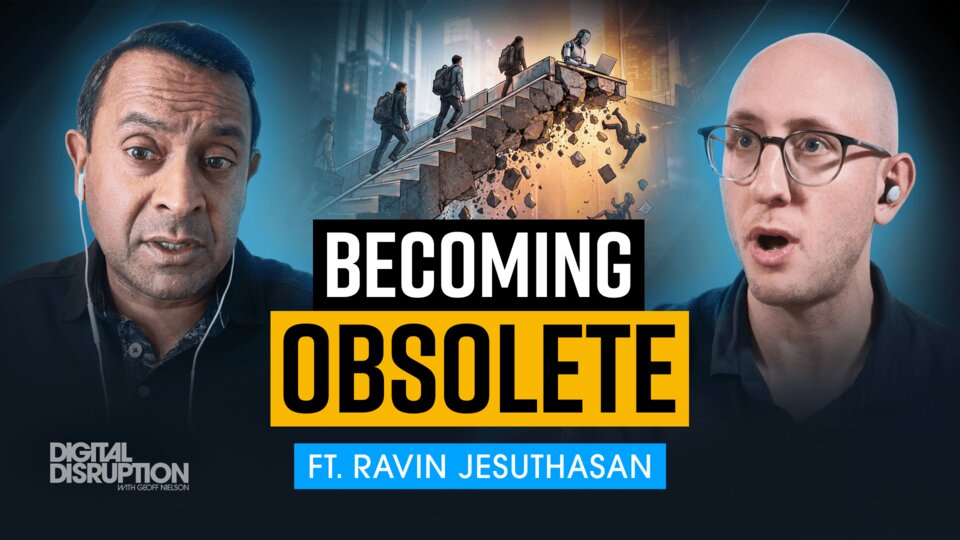



The Next Industrial Revolution Is Already Here
Digital Disruption is where leaders and experts share their insights on using technology to build the organizations of the future. As intelligent technologies reshape our lives and our livelihoods, we speak with the thinkers and the doers who will help us predict and harness this disruption.
Listen


Our Guest Ravin Jesuthasan Discusses
AI Is Breaking the Economics of Work. No One Is Ready
In this episode, futurist and bestselling author Ravin Jesuthasan joins Geoff to discuss generative AI, AI agents, and the impact of automation on jobs.
Listen
Our Guest Blaise Agüera y Arcas Discusses
Is AI Already Conscious? Google’s Blaise Agüera y Arcas Explains
Blaise Agüera y Arcas joins us on this episode of Digital Disruption to talk about AI consciousness, large language models, and why intelligence is inherently social. He explains how AI agent swarms work together, what recursive self-improvement looks like today, and why he questions the idea that smarter machines will inevitably dominate humanity.
Listen
Our Guest Eric Siegel Discusses
The Other AI Revolution: Why Predictive AI Will Overtake Generative AI in 2027
Predictive AI often gets ignored, yet it may hold the real key to business value in the current tech landscape.
Listen
Our Guest Peggy Johnson Discusses
AI Humanoid Robots Have Already Entered the Workforce. Should You Care?
Peggy Johnson, CEO of Agility Robotics, joins us on today's episode to look beyond the fear of robot overlords and ask: How will humans and robots work together in the years ahead?