
Digital Disruption
with Geoff Nielson


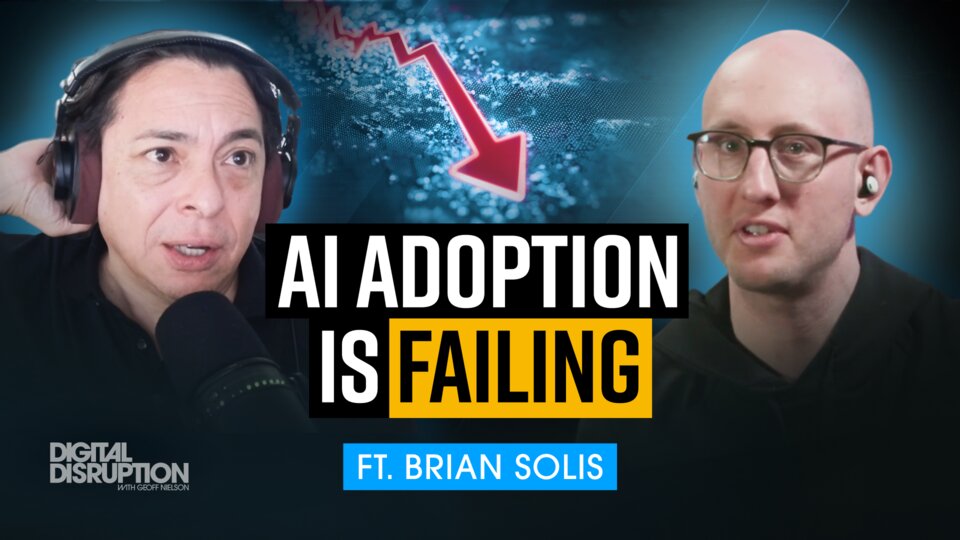
Our Guest Brian Solis Discusses
AI Adoption Is Failing
Are businesses falling behind in the AI revolution?
While AI is transforming everything from workflows to decision-making, many companies are facing a surprising reality: they’re becoming less prepared for AI, not more.
In this episode, we sit down with Brian Solis, a globally recognized futurist and thought leader, to explore how disruptive technology is reshaping business, society, and the future of work.
As Head of Global Innovation at ServiceNow, Brian shares expert insights on business innovation, AI adoption, and what it truly takes to succeed in this rapidly evolving landscape. We also talk about the growing gap between AI-native companies and traditional enterprises, the rise of the agentic enterprise, and why true AI-driven reinvention requires far more than simple automation.
00;00;00;20 - 00;00;24;19
Geoff Nielson
Hey everyone! I'm super excited to be sitting down with Brian Solis. Brian is a globally recognized futurist and thought leader in business, innovation, currently serving as the Head of Global Innovation at ServiceNow. What I love about Brian is that from innovation to digital transformation to AI business reinvention. He's been the leading authority on how disruptive technology is impacting society and work for a generation.
00;00;24;21 - 00;00;44;23
Geoff Nielson
What really sets him apart, though, is that he gets beyond the ivory tower thinking that some futurists fall into and is actually written and executed the playbooks to reinvent the way companies do business. I want to ask him how big the risk is that AI native companies torpedoed today's leading businesses. What does the enterprise of the future actually look like?
00;00;45;00 - 00;00;52;11
Geoff Nielson
And what do we need to do and avoid to build it? Let's find out.
00;00;52;13 - 00;01;19;07
Geoff Nielson
Brian, thanks so much for being here today. Super excited to have you. One of the things I wanted to talk about right off the bat is, you know, AI is obviously disrupting, you know, consumer patterns. It's disrupting businesses. It's disrupting the markets. And one of the things that I've seen in my experience with the clients that that I'm advising and that we're advising is that businesses, by and large, seem to be losing ground in this adoption of AI.
00;01;19;10 - 00;01;31;19
Geoff Nielson
And I wanted to get your perspective in terms of what's going right, what's going wrong, and what's kind of the state of the nation when it comes to how businesses are attempting to adopt AI and and better use it in their business practices?
00;01;31;21 - 00;01;37;08
Brian Solis
Well, Jeff, let's just kick it off with a big, huge question.
00;01;37;10 - 00;01;40;17
Geoff Nielson
Where I don't want to save the big ones for the end. You got to get into it.
00;01;40;19 - 00;02;01;24
Brian Solis
Where do you want to start? I mean, look, the keyword you use was disruption. You talked about consumer and then you talked about business. Did that is the right word to talk about this? So let's let's have some fun. So disruption, the way I talk about disruption, I like to give it sort of a tangible meaning so that it frames the rest of the conversation.
00;02;01;27 - 00;02;41;02
Brian Solis
The way that I define disruption is doing new things that make the old things obsolete. Another way to think about disruption is doing things, whether consciously or subconsciously, in ways that change behavior. So whether you realize it or not, change patterns, change thinking because of that adoption. So the reason I give that additional sort of context is because on a personal level, AI is is absolutely disrupting how people think or not think.
00;02;41;04 - 00;03;18;28
Brian Solis
And it is certainly, stoking or even in some cases sparking new biases, meaning like, you know, AI sycophancy, which is something that a lot of people are, are experiencing, where for those who aren't following that term, it's where AI is constantly giving you accolades and and compliments, and it starts to create, subconsciously in many cases, sort of this false sense of confidence and validation that can lead into all kinds of crazy cases that the news media has covered.
00;03;19;00 - 00;03;41;17
Brian Solis
And then also, just like what I call cognitive Darwinism, but is is referred to as AI atrophy, where, the more you if, for example, high school students, having it do their homework for them, to save time, what they're doing is giving the thinking to AI and therefore sort of reducing their capacity for critical thinking, creativity, etc..
00;03;41;19 - 00;04;19;06
Brian Solis
And then you carry that all the way into business, and you have what OpenAI calls capability overhang, which is described as the, the capacity for AI to do X. Yet most people only use it for a Y. And in their research they found on their platform, for example, that they experience power users who use seven x more capabilities of open AI than the rest of the pack.
00;04;19;07 - 00;04;43;14
Brian Solis
So that's a pretty large delta. And if you look at Kevin Ross, who's a famous New York Times tech writer, he describes that in detail of what he sees firsthand in San Francisco with all of these AI native entrepreneurs, the agents that they surround themselves with. Or we could look at the news and everybody who's using cloud bought it, Mac minis and all the agents that they have doing their work for them.
00;04;43;19 - 00;05;22;22
Brian Solis
So anyway, it's a long way of saying that the real disruption is one that I would say is, is is is named or realized. Yet that businesses do not know what they do not know. And that disruption is, is, is to borrow OpenAI's term, the overhang that at some point competition and disruption is coming for them in ways that they're not seen because they're focused on skills upskilling, fluency, literacy, but not necessarily against that vision of what do we want to become because of AI versus how should we use it?
00;05;22;25 - 00;05;49;01
Geoff Nielson
So, so all of that makes sense to me. And it, you know, it frames it up really nicely in terms of the use cases right now, the art of the possible, maybe not even with future tech, but with what's available right now. Something caught my attention while I was, you know, doing some research on you, Brian, which is this, AI index that that you and ServiceNow put out recently, and that in the past year, there's been a regression.
00;05;49;01 - 00;06;08;09
Geoff Nielson
It sounds like, if I'm reading it correctly in the business, AI index, which means that businesses feel less able or ready to capitalize on AI than they did a year ago. That is, you know, startling and and maybe a little bit surprising. What what do you make of that? First of all, do I have that right. And and what do you make about that.
00;06;08;09 - 00;06;10;00
Geoff Nielson
And then maybe, maybe more importantly, what do we.
00;06;10;00 - 00;06;33;20
Brian Solis
Do about it? Well, first of all, thank you for doing your homework. And also thanks for for plug and service now. Yes. I'm, I'm very proud of our AI index research. And one of the reasons why is because it's the analyst in me, where, for those who don't know, I used to be, a principal analyst at a firm called altimeter Group.
00;06;33;20 - 00;06;55;06
Brian Solis
And we studied emerging disruptive technology, and made sense of it at a time where most analyst firms were just studying the based, you know, like the stuff they have to cover. And, for example, generative AI would have been something we were ahead of and, and, and discussing at a high level. And so it's like right up my alley.
00;06;55;06 - 00;07;31;23
Brian Solis
And so that when I say the analysts in me when generative AI, I hit the natural first thing that came to my mind was to do what I had done with digital transformation, to see if I could start to document stages of how organizations might adopt it, and then how that adoption starts to transform the organization internally. And so what we had come up with was a maturity model of five notable stages of progress for generative AI between the most advanced and the the those like everybody else because it's change is hard.
00;07;31;26 - 00;08;04;11
Brian Solis
So anyway, that maturity model became the foundation for what later became the AI index, where we were able to survey against it around the world. Since we had these these models to understand where people were in their journey. So with that set up, what we had found was that in 2025, the average score for AI maturity with 100 being the most mature, was 35 out of 100.
00;08;04;13 - 00;08;36;17
Brian Solis
In 2024, the average score was 44 out of 100. So it was a it was a drop of nine points. And what we really sought out to understand was, well, what what happened in that year where companies might regress. And in that one year alone, we saw rapid evolutions of AI models or, you know, frontier models. And then we also saw, AI agents start to become a thing.
00;08;36;20 - 00;09;16;25
Brian Solis
And also the concept then of an agent tech enterprise. So it was just so much so fast that companies had to take a step back and say, wow, I made it all over it because that's the foundation, that's their DNA. But for other organizations where things like governance becomes a huge factor trust, security risk. These things required organizations to better understand at a foundational level, how do we need to reorganize for this stuff, so that our organization isn't caught off guard?
00;09;16;28 - 00;09;25;04
Brian Solis
As we go further down this path. So it was it was a regression, but for the right reasons.
00;09;25;07 - 00;09;52;04
Geoff Nielson
If you work in it, Infotech research Group is a name you need to know no matter what your needs are. Infotech has you covered. AI strategy covered. Disaster recovery covered. Vendor negotiation covered. Infotech supports you with the best practice, research and a team of analysts standing by ready to help you tackle your toughest challenges. Check it out at the link below and don't forget to like and subscribe!
00;09;52;07 - 00;10;10;29
Geoff Nielson
It's notable to me as well that you said the score in 2025 was 35 out of 100, right? Like this wasn't a regression from like 95 to, you know, 86. This is like we're deep in the red, right? Like we're talking about like an F on like a grade point scale. Right. Right. I mean.
00;10;11;01 - 00;10;13;22
Brian Solis
What a way to put it.
00;10;13;24 - 00;10;35;12
Geoff Nielson
I mean, I'm, I'm struggling to and I look, I'm familiar with, you know, the five point scales and, you know, it's very typically the way they're constructed is it's pretty tough to get like a five out of five on them. But it we're seeing, we're seeing a playing field where there's just not a lot of organizations, you know, except for the AI native ones that are you know, really excelling here.
00;10;35;17 - 00;10;59;06
Geoff Nielson
And so maybe to just back up for a second before we, you know, talk about the agenda organization is, you know, how big is the concern level? How big is the risk that AI native firms are going to swoop in and eat the lunch of, you know, a lot of these, you know, if I can call them more legacy or established firms that are not implementing these technologies in a material way.
00;10;59;09 - 00;11;26;15
Brian Solis
I was certainly, you know, in the absence of understanding how things actually work and function and why, there's certainly a narrative out there that says, we're coming, AI natives, they're coming for, all of the legacy players. But in reality, there are just like a maturity model. There are layers. And so if we if let's just take a step back to kind of set, set the conversation for everybody.
00;11;26;15 - 00;11;51;07
Brian Solis
If we look at a model and, you know, you had used the, the, the, the, the great F issue for 35 out of 100, the way, the way that I would want to think about it is if you're learning how to ride a bike or if you use the, the traditional analogy of crawl, walk, run, you know, you're grading, you know, that ultimately someone is that running is is the, the ultimate achievement.
00;11;51;07 - 00;12;22;13
Brian Solis
So that's the 100. And so you're grading sort of someone's progress and it becomes an issue if that progress becomes slower than the rest of your peers. And that's how we look at it. But the fact that there's progress and so, so quick in terms of, of adoption. So just as a reminder, generative AI hit in 2022. So with that context set, if we look at why that regression happened in terms of the score, it was because companies have to protect themselves.
00;12;22;13 - 00;12;48;09
Brian Solis
Whether it's a matter of regulatory compliance, whether it's compliance in general, whether it's reporting, whether it's security, like these things matter at enterprise grade, if you're an AI native startup, you're you're not thinking about those things. You know, if you're if you're worried about auditing, if you're a publicly traded company, I mean, these are things that I think we we just take for granted because we don't know what we don't know.
00;12;48;11 - 00;13;12;19
Brian Solis
So with all of that said, enterprise software gets an A in those things for a reason. Because it has to. You can't run your business on this stuff. It. If those things weren't covered now where where the conversation gets interesting is now the nuance of what are we going to do with AI? It is one thing at an individual level.
00;13;12;21 - 00;13;44;05
Brian Solis
It is another thing at a the genetic level, because now what you're talking about is not just automating how workflows were actually empowering software to take on tasks that might normally be done by a human employee. And so this brings up much bigger conversations than just the capacity of software. Now we're looking at human resources and it working together to better understand now how software collaborates with people.
00;13;44;07 - 00;14;12;28
Brian Solis
And it's not just a matter of okay, this, this, the this company is doing really cool things. Let's put it in there. It is now a bigger conversation of breaking roles down into tasks, understanding where those tasks are actually holding people back from their own professional progress, and then not only dividing in concrete, but starting to understand what can we do with that freed up time and those freed up resources to achieve what we didn't know we could do, or what wasn't possible yesterday?
00;14;13;01 - 00;14;31;03
Brian Solis
And then also, how do we do it in a secure way, in a, in a, in a governed way that does not expose the company to unnecessary risk or compliance issues? So these are these are really big conversations. And I don't know that they're sexy headlines but they're reality.
00;14;31;05 - 00;15;07;18
Geoff Nielson
Well, and I completely agree with that. And certainly for a lot of our audience who, you know, is business leader and technology leaders, it's a really critical conversation to have. And maybe not one that's being sufficiently understood or is is taking a little bit longer to understand. And, you know, one of the things that's been on my mind and it's it's feels like we're starting to have like a come to Jesus moment around it is in 2023 and 2024, you know, what I had heard is at the CEO and board level, there was sort of this wishful thinking around AI that it would be easy and you could just sprinkle AI into your business and
00;15;07;18 - 00;15;41;00
Geoff Nielson
suddenly it would be transformed, which, you know, I have to laugh at because I have a background working with, you know, it in CIOs and I've never I've never met an enterprise grade tech project that was, you know, easy or, you know, took substantially less time and less cost and less than people expected. And it feels like we're finally starting to acknowledge at that enterprise level that, as you said, oh, we need all these enterprise grade capabilities around risk, around governance, around integration.
00;15;41;02 - 00;16;06;22
Geoff Nielson
How so? Before we talk about the how and what exactly that looks like, one of the challenges here is, you know, when you compare this to riding a bicycle or, you know, some of the technology implementations of the past, one of the things that strikes me as being unique about AI is there isn't necessarily a defined target state because the technology is changing.
00;16;06;22 - 00;16;32;07
Geoff Nielson
And in some ways the technology is, you know, it's a means to an end versus you're doing it for this specific reason. And you talk about the agen tech enterprise. And so, you know, at least in 2026, what end state or what capabilities should organizations be building toward and what's sort of the right way or the wrong way to to pick your North Star here?
00;16;32;09 - 00;16;57;19
Brian Solis
I love these questions because essentially what you're getting to, at least the theme that I'm picking up on throughout your questions is this idea of of what Bill, our CEO would, would say, Bill McDermott, for those who don't know, is what he would call AI business reinvention. That's essentially what we're talking about here. And or it's what we could be talking about here.
00;16;57;21 - 00;17;20;10
Brian Solis
And I say that because as someone who, for those who don't know, I wrote some of the original research around digital transformation, with all credit due to Capgemini. They were the ones who popularized the term in the early 2000. My research was some of the first to look at not the IT implications of digital transformation, but the business opportunities for it.
00;17;20;10 - 00;17;49;09
Brian Solis
So for example, the A working hypothesis was it would be like if we believe mobile and digital and social media will become prominent mainstream, human level transformative platforms, then how might a business reimagine parts of itself or a whole of it, you know, as a whole, in order to do business natively for a digital customer or a digital employee?
00;17;49;12 - 00;18;25;17
Brian Solis
And so it framed the conversation under the assumption that digital was going to transform the outside, therefore need to transform the inside. And I would work with the same assumption that AI is going to do the same thing. Hence the the maturity model that was originally created. So I say that because one of the things that I had studied in digital transformation was, I, I think I remember a stat from one report that, 86% of organizations around the world reported that they were actively investing in digital transformation, but only 25% of them could tell you why.
00;18;25;19 - 00;18;54;08
Brian Solis
And the the reality is, is that like AI and like digital back and digital transformation, I used to say we weren't transforming with digital. We were digitizing the existing business. So modernizing whatever terms you want to use, things that might even date back to analog processes and systems. So with AI, you could say that some of the same patterns are already starting to to exhibit or are exhibiting.
00;18;54;08 - 00;19;22;21
Brian Solis
So for example, the famous MIT report last year that found that 95% of companies were realizing ROI. It is because, like the digitization, we are automating what was digitized. So it's hard to take ROI out of that if you're not reducing costs, like, for example, whether that's headcount, whether that's software, whatever it is, you have to you have to realize something back from it.
00;19;22;24 - 00;19;33;01
Brian Solis
So one of the one of the interesting conversations that our team has is we're looking at.
00;19;33;03 - 00;20;05;11
Brian Solis
How can I save costs and resources by automating existing stuff. And then because it is it is a frontier technology. How can we use it to do what wasn't possible yesterday to create new value? So it's this automation augmentation, this iteration innovation conversation. And it's one I believe that you could you could make the argument that with digital transformation it wasn't as profound.
00;20;05;11 - 00;20;32;11
Brian Solis
But with AI it is. And so now the conversation is a matter of vision. It's a long way of saying that this is vision and leadership, not just traditional I.T looking at existing infrastructure to take out costs and to increase efficiencies. It's part of it, for sure. But I think that this is a bigger opportunity for technology leaders within the organization to say, hey, we're not just here working in the back end and we're not just here to take out costs.
00;20;32;19 - 00;20;48;22
Brian Solis
We are a growth engine opportunity now, and we need to work closer to business leaders in order to define what we can become with AI, not just use it as a tool or a cost takeout mechanism.
00;20;48;24 - 00;21;10;19
Geoff Nielson
That I, I completely buy that. And the vision piece is really interesting to me, especially through the lens, Brian, that you just set up of digital transformation because, you know, looking at digital transformation. And I imagine your experience was similar to mine. There were a lot of organizations that were, you know, deep in digital transformation, but shallow on the vision around digital transformation.
00;21;10;19 - 00;21;36;21
Geoff Nielson
Right? It's a lot easier to say you're doing it than to actually have that compelling business behind it. And be, you know, reinventing the business in, you know, a really big and valuable way. From your time in that space, what are the lessons learned that organizations should be thinking about, if they're really serious about, you know, what what you and Bill, you know what Bill is calling AI business reinvention?
00;21;36;24 - 00;21;49;18
Geoff Nielson
Where does that vision come from and what do you have to get right if you're going to move beyond, you know, kind of pot shots and small fixes to something, you know, actually truly transformational.
00;21;49;20 - 00;22;14;23
Brian Solis
I love this question. And we as we are building out the initial model for for the maturity, assessment, vision and leadership was there from the beginning, and it was not there because I had seen it in AI implementations at the time. It was there because I had I had not seen it in the years of digital transformation.
00;22;14;26 - 00;22;38;22
Brian Solis
And so I knew that that would be a pillar at some point. So I'll give you I'll give you an example. It's it's a couple of years old, but it's still a it's, it's I guess it's a great example to show you, even though it's a couple of years old, it is how rare vision is right now. So Ikea famously deployed an AI chat bot it named Billy after its most popular bookcase.
00;22;38;24 - 00;23;10;28
Brian Solis
And like everybody, an AI chat bot is meant to take on, level one customer service engagements and try to, to solve every, every instance as best as possible, and minimize elevation towards a human agent. And it was so successful. And forgive me if I get this statistic wrong, but it was it was something like this compelling, like 57% effective in level one engagement.
00;23;10;28 - 00;23;38;01
Brian Solis
So it it it resolved those cases, without human human escalation. And most companies would then say, all right, wow, 57%. That's a whole lot of human agents. We're just not going to need anymore. And the ROI in that implementation would come from reducing those heads. And that is a popular narrative and fear, with AI today.
00;23;38;03 - 00;23;59;07
Brian Solis
But this is where technology leadership comes in, in partnering with the business by saying, I don't know if this was the conversation that was happen, but I'll, I'll, I'll acted as if it were, for what were the 43% that couldn't be resolved by Billy. That's that's a pretty staggering number of of cases. It couldn't resolve. Let's study what those were.
00;23;59;07 - 00;24;35;14
Brian Solis
And what they had realized in that research was that those were, in many cases, not all of the cases, but a notable amount of cases were inquiries about interior design in commercial and, and, residential applications. And the long story short, is that they spun up an interior design consultancy within Ikea, reskill those agents to now become interior designers, and applied a service fee for that.
00;24;35;17 - 00;25;01;17
Brian Solis
And ended up in the first year, I think it was generating, €1 billion net new revenue. And so that that is an example of leadership. I don't know that it was vision because it was more of a reactive thing, but it was a it was a leadership opportunity to grow the business. On the vision side, you have someone like, Jamie Dimon at, JPMorgan.
00;25;01;19 - 00;25;23;05
Brian Solis
And he famously and his executives famously put out a vision like a lighthouse last year that says, we are going to become the AI Mega Bank by 2030 or whatever. What whatever it was that they said, and they detailed how they see themselves getting there. Now, that's a vision. Now, you know, someone will say, well, it comes down to execution.
00;25;23;05 - 00;25;54;29
Brian Solis
Of course it does. But we don't see a lot of vision as to where we're going to transform or what we're going to become differently as a result of AI. And so when you take the Ikea and the JPMorgan examples, what we're looking at now is this synergy, maybe the wrong word, sorry to use a buzz term, but this relationship between technology and now business leadership because together we're going to be able to now rethink our approach to technology.
00;25;55;01 - 00;26;26;10
Geoff Nielson
That's that's that's really interesting to me. And it's exactly where I want to focus, especially because it's a, it's an area that traditionally has been fraught with tension, with distrust with, you know, issues with execution. And so, you know, you made sort of a, you know, a throwaway comment, Brian, earlier about, if organizations are going to reinvent themselves in this space, we need it and are much more fully involved.
00;26;26;10 - 00;26;47;10
Geoff Nielson
And they've been in the past. What does that look like to you? Like just sort of broadly what what's the what's the process here and what are the roles for, you know, it versus HR versus, you know, the CEO or executive leadership versus any other, you know, group that needs to come to the table here.
00;26;47;12 - 00;27;09;23
Brian Solis
You're you're you're not given me softballs, are you? This we're all right now. We're getting into the construct of business reinvention and actually what that looks like. So let's let's bring it back to leadership first. The reason why leadership is such a vision and leadership are such important pillars. And all of this is because we're essentially navigating uncharted territory.
00;27;09;25 - 00;27;44;18
Brian Solis
And and I say that literally, literally, I don't take it lightly that there is no playbook for this, though. If you Google AI playbook, it's there are countless playbooks. I just mean that there isn't a blueprint for what the business of the future can become with AI, even if it's a legacy business or an incumbent. So that means that every business, depending on leadership, vision and culture of how that organization makes decisions, takes risks, executes, etc., balances iteration.
00;27;44;18 - 00;28;13;28
Brian Solis
Innovation balances the known with unknown. Everybody's going to attack this differently. So and there's nothing wrong with that as long as we're making progress with this. But I'll give you an example. My, my boss, his name is Dave, right? He's the chief innovation officer at ServiceNow. And together we wrote some research around, the concept of when Johnson weighing in at Kes in 2025.
00;28;13;28 - 00;28;37;19
Brian Solis
So this is this is already old in the world of AI, but it was still provocative and still meaningful today. Jetson said something along the lines of it will become the HR of AI agents, and a statement like that from someone like that is going to be scrutinized. And it was it made headlines all around the world.
00;28;37;19 - 00;28;59;23
Brian Solis
But what I had, what we had noticed was that there was no real dissection of that statement, no real critical thinking around it like, well, what does he mean? What does that look like? Why would he say that? And what we had found in the, in the paper that we were, we were. And this is publicly available, by the way.
00;28;59;23 - 00;29;16;25
Brian Solis
So if you if you want it, you can you could just email Brian Brian Solis and I'll, I'll send it to you. What we had found was that it requires for the first time, let's just take it from an IT perspective, and then we'll look at it at the broader collaboration around your question.
00;29;16;28 - 00;29;49;07
Brian Solis
An AI agent is let's pretend it's not. Let's let's pretend it's let's take its term AI agent, because that has human implications in its name, intelligent software that can accomplish tasks on its own and theoretically learn from that execution in order to optimize itself every time it runs those tasks. If you put agents together, then they're handing off task tasks to one another to then together drive towards an outcome.
00;29;49;09 - 00;30;15;16
Brian Solis
Now they don't just magically appear, even though you can download them from your place or buy them from your place of choice, they have to be tuned to the specific way your organization works. The way you where your data is, is archived and stored. All the things that a human being, for example, would need to understand before it's allowed to go off and start doing things.
00;30;15;16 - 00;30;47;00
Brian Solis
So there's training, with HR, there's onboarding, even before that, there's identification that this is a resource we need. So in H.R we might hire for it. We might then skill and train for it. We might then deploy, manage and assess etc.. So in the in in the AI agent model someone's got to do that. And so that's, that's what we, we believe Jensen meant by that.
00;30;47;02 - 00;31;15;09
Brian Solis
But that just that doesn't necessarily just happen because it realizes that there are tasks that could be automated. The bigger idea was that we explored is then how does it work with H.R. To then assess what those tasks are within someone's role, and then build out the framework from there, the model from there, the management from there.
00;31;15;12 - 00;31;34;28
Brian Solis
What we learned after we published that or what we had, what we what we realized as we were continuing this research was that essentially, like in the HR world, how we manage people, how they're an org chart, etc., how we have performance reviews and those are documented.
00;31;35;00 - 00;32;07;02
Brian Solis
AI agents are essentially software, and software is an asset, and there is software asset management in the IT world. And so agents also then become managed as assets. So this Venn diagram really starts to take shape for these forward looking companies that are thinking about it beyond just the simple automation route. So then last but not least, you you have now some real world examples of where this is starting to take shape.
00;32;07;05 - 00;32;32;18
Brian Solis
So Moderna quite famously, moved it under the CRO and now that's a one of one. And she's highly, she's a highly technical, CRO let's let's make that clear. But it is an example of what is possible. So as a futurist, that is a signal. I want to understand the signal. What could this look like?
00;32;32;18 - 00;33;06;09
Brian Solis
Over time, you have in Nike and Puma's case technology rolling up to the CEO now because they see AI as a business, technology as a business enabler. So. My 2026 prediction was that in reality, regardless of how this stuff plays out individually at an organization, what will be consistent is this collaboration between HR and IT, especially as agents start to become more sophisticated in their ability to do more than one task?
00;33;06;12 - 00;33;29;18
Geoff Nielson
It's an interesting prediction, and it makes sense to me. That they would be working together and I, I love the model of, it thinking of agents as assets and running that and that the two groups collaborating together in a big way. It seems like it could be fraught with risk without the appropriate sort of front end to that entire process.
00;33;29;18 - 00;33;53;02
Geoff Nielson
Right? Like someone needs to be answering the question about how do we do the things that we do here, right? Because like, you have to you have to decide, does this require an agent or intelligent software or does this require a human? And, you know, like how do you treat like now I'm thinking about business architecture. Like how do you triage that?
00;33;53;02 - 00;33;57;21
Geoff Nielson
And who answers the how do we do the things that we do here?
00;33;57;24 - 00;34;22;23
Brian Solis
That's so what I love about your question is that it is exactly the reason why there is no true playbook, because that is one of many questions that need to be answered or even thought of. Right. What what we're seeing right now, one of the reasons why maturity isn't just accelerating through the roof is because, one, we have to be cautious.
00;34;22;23 - 00;34;45;27
Brian Solis
But number two, we don't know what we don't know. And when as human beings, when we don't know what we don't know, we lean on what we do know, which is years of proven expertise, experience against failures, successes, etc.. And so this is why we see early adoption going against the things we do. Now. Your question begs what do we not know and what should we be thinking about?
00;34;46;00 - 00;35;01;16
Brian Solis
So we call this an AI mindset. We published a paper on this too. It's asking the right sets of questions in the right context. So in one way, it's how do we save money? How do we scale, how do we make this more efficient, etc.. And the other one is, why do we do it this way in the first place?
00;35;01;18 - 00;35;19;24
Brian Solis
How might we reimagine it for a world when I, when, when this workflow was designed at a time when that didn't exist. And so when you balance both of those mindsets, you now start to unlock new opportunities. You now start to create the blueprint for whatever your playbook is going to be as you start to think about and solve for these things.
00;35;19;24 - 00;35;55;00
Brian Solis
So one of the things that, Dave and I have been thinking about in depth is, was inspired by, Quantum Black, which is a McKinsey, entity. They published a paper last year called The State of AI. And there was one line that really struck me, because I'm in the workflow business, which is of all they had come up with 25 attributes that studied where businesses were realizing any kind of returns on AI investments.
00;35;55;07 - 00;36;21;11
Brian Solis
And they said the number one attribute was when a business was able to reimagine a workflow end to end with AI. So essentially forcing all the tough questions, forcing all of the new things. But in a, in a, in a, in a contained environment. And so what we realized in this comes back to your question. Sorry, these answers are so long because your questions are so deep.
00;36;21;14 - 00;36;42;27
Brian Solis
Who's going to figure that out or who's going to think about that? So right now it's it's depended on the company if anyone is is asking those questions or thinking about it. But what we had realized is if, if we believe then that the number one attribute for ROI is going to be end to end workflow re-imagination then someone's got to own that and that role doesn't exist.
00;36;43;02 - 00;37;14;23
Brian Solis
So we playfully came up with the term the Chief workflow officer. That is someone's job now who is going to audit and assess and let's say theorize before we architect, then what that architecture could look like and then bring the right people in, whether it's IT, HR, etc., to then reimagine now what that workflow could look like that that is the extent, at least initially, to which we can now start to reimagine or reinvent a business.
00;37;14;25 - 00;37;33;29
Geoff Nielson
I've never heard, Chief Workflow officer before, and I like it. And I'm chuckling to myself because you're in the workflow business, obviously. So of course, of course there's the chief workflow officer. But aside from that, I, I do like the idea. And I do see I do see merit to it. But I wanted to, you know, I wanted to tease out something there and get your take on it.
00;37;33;29 - 00;38;06;08
Geoff Nielson
And, and again, you may you may have an inclination based on the, the business that you're in, but there's, there's sort of this implication that the way that this is designed is top down or it's centrally managed. You have, you know, an Office of Business workflows or a vision coming from the CEO. To what degree is should it also be bottom up or emergent from different parts of the organization where people put up their hand and say, I think we can make this workflow better, whether they're in the workflow of their managing the workflow.
00;38;06;10 - 00;38;11;22
Geoff Nielson
Or does this really, truly need to be top down to succeed?
00;38;11;25 - 00;38;41;01
Brian Solis
I, I'm going to answer that with, the answer that no one likes, which is it depends. It really does. So I'm someone who's studied also innovation. So my whole career I've worked with startups, I've worked with. I've helped establish some of the world's first actual, not R&D, but actual innovation centers. I wrote research on how those innovation centers were and weren't successful.
00;38;41;03 - 00;39;10;11
Brian Solis
And what was consistent across that was when bottom up was a factor in order for gaining success, not just in bottom up within the organization, but also from the outside, it so this is where you see things like, what Walmart has successfully, scaled, which is incubation, acquisition, separation of acquisition between the mothership. And, you know, a lot of these lessons were learned the hard way.
00;39;10;13 - 00;39;43;17
Brian Solis
So, for example, in our research already, there there is, so what every company starts to do as they mature is they create a center of excellence, if you will, that goes by different names. But, what what we're what we're looking at then is bringing together all of the key stakeholders now to ensure that they're doing the right things at every step, you know, governance being one of them, enablement training, etc. being another one, a place where questions could be asked and sorted and answered.
00;39;43;20 - 00;40;12;23
Brian Solis
There's another. But, there is a company out of Australia called Orica. There are mining company and Rachel Sandell is, is the person sort of leading that AI initiative over there. They have something beyond a CEO. They have what they call an AI advisory committee, which is staffed by, of course, some internal stakeholders, but also external, stakeholders.
00;40;12;23 - 00;40;43;13
Brian Solis
And it is for the reason you ask it is to make sure that it is a place where the right ideas or questions can come through and be vetted and also explored without the usual politics or bureaucracy of just everyday business and in that case, they are what we call an AI pacesetter. They are so much further ahead than everybody else for the very reasons that you're looking at, because now they're exploring things that they might not have considered because those ideas are coming from new places.
00;40;43;20 - 00;40;59;04
Brian Solis
It is actually just to add in the side. It is how if, if, if anyone wants to geek out, it's how Amazon Prime came to life. It did not come from the C-suite. It came from, organically from the organization.
00;40;59;06 - 00;41;29;24
Geoff Nielson
Interesting. And, you know, I tend to be, in general, a pretty big advocate of that. And, you know, like you I've got a background in innovation and I've, not just internally, I've done internal corporate innovation. I've done, you know, advisory with other firms and innovation. And one of the things that I'm a little bit skeptical of, but I'm curious in your perspective, because it seems like some of these, these models are flirting with it is having a monolithic innovation organization, within the broader organization.
00;41;29;24 - 00;41;56;27
Geoff Nielson
And that may or may not be how you're structured right now. But one of the challenges I've found with those models is that you're sufficiently divorced from the actual workflows, from the business itself that it can create, either relationship friction with the people that are running it or just feeling a sense of distance from the actual workflows that you're trying to, ultimately influence.
00;41;57;01 - 00;42;09;26
Geoff Nielson
Has that been your experience or, you know, how do you best how you best conceptualize of innovation that works versus that ends up in, you know, kind of a failed state that doesn't have the desired impact?
00;42;09;28 - 00;42;56;13
Brian Solis
I mean, it's all of the things I'm, you know, better than anybody that sometimes this stuff works and sometimes this stuff doesn't work. And it innovation is one of those loaded terms, that I think you'll appreciate this. Everybody wants it. Everybody talks about it. Certainly, you know, since the 90s and early 2000s innovation, Silicon Valley. I mean, all of these things become, I don't know, this everybody goes I used to call it the Disneyland to where everybody goes to Silicon Valley, to visit Google or visit meet, or that we, we even host executives, in our innovation center in Santa Clara, where they just want to touch Silicon Valley.
00;42;56;13 - 00;43;28;05
Brian Solis
Miss. You know, I don't know if it's in the water or if there's. It's in the air, because innovation is is is that is that. I don't want to call it a North Star, but it is like that thing that should be a North Star. But what it really comes down to is leadership, vision and culture. So culture was not something I set out to study, but it became something I had to study in order to understand how to make a culture ready for innovation.
00;43;28;07 - 00;43;49;20
Brian Solis
And the way I describe innovation is not just the allure of Silicon Valley. Just just really specific innovation is doing something new that creates new value, whereas iteration is doing what we did yesterday better, faster, cheaper, and so you need a balance of both of those things. A culture of innovation is one that allows for new use.
00;43;49;20 - 00;44;19;23
Brian Solis
Right words, failure, taking risks, counterintuitively, investing in failure and the acceleration of failure because that term is so loaded and that term is so, it's it's become like stigmatized that you can't take risk for the fear of failure. So you do the right thing by where you do what you think is the right thing, by iterating on a proven model.
00;44;19;23 - 00;44;25;09
Brian Solis
And if that fails, you still have something to fall back on. But.
00;44;25;11 - 00;44;52;17
Brian Solis
My favorite, one of my favorite thinkers of all time, his name is Sir Ken Robinson, and he had talked about he was a champion for continuing creativity in schools, and continuing creativity outside of school, like in our work, for example, where things like creativity, art is celebrated, risk is celebrated as, as as much as, say, when we were kids, we would just do whatever we would think, whatever we would explore, whatever.
00;44;52;17 - 00;45;21;13
Brian Solis
Because curiosity was an essential skill for us. And what he said was, if you are not prepared to be wrong, you will never come up with anything original. And if you can't come up with anything original, you will not create new value, was essentially what he was saying. So culture then becomes essentially what people would understand as an organizational psychology, as essentially safety.
00;45;21;15 - 00;45;43;19
Brian Solis
Is it safe for me to have this to ask this question? Is it safe for me to propose this idea? And, and do I have a support system around me that allows for me to further that conversation? So some examples would be, I remember when one of the earliest ones that I found was the Tata group out of India.
00;45;43;21 - 00;46;22;03
Brian Solis
They culturally said, you have to spend ten hours of your 40 hour week. If we believe that 40 hours was was all they work, or we work, ten hours either learning a new skill or thinking about how to improve something, but then everything above that managers performance reviews, managerial reviews of themselves, etc. everything then had to be systematized to ensure that those ideas were explored, vetted, deployed or cascaded or, you know, for the next thing to come through.
00;46;22;03 - 00;46;46;29
Brian Solis
So I say all of that, to say that culture and organizational or psychological safety are things that ensure that innovation becomes a thing. The last example I will give you is, is Google, who is I think we could both agree that is the innovative company they studied, why their high performers outperformed all the other high performers and what they had found.
00;46;47;01 - 00;47;10;06
Brian Solis
They thought it was school. They thought it was leadership. And of course those are probably factors. But what they had found was that those teams felt psychologically safer than the rest of the teams in order to do these things, to explore these things, to test and iterate and fail on these things. And so, one of my favorite companies, the, out there is called Gaping Void.
00;47;10;06 - 00;47;23;17
Brian Solis
And they are dedicated to creating cultures of innovation and cultures of transformation, all vetted in what they call culture science, because it is a must, in addition to all of these things that we're talking about.
00;47;23;20 - 00;47;50;24
Geoff Nielson
So the conversation around innovation very quickly pivoted to innovation being much more of a cultural force than necessarily how you structurally design the organization. Which I really like. And it makes a lot of sense to me. One of the challenges, and this is I'll preface this by saying this is going to be a difficult question. One of the challenges a lot of organizations and a lot of organizational leaders face is they don't have that culture of innovation.
00;47;50;24 - 00;48;25;04
Geoff Nielson
It's not in their DNA. And maybe, you know, their their executives go to the Disney World of Silicon Valley. But then when they come back, they say everybody needs to innovate all. But by the way, that's subservient to the other 100 things you're doing for business as usual. And they functionally deprioritized that. Right. And so if you were to call it a technology leader or, you know, a non-executive business leader in an organization like this that suddenly has a mandate to bring in AI, which we've already said has no playbook, right?
00;48;25;04 - 00;48;47;21
Geoff Nielson
There's no like follow these three things and tada, you'll have AI and at all, you know, reinvent your business. Is it is it is it a fool's errand like it is is a culture of innovation a necessary precondition to being successful with AI? And if you don't have it, should you give up? Or is there some other road you should take on that AI journey?
00;48;47;23 - 00;49;15;00
Brian Solis
Oh, you're right that it's not. It's not an easy question. And I don't think it should be because if it were an easy question to answer, then everybody would be innovative, right? So, the way I would think about it is, is it? It's this way when. So even before I, when I used to publish these studies on monitoring and answering the questions you're asking, just in general, how can corporations be more innovative?
00;49;15;03 - 00;49;40;18
Brian Solis
Capgemini I had partnered with Capgemini at the time. I think we wrote like three or 4 or 5 reports on this. They became the first reports that really started to answer this, and there was no one answer. What we had found was it was highly dependent on the culture of the organization. And in those cultures, though, there would be different models that would work.
00;49;40;18 - 00;50;15;19
Brian Solis
So think, innovation center, think external innovation center, think incubation and ventures programs. There were there were so many different models, but the successful ones always came down to leadership. And then the culture that that leader set for. And so I want, I want to just give culture is also a loaded term. So what it isn't is a vision statement, a mission statement, value statements.
00;50;15;19 - 00;50;25;04
Brian Solis
That is not what a culture is. And I think a lot of organizations sort of mistake those as culture theater. The.
00;50;25;07 - 00;50;58;25
Brian Solis
The culture is how someone might define in any part of the organization, not just what we do, but where we're going and why. And then everybody agrees that this is the right way to go and that as a result, there has been sanctioned behaviors and those behaviors become norms. And then those norms are what's measured, celebrated, etc.. And so in a more innovative organization, asking questions, supporting those ideas, that that's just a norm and those norms have to be established.
00;50;58;25 - 00;51;24;09
Brian Solis
And that's these are things we don't we don't we don't talk about. So for I to do what what we know, it is at least possible to do in terms of AI business reinvention, there has to be an articulation of this. And it doesn't have to be like, this is what it's going to do, this is what it's going to look like.
00;51;24;09 - 00;51;54;14
Brian Solis
It could even be like, I don't know. But what I do know is that these AI natives coming out of Silicon Valley are, are completely reinventing their business with AI to ancient ratios. Already we don't have that, nor are we close to that. So what I as a leader am committing to is giving you the resources and the safety nets and whatever you need in order to start answering those questions of what do what does good look like with AI?
00;51;54;14 - 00;52;13;08
Brian Solis
What is great look like with AI? I don't know the answers, but we're going to create a space of which then we can explore what comes back with that and do something with it. And then the rest of the organization then has to now bring that to life. The norms, the values, the measures, etc.. Like, that's big stuff.
00;52;13;08 - 00;52;31;19
Brian Solis
That's not easy. That's not overnight. This is why I'm sure if you talk to Jamie Dimon and you ask him, hey, so when you said you're going to be a 2030 AI Mega Bank, how are you doing that? Besides the AI investments, like what are you doing differently with your leadership? How are you? What are you doing differently with human resources?
00;52;31;19 - 00;53;02;12
Brian Solis
What are you doing differently about, performance reviews? What are you doing differently about the word failure? How are you? How are you allowing people to explore and experiment without without repercussions? How are you? How are you promoting, or incentivizing, around failure? These are real questions. And so if you think about, like, the companies where culture was a brand like Zappos or for many years Southwest Airlines or, one of my favorite examples is I got to work on it.
00;53;02;12 - 00;53;23;19
Brian Solis
Well, I worked on Zappos too, which was, Virgin America while I existed. I mean, these are companies that had leadership that could answer all of those questions. I could even give you specific examples of, like with Virgin America, how flight attendants were trained and how that came to life in, in, in the airplane environment. But most companies don't have these types of conversations.
00;53;23;21 - 00;53;34;17
Geoff Nielson
What is one narrative around AI that you're hearing a lot in the media these days that you think is complete bullshit, and people should completely throw out the window?
00;53;34;20 - 00;54;03;28
Brian Solis
I think I think I would speak for the entire enterprise software industry and saying that one of those narratives is that, AI natives are going to eat enterprise software. I think that is I think that is not only an incorrect narrative, it is it's doing a disservice to executives who are really trying to navigate uncertainty and complexity.
00;54;04;01 - 00;54;30;27
Brian Solis
And so it would it is it is something that is it is what it is. But at the end of the day, it it only incentivizes us and me and my work personally to be the clarity, to be the voice, to be the lighthouse of thinking through these tough questions and also thinking through the questions that are being asked to have more meaningful conversations at scale.
00;54;31;04 - 00;54;56;15
Brian Solis
And if I can, if I can find a PR platform for that to counter those narratives, at least, and in the public spotlight, that would be even more helpful. But if it's a message that I want to send to everybody is that you have people actually thinking deeply about this and what it means to you so that you can safely, securely, with all the right reasons, no matter how slow or fast it is, transform in the right way.
00;54;56;17 - 00;55;07;15
Geoff Nielson
I love that, and you know, I'm inclined to agree with you as well. And, another time we'll have to have a much more fulsome discussion on that. But for now, Ryan, I wanted to say a big thanks for coming on the program. I really appreciate your insights.
00;55;07;17 - 00;55;15;26
Brian Solis
Jeff, thank you. I mean, obviously, we could keep going, but, hopefully this isn't the last time. So thank you for this opportunity.
00;55;15;28 - 00;55;41;09
Geoff Nielson
If you work in it, Infotech research Group is a name you need to know no matter what your needs are. Infotech has you covered. AI strategy covered. Disaster recovery covered. Vendor negotiation covered. Infotech supports you with the best practice, research and a team of analysts standing by ready to help you tackle your toughest challenges. Check it out at the link below and don't forget to like and subscribe!



The Next Industrial Revolution Is Already Here
Digital Disruption is where leaders and experts share their insights on using technology to build the organizations of the future. As intelligent technologies reshape our lives and our livelihoods, we speak with the thinkers and the doers who will help us predict and harness this disruption.
Listen


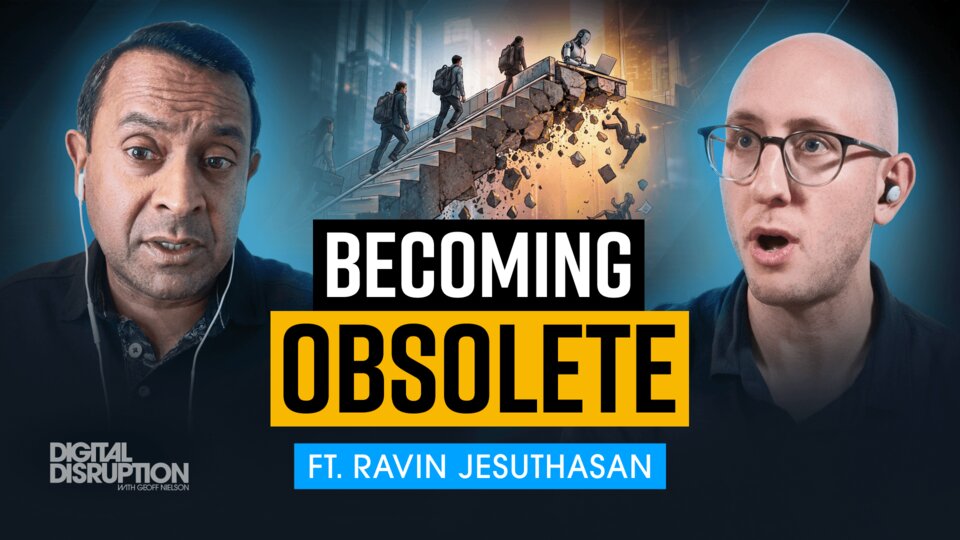
Our Guest Ravin Jesuthasan Discusses
AI Is Breaking the Economics of Work. No One Is Ready
In this episode, futurist and bestselling author Ravin Jesuthasan joins Geoff to discuss generative AI, AI agents, and the impact of automation on jobs.
Listen
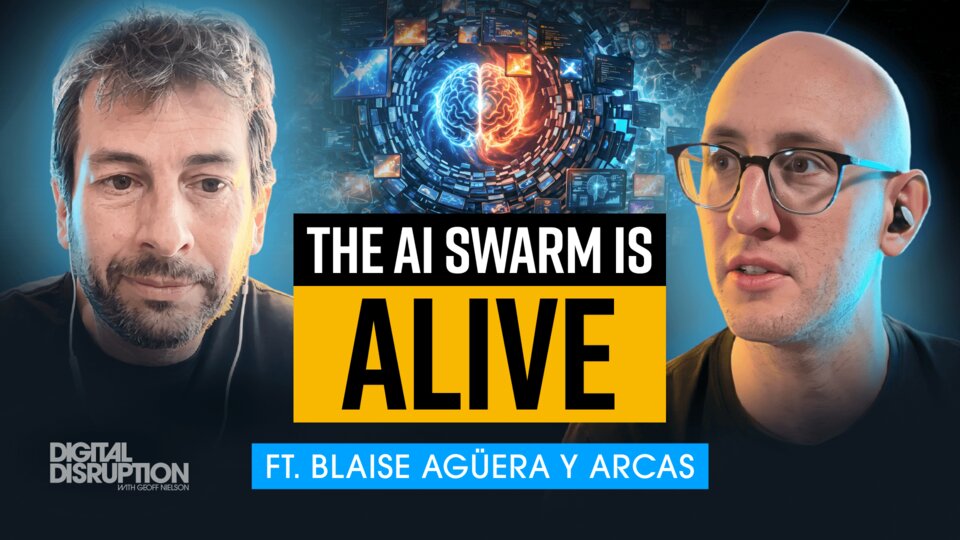
Our Guest Blaise Agüera y Arcas Discusses
Is AI Already Conscious? Google’s Blaise Agüera y Arcas Explains
Blaise Agüera y Arcas joins us on this episode of Digital Disruption to talk about AI consciousness, large language models, and why intelligence is inherently social. He explains how AI agent swarms work together, what recursive self-improvement looks like today, and why he questions the idea that smarter machines will inevitably dominate humanity.
Listen
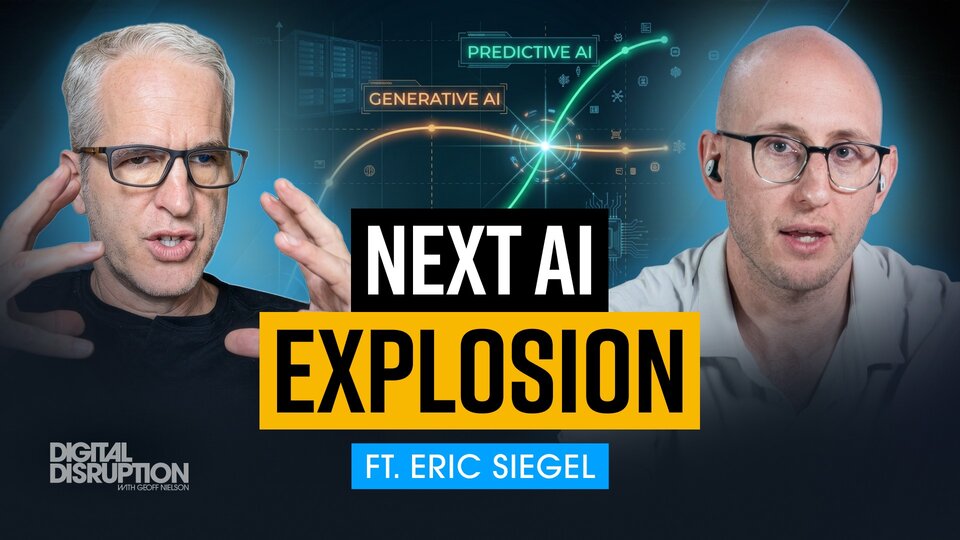
Our Guest Eric Siegel Discusses
The Other AI Revolution: Why Predictive AI Will Overtake Generative AI in 2027
Predictive AI often gets ignored, yet it may hold the real key to business value in the current tech landscape.
Listen
Our Guest Peggy Johnson Discusses
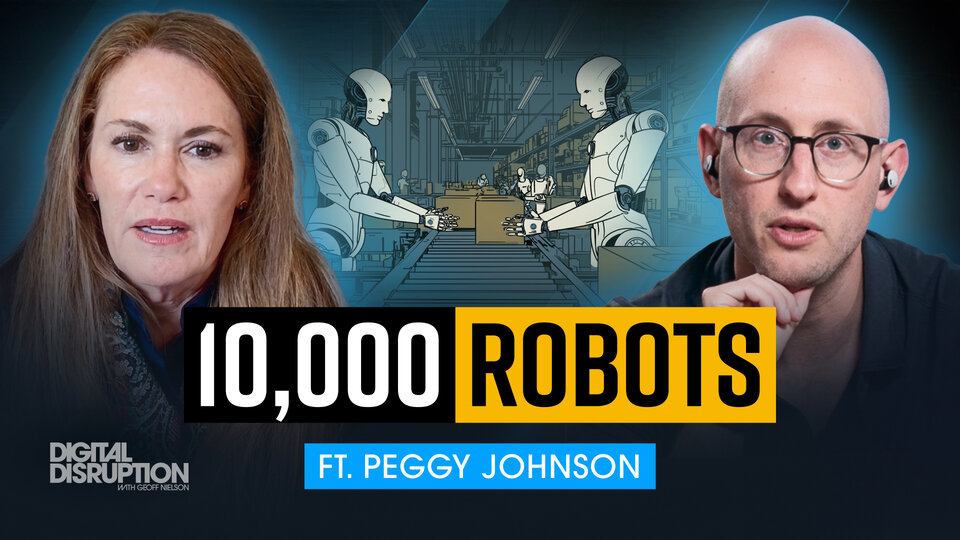
AI Humanoid Robots Have Already Entered the Workforce. Should You Care?
Peggy Johnson, CEO of Agility Robotics, joins us on today's episode to look beyond the fear of robot overlords and ask: How will humans and robots work together in the years ahead?